Little Rock Look Back: Christmas Eve 1937 Groundbreaking for Robinson Auditorium

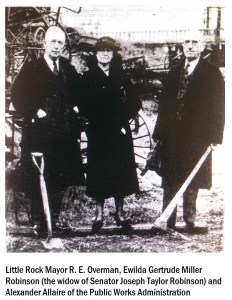
On December 24, 1937, at 11:30 a.m., Little Rock Mayor R. E. Overman, Ewilda Gertrude Miller Robinson (the widow of Senator Joseph Taylor Robinson) and  Alexander Allaire of the PWA turned dirt to participate in the brief groundbreaking ceremony for Little Rock’s municipal auditorium.

That morning, the Arkansas Gazette ran a brief story on the upcoming groundbreaking.  The story mentioned that the building would be named in memory of the late beloved Arkansas politician.  This appears to be the first public pronouncement of the Robinson name for this civic structure.

Among others in attendance at the groundbreaking were Mrs. Charles Miller (sister-in-law of Mrs. Robinson), Mr. and Mrs. Grady Miller (brother and sister-in-law of Mrs. Robinson), the mayor’s wife, the three architects (George Wittenberg, Lawson Delony and Eugene John Stern), and D. H. Daugherty and Will Terry of the City’s Board of Public Affairs.

Construction had to start by January 1, 1938, in order to receive PWA funds.  By breaking ground on December 24, there was over a week to spare.  The site had been selected in late October 1937, and the purchase had not been finalized.  But the PWA did give permission for the City to let a contract for excavation, demolition and filling on the site.

The groundbreaking took place at the corner of Garland and Spring Streets which was on the northeast corner of the block set aside for the auditorium.  Today, Spring Street does not extend north of Markham; the street was closed to make way for the parking structure and what is now the Doubletree Hotel.  Garland Street is basically an alley that runs parallel to Markham north of City Hall, Robinson Auditorium and the Doubletree Hotel.

Happy Festivus!

In honor of Festivus 2018, here is a photo of Jason Alexander (aka George Costanza) when he was at Arkansas Rep in January 2016 to conduct auditions for the play WINDFALL which he directed at the Rep.  He is pictured with Bob Hupp, who was then Producing Artistic Director of Arkansas Rep.


Little Rock Look Back: Roswell Beebe born

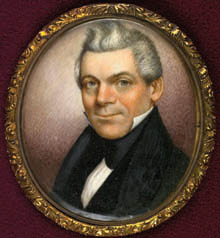
Roswell Beebe, Little Rock’s 16th Mayor

On December 22, 1795, future Little Rock Mayor Roswell Beebe was born in Hinsdale, New York.  His family were wealthy English immigrants.  At seventeen, Beebe went to New Orleans and fought with Andrew Jackson in the 1815 Battle of New Orleans.  He stayed in the Crescent City for the next two decades building successful lumber and brick businesses.

Due to health concerns, he moved north to a drier climate in 1834.  After first stopping in Fulton, Arkansas, he settled in Little Rock in 1835 at the age of forty.  He stayed at the home of Chester Ashley and married Ashley’s sister-in-law, Clarissa Elliott.  He and Clarissa had two children, Roswell and Cora.

For nearly 30 years, Little Rock had a complicated history of deeds, titles and land ownership.  In 1839, Beebe went to Washington DC and received the original patent from President Martin Van Buren.  He then set about clearing up the land and title issues, as well as drawing up a plan for the city and laying off blocks and streets.  Beebe deeded the streets and alleys to the City for a dollar.  He also donated the land on Markham Street for a new State Capitol building (now home of the Old State House Museum).  Along with his brother-in-law Chester Ashley, he donated the land for the establishment of Mount Holly Cemetery.

In 1848, Beebe was elected to the Little Rock City Council.  The following year, he was elected Mayor.  He served as Mayor of Little Rock from April 1849 to February 1850.

While his primary business focus in the 1840s had been real estate, in the 1850s he focused on railroads.  Beebe was named president of the Cairo and Fulton Railroad Company in 1853.

While on a visit to New York, Beebe died on September 27, 1856.  His body was returned to Little Rock, and Roswell Beebe was buried at Mount Holly Cemetery.  The town of Beebe, Arkansas, is named in his honor.

Clinton Center affected by Government Shutdown

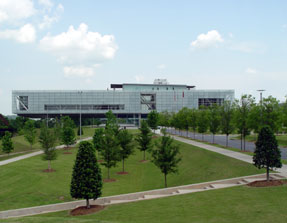
During the Federal Government shutdown, the permanent and temporary exhibits at the Clinton Center are closed.  Likewise access to the National Archives information is closed.
HOWEVER, 42 Bar and Table is still open its usual schedule for lunch, happy hour and dinner.

AND the Clinton Museum Store is open. It is offering special discounts during the shutdown.

GREMLINS is final entry in CALS “Not-Quite-Holiday” Film Fest

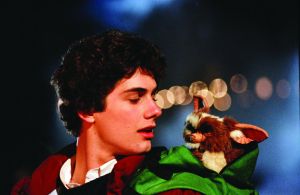
A boy inadvertently breaks three important rules concerning his new pet and unleashes a horde of malevolently mischievous monsters on a small town. This is all a part of GREMLINS as it brings to a close the Central Arkansas Library System (CALS) ”Not-Quite-Holiday” Film Fest.
(A scarier film of the same title would be a movie about the 1970s era AMC cars coming to life.)

Starring Zach Galligan and Phoebe Cates, this 1984 film also features Hoyt Axton, Keye Luke, Polly Holliday and the voice of Howie Mandel. And because it was a 1980s teen movie, it features one of the Coreys — the Feldman variety.

GREMLINS starts at 6:30 pm at the Ron Robinson Theater, 100 Rock Street in Library Square.  Admission is $5. Tickets are available at ronrobinsontheater.org.

As part of the holiday film series, concessions at Ron Robinson Theater include an expanded hot drinks menu and gourmet candied popcorn options.

The Not-Quite-Holiday Film Fest is sponsored in part by The Point 94.1 and The Ride 106.7.

Little Rock Look Back: 1968 THE NUTCRACKER is largest production to date at Robinson

In December 1968, the final stretch of Interstate 40 between Little Rock and Memphis was completed. (Little did anyone know that milestone merely meant work would change from construction to non-stop reconstruction.)  Talks were underway about merging private Little Rock University with the University of Arkansas system.  On the TV on December 19, “The Little Drummer Boy” TV special was being shown for the first time.  Also, Arkansan Glen Campbell was one of the guest stars on Bob Hope’s Christmas TV special.
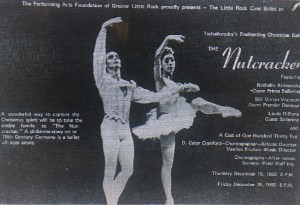
For those who did not sit at home watching TV, at Robinson Auditorium on December 19 and 20, 1968, the nascent Little Rock Civic Ballet (a forerunner to today’s Ballet Arkansas) presented its first production of THE NUTCRACKER. (There appears to be some debate as to whether this was the first complete production of this ballet in Little Rock.)

Under the direction and choreography of D. Cater Cranford, this production featured 135 performers, a fifty piece orchestra under the direction of Vasilios Priakos, and the largest number of stagehands in Robinson Auditorium’s history.  The production cost $25,000 to mount.  That would be the equivalent of just over $181,000 in 2018.

A large portion of the money went to renting sets from Dallas for the production.  The costumes were designed and sewn by Cranford.  He also appeared as Drosselmeyer in the production.  His wife Lorraine, assisted with the choreography and also appeared on stage.

Though most of the dancers were local, the leading roles were danced by Bill Martin-Viscont, Nathalie Krassovak, Linda DiBona, Margo Dean and Carl Tressler.  Some of the dancers who had rehearsed for the production were unable to participate due to several cast members coming down with flu in the days immediately prior to the production.

The production sold out both public performances as well as the daytime matinee for school children.  The dress rehearsal on December 18 was opened up for children with disabilities to attend.

Though The Nutcracker has not been presented in Little Rock every year since 1968, the overwhelming response to this production set the stage for it to become a much-loved holiday tradition in the city.


Little Rock Look Back: Museum of Discovery is gifted to City in 1929

At the City Council meeting on December 19, 1929, Bernie Babcock presented the City of Little Rock with a Christmas present — the Museum of Natural History.

After the meeting was convened, Mrs. Babcock was given permission to make remarks to the City.  According to Council minutes from that meeting, she stated “she was at this time making a Christmas gift to the City of Little Rock in presenting to it the museum located on the third floor of the City Hall, setting forth, at length, the struggles in making the collections of which the museum is composed, and stressing the value of the museum to the city.”

Upon a motion, the museum was accepted by the City.  She then presented letters which formally made the offer to the City and suggested persons for a governing board.

Mrs. Babcock had been trying to get the City to accept the museum for a while.  She had been unsuccessful in getting Mayor Pat L. Robinson to agree to it after he took office in April 1929.  Ever-determined, she circumvented the mayor and went directly to the City Council. By December 1929, they had grown estranged from Mayor Robinson.

Since December 19, 1929, the museum has been affiliated with the City of Little Rock.  During that time, it has had several names and three locations.