Unknown's avatar

About Scott

A cultural thinker with a life long interest in the arts and humanities: theatre, music, architecture, photography, history, urban planning, etc.

Local Live Tonight at South on Main – Cindy Woolf and Mark Bilyeu

pic_cindy_woolf_(1).jpg.190x140_q60_cropTonight at 7:30 PM—Join the Oxford American magazine for this week’s Local Live concert at South on Main, starring Cindy Woolf and Mark Bilyeu! As always, Local Live is free and open to the public. To guarantee a table/seat for this popular series, call ahead at (501) 244-9660. Local Live is made possible by the generous sponsorship of Cosmic Cowboy Music.

Guitarist Mark Bilyeu and banjoist Cindy Woolf have been playing together for the better part of ten years, performing on the Americana/Folk and singer-songwriter circuit. They are a full-time duo in music and in life, having wed in 2013. Spring of 2015 finds them in the studio recording an album of traditional Ozarks’ songs, culled from the folksong collections of Max Hunter (from Springfield, Missouri, Mark’s home town) and John Quincy Wolf (from Batesville, Cindy’s home town); thus the title Wolf Hunter. This will be the first album from these two as a duo; Cindy has three CDs under her own name; Mark has one solo title plus the back catalogue from his previous work in Big Smith.

Little Rock Look Back: Rabbi Ira Sanders

SandersIraE_fOn May 6, 1894, Ira Eugene Sanders was born in Missouri.  After receiving an undergraduate degree and rabbinate degree in Cincinnati, he was ordained a rabbi in 1919.  He served congregations in Pennyslvania and New York before coming to Little Rock in September 1926.

Shortly after arriving to lead the B’nai Israel congregation, Rabbi Sanders became active in the Little Rock community.  Among his projects were the Little Rock Community Fund, Little Rock School of Social Work (which he founded), Central Council of Social Agencies, and University of Arkansas Extension Department. During the Great Depression, he helped organize the Pulaski County Public Welfare Commission.  Other areas of involvement over his career included the Arkansas Human Betterment League, Urban League of Greater Little Rock and Arkansas Lighthouse for the Blind.  On November 3, 1930, Rabbi Sanders debated Clarence Darrow about the existence of God in front of a packed house at Little Rock High School.

For his many involvements, he received an honorary Doctor of Humanities degree in 1951 from the University of Arkansas.  Three years later he received an honorary Doctor of Divinity degree from Hebrew Union College’s Jewish Institute of Religion.

A lifelong supporter of a Jewish state, he participated in nineteen bond drives for the state of Israel.  In August 1963, he retired as the leader of B’nai Israel after over 35 years. He would remain as Rabbi Emeritus until his deal in 1985.

In January 1978, Rabbi Sanders tendered his resignation from the Central Arkansas Library board of directors.  The City Board of Directors passed resolution 5873 which noted that he had served for 51 years on the Library Board. He was first appointed in 1926.  He served during 19 different Mayoral administrations from Charles Moyer’s first term through Donald Mehlburger’s.

On April 8, 1985, Rabbi Ira Eugene Sanders died of natural causes.  He is buried in the City’s Oakland Jewish Cemetery.  The Central Arkansas Library System honors his memory with an annual distinguished lecture series.

Legacies & Lunch – Chris Engholm discusses White River Memoirs today at noon

white_riverThe White River and its tributaries represent the most ecologically intact watershed in the continental United States. Over a million people inhabit it, living in 234 communities in 60 counties. For the past two years, Chris Engholm has traveled the White River in a cedar strip canoe, listening to people connected to it and collecting the artwork of 25 fine artists who maintain a special relationship with the river.

This artwork is showcased in a gallery exhibition, White River Memoirs, on view in Butler Center Galleries, 401 Pres. Clinton Ave., now through July 25, 2015. At Legacies & Lunch, Engholm will discuss his experiences and present visual documentation of his findings.

The program takes place today at noon at the Darragh Center on the Main Library campus.

Legacies and Lunch is sponsored in part by the Arkansas Humanities Council. Bring a sack lunch; drinks and dessert are provided.

Heritage Month – Boyle Park

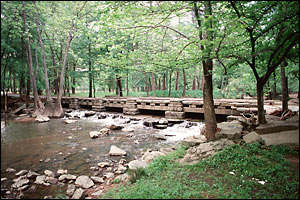
Boyle ParkLocated near the intersection of the western and southwestern neighborhoods of the city of Little Rock, Boyle Park is an approximately 250-acre tract of largely-unimproved woodland donated to the city by Dr. John F. Boyle in 1929. The warranty deed authorizing the transfer of title to the land explicitly stipulated that the park be used for “recreational purposes” only and that should this property ever cease to be used as such the title would revert back to the family and its heirs. At the time of its donation it was only the third public park in the city of Little Rock (the others being MacArthur Park and Allsopp Park).

The park remained largely unimproved until the mid-1930s, when the Civilian Conservation Corps boys arrived (though there seems to be some uncertainty about exactly when the actual construction work began, two different contemporaneous sources reveal that as of the spring of 1935 work had not yet begun, but that by the spring of 1937 work was complete and the unit involved in finishing the work within the park — the 3777th company, originally from West Fork, where they were supposed to be involved in the ongoing construction at Devil’s Den State Park — were wondering where they would be shipped next).

The CCC boys camped at Fair Park (approximately one mile to the northeast) and worked on such improvements to Boyle Park as walls, signage, rest room facilities and a concession building in addition to the resources that survive. Boyle Park forms an historic district that is significant by virtue of its associations with the men that built it, the enrollees of the Civilian Conservation Corps Company 3777, and by virtue of their being outstanding and remarkably intact examples of the Rustic architectural style.

Boyle Park was added to the National Register of Historic Places on September 22, 1995.

Premiere of new production PROJECT ELAN next on stage at Arkansas Rep

Project êlan small2Project Élan is a brand-new, original, culture-current musical that seeks to shed light on the individual and universal needs of the millennial generation. Digital and uniquely undefinable, this generation seeks to find answers in an unpredictable world. And although they may appear to be an age overrun by technology and isolation, their dreams are timeless. The millennial generation still longs for the most basic of human needs – safety, hope and love.

Conceived and directed by The Rep’s Resident Director and Director of Education, Nicole Capri, Project Élan is written by Capri and seven SMTI alumni and staff including. The production, which opens on the 10-year anniversary of The Rep’s Summer Musical Theatre Intensive (SMTI) program, features approximately 50 of the best past and present alumni from the last decade of the program.

Project Élan features a diverse musical score with original songs from almost every genre of music – contemporary-alternative, acoustic-folk, urban-rock, indie-pop, jazz-fusion, Nashville-sound, progressive-Broadway and sunshine-pop.

The word “élan” – is defined in several ways — “to live in the moment,” “to live with reckless abandon and enthusiasm,” “confidence,” and “spirit.” The writers of this piece seek to produce a relevant and relatable musical that speaks to the heart of all generations.

Public previews begin tomorrow with the official opening night on Friday, May 8. The production runs through May 16.

The creative team includes:

  • Nicole Capri – conception, director, choreographer, writer
  • Mark Binns – writer, musical director
  • Bobby Banister – writer
  • Conly Basham – writer
  • Sam Clark – writer
  • Robert Frost – writer
  • Jimmy Landfair – writer
  • Charity Vance – writer
  • Marisa Kirby – choreographer
  • Stephen K. Stone – choreographer
  • Drew Posey – set designer
  • Shelly Hall – costume designer
  • Dan Kimble – lighting designer
  • Lynda J. Kwallek – props designer
  • Travis Mosler – video designer
  • Beth Thiemann – stage manager

Tonight at South on Main – Hurray for the Riff Raff

hrraff_website.jpg.190x140_q60_cropThe Oxford American magazine is excited to welcome Hurray for the Riff Raff to the South on Main stage!

The music starts at 7:30pm, but doors open at 5:30pm, with dinner and drinks available for purchase at that time. This concert is made possible in part by the generosity of Landes FIAT of Benton.

Seating at tables is limited and available on a first-come, first-seated basis beginning at 5:30 PM when the doors open. No reservations are being taken ahead of time. To ensure the best possible seat, plan to arrive when the doors open.

Hurray For The Riff Raff is Alynda Lee Segarra, but in many ways it’s much more than that: it’s a young woman leaving her indelible stamp on the American folk tradition. If you’re listening to her new album, Small Town Heroes, odds are you’re part of the riff raff, and these songs are for you.

“It’s grown into this bigger idea of feeling like we really associate with the underdog,” says Segarra, who came to international attention in 2012 with Look Out Mama. The album earned her raves from NPR and the New York Times to Mojo and Paste, along with a breakout performance at the 2013 Newport Folk Festival, which left American Songwriter “awestruck” and solidified her place at the forefront of a new generation of young musicians celebrating and reimagining American roots music. “We really feel at home with a lot of worlds of people that don’t really seem to fit together,” she continues, “and we find a way to make them all hang out with our music. Whether it’s the queer community or some freight train-riding kids or some older guys who love classic country, a lot of folks feel like mainstream culture isn’t directed at them. We’re for those people.”

Segarra, a 26-year-old of Puerto Rican descent, whose slight frame belies her commanding voice, grew up in the Bronx where she developed an early appreciation for doo-wop and Motown from the neighborhood’s longtime residents. It was downtown, though, that she first felt like she found her people, traveling to the Lower East side every Saturday for punk matinees at ABC No Rio. “Those riot grrrl shows were a place where young girls could just hang out and not have to worry about feeling weird, like they didn’t belong,” Segarra says of the inclusive atmosphere fostered by the musicians and outsider artists who populated the space. “It had such a good effect on me to go to those shows as a kid and feel like somebody in a band was looking out for me and wanted me to feel inspired and good about myself.”

NPR has said that Hurray for the Riff Raff’s music “sweeps across eras and genres with grace and grit,” and that’s never been more true than on Small Town Heroes. These songs belong to no particular time or place, but rather to all of us. These songs are for the riff raff.

Heritage Month – Beal-Burrow Building

Beal BurrowConstructed in 1920, the Beal-Burrow Dry Goods Company Building is believed to have been designed by the architectural firm of Charles Thompson and Thomas Harding (only mechanical drawings are present in the Thompson Archives).

The original owner and user, the Beal-Burrow Company, was founded in 1913 as a wholesale operation and quickly gained prominence on a regional level.  The location of their office and warehouse facilities near the intersection of Main and Markham Streets served to anchor the northern edge of Little Rock’s commercial district.  By 1926, the firm had begun to manufacture work clothes and several floors of this building were devoted to that industry.

In 1955, the Archer Drug Company purchased the building from Berry Dry Goods Company, another wholesale establishment that had earlier bought out the Beal-Burrow partnership.

It is presently part of the Block 2 Development which consists of commercial space on the first floor and loft apartments on upper floors. The Little Rock Tech Park is operating out of space on the first floor of this building.

It was listed on the National Register of Historic Places on June 26, 1995.