
 Tonight (April 23), the Architecture and Design Network (ADN) continues its 2018/2019 June Freeman lecture series by welcoming Dr. Victoria Herrmann, President and Managing Director of the Arctic Institute for a lecture entitled, “Weathering It Together: Designing for the Anthropocene.”
This lecture is in partnership and provided by the Fay Jones School of Architecture and Design lecture series. It starts at 6pm at the Arkansas Arts Center; a 5:30pm reception precedes it.
The Fourth National Climate Assessment, released in late 2018, warned that the quality of life for residents across the southeast will be compromised as the built environment becomes ever-more vulnerable to increasing temperatures and flooding brought about by a changing climate, particularly as infrastructure ages and populations shift to urban areas. Professionals in design, architecture, and historic preservation can be the game-changers needed to support the continued vibrancy and viability of resilient communities amidst rapid environmental change.
This interactive lecture will help the audience better understand the climate change impacts already underway in the southeast and, through examples from across America, the role the architecture and design community has in building a community-driven vision for a resilient future.
This lecture will analyze the gaps in climate change adaptation for the built environment, and the opportunities to co-create buildings that produce adaptation and mitigation benefits, while focusing to help understand the concept of loss and damage in climate change, and examine the role architecture and design can play in loss and damage work.
Dr. Victoria Herrmann is the President and Managing Director of the Arctic Institute, a nonprofit organization dedicated to Arctic security research. She is one of 16 women leaders in the top 100 U.S. think tanks, and the youngest of all 100. As a National Geographic Explorer, Dr. Herrmann traveled across the country in 2016 and 2017 interviewing 350 local leaders to identify what’s needed most to safeguard coastal communities against unavoidable climate change impacts.
Her current JMK Innovation Prize project, Rise Up to Rising Tides, is creating a matchmaking program to connect skills-based volunteers with climate-affected communities for climate adaptation, historic preservation, and cultural heritage documentation projects. Dr. Herrmann teaches sustainability at American University and science communication at the University Centre of the Westfjords, Iceland. She was previously a Junior Fellow at the Carnegie Endowment, a Fulbright Canada Awardee, a Mirzayan Science and Technology Policy Fellow at the National Academies of Sciences, and a Gates Scholar at the Cambridge University.


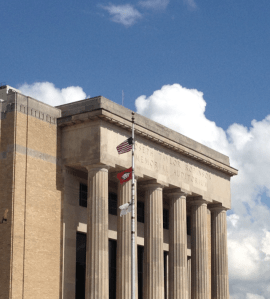 Though Joseph Taylor Robinson Memorial Auditorium opened in February 1940, there was still money that needed to be raised to finish the construction and the building’s furnishing. Ten days after the auditorium opening, the City Council approved an ordinance to call a special election on April 2, 1940, for the purposes of approving bonds for three separate projects. One of these was for $30,000 for the completion of the auditorium; the bonds would not require any additional tax levy.
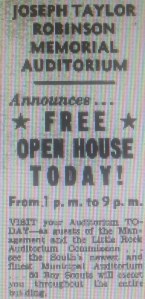 On March 31, 1940, the City of Little Rock and the Auditorium Commission threw open the doors of Joseph Taylor Robinson Memorial Auditorium to the public for an open house.
 Join the QQA for the start of the 55th Tour of Homes, 2019!
 Little Rock Culture Vulture