

CALS renames Ark Studies Institute for former Director Bobby Roberts

The Central Arkansas Library System (CALS) has renamed the Arkansas Studies Institute (ASI) the Bobby L. Roberts Library of Arkansas History and Art in honor of the former CALS executive director who served in the position for more than twenty years before retiring in 2016. CALS Board of Trustees approved the motion in December.

“Bobby established a new normal at CALS by creating new concepts of what the public library could offer the community and by constructing unique spaces to make the library more appealing and accessible to all sorts of groups with varied interests in learning, enrichment, and entertainment,” said Nate Coulter, CALS executive director. “The library’s primary purpose has always been to provide access to information, but Bobby transformed and expanded what it means to be a library by placing a particular emphasis on Arkansas history and culture.”

Since the early 1990s, CALS has undergone several changes and expansions, now consisting of fourteen library locations in Little Rock, Perryville, and throughout Pulaski County. The Main Library moved from its original location at 7th and Louisiana to its current home in the River Market District, which helped trigger the revitalization of downtown Little Rock. That Main Library is now the centerpiece of a campus that includes the Ron Robinson Theater, the Cox Creative Center, and the Bobby L. Roberts Library of Arkansas History and Art (formerly ASI). Former CALS Board members spoke of Roberts’s leadership and his vision for the library system. Susan Fleming and Sheila Wright, former board vice-president and president, respectively, said Roberts’s vision and commitment to excellence are reflected in the building that will be displaying his name. Former CALS board member Frederick Ursery expanded on their thoughts:

“Our library system has been fortunate throughout its history to have strong leadership from numerous members of our community,” said Ursery. “However, I am not aware of any single person who has done more than Bobby Roberts to make CALS the dynamic asset that it is today. He deserves to be recognized for his achievement.”

Roberts’s efforts in building striking library structures, in ecologically sustainable construction, and in adaptive reuse have been recognized by local, state, national, and international organizations. That includes the newly named Roberts Library. Opened in 2009, as the Arkansas Studies Institute, the structure houses the Butler Center for Arkansas Studies, CALS’s Arkansas history department, and five galleries that feature art depicting the state or created by artists living in or from Arkansas.

“This complex of buildings certainly wouldn’t be here if it hadn’t been for Bobby Roberts. It is truly fitting for this edifice to be named in his honor,” said David Stricklin, director of the Butler Center.

Roberts’s special interests in Arkansas history and art and CALS’s long-held practice of collecting materials for the benefit of patrons interested in those topics helped inspire the conception of the ASI, which also houses the UA Little Rock Center for Arkansas History and Culture. The university’s Arkansas-related documents and photographs were moved to the facility and are available for public use under an arrangement Roberts developed with former UA Little Rock Chancellor Joel Anderson. The building is also home to the Arkansas Humanities Council’s headquarters and classrooms and offices for the Clinton School of Public Service.
Little Rock Look Back: Charity Event opens 1868 Little Rock City Hall

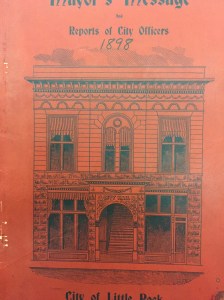
The 1868 City Hall as featured on a city report.

On January 22, 1868, a charity ball (including a supper) was the first special event held in the new Little Rock City Hall located at 120 to 122 West Markham.

The two story building featured city offices downstairs, including an engine house for the volunteer fire department. Upstairs was the council chambers and a special event space. The facility was the width of two storefronts. The upstairs was accessed by a central staircase which went from street level through an archway directly up to the second floor. The first floor had a stone exterior and the second floor was a combination of brick and woodwork.

Records do not indicate when the first city council in the new building took place. At the January 21, 1868, meeting, the body formally accepted the building and cancelled any clauses in the contract about penalties should the contractor not meet the construction deadline. But there is no indication whether that meeting took place in the new building or in the previous city hall. (The location of that prior city hall is a mystery.). The minutes from the council meetings just prior to and just after the January 21 meeting give no indication as to which building was the site for the meeting.

It IS known that March 30, 1908, was the date of the final council meeting in the 1868 City Hall. After that meeting, city offices completed their move to the edifice at Markham and Broadway, which still serves as Little Rock City Hall.

As early as November 1867, the City Council was getting requests for special events to be held in the new city hall. In November and December the council refused to take action on any requests because the building was still under construction.

The January 22, 1868, event was created to help the destitute in Little Rock. The ARKANSAS GAZETTE encouraged people to be generous and purchase tickets. Even the day before the event, the weekly version of the GAZETTE (which at the time had added daily editions in addition to its weekly issue) was assuring people there would be plenty of space in the splendid new building so there was still room for additional ticket purchases. Tickets were $5 to admit a lady and a gentleman.  (That would be the equivalent of $83.71 today. While cheap for two people to attend a Little Rock event in 2018, in the post-Civil War era, it was a definite hit to the pocketbook.)

The unnamed organization which put on the charity event was led by W. W. Wilshire (president), George W. Clark (secretary), Joseph Meyer (treasurer) and a standing committee of Dr. C. M. Taylor, Dr. P. O. Hooper, A. Adams, F. H. Moody, and E. Langley.  Donations could be made to any of the officers.  The arrangements for the event were handled by Joseph Meyer, A. Adams, J. P. Jones, Alexander George, Jr., Joseph W. Bossert, and Daniel Ottenheimer.  The reception committee was W. D. Blocher, H. C. Ashley, A. McDonald, P. W. McWhorter, T. Lafferty, and F. H. Moody.   Tickets could be purchased at the stores of J. E. Reardon, G. H. Gibbs, Joseph Meyer, Lafferty & Raleigh, S. L. Griffith, McAlmont & Stillwell, Beideman & Co., and Dodge & Co as well as at the Anthony and Commercial Houses.  (It is interesting to note how so many people at the time were publicly listed by only their first initial.)

The building stood for 56 years after City Hall vacated it.  It housed a variety of businesses over the years including being home to Breier’s restaurant (until it moved to a Cantrell Road location in the early 1960s).  The building was torn down in 1964 as part of Urban Renewal.  Today it is the site of part of the Statehouse Convention Center.  It is directly across from the One-Eleven restaurant side of the Capital Hotel.

Little Rock Look Back: Robinson Auditorium groundbreaking 80 years ago today


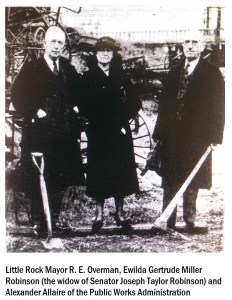
122437 GroundbreakOn December 24, 1937, at 11:30 a.m., Little Rock Mayor R. E. Overman, Ewilda Gertrude Miller Robinson (the widow of Senator Joseph Taylor Robinson) and  Alexander Allaire of the PWA turned dirt to participate in the brief groundbreaking ceremony for Little Rock’s municipal auditorium.  That morning, the Arkansas Gazette ran a brief story on the upcoming groundbreaking.  The story mentioned that the building would be named in memory of the late beloved Arkansas politician.  This appears to be the first public pronouncement of the Robinson name for this civic structure.

Among others in attendance at the groundbreaking were Mrs. Charles Miller (sister-in-law of Mrs. Robinson), Mr. and Mrs. Grady Miller (brother and sister-in-law of Mrs. Robinson), the mayor’s wife, the three architects (George Wittenberg, Lawson Delony and Eugene John Stern), and D. H. Daugherty and Will Terry of the City’s Board of Public Affairs.

Construction had to start by January 1, 1938, in order to receive PWA funds.  By breaking ground on December 24, there was over a week to spare.  The site had been selected in late October 1937, and the purchase had not been finalized.  But the PWA did give permission for the City to let a contract for excavation, demolition and filling on the site.

The groundbreaking took place at the corner of Garland and Spring Streets which was on the northeast corner of the block set aside for the auditorium.  Today, Spring Street does not extend north of Markham; the street was closed to make way for the parking structure and what is now the Doubletree Hotel.  Garland Street is basically an alley that runs parallel to Markham north of City Hall, Robinson Auditorium and the Doubletree Hotel.

Little Rock Look Back: Clinton Center opens in 2004

wjc library openingIt has been thirteen years since the Clinton Presidential Center opened on a wet, cold Thursday.

The days leading up to it has been glorious.  And while the weather may have literally dampened spirits a bit, it was still an important day for Little Rock and Arkansas.

The events leading up to the opening included a concert by Aretha Franklin with the Arkansas Symphony Orchestra and an appearance by Senator John Glenn at the Museum of Discovery.  Events were hosted by the Arkansas Arts Center, Arkansas Repertory Theatre, Historic Arkansas Museum, and Old State House Museum.  There were scores of receptions and parties as Hollywood, New York, and DC descended on Little Rock.

November 18 dawned rainy and cool.  As the day continued on the precipitation continued while the temperature did not warm up.  Years of planning for a grand opening ceremony came down to this.  But at the appointed time, festivities began.

On the site of an abandoned warehouse district and unofficial dump which had previously been a train station, many leaders of the free world were gathered.  They rubbed shoulders with thousands of Arkansans from probably every county in the state.

It had been seven years and eleven days since Bill Clinton had announced the site of his presidential library.  It had been five years since artifacts and articles started arriving from Washington DC in Little Rock.  There had been lawsuits, threats of lawsuits, the threat of a Counter-Clinton Library, and countless meetings.

After speeches from Presidents Carter, Bush 41 and Bush 43, remarks from President Clinton and then-Senator Clinton (who was made even wetter by water pouring off an ill-placed umbrella), and even a musical performance by Bono and The Edge, Chelsea Clinton turned over the ceremonial key from the Clinton Foundation to the National Archives to officially open the Clinton Presidential Center.

In his capacity leading the Clinton Foundation, Skip Rutherford oversaw the planning for the Clinton Library and the grand opening festivities.  He, along with the foundation’s Executive Director Stephanie Streett, oversaw a phalanx of volunteers and staff to anticipate every detail.  The 1,000 days countdown sign that had been on the construction site (the brainchild of Tyler Denton) finally reached 0.

Isabelle Rodriguez, Shannon Butler, Mariah Hatta, Jordan Johnson, Lucas Hargraves, and Ben Beaumont — among others — had been putting in twelve plus hour days for months on end to get ready for the opening.  City Manager Bruce T. Moore led a team of City officials who had assisted on the planning and execution of the site preparation and making sure Little Rock was ready to welcome the world.  Moore and City Director Dean Kumpuris had been appointed by Little Rock Mayor Jim Dailey to lead Little Rock’s efforts to land the library.  After Clinton’s announcement of the site, Dailey, Kumpuris and Moore continued to work together to ensure the library would be successful.

While the weather on November 18, 2004, may have been a disappointment, the people who were gathered knew they were witnesses to history.  And thirteen years later, is a day people still talk about.

Little Rock Look Back: Bill Clinton announces LR as site for his library

Refuse on the site where the Clinton Center would be built

On November 7, 1997, President Bill Clinton announced his intentions to locate his presidential library in Little Rock at the end of a warehouse district.

The Little Rock City Board met in a special meeting that day to rename part of Markham Street, which would lead to the site, as President Clinton Avenue.

While the announcement was met with excitement in many quarters, there were still some skeptics who had a hard time envisioning a presidential library and park in the middle of a wasteland worthy of a T. S. Eliot poem.

There would be many hurdles between the November 1997 announcement to the December 2001 groundbreaking. But for the moment, City of Little Rock leaders, celebrated the achievement.  Then Mayor Jim Dailey had appointed City Director Dean Kumpuris and City employee Bruce T. Moore to lead the City’s efforts.  Moore and Kumpuris worked with Skip Rutherford and others to narrow the potential sites.

In September 1997, the Clintons were in town for the 40th anniversary of the integration of Central High School.  They surprised Kumpuris and Moore with a decision for a Sunday afternoon visit to the warehouse district proposed site. Secret Service would not let the limousine drive in part of the property, so the Clintons, Moore, Kumpuris, and Rutherford walked up a path to the roof of the abandoned Arkansas Book Depository.  It was there that the Clintons could see the Little Rock skyline which would be visible from the library.

Of course by the time the library had opened in November 2004, the Little Rock skyline was different. Spurred on by the library, several new highrises had been constructed in downtown.

Little Rock Look Back: Little Rock High School Auditorium Dedicated

On October 31, 1927, a recital took place in the auditorium of the new Little Rock High School which served as a dedication ceremony for the new high school auditorium.  The school had been serving students for several weeks by the time the recital took place.  The first day of school was Wednesday, September 14, 1927.

The star of the recital was Mary Lewis, a Little Rock High School graduate (from the previous location on Scott Street) who had made her Metropolitan Opera debut and become a toast of New York City.

The evening started with remarks from former Arkansas Governor Charles Brough, who had made a name for himself as an advocate for education before, during and after his stint in the statehouse.  He was followed by Miss Lewis, who sang over a dozen arias and musical selections.  For her first encore, Miss Lewis sang “Dixie.”  Her second encore was supposed to be “Home Sweet Home.”  After several attempts to sing it, she was so overcome that she had to abandon the effort.

For more on the opening event, read Jay Jennings’ excellent book Carry the Rock: Race, Football, and the Soul of an American City.

The 1927 schoolbuilding replaced one built in 1905 at 14th and Scott Streets (with an auditorium completed a few years later at 14th and Cumberland).  This new building was located in the western edges of Little Rock on what had been city parkland.  The former West End Park was now site to Little Rock High School.  The adjoining Kavanaugh Field was a baseball field on which Earl Quigley’s football Tigers also played their games.

Architects John Parks Almand, Lawson L. Delony, George R. Mann, Eugene John Stern, and George H. Wittenberg (virtually all of Little Rock’s full-time working architects at the time) designed the $1.5 million structure, which the New York Times dubbed the most expensive school ever built in the United States at that time.

Featuring a combination of Collegiate Gothic and Art Deco architecture, Central High spans two city blocks, comprising over 150,000 square feet of floor space, upon its completion. Requiring 36 million pounds of concrete and 370 tons of steel, the finished product consisted of 100 classrooms (accommodating over 1,800 students), a fireproof 2,000-seat auditorium, a gymnasium, and a greenhouse.

The six-story structure (counting the bell tower and basement) features a middle section containing the auditorium with four classroom wings (two per side) flanking a reflection pool in the foreground of the building. Faced with brick, the building’s highlights include pilasters and colonnades of cut stone, double-hung window frames with twelve lights per sash, and a main entry terrace supported by a colonnade of five masonry arches rising above Corinthian columns of stone.


Little Rock Look Back: Plans approved for new City Hall…finally

City Hall circa 1908

After a judge ruled in August 1906 that the City of Little Rock could not build a new City Hall and Auditorium complex, it looked like Little Rock would be stuck with its existing inadequate building.

However on September 10 it became obvious that much work had been taking place behind the scenes after that ruling.  On that day, the Board of Public Affairs (a City body charged with overseeing municipal government construction projects and comprised of the mayor and two citizens approved by the City Council) voted to ask the aldermen to cancel plans and rescind legislation for the city hall, jail and auditorium complex.  The Board of Public Affairs then offered up a new plan for a city hall and jail building.  Because no auditorium was involved, these plans would not be in violation of the Chancery Court.

That same evening the City Council followed suit and revoked the plans for the original project.  The aldermen then voted to proceed with building a new city hall and jail without the auditorium.  There was only one dissenting vote; Alderman Jonathan Tuohey voted no.  He explained his negative vote was not a lack of support for the project, but he was not comfortable with the way it was rushed through.

Mayor Warren E. Lenon told the Gazette, “The Chancery Court has enjoined us from erecting an auditorium and the Board of Public Affairs has consequently rescinded all resolutions and orders pertaining to that structure.” He noted that there would “be no appeal from the injunction granted by Chancellor Hart, because there is nothing to appeal.”

The coverage of the actions of the City Council that night was in keeping with the manner in which the two daily newspapers had covered the lawsuit and the trial.  The Gazette headline cried “City Hall Ordinance Railroaded Through” while the staid Democrat merely stated “New $175,000 City Hall Provided by City Council.”  The tone of theGazette’s article matched the headline while the Democrat’s story was more straightforward.

Architect Charles Thompson adjusted his plan for the new City Hall by removing the auditorium wing.  With the revised Th0mpson plan and the approval of the City Council, Little Rock was at last on its way to a new City Hall.  This was over two years after Mayor Lenon had first broached the subject.

Originally slated to open in 1907, the building officially opened in April 1908.