A Conversation with Rocco Landesman this afternoon

Rocco Landesman, Chairman of the National Endowment for the Arts, will be making his first visit to Arkansas.  Rocco Landesman, Chairman of the National Endowment for the Arts, will be making his first visit to Arkansas today.

As a part of that visit, he will be participating in a Please join us for a very enlightening panel discussion at the Arkansas Repertory Theatre. It is being co-hosted by The Rep and the Oxford American. Arkansas First Lady Ginger Bebee will introduce the conversation.

Visiting Arkansas for the first time, Chairman Landesman will participate in a panel discussion with Rep Producing Artistic Director Bob Hupp and Oxford American Publisher Warick Sabin. Arkansas Arts Council Executive Director Joy Pennington will moderate the panel on “Creative Placemaking in Little Rock.”

The panel discussion will take place in the Rep’s Cindy Murphy Theatre at 4:00 – 5:00 p.m. Following the panel, there will be a reception at 5:00 – 6:00 p.m.
The panel discussion and lobby reception are free and open to the public. Refreshments will be served.

Rocco Landesman was confirmed by the United States Senate on August 7, 2009 as the tenth chairman of the National Endowment for the Arts (NEA). Prior to joining the NEA, he was president of Jujamcyn Theatres, which owns five Broadway theatres. A Broadway theater producer and multiple Tony winner, he has brought Big River (1985 Tony Award for Best Musical), Angels in America: Millennium Approaches (1993 Tony Award for Best Play), Angels in America: Perestroika (1994 Tony Award for Best Play), Into the Woods, and The Producers (2001 Tony Award for Best Musical) to Broadway.
Tuesday – Explore Intelligent Cities at Art of Architecture lecture

As part of the monthly “Art of Architecture” series, this month Susan Piedmont-Palladino will present a lecture entitled “Intelligent Cities.”  This month’s lecture is presented in conjunction with the Clinton School for Public Service lecture series and will take place at Sturgis Hall on the Clinton Presidential Center campus at 6pm on Tuesday, March 13.

Professor Piedmont-Palladino is a professor of architecture at Virginia Tech’s Washington-Alexandria Architecture Center and a curator at the National Building Museum. She will give a lecture titled “Intelligent Cities,” which investigates the intersection of information technology and urban life and design.

Susan C. Piedmont-Palladino is an architect and Professor of Architecture at the Washington/Alexandria Architecture Consortium (WAAC), the College’s urban campus.

She received her Master of Architecture from Virginia Tech and her Bachelor of Arts in the History of Art from The College of William and Mary in Williamsburg, Virginia. Before joining Virginia Tech, she taught at the University of Maryland and the Catholic University of America.

Her 1st book, Devil’s Workshop: 25 Years of Jersey Devil Architecture, on Jersey Devil and design/build was published by Princeton Architectural Press. Her articles have appeared in the popular and professional press, including the “Journal of Architectural Education”, “Journal of Urban Technology” and “Perspecta 29” among others. And she has lectured at the Smithsonian Institution, as well as schools from Mississippi State in Starkville to Universidad de Desarrollo in Santiago Chile.

She is the former national president of Architects/Designers/Planners for Social Responsibility, served on the design committee for the National Peace Garden Foundation, and has been a consultant to the Department of Energy for the Solar Decathlon.

Since 2002 she has been a consulting curator to the National Building Museum, and most recently was the guest curator for Tools of the Imagination and editor of its eponymous companion book, to be published by Princeton Architectural Press in fall 2006.

Marching along 2nd Friday Art Night

History takes front and center at this month’s 2nd Friday Art Night.

First up, the Butler Center Galleries of the Arkansas Studies Institute are featuring the new exhibit “Making a Place: Jewish Experience in Arkansas.”  This exhibit explores the development of the Jewish community in Arkansas focusing on immigration, isolation and assimilation.

Over at Historic Arkansas Museum, the Smittle Band will be entertaining visitors who are looking at the temporary and permanent exhibits of art and history.  The evening will also feature a sample of wines hosted by downtown’s very own Zin Wine Bar.

The Old State House Museum will be open so that visitors can see the new exhibit “Things You Need to Hear: Memories of Growing up in Arkansas from 1890 to 1980.”

Another exhibit with a history flavor will be at studioMain. The March exhibition is “The History of Our Downtown.”

These and other stops of 2nd Friday Art Night will be open from 5pm to 8pm.  While on-street parking is available near most sites, a free trolley makes stops at each of the venues.  The Arkansas Times is a sponsor of 2nd Friday Art Night.

Historic Preservation Alliance seeking Endangered Places nominations

The Historic Preservation Alliance of Arkansas is now accepting nominations for the 2012 Most Endangered Places List.  The deadline for nominations is Monday, April 2, 2012.

Every year, many historic properties across the state of Arkansas are threatened by demolition, neglect, lack of resources or knowledge of their importance. Each of the endangered resources holds a special place in our collective memory and helps to define who we are as a people, a culture, and a State. Once these unique places are gone, they are gone forever

The Historic Preservation Alliance of Arkansas has maintained a Most Endangered Places List in our state since 1999. By bringing attention to these threatened buildings, sites and places in Arkansas, we seek to raise awareness in communities statewide and to create many success stories from places in peril. This nomination form is your chance to initiate your own story of success.

Properties selected for the Most Endangered Places List will be announced in May during Arkansas Heritage Month and National Preservation Month.

The list of Arkansas’s Most Endangered Historic Places is publicized each year through the announcement of the list in mid-May, which is also Arkansas Heritage Month and National Preservation Month. Press packets are issued to the media in conjunction with the announcement, encouraging TV and radio coverage as well as articles in both statewide and local newspapers. In addition, the Alliance newsletter annually publishes an article about the properties in the list, and information about the list is provided to the Arkansas Historical Quarterly and to the newsletters of local preservation groups and historical societies.

Each year, the Board of Directors of the Alliance appoints a special five-member “Most Endangered List Committee” to oversee the selection of properties for the list and to work with Alliance staff on organizing the announcement of that year’s list.

The composition of this special committee is as follows:

  • A representative of the Alliance Board of Directors
  • A representative of the Arkansas Historic Preservation Program
  • An architect
  • A historian familiar with Arkansas history
  • An at-large member chosen from the Alliance membership

The representative of the Alliance Board of Directors chairs the committee.

February Frieze Frame Friday – Nature Friezes

701 Capitol

Since there was really no freezing weather this February, the architectural friezes have had to do.  The final feature in this series is actually five small friezes on a one story building at 701 West Capitol.

This one story office building sits on a corner with the entrance actually being off the corner instead of a street front.  Though the majority of the building is brick, the granite front entrance wraps around the corner. 

(no idea what this is)

The friezes are spaced at the top of this granite.  According to the Pulaski County Assessor’s office, this building (which is across the street from the Federal Courthouse) was built in 1960.

The friezes, designed in an art deco style, depict scenes of nature.  It is apparent that one is of a bird (an eagle?), one is a duck flying, one is of fish, and one of an antlered animal (an antelope?).

The remaining frieze is a mystery to the LR Culture Vulture. All of the other designs are very detailed yet this one appears to be more stylistic.

Eagle (centered over entrance)

Duck flying (along Capitol Avenue)

Fish swimming (along Capitol Avenue)

Antelope playing (along Capitol Avenue)

Art of Architecture: William Morris and Arts & Craft Movement

Morris

Tonight at the Arkansas Arts Center, the next installment of the Art of Architecture lecture series takes place.

Dr. Floyd Martin of UALR is discussing William Morris and Arts and Craft Movement. The lecture starts at 6pm in the Lecture Hall at the Arts Center.

William Morris, born in England in 1834, is long recognized as one of the major figures of the Arts and Craft Movement. A designer of textiles, wallpaper, furniture and books, Morris emphasized the importance of natural and organic forms in his work. Seeking inspiration from vernacular architecture and home furnishings, he schooled himself in the techniques and materials used in their construction.

Committed to making “aesthetically pleasing and well crafted things and making them available to as many people as possible”, Morris, had a profound influence on building and design. Though not an architect himself, working in collaboration with with architect Philip Webb, he played a major role in the design of his own home, known as the The Red House, a structure built in 1860 and now part of the British National Trust. Standen, another property with which Morris was associated, is a legacy of the Arts and Crafts movement and, too, part of the Trust.

Martin

Floyd Martin, the speaker, is Professor of Art History at UALR where he has taught since 1982. He has degrees in art history from Carleton College (BA), the University of Iowa (MA), and the University of Illinois at Urbana-Champaign (PhD).

Material for this lecture on William Morris was developed while Martin was on sabbatical from UALR during the spring of 2010, and able to visit the Red House for the first time, and return to Standen, a favorite country house from previous trips. In November he began a three year term as President of the Southeastern College Art Conference, an organization of college and university studio artists, art historians, and art educators, that is the second largest national organization of its type.

February Frieze Frame Friday, the 3rd

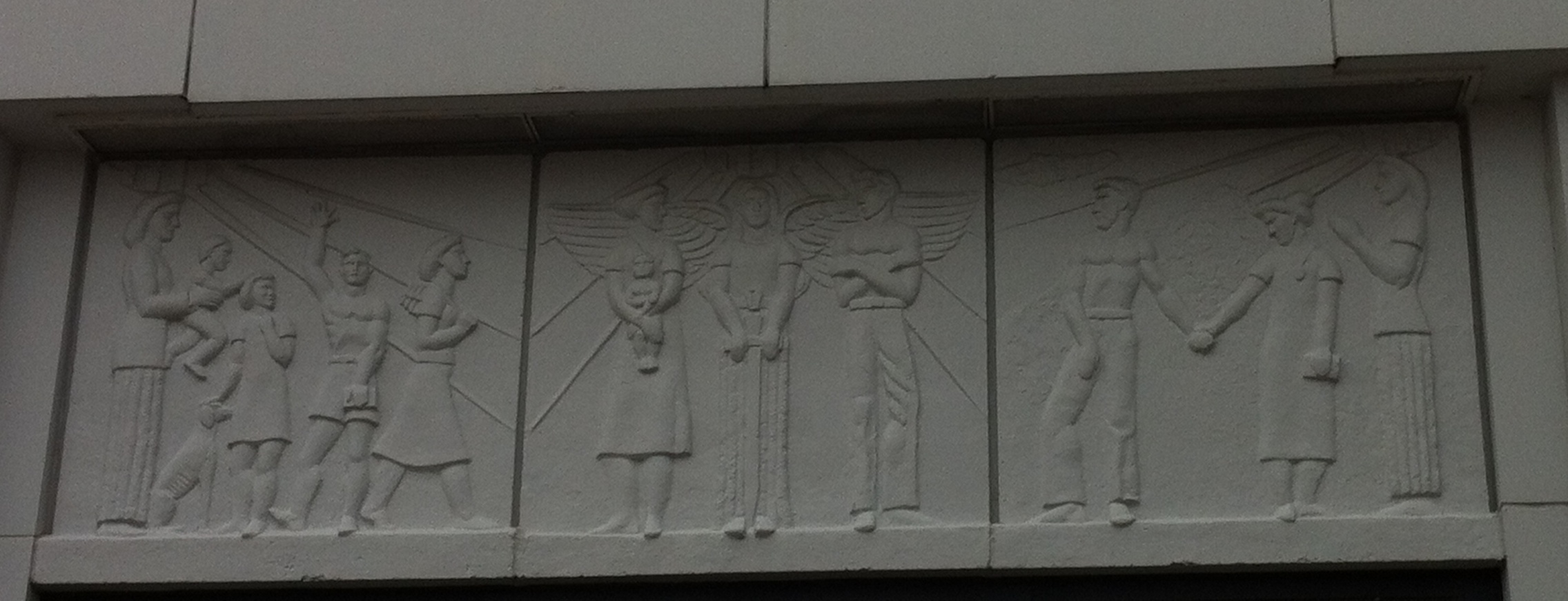
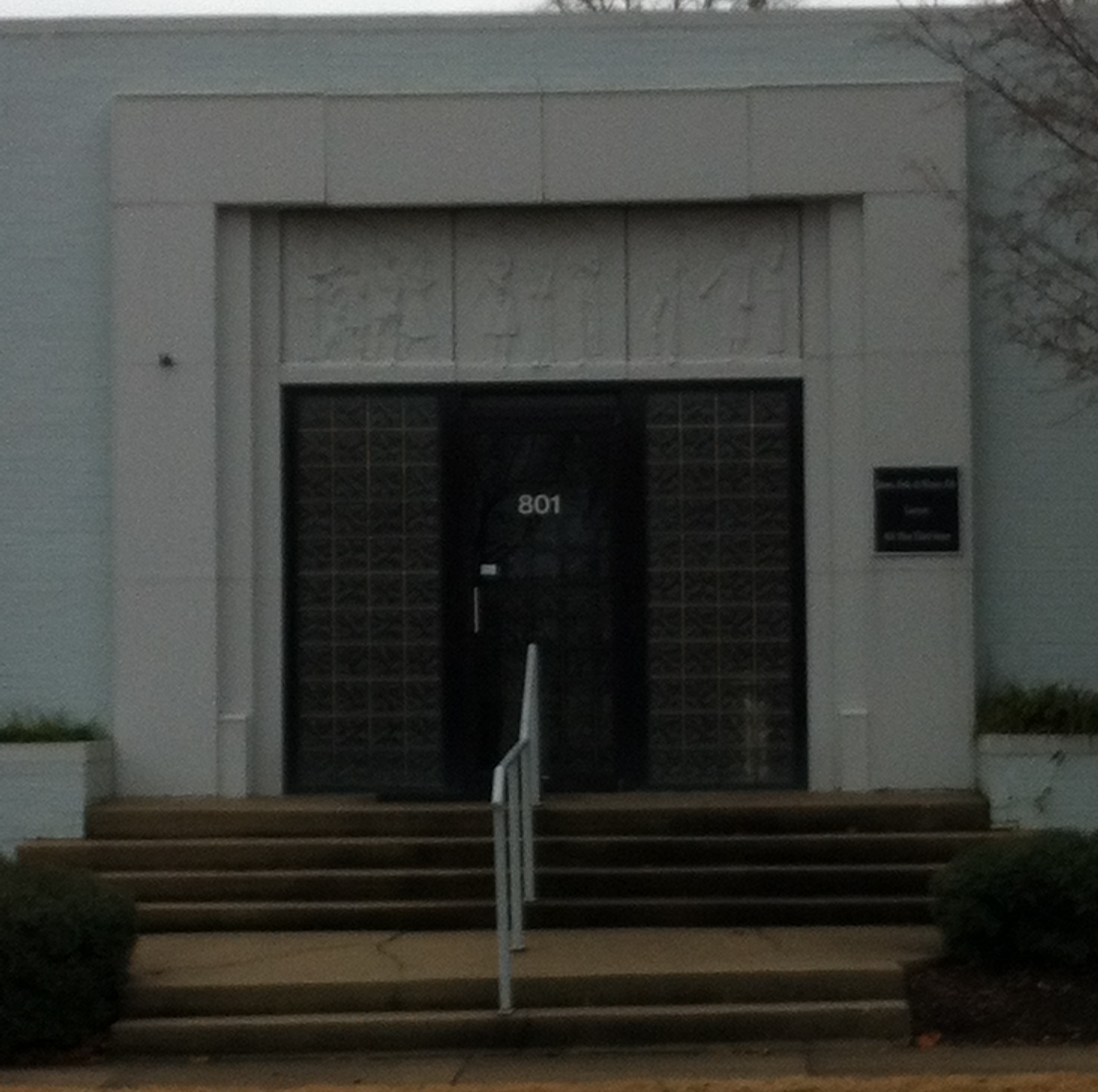
This frieze is found above the entrance to the building at 801 West Third Street, which houses a law firm.  The building was built in 1954 as an office.  At the time, that portion of Third Street was a mix of commercial and residential structures.

Though it is only a one story building, the combination of the frieze above the door and the glass blocks framing the door makes the building look more imposing than a typical 1950s one-story office structure would.

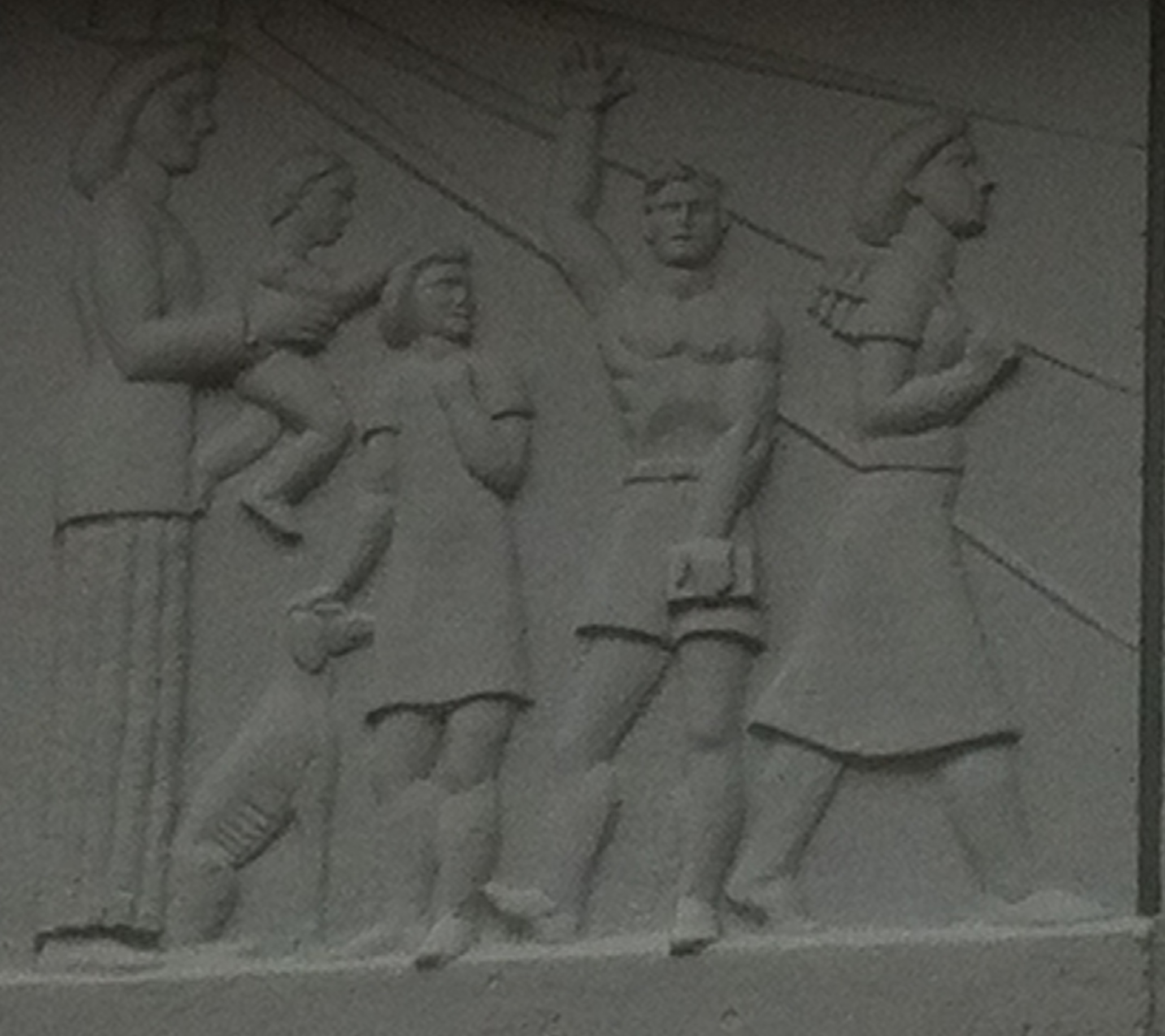
As was the case with many 20th century friezes, this depicts people in “modern” dress but in classical style.  These are less angular depictions than are found in Art Deco freizes; the lines are more natural and realistic.  The women’s fashions are definitely mid-20th century in dress and hair.  The men are depicted in a similar fashion, but in keeping with the classic tradition, the men are shirtless.