
The penultimate look back at 19 Little Rock cultural milestones in 2019 with numbers 14 to 16.
 14 – CALS rebrands literary festival as Six Bridges Book Festival. Previously known for 16 years as the Arkansas Literary Festival, this summer, the Central Arkansas Library System announced that starting with the April 2020 event, it would be known as Six Bridges Book Festival.
The four-day event in April celebrates reading, literacy, stories and wordsmithing including musical lyrics. Scores of nationally known authors converge on the city to offer panels on a wide variety of topics, from cooking demonstrations to award-winning comedy to personal stories of tornado-chasing. A slate of programming for children and teens includes hands-on crafts and music, animal visits, poetry contests, and more. Authors also venture out into the community for efforts such as “Writers in the Schools” (WITS), bringing the joy of writing to hundreds of students in the Little Rock area. Concerts, films, readings, and author parties enhance the festive atmosphere across 18 venues in downtown Little Rock.
The continuing success of the festival and its mission to encourage the enjoyment of reading and literacy have led CALS leadership to envision an even larger and more widely appealing festival for the future. By actively soliciting community input from all demographic groups and throughout the region, CALS plans to draw more people to experience the rich atmosphere of the festival and to see for themselves that the Six Bridges Book Festival offers something for everyone.
CALS Executive Director Nate Coulter noted, “The label ‘literary’ doesn’t describe the wide variety of festival offerings available to our community members. And the word can be off-putting to those who associate it with books they were made to read in school, rather than books they like now. The Six Bridges Book Festival is a diverse, energetic celebration of all kinds of stories and topics, both literary and mainstream, and we feel the new name reflects the festival’s nature more accurately. Our goal is to draw a wider audience by removing any barriers of perception that this event is only for highbrow tastes.”
The 17th annual festival now known as the Six Bridges Book Festival will take place April 23-26, 2020. Community organizations and community members at CALS branch libraries will soon be involved in the planning process.
 15 – Museum of Discovery “Shocked the Rock” with 40 feet tall Tesla Coil. Thousands of fans of famed inventor Nikola Tesla (or of the Museum of Discovery) flocked downtown on July 20 to witness the world’s largest Tesla Coil in action at “Shock the Rock!,” a Tesla-themed, free event on the grounds of the Clinton Presidential Center. “Shock the Rock!” was powered by Entergy and presented by the Museum of Discovery.
Greg Leyh, a California electrical engineer and scientist, completed construction of the 40-foot Tesla coil tower in October 2018 and displayed its awesome capabilities in Little Rock after his world-record device is featured at a Nikola Tesla birthday party celebration July 13 at the Tesla Science Center in Wardenclyffe, NY.
Leyh’s latest world-record coil was centered on the large concrete pad at the western edge of the Clinton Center grounds cordoned off from the crowd, ensuring zero danger from being on-site to watch the awesome power of 60-foot bolts of lightning.
Pre-“Shock the Rock!” festivities included electricity-related demonstrations and host hands-on, interactive activities with guests.
 16 – Artspace Rocks. Over 300 people gathered in July at Mosaic Templars Cultural Center for the Artspace Rocks first public event. It was part-description of what Artspace does, part-celebration of the vibrant Little Rock arts scene, part-networking event, and part-performance. It was all fun!
Artspace is the leading non-profit developer of live/work artist housing, artist studios, arts centers and arts-friendly businesses in the U.S. They specialize in creating, owning, and operating affordable spaces for artists and creative businesses. These spaces include live/work apartments for artists and their families, working artist studios, arts centers, commercial space for arts-friendly businesses, and other projects.
The Windgate Foundation invited Artspace to Little Rock to conduct a feasibility study during the first several months of 2019. They assembled a core committee made up of a diverse group from a variety of facets from the creative economy. The feasibility study process involved tours, focus groups, interviews, and the aforementioned public event. The name given to the Little Rock project was Artspace Rocks.
In September, a Creative Space Needs Survey was launched. It sought specific input from creative people, especially those interested in affordable space. Several hundred responses were received. In October, the preliminary feasibility study was released.
Artspace will be back in The Rocks at the end of January 2020 with more updates. Stay tuned….
 11 – Downtown Little Rock Partnership Murals. The Downtown Little Rock Partnership focused on increasing murals throughout the downtown area. In the summer, Jason Jones’s Playtime was painted and dedicated.
 12 – Women’s Suffrage Sculpture in Riverfront Park. While 2020 marks the centennial of the formal adoption of the 19th Amendment, 2019 marked 100 years since Arkansas ratified it. In tribute to that, a new Women’s Suffrage Plaza with a sculpture was dedicated in October. Jane DeDecker’s Every Word We Utter is the centerpiece of a new plaza inside the Vogel Schwartz Sculpture Garden.
 12 – Launch of River Market Entertainment District. After passage of a new state law earlier in 2019, some River Market merchants started working with the Downtown Little Rock Partnership, the Little Rock Convention & Visitors Bureau, and the City of Little Rock to create an entertainment district.
 4.
4.  5.
5.  6.
6. 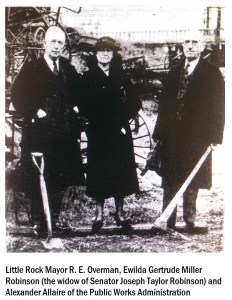 On December 24, 1937, at 11:30 a.m., Little Rock Mayor R. E. Overman, Ewilda Gertrude Miller Robinson (the widow of Senator Joseph Taylor Robinson) and Alexander Allaire of the PWA turned dirt to participate in the brief groundbreaking ceremony for Little Rock’s municipal auditorium.
 On December 20, 1937, the Little Rock City Council adopted Resolution 1,418 which authorized the sale of municipal bonds to fund the municipal auditorium.
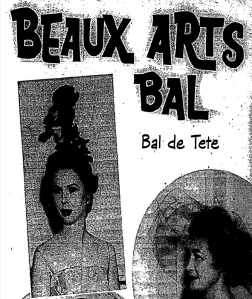 Snow covered highways throughout the state on Friday, December 12, 1958. However, the 400 guests at the Fine Arts Club’s first Beaux Arts Bal braved the roads and made their way to the blue drape bedecked ballroom of the Country Club of Little Rock. (Note, the event used the French spelling of Ball using only one “l.”)

 On Tuesday, Dec. 10, 2013, voters of Little Rock overwhelmingly chose to renovate the historic Joseph Taylor Robinson Memorial Auditorium.
 Little Rock Culture Vulture