
Little Rock Look Back: B-47 Explodes over Little Rock in 1960

An LRPD officer talks to bystanders next to a piece of debris

The peaceful morning of March 31, 1960, was interrupted by a horrendous noise over Hillcrest around 6:00am.  A six-engine B47 from the Little Rock Air Force Base exploded mid-air.

Flaming debris fell from Allsopp Park all the way to the State Capitol grounds and stretched from Cantrell to 12th Street.  Other debris was found as far away as the Country Club of Little Rock.  The next day the Arkansas Gazette ran a map which showed the extent of the damage.

Three airmen died in the explosion and two civilians were killed when debris fell on their homes.  The only survivor from the crew, 1st Lieutenant Thomas Smoak, was found dangling from a tree in his parachute at Kavanaugh and Martin.  He was treated by a nurse, Jimmye Lee Holeman, in whose yard he had landed.

Two civilians on the ground were killed by falling debris.  Many vehicles and homes were damaged, some were destroyed by debris.  The damage estimate was put around $4 million.

Police and fire crews were quickly on the scene to secure impacted areas, fight fires and rescue injured persons.

Those who perished were Captain Herbert Aldridge, Lieutenant Colonel Reynolds Watson, Staff-Sergeant Kenneth Brose, and civilians Alta Lois Clark and James Hollabaugh.

Today, part of the crash site is part of the Arkansas Children’s Hospital campus.  Other sites were removed by the I-630 construction.  Other houses were rebuilt or removed.  Fifty-eight years on, there are no visible scars to Little Rock’s landscape caused by the damage.

B47 Wreck Map

Arkansas Gazette map of debris and damage
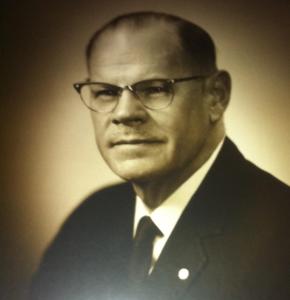
Little Rock Look Back: Werner C. Knoop

To Little Rock citizens under a certain age, the name Knoop means Knoop Park — a picturesque park tucked away in a pocket of Hillcrest.  There are, however, still many who remember Werner C. Knoop as a business and political leader who helped shape Little Rock as a modern city.

Knoop was born on March 30, 1902.

In 1946, Knoop joined with Olen A. Cates and P. W. Baldwin to form Baldwin Construction Company in Little Rock.  Knoop had previously founded Capital Steel Company and established his business reputation there.  From 1945 through 1951, he served on the Little Rock School Board.

Following a series of political scandals, efforts were undertaken for Little Rock to shift from Mayor-Council to City Manager form of government.  Even before the desegregation of Little Rock Central put the city in the eyes of the world, an election for new leaders had been set for November 1957.  Knoop was on a “Good Government” slate and was one of the members elected.

At the first meeting of the new City Board, Werner C. Knoop was chosen by his fellow directors to serve as Little Rock Mayor.  Knoop served as Mayor until December 1962.  For the first several months in office, Little Rock had no City Manager so Knoop oversaw the transition of City staff as the forms of government changed.

Though City Hall generally stayed out of school district matters, that did not mean that the public viewed the two entities separately.  In September 1959, the Baldwin Construction offices were bombed as part of a series of terrorist activities protesting the desegregated reopening of all Little Rock high schools.

Downtown LR as viewed from Knoop Park

Downtown LR as viewed from Knoop Park

After two terms on the City Board, Knoop decided against seeking a third term.  He concluded his elected public service on December 31, 1962.  Following his time on the City Board, Knoop did not retire from Civic Affairs.  In 1970, he served as Chairman of the Little Rock Chamber of Commerce.   The previous year he served as President of the Arkansas Chapter of Associated General Contractors.

Mayor Knoop died in July 1983.  He is buried at Roselawn Memorial Park next to his wife Faith Yingling Knoop, a renowned author.

In the 1930s, Knoop moved into an Art Moderne house on Ozark Point in Hillcrest.  It was adjacent to Little Rock Waterworks property which was developed around the same time.  Eventually much of the land was deeded to the City for creation of a park.  In 1989, it was named in tribute to long-time neighbor Knoop in honor of his lifetime of service to Little Rock.

Little Rock Look Back: Final City Council meeting in 1868 City Hall

On March 30, 1908, the Little Rock City Hall held its final meeting in the 1868 City Hall.  The new city hall, located at Markham and Broadway streets, was nearing completion.  The meeting was presided over by Mayor W. E. Lenon.

The aldermen present were: John A. Adams, John Brod, A. B. Hightower, W. H. Jarrett, Christopher Ledwidge, Louie Miller, Jonathan S. Odom, R. C. Powers, A. L. Smith, George Stratman, Jonathan H. Tuohey, Louis Volmer, and L. N. Whitcomb.  Three aldermen missed the meeting: John Herndon Hollis, A. B. Poe and Benjamin S. Thalheimer.

The meeting was filled with typical requests for zoning and street improvements.  There was actually nothing out of the ordinary about the meeting.  If there was mention that it would be the final meeting, it did not make it into the minutes.

There was a request by the Arkansas Association of Pharmacists to have a meeting at the new building on May 12, 13 and 14.  It was referred to the City Hall Committee.  At prior meetings, there had also been requests by other groups to hold conferences at the new edifice.

At the conclusion of the meeting, it was noted that former City Clerk Clay Jones had died. A resolution memorializing him was proposed to be presented and adopted at the next meeting.

And with that, the meeting ended.  Forty years of City Council meetings at 120 to 122 West Markham came to a close.

LR Women Making History – June Freeman

June Biber Freeman, born and reared in New Jersey, came to Pine Bluff from the University of Chicago, where she had met and married her husband, Edmond Freeman, a Pine Bluff native.

Long interested in the arts, she was instrumental in establishing the Little Firehouse Community Arts Center. Serving as its unpaid director until, with her continued vision and help, it morphed into the Arts and Science Center for Southeast Arkansas (ASC).  In 1973, she conceived and organized the  Women and the Arts: A Conference on Creativity,  the first of its kind in the region. Governor Dale Bumpers appointed her to the Governor’s Commission on the Status of Women.  In 1975,  Freeman was  hired by  Townsend Wolfe as the Arkansas Arts Center’s Director of State Services, a job  she held for the next five years.

In 1982, she was instrumental in establishing Pine Bluff Sister Cities.   She has served on the Little Rock Arts+Culture Commission as well as the boards of the Arkansas Arts Center, the Mid-American Arts Alliance and the Arkansas Arts Council. (In view of her background in psychology, she has served as a longstanding member of the UAMS Advisory Board of the Psychiatric Research Institute.)

Freeman is the founding director of the non-profit Architecture and Design Network (ADN) which got underway in 2003. Securing the support of the Arkansas Arts Center, the UA Fay Jones School of Architecture and Design (FJSAD) and the central section of the Arkansas chapter of the American Institute of Architects (AIA), Freeman launched a series of free public lectures by distinguished architects.  Retiring as director at the end of 2016, she continues to serve as a board member. She was named an honorary member of the FJSAD Dean’s Circle and, in 2013, was given an Award of Merit by the state Chapter of the AIA at its annual meeting. In 2016 the ADN board named the lecture series for her.

In 2017, she was inducted into the Arkansas Women’s Hall of Fame.  In 1995, she received the Governor’s Arts Award for Outstanding Patron.  In 2018, she became a rare two-time award recipient of a Governor’s Arts Award as she received the Lifetime Achievement Award.

Freeman and her husband, who retired as publisher of the Pine Bluff Commercial, moved to Little Rock in 1995. The couple has four children and six grandchildren.

LR Women Making History – Kathy Webb

While Kathy Webb has had many titles over her career in public service, Advocate for Others probably encompasses all of them.
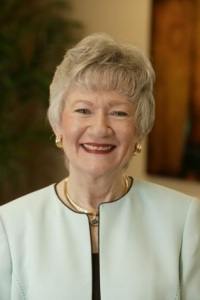
One of the most important committees at the Arkansas General Assembly is the Joint Budget Committee.  It is chaired by a senator and a representative.  In 2011 and 2012, as a state representative, Kathy Webb became the first woman to chair the committee.  

Considering that the first woman to be sworn in to the Arkansas General Assembly (Erle Chambers) was from Little Rock, and the first woman to chair a standing committee of the General Assembly (Myra Jones) was from Little Rock, it is fitting that the first woman to chair Joint Budget was also from Little Rock.

While women had been chairing committees for two decades, no female had ever led this committee.  During her tenure, Rep. Webb received praise from people in both houses and both parties for her leadership.  She served in the Arkansas General Assembly from 2007 until 2012.  During that time, she was also named the most effective legislator by Talk Business

Now, she is Vice Mayor of Little Rock.  Vice Mayor Webb is in her first term representing Ward 3 of Little Rock.  She will be vice mayor until December 2018.  Vice-Mayor Webb grew up in Arkansas and graduated from Little Rock Hall High. She earned a degree from Randolph-Macon Woman’s College and attended graduate school at the University of Central Arkansas. She has also participated in the Senior Executives in State and Local Government program at the John F. Kennedy School of Government at Harvard University.

After working in political advocacy in Washington D.C. and throughout the U.S. for several years, she spent over 20 years in the restaurant industry in Illinois, Tennessee, and Arkansas.

Her community involvement includes service on the UAMS College of Medicine Board of Visitors, Arkansas Hospice, and First United Methodist Church of Little Rock. She was the founding president of the Chicago-area affiliate of Susan G. Komen for the Cure.

Vice Mayor Webb has been honored by the Arkansas Kids Count Coalition, Just Communities of Arkansas, Arkansas Judicial Council, National Association of Women Business Owners, Sierra Club, Arkansas AIDS Foundation, Arkansas Chapter of the National Association of Social Workers, Pulaski County CASA, Interfaith Alliance for Worker Justice, Arkansas AARP, Arkansas Hospitality Association, Arkansas Municipal League, Hendrix College and Black Methodists for Social Renewal.

She is the Executive Director of the Arkansas Hunger Relief Alliance. The Alliance is the statewide umbrella organization for Feeding America food banks, food pantries and agencies and hunger activists and the education and advocacy clearinghouse on hunger issues in Arkansas

LR Women Making History – Lucy D. Dixon

Photo courtesy Little Rock School District

Lucy Dixon was elected to the initial Little Rock Board of Directors in November 1957.  She previously had served for six years on the Little Rock School Board.

Mrs. Dixon is the only woman to have served on both the governing boards of the City and the school district.  Mrs. Dixon chose not to seek a second term and left the City Board on December 31, 1960.

With her election in 1957, Mrs. Dixon became the first woman to be elected to a City position without her husband having previously held that position.

Her father had a lumber business, in which she worked off and on throughout her lifetime. She served not only as an officer of the business, but had a desk at the office and participated in the daily business.  She was also very active in Methodist Woman functions in Little Rock and Arkansas.

LR Women Making History – Pat Lile

Pat Lile has worked to make Little Rock, and indeed all of Arkansas, a better place.

A native of Hope, she attended Hendrix College.  After marriage and her husband’s law school, Pat and John Lile settled in Pine Bluff.  For nearly three decades she devoted herself to improving that city. She served in many volunteer leadership positions, so it is no surprise that in 1981, she and John founded Leadership Pine Bluff to help cultivate the next leaders.  She served as its executive director for nine years.

In 1990, the Liles moved to Little Rock.  From 1990 to 1995, she was the Executive Director of the Commission for Arkansas’ Future.  Then in 1996, she became President and CEO of the Arkansas Community Foundation.  Until her retirement in 2007, she led that organization as it grew.  Since her retirement, she has not slowed down.

Among the organizations she has founded or co-founded since the 1970s include Arkansas Advocates for Children and Families, the Women’s Foundation of Arkansas, and the Arkansas Non-profit Alliance.  She is on the Board of Trustees of Philander Smith College, U.S. Marshals Museum and Joseph Pfeifer Kiwanis Camp. She is also very active in her church, First United Methodist.

Lile has received a number of other honors including the Arkansas Community Foundation’s Lugean Chilcote award in the late 1980’s and the “Roots and Wings” Arkansas Benefactor award in 2008. Entergy, Inc. awarded her its “Distinguished Leadership Award” in 1997. Appointed by then President Bill Clinton, she was the only Arkansas delegate to the 1999 White House Conference on Philanthropy. In 2004 the Dr. Martin Luther King Jr. Arkansas Commission named her the recipient of a “Salute to Greatness” Community Service Award. In March of 2009 Lile was named by Arkansas Business, the state’s premier weekly business publication, as one of the top 25 Arkansas women leaders over the past 25 years, one of only two from the philanthropic sector. In March of 2010 Lile was presented the Father Joseph Biltz award from Just Communities of Arkansas (JCA).  In 2016, she received the James E. Harris Nonprofit Leadership Award.

The real reason Pat Lile has been successful is her determination and dedication. She is an encourager who works to bring out the best in others. Whether she is serving as a Brownie leader in Pine Bluff or attending a White House summit, Pat Lile believes that everyone in the room has the capacity to change lives by showing love for others. And then she does not give up!