
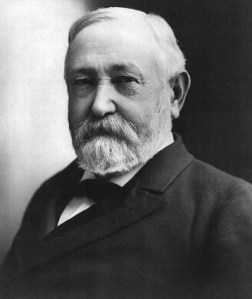
Benjamin Harrison becomes first sitting president to visit Little Rock

On April 17, 1891, Benjamin Harrison became the first sitting president to visit Arkansas.  He was on a cross-country railroad trip having left DC on April 13.

The morning of the 17th he spoke in Memphis and then took the train to Little Rock.  Accompanying him from Memphis to Little Rock were a delegation which included Governor and Mrs. James P. Eagle, Mayor H. L. Fletcher and Col. Logan H. Roots.  Also in the party was Mrs. W. G. Whipple, a former first lady of Little Rock.

They arrived in Little Rock in the afternoon.  A parade took them from the train station to the State House (now the Old State House Museum) where the Governor formally welcomed the President and his party.

In his brief remarks, President Harrison spoke of the hospitality and the natural resources available in Arkansas.  He also touched on the Civil War, which at the time was less than 30 years in the past. He noted “The commonwealth rests upon the free suffrage of its citizens and their devotion to the Constitution and the flag is the bulwark of its life.  We have agreed, I am sure, that we will do no more fighting among ourselves.” These remarks were met enthusiastically by the crowd assembled.

The President concluded is brief remarks thanking the State officials and the citizenry.  He then took the train to Texarkana where he made his third set of remarks of the day.

Benjamin Harrison was on the Presidential ticket two times. The first time he lost the popular vote but won the Electoral College defeating incumbent Grover Cleveland. The second time he lost both the popular and electoral votes to Cleveland.  He did not carry Arkansas in either election. Though he was the first sitting president to visit Little Rock, there is nothing here named for him.  Since there was already a Harrison Street named after his grandfather, he is skipped between Cleveland and McKinley in the presidential streets.

Grant in Little Rock, but horseless in Capital Hotel elevator

US_Grant_fOn April 15, 1880, former president Ulysses S. Grant spoke in Little Rock as part of his world tour. While here he made a couple of appearances and participated in a parade. It was General Grant’s first visit to Arkansas either as a soldier or a politician.

(At the time, and through much of the 20th Century, former US presidents were not referred to as President after leaving office. He was referred to as General Grant or Mr. Grant during his time in Little Rock.)

At his outdoor speech, his remarks followed brief comments by Governor William R. Miller and Mayor John Gould Fletcher (erroneously referred to as John C. Fletcher in the Memphis Appeal story the next day). Grant’s comments were brief and flowery. He thanked Arkansans for a warm welcome, praised the future prospects of Arkansas and discussed the demise of what he termed “sectionalism” which was undoubtedly a reference to the division between the Union and and former Confederate states.

Also that day, Grant addressed a banquet in Concordia Hall (now part of the Arkansas Studies Institute complex on the Central Arkansas Library downtown campus). His was one of fifteen toasts that evening. It was simply “The United States of America, forever United.” He expounded briefly on the theme of unity of citizens from all states. He also discussed immigration noting, “All foreigners find a welcome here. We make them American citizens. After we receive them, it is but one generation until they are Americans.” He noted that he could speak much more on the topic, but that since he was but one of fifteen toasts and that there was to be music after each toast, “It will be to-morrow (sic) morning when we get through if we all take as much time as the subjects admit of.”

Not everyone was thrilled to have the former commander of the Union Army in Little Rock. The story goes that when he was parading down the street, some Little Rock women (in a display of Souther un-hospitality) sat in chairs with their backs to the parade route. But all in all, it appears to have been a successful visit for the man who was the only Republican in the 19th Century to win Arkansas’ Electoral votes.

Grant arrived in Little Rock on the night of April 14 and lodged at the Capital Hotel. He undoubtedly enjoyed some whiskey and cigars while at the Capital. Grant had originally planned on departing in the afternoon of April 15, but Little Rock leaders pled with him to stay so that he could be honored at the banquet. He assented.

Incidentally, there is an urban myth that, while in Little Rock, General Grant rode his horse in the oversized elevator of the Capital Hotel.  This is a relatively recent story. The oversized elevator was not installed until the 1980s, over 100 years after Gen. Grant was a guest of the facility.

Little Rock City Hall at 110

LR City Hall circa 1908

City Hall circa 1908

110 years ago today, Little Rock City Hall officially opened at the corner of Markham and Broadway.

On April 15, 1908, the Italian Renaissance Revival style building, which had been designed by local architect Charles Thompson, played host to an open house. Staff had started moving into the building in March of that year.   This was, as often is the case, behind schedule.  The date in the cornice toward the top of the building is 1907, but the building was not completed until 1908.

An open house took place on April 15, 1908, presided over by Mayor John Herndon Hollis and his wife as well as former Mayor W. E. Lenon and his wife.  (Mayor Hollis’ wife is a distant cousin of the Culture Vulture.)

In 1903, W. E. Lenon became Mayor of Little Rock. Back then, the terms were two-year terms.  Before the start of his second term in 1905, he realized that the City was outgrowing City Hall, which was, at the time, on the northeast corner of Markham and Louisiana – where part of the Statehouse Convention Center sits today.

In February 1906, Mayor Lenon appointed a committee of five aldermen to over see the planning for the building of a new City Hall. In July 1906, the City Council approved plans, which called for a City Hall with an municipal auditorium wing. There was some hue and cry about the cost spending and a resulting lawsuit, so, in September 1906, those plans were scrapped and a simpler City Hall was approved for the cost of $175,000.

The last resolution in the old City Hall called for the banning of smoking in the new Council Chambers – while the Council was in session. This may well have been the first smoking ban in a public government building in the history of Arkansas.

When the building opened, the third floor was not finished out. The space was not needed. When the Museum of Natural History and Antiquities (now the Museum of Discovery) moved into City Hall in 1929, they had to finish out their space.

In 1913, the new Central Fire Station, designed in the Beaux Arts style, was constructed adjacent to City Hall. During the 1930s, as the City grew, more space was needed. A garage, designed in the “austere, utilitarian” style was built in 1936 and a City Jail Annex, built by the WPA in the modified Art Deco style was built in 1938.


By 1984, the decision was made to stay at Markham and Broadway. An extensive renovation and restoration effort was undertaken. In 1988, the building reopened, and the interior had been restored to its 1908 appearance.

Little Rock Look Back: Brooks-Baxter War Starts

Brooks BaxterOn April 15, 1874, Joseph Brooks, accompanied by armed men, including the Pulaski County Sheriff, went into the office of Governor Elisha Baxter demanding he vacate the office.  Alone, save a young son, Governor Baxter departed the Arkansas State Capitol (now the Old State House), and met up with a group of supporters to plan their response.

Thus, the Brooks-Baxter War in Arkansas had begun.

Brooks had faced off against Baxter in the 1872 gubernatorial election.  Both were Republicans, but represented different factions of the party.  Brooks led the Brindletails, which were more aligned with efforts to gradually re-enfranchise former Confederates as well as have a smaller government with limited gubernatorial powers.  Baxter led the Minstrels.  This group was focused on retaining power and control of state government by limiting re-enfranchisement of former Confederates.

Many historians believe that Brooks may have actually won the election, but Baxter’s faction’s control of the state machinery resulted in him being declared the winner.  Brooks’ appeal to the Arkansas General Assembly was unsuccessful.  He took it to the state courts, which was likewise going nowhere.  EXCEPT….

Baxter had changed course on his views toward Democrats and members of his own party. This resulted in him losing support of many Republicans.  He also fought with fellow Republicans regarding a railroad issue.  This led to a meeting of many leading Republicans including Arkansas’ two US Senators.  Not long after that, Pulaski County Circuit Judge John Whytock heard Brooks’ case.  On April 15, 1874, Judge Whytock ruled in favor of Brooks.

Following his ouster from the governor’s office, Baxter telegraphed President Grant, asking for assistance.  In the meantime, both sides recruited supporters.  Baxter and 200 men set up headquarters in the Anthony House, which was near the State Capitol.  Brooks and his supporters used furniture to barricade the capitol building.  Robert Catterson, a former Little Rock mayor, set up artillery pieces on the capitol lawn to defend Brooks.

For the next month, there would be many rumors and skirmishes.  Little Rock, like the rest of the state, was divided. And the conflict was just beginning.

Little Rock Look Back: First Council Meeting in 1908 City Hall

City Hall circa 1908

On April 6, 1908, the first City Council meeting took place in the new Little Rock City Hall.  Located at the corner of Markham and Broadway Streets, this three story structure was designed by Charles L. Thompson.

The idea of a new City Hall had first been raised by Mayor W. E. Lenon in 1904.  After a couple of false starts and delays, the project finally got underway in the autumn of 1906.  (The date on the front of the building is the optimistic and ultimately wrong 1907.  But it is etched in stone and set into the exterior.)

City offices started moving in during January and February 1908 while construction continued.  By the end of March, the building was complete and all offices moved in.  The final City Council meeting in the 1868 City Hall took place on March 30.  One week later, the body reassembled in their new space.

All sixteen of the aldermen were present for this meeting, which was a rare occurrence.  The regular order of business was dispensed with except for approval of payments for the bills and payroll for March.  That totaled $25,719.56. (This is the equivalent of $664,729.65 in 2018).

The floor was then turned over to Mayor Lenon to make an announcement.  In his remarks, the Mayor praised the new building, and then stated he was resigning immediately.  His business interests were such that he did not have time to be mayor.

The Council reluctantly accepted the resignation.  Because there was over a year remaining in the term, a special election would need to be called to select a successor.  If Mayor Lenon had waited two more weeks to resign, the Council would have appointed a new mayor for the duration of the term.

Alderman John Herndon Hollis was chosen to serve as mayor until the special election could be held.  First elected in 1904, he was about to start his third term as an alderman.  Though he did not have to give up his seat (and in fact served as an alderman until 1918), he was referred to as Mayor Hollis during his brief tenure.  He is counted as one of Little Rock’s mayors.  Unlike other times where there was an acting mayor while a mayor was out of town, in 1908, there was no other mayor for whom Mayor Hollis was acting in absentia.

After the selection of the new mayor, a committee was appointed to draft a resolution praising retiring Mayor Lenon.  The final business at the meeting was the reading of a resolution memorializing longtime City Clerk H. Clay Jones.  The former city official had died in March.

Little Rock Look Back: The Assassination of Dr. King

On April 4, 1968,  when Dr. King was assassinated, Little Rock did not see the unrest that many cities did.  Part of that was probably due to quick action by Governor Winthrop Rockefeller.

The Governor released a statement fairly quickly expressing his sorrow at the tragedy and calling for a day of mourning. He also made the State Capitol available for the NAACP to have a public memorial, as well as worked with a group of ministers to host an interdenominational service.

Little Rock Mayor Martin Borchert issued a statement as well:

We in Little Rock are disturbed about the incident in Memphis. We are disturbed regardless of where it had happened.  Killing is not the Christian solution to any of our problems today.

In Little Rock, we feel we have come a long way in 10 years toward solving some of our problems of living and working together regardless of race, creed or color.

The city Board of Directors in Little Rock has pledged itself toward continuing efforts to make Little Rock a better place in which to live and work for all our citizens.

We feel the efforts of all thus far have proved we can live in harmony in Little Rock and are confident such an incident as has happened will not occur in Little Rock.  We will continue our most earnest efforts toward the full needs of our citizens.

The day after Dr. King was assassinated, a group of Philander Smith College students undertook a spontaneous walk to the nearby State Capitol, sang “We Shall Overcome” and then walked back to the campus.  President Ernest T. Dixon, Jr., of the college then hosted a 90 minute prayer service in the Wesley Chapel on the campus.

On the Sunday following Dr. King’s assassination, some churches featured messages about Dr. King.  As it was part of Holy Week, the Catholic Bishop for the Diocese of Little Rock had instructed all priests to include messages about Dr. King in their homilies. Some protestant ministers did as well. The Arkansas Gazette noted that Dr. Dale Cowling of Second Baptist Church downtown (who had received many threats because of his pro-integration stance in 1957) had preached about Dr. King and his legacy that morning.

Later that day, Governor Rockefeller participated in a public memorial service on the front steps of the State Capitol. The crowd, which started at 1,000 and grew to 3,000 before it was over, was racially mixed. At the conclusion of the ceremony, Governor and Mrs. Rockefeller joined hands with African American ministers and sang “We Shall Overcome.”

That evening, Trinity Episcopal Cathedral was the site of an interdenominational service which featured Methodist Bishop Rev. Paul V. Galloway, Catholic Bishop Most Rev. Albert L. Fletcher, Episcopal Bishop Rt. Rev. Robert R. Brown, Rabbi E. E. Palnick of Temple B’Nai Israel, Gov. Rockefeller, Philander Smith President Dixon, and Rufus King Young of Bethel AME Church.

Earlier in the day, Mayor Borchert stated:

We are gathered this afternoon to memorialize and pay tribute to a great American….To achieve equality of opportunity for all will require men of compassion and understanding on the one hand and men of reason and desire on the other.

Little Rock Look Back: LR Voters approve additional funds for Robinson Center in 1940

Though Joseph Taylor Robinson Memorial Auditorium opened in February 1940, there was still money that needed to be raised to finish the construction and the building’s furnishing.  Ten days after the auditorium opening, the City Council approved an ordinance to call a special election on April 2, 1940, for the purposes of approving bonds for three separate projects.  One of these was for $30,000 for the completion of the auditorium; the bonds would not require any additional tax levy.

At the same meeting, a letter was read from the Young Men’s Business Association expressing support for the auditorium in the election, which was to be held in conjunction with the annual municipal general election. The Auditorium Commission had previously asked the City Council to consider issuing the bonds to pay for additional equipment for the building.  In their request to the aldermen, the members stressed that due to the current bond structure, these new bonds would not necessitate any tax increase.

The campaign for the new bonds used a similar structure and message as the 1937 election to build the auditorium.  There were newspaper ads by the steering committee (this time simply called the Citizen’s Committee and led by Omar Throgmorton) and support from civic organizations.  One thing very different from the 1937 campaign was the presence of an actual building.  On Sunday, March 31, just two days before the election, there was an open house for the public to explore the edifice.  From 1:00 p.m. to 9:00 p.m., members of various Little Rock Boy Scout troops led 4,000 visitors on tours of the auditorium.  Visitors were shown all over the building; one scout calculated that the walking tour equated to two miles.  Though most people were from Little Rock, the guest registry indicated visitors from California and Pennsylvania.

On April 2, 1940, Little Rock voters approved the new bonds 1,413 to 423.  Every precinct in every ward of the city voted in favor of the new bonds.  Shortly after the election, the bonds were issued.  The auditorium construction which had first been broached in 1904 was now completed in 1940.