

Early voting now through Feb 8 for Arts+History in Little Rock


Feb9electionlogoEarly voting started yesterday for the February 9 special election for Arts + History in Little Rock.

By voting FOR on Tuesday, February 9th Little Rock residents can expand and enhance our Arkansas Arts Center, MacArthur Museum of Arkansas Military History, and MacArthur Park. Your vote FOR on February 9th will upgrade facilities and public spaces to ensure the Arkansas Arts Center keeps its accreditation by issuing a bond backed by an existing hotel tax on out of town visitors.

Early voting takes place at the Pulaski County Election Commission headquarters at 501 West Markham (across from City Hall) from 8:00am to 5:00pm through February 8 (no weekend early voting).

On Election Day (February 9), regular polling sites will be open from 7:30am to 7:30pm.

  • Your for vote will keep the Arkansas Arts Center in Little Rock accredited, with updates to aging facilities over 50 years old, bringing in more world-class exhibitions and educational opportunities.
  • Your for vote will help expand and enhance the Arkansas Arts Center and improve the MacArthur Museum of Arkansas Military History by providing much needed help to aging facilities and addressing landscaping needs in MacArthur Park.
  • Your for vote will spur community involvement by increasing educational opportunities, attracting more world class exhibits, expanding art classes and renovating the Children’s Theatre.
  • Your for vote will establish a public/private partnership between public funding and private donations that ensures our city can expand and enhance the Arkansas Arts Center, MacArthur Museum of Arkansas Military History and MacArthur Park.

In legalese: An issue of bonds of the City of Little Rock, Arkansas in one or more series in the maximum aggregate principal amount of Thirty-Seven Million, Five Hundred Thousand Dollars ($37,500,000.00) for the purpose of financing a portion of the costs of improvements to MacArthur Park, including particularly, without limitation, renovations and additions to, and furnishings and equipment for, the Arkansas Arts Center and renovations and equipment for the MacArthur Museum of Arkansas Military History, including any necessary parking, landscaping, signage, drainage, lighting, road and utility improvements in MacArthur Park. The bonds will be payable from and secured by a pledge of the collections of the taxes levied by the City at an aggregate rate of 2% upon the gross receipts or gross proceeds derived and received from the renting, leasing or otherwise furnishing of hotel, motel, bed and breakfast or short-term condominium or apartment rental accommodations for sleeping for profit in the City, pursuant to Ordinance Nos. 21,140 and 21,141 adopted December 1, 2015. The proceeds of the bonds will also be used to provide a debt service reserve and pay costs of issuing the bonds.


Black History Month Spotlight – Mosaic Templars Cultural Center

The new Arkansas Civil Rights History Audio Tour was launched in November 2015. Produced by the City of Little Rock and the University of Arkansas at Little Rock allows the many places and stories of the City’s Civil Rights history to come to life an interactive tour.  This month, during Black History Month, the Culture Vulture looks at some of the stops on this tour which focus on African American history.
The Mosaic Templars Cultural Center and Museum collects, preserves, interprets and celebrates Arkansas’s unique African American political, economic, and social achievement from 1865 to 1950. The Center resides in the footprint of the original Mosaic Templars of America National Headquarters and Annex Buildings.

The permanent museum exhibits depict historic West Ninth Street as a thriving commercial and social hub, focusing on the black entrepreneurship, Templars organization, and the legacy of black legislators. Between 1868 and 1893, eighty-five African Americans served in the Arkansas General Assembly. The majority served in the House, with nine in the Senate. Election laws passed in 1891, together with a poll tax in 1832, ended the election of African Americans to the legislature. No black person served again until the General Assembly in 1973.

In addition to community educational programs, the Center offers a genealogy research room, an art collection created by local talent, and a well-stocked store. The Center’s third floor features a replica of the original Headquarters Building auditorium and the Arkansas Black Hall of Fame galleries.

The Center is a museum of the Department of Arkansas Heritage and admission is free.

The app, funded by a generous grant from the Arkansas Humanities Council, was a collaboration among UALR’s Institute on Race and Ethnicity, the City of Little Rock, the Mayor’s Tourism Commission, and KUAR, UALR’s public radio station, with assistance from the Little Rock Convention and Visitors Bureau.

Arkansas and the Southern Manifesto explored at Butler Center’s Legacies & Lunch today

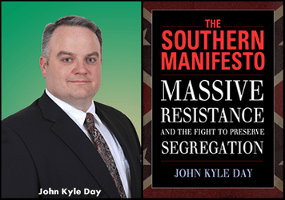
southern_manifestoAt Legacies & Lunch, John Kyle Day, associate professor of history at University of Arkansas at Monticello, will discuss the efforts of the United States Congress to delay desegregation in the 1950s and onward.  The program will take place today (February 3) at 12 noon at the Darragh Center on the CALS campus.

On March 13, 1956, ninety-nine members of the United States Congress promulgated the Declaration of Constitutional Principles, popularly known as the Southern Manifesto. This document formally stated opposition to the landmark United State Supreme Court decision Brown v. Board of Education, and the emergent civil rights movement. This allowed the white South to prevent Brown‘s immediate full-scale implementation and, for nearly two decades, set the slothful timetable and glacial pace of public school desegregation. The Southern Manifesto also provided the Southern Congressional Delegation with the means to stymie federal voting rights legislation, so that the dismantling of Jim Crow could be managed largely on white southern terms.

Day’s book, The Southern Manifesto: Massive Resistance and the Fight to Preserve Segregation, narrates this single worst episode of racial demagoguery in modern American political history and considers the statement’s impact upon both the struggle for black freedom and the larger racial dynamics of postwar America.

Legacies & Lunch is free, open to the public, and supported in part by the Arkansas Humanities Council. Programs are held from noon-1 p.m. on the first Wednesday of each month. Attendees are invited to bring a sack lunch; drinks and dessert are provided. For more information, contact 918-3033.

Little Rock Look Back: LR Mayor George Wimberly

https://www.meaningfulfunerals.net/fh_live/10300/10306/images/obituaries/1388392.jpgOn February 3, 1920, future Little Rock Mayor George Wimberly was born in Star City. He served his country first in the Civilian Conservation Corps and later aboard a U.S. Naval Department hospital ship in the Pacific during World War II.

Wimberly was first elected to the Little Rock City Board in November 1968.  He was re-elected in November 1972 and served until December 1976.  In January 1971, he was selected to serve as Little Rock Mayor through December 1972.  In a rare move, he was again selected to serve as Mayor from January 1975 through December 1976.  During the era of the City Board selecting one of their own members to serve as Mayor, George Wimberly was the only one selected to two non-sequential terms.

In 1978, he was elected to the State House of Representatives and served until December 1988.  While in the House he led the effort for smoking to be banned in the House chambers (a move that predated many public smoking bans of the 1990s and onward).

For over fifty years he was an employee and later owner of Buice Drugstore located on Markham in the Stifft Station neighborhood. In 1986 he received the Arkansas Pharmacist of the Year Award and the Lifetime Achievement Award in 2009.

Mayor Wimberly died on February 5, 2012, two days after his 92nd birthday.  He was survived by his wife, two sons, a grandson and several other relatives.

Little Rock Look Back: Little Rock Public Library opens in 1910

On February 2, 1910, the Little Rock Public Library officially opened its doors.  There had been an open house the night before, but this was the first day of acquiring a library card and checking out books.
Various private libraries had existed sporadically in Little Rock throughout the 19th Century.  In November 1900, a Little Rock School District committee made the first inquiry into the the creation of a Carnegie Library in Little Rock.  Over the next several years, numerous entreaties were made, but funding for the City’s portion was an obstacle.  On December 17, 1906, the Little Rock City Council passed an ordinance to move forward with building, furnishing and equipping a library.  Finally, in February 1908, the City approved acceptance of $88,100 from Andrew Carnegie.  The building would be designed by Edward Tilton, who designed Carnegie libraries, working with local architect Charles Thompson.

Mary Maud Pugsley was hired as the first librarian for Little Rock in May 1909. She began her duties on September 15, 1909, in order to get ready for the opening of the library at the southwest corner of 7th and Louisiana Streets.

On February 2, 1910, formal circulation of books began.  J. N. Heiskell was issued library card number 1.  He was secretary of the Library’s Board of Trustees and had long been an advocate for a public library in Little Rock.  He had often used his bully pulpit as editor of the Arkansas Gazette to advocate for a public library since arriving in Little Rock in 1902.  (Years later — he lived until 1972 — he received a replica of the library card made out of gold.)

That first day of operation, 500 people had applied for library cards. The application process required one to be a Little Rock property owner or to have a property owner sign the application.

Within the first year of operation, 2.5% of Little Rock’s population of 45,951 had applied for a library card.

For more on the history of the transformation of the Little Rock Public Library into the Central Arkansas Library System, read Shirley Schuette and Nathania Sawyer’s From Carnegie to Cyberspace — 100 Years at the Central Arkansas Library System, published by Butler Center Books.

National Park Service Director, Local Leaders to Speak at Black History Month Town Hall Meeting

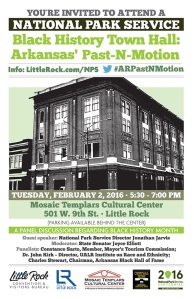
Feb 2 NPS eventLittle Rock Central High School National Historic Site in partnership with Little Rock Convention & Visitors Bureau, Mosaic Templars Cultural Center and the City of Little Rock, invite the public to join them for a Black History Month Town Hall Meeting entitled Arkansas’s Past-N-Motion to be held at Mosaic Templars Cultural Center at 5:30pm on February 2, 2016.

National Park Service Agency Director Jonathan Jarvis will serve as the guest speaker, and will discuss the National Parks Centennial Celebration, his tour to several of our nation’s civil rights-related historic sites and parks, and the importance of the National Park Service’s role in preserving and sharing our country’s history for future generations.  After his remarks, a panel discussion with local individuals will discuss several local institutions, and their roles and recent initiatives in preserving and sharing our city’s African American history, and its unique place in our nation’s civil rights movement.  This discussion will feature State Senator Joyce Elliott as moderator, and feature local panelists: Constance Sarto, Member, Mayor’s Tourism Commission; Dr. John Kirk – Director, UALR Institute on Race and Ethnicity; and Charles Stewart, Chairman, Arkansas Black Hall of Fame.

This Town Hall Meeting will highlight the resources of Civil Right institutions both from a national and local perspective, and the role of the National Park Service as the nation’s storyteller as it prepares to embark upon its Centennial 100th Birthday celebration on August 25, 2016.

During Director Jarvis’ time in Arkansas, he plans to visit Little Rock Central High School National Historic Site, engage Youth Leadership Academy members from Central High School as well as elementary students around the new White House youth initiative to get all 4th graders and their families to experience the places that are home to our country’s natural treasures, rich history, and vibrant culture FREE OF CHARGE! His visit to Arkansas will mark the start of Director Jarvis’ month-long endeavor to promote Civil Rights Sites during Black History Month.

They have also created the hashtag #ARPastNMotion to encourage local community groups to share information regarding any upcoming events relating to Black History Month.

For more information, please contact Enimini Ekong at (501) 396-3006 or Enimini_Ekong@nps.gov, or visit www.LittleRock.com/NPS.

Little Rock Central High School National Historic Site is located at 2120 Daisy L. Gatson Bates Drive, diagonally across the street from Central High School. The visitor center is open from 9:00 a.m. – 4:30 p.m. Monday through Sunday.  Admission is free. For more information call (501) 374-1957 or email chsc_visitor_center@nps.gov.

African Americans in the arts is topic of Mosaic Templars lunchtime program

mosaictemplarsThe Mosaic Templars Cultural Center “It’s In the Bag” quarterly lunch series offers a variety of topics meant to educate, entertain and inspire.

Today (2/2) at noon, the topic is African Americans in the arts.  It will feature guest panelists: poet Chris James, founder and executive director, House of Art; filmmaker Brian Lee; and Theresa Timmons-Shamberger, executive director, Timmons Arts Foundation.

Bring your lunch and MTCC will provide the drinks!

The Mosaic Templars Cultural Center is an agency of the Department of Arkansas Heritage.