Arts+History Election Results – By The Numbers

Feb9electionlogoThe Culture Vulture loves crunching numbers almost as much as attending cultural events.

Here are some thoughts about the results from the February 9 MacArthur Park Bond election.  These bonds will pay for improvements to the Arkansas Arts Center, MacArthur Museum of Arkansas Military History and MacArthur Park.  Excess revenues from the bonds will be available for the Little Rock Zoo, Museum of Discovery, other Little Rock parks and other Little Rock cultural institutions.

There were 7,990 votes cast in the special election.  This was 6.61% of the electorate.  By comparison, there were 4,462 ballots cast in the July 2015 Central Arkansas Library System special election and 6,995 ballots cast in the December 2013 Robinson Center special election.  The latter election brought 6.14% of voters to the polls.

Comparing early and absentee voters to election day voters:

  • Robinson (December 2013) – 871 or 12.45% of all ballots cast
  • CALS (July 2015) – 750 or 16.81% of all ballots cast
  • MacArthur Park (February 2016) – 1,171 or 14.66% of all ballots cast

The top ten precincts for voter participation on February 9:

107 – LRFD Station #10 —– 23.66%
106 – LRFD Station #10 —– 22.85%
109 – Pulaski Heights Presbyterian —–  18.17%
91 – Cammack Village City Hall —– 17.43%
108 – Woodlawn Baptist —– 17.33%
90 – Second Presbyterian —– 15.86%
112 – Pulaski Heights Presbyterian —– 15.00%
96 –  St. Mark’s Episcopal —– 13.42%
70 – Pleasant Valley CoC —–  12.58%
92 – St. Paul UMC —–  12.27%

While most of these are in the midtown area of Little Rock, some are in the western portion of Little Rock.  They tend to have the highest percentage of voter turnout in primary, general and special elections regardless of what or who is on the ballot.


The top 10 precincts for number of voters were:
109 – Pulaski Heights Presbyterian —– 497
106 – LRFD Station #10 —– 351
107 – LRFD Station #10 —– 308
90 – Second Presbyterian —– 260
71 – Pulaski Academy —– 252
108 – Woodlawn Baptist —– 238
114 – Arkansas Arts Center —– 230
88 – St. James UMC —– 223
95 – Grace Presbyterian —– 211
68 – Chenal Valley Church —– 204

These results spread from downtown to midtown to west Little Rock and are fairly evenly distributed.


There were twelve precincts in which over 90% of the voters cast ballots in favor of the bonds.  Precinct 61 at Pilgrim Rest Baptist Church was 100% in favor of it. But there was only one ballot cast.  Of the remaining eleven precincts in which more than one vote was cast, here are the rankings by percentage:

112 – Pulaski Heights Presbyterian —– 96.97
118 – Dunbar Recreation Center —– 95.83
114 – Arkansas Arts Center —– 95.65
109 – Pulaski Heights Presbyterian —– 94.77
107 – LRFD Station #10 —– 94.16
108 – Woodlawn Baptist  —– 92.86
79 – Henderson UMC —– 92.59
128 – St. John Vision Center —– 92.37
90 – Second Presbyterian —– 91.54
110 – Woodlawn Baptist  —– 91.3
135 – Pilgrim Rest Baptist —– 91.18

Again, they are fairly evenly distributed from downtown to midtown to west Little Rock.
Vote Today FOR Little Rock’s Arts+History

Feb9electionlogoToday is Election Day for the Campaign for Arts + History.

By voting FOR on Tuesday, February 9th Little Rock residents can expand and enhance our Arkansas Arts Center, MacArthur Museum of Arkansas Military History, and MacArthur Park. Your vote FOR on February 9th will upgrade facilities and public spaces to ensure the Arkansas Arts Center keeps its accreditation by issuing a bond backed by an existing hotel tax on out of town visitors.

Polling sites are open from 7:30am to 7:30pm.

  • Your for vote will keep the Arkansas Arts Center in Little Rock accredited, with updates to aging facilities over 50 years old, bringing in more world-class exhibitions and educational opportunities.
  • Your for vote will help expand and enhance the Arkansas Arts Center and improve the MacArthur Museum of Arkansas Military History by providing much needed help to aging facilities and addressing landscaping needs in MacArthur Park.
  • Your for vote will spur community involvement by increasing educational opportunities, attracting more world class exhibits, expanding art classes and renovating the Children’s Theatre.
  • Your for vote will establish a public/private partnership between public funding and private donations that ensures our city can expand and enhance the Arkansas Arts Center, MacArthur Museum of Arkansas Military History and MacArthur Park.

In legalese: An issue of bonds of the City of Little Rock, Arkansas in one or more series in the maximum aggregate principal amount of Thirty-Seven Million, Five Hundred Thousand Dollars ($37,500,000.00) for the purpose of financing a portion of the costs of improvements to MacArthur Park, including particularly, without limitation, renovations and additions to, and furnishings and equipment for, the Arkansas Arts Center and renovations and equipment for the MacArthur Museum of Arkansas Military History, including any necessary parking, landscaping, signage, drainage, lighting, road and utility improvements in MacArthur Park. The bonds will be payable from and secured by a pledge of the collections of the taxes levied by the City at an aggregate rate of 2% upon the gross receipts or gross proceeds derived and received from the renting, leasing or otherwise furnishing of hotel, motel, bed and breakfast or short-term condominium or apartment rental accommodations for sleeping for profit in the City, pursuant to Ordinance Nos. 21,140 and 21,141 adopted December 1, 2015. The proceeds of the bonds will also be used to provide a debt service reserve and pay costs of issuing the bonds.

Black History Month Spotlight – Little Rock Cemeteries

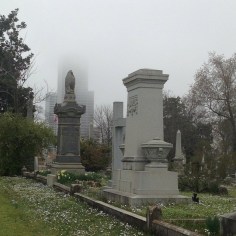
Mount Holly greyThe new Arkansas Civil Rights History Audio Tour was launched in November 2015. Produced by the City of Little Rock and the University of Arkansas at Little Rock allows the many places and stories of the City’s Civil Rights history to come to life an interactive tour.  This month, during Black History Month, the Culture Vulture looks at some of the stops on this tour which focus on African American history.

Mount Holly Cemetery: Broadway at Twelfth Street, est. 1843

Oakland and Fraternal Historic Cemetery Park: 2101 S. Barber, est. 1863

Haven of Rest Cemetery: 1702 Twelfth Street, est. 1903

National African Americans and important civil rights leaders are interred in several local cemeteries.

Mount Holly Cemetery is the final resting place of enslaved people, who were buried in their owner’s family plots, and the graves of several free blacks in the mid-1800s. One notable black leader buried here is Nathan Warren, founding pastor of Bethel AME Church. A marker is dedicated to Quatie Ross, wife of Cherokee Chief John Ross, who died along the Trail of Tears in 1839.

Oakland and Fraternal Historic Cemetery Park is composed of several cemeteries serving different communities: Oakland, Confederate, National, Jewish, and Fraternal, an historically black cemetery. Civil rights advocates buried in Fraternal include Mifflin Wistar Gibbs, John E. Bush, Charlotte Andrews Stephens, Dr. John Marshall Robinson, Isaac Gillam, Sr. and Jr., Asa l. Richmond, as well as members of the influential Pankey and Ish families.

Haven of Rest Cemetery is the largest cemetery for black people in Little Rock. Among the graves here are those of Daisy Gatson Bates, civil rights activist and mentor to the Little Rock Nine; attorney Scipio Africanus Jones; and Rev. Joseph Booker, president of Arkansas Baptist College.

The app, funded by a generous grant from the Arkansas Humanities Council, was a collaboration among UALR’s Institute on Race and Ethnicity, the City of Little Rock, the Mayor’s Tourism Commission, and KUAR, UALR’s public radio station, with assistance from the Little Rock Convention and Visitors Bureau

Super Bowl Sunday Little Rock Look Back: Copper Bowl

Copper Bowl

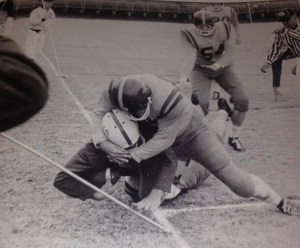
A Little Rock police officer tackles a NLR player in one of the Copper Bowls.

Today is Super Bowl Sunday, so it seems to be a good time to remember the five year series of football games in Little Rock known as the Copper Bowl.

From December 1959 through December 1963, the Little Rock Police Department played the North Little Rock Police Department in a series of football games.  The Copper Bowl games were fundraisers to help the LRPD provide food and presents for needy families during the Christmas season.

The agreement was that the teams would play for five years. The team with the most wins would permanently receive the Copper Bowl trophy.  The LRPD was outfitted with uniforms from Little Rock University and Louisiana State University (thanks to the efforts of Sgt. Harold Zook).  The games were played at Quigley Stadium.

Before the final game on December 1, 1963, the series was tied at 2-2.  The LRPD team won the game and permanently captured the trophy.  Over the five year period several thousand dollars were raised.

Black History Month Spotlight – Lynching of John Carter

John Carter lynch victimThe new Arkansas Civil Rights History Audio Tour was launched in November 2015. Produced by the City of Little Rock and the University of Arkansas at Little Rock allows the many places and stories of the City’s Civil Rights history to come to life an interactive tour.  This month, during Black History Month, the Culture Vulture looks at some of the stops on this tour which focus on African American history.

On May 4, 1927, Little Rock witnessed its worst episode of racial violence in the twentieth century. Thirty-eight year old African American John Carter allegedly “assaulted” two white women on the outskirts of the city. A white mob hunted Carter down, hung him from a telegraph pole, and riddled his dead body with hundreds of bullets. The mob transported Carter’s body downtown and then dragged it through the streets tied to the back of an automobile.

Thousands of white onlookers gathered at West Ninth Street and Broadway, the heart of the black business district. There the mob tore pews from Bethel AME Church, one of the city’s largest and oldest black churches, and threw Carter’s body onto a makeshift funeral pyre. The mob only dispersed when Gov. John E. Martineau sent in Arkansas National Guardsmen because Mayor Charles Moyer, the Chief of Police, and Sheriff “could not be reached.” No charges were ever brought against any of the perpetrators.

During the Jim Crow era, white lynch mobs murdered at least 284 black people in Arkansas, the second highest per capita number of lynchings in any state outside of Mississippi.

The app, funded by a generous grant from the Arkansas Humanities Council, was a collaboration among UALR’s Institute on Race and Ethnicity, the City of Little Rock, the Mayor’s Tourism Commission, and KUAR, UALR’s public radio station, with assistance from the Little Rock Convention and Visitors Bureau.

Little Rock Look Back: Acting Mayor John Herndon Hollis

John Herndon HollisOn February 5, 1870, future Little Rock alderman and acting mayor John Herndon Hollis was born shortly before his family moved to what is now Cleveland County. His parents were originally from Georgia and came from prosperous and longtime families there.

The Hollis family came to Arkansas after the Civil War and settled in Union County. A portion of that county was carved off and became Dorsey County (named after a Republican US Senator from Arkansas) but was renamed Cleveland County after Grover Cleveland was elected President. Cleveland was the first Democrat to be elected President in over 20 years. This name change also reflected the political shift in Arkansas from the Reconstruction-led Republican politics to the Democratic Party politics which would dominate for the next century.

John Herndon Hollis was one of six children, and the only one with a middle name. Herndon had been his mother’s maiden name. As one of his brothers described their childhood in Cleveland County, “they all went to country schools in their home neighborhood, worked hard on the farm in the summertime, and were inside their little Methodist Church every time the doors were open.”

Around 1900, Hollis and his new wife Malinda M. “Linda” Taliaferro Hollis (formerly of Rison) moved to Little Rock.  Together the couple had six children. In Little Rock, Hollis worked in the banking industry. For years he worked for People’s Building and Loan Association.

Hollis was first elected to the Little Rock City Council in April 1904. He would serve as one of the Aldermen from the city’s Fourth Ward until April 1918.  This was on the western border of Little Rock at the time. The family lived at 1510 S. Schiller, which is one block east of Central High, though at the time neither the school nor its predecessor (West End Park) existed.  From 1907 until 1913 he also served on the Little Rock School Board.

In April 1908, at the first City Council meeting in the new City Hall, Mayor W. E. Lenon announced his resignation. Because the resignation was effective immediately, there was a vacancy in the office of mayor.  Hollis was selected by his colleagues to serve as acting mayor until a successor could be elected. So from April 1908 through June 1908, Hollis was the City’s chief political and executive leader.

Though he was never formally mayor (and did not resign his position as alderman), since 1908, Hollis’ name has appeared on the list of mayors of Little Rock. The reason seems to be as a sign of respect since there was a vacancy.

There previously had been acting mayors when the mayor would be absent on business or due to illness. But in those instances, the mayor had not resigned. This is the only instance in Little Rock history when a mayor resigned immediately with no successor in place. So John Herndon Hollis holds a unique role in Little Rock history.

Hollis’ wife died in 1920.  He later married Ann Jewell of Little Rock (who was a distant cousin of his first wife). They were married until his death on October 23, 1941.  Ann Hollis lived in Little Rock until her death in 1980.  The Hollis family is entombed in the mausoleum at Mount Holly Cemetery.

Both of John Herndon Hollis’ wives are distant cousins of the Culture Vulture, so he is particularly fond of John Herndon Hollis.

Art+History Throwback Thursday – Arkansas Arts Center in the 1960s

On February 9, Little Rock voters will have the chance to say Yes to improving the Arkansas Arts Center, MacArthur Museum of Arkansas Military History, and MacArthur Park.

Leading up to that election is a good time to look back at the development of these entities over the years.  Today, some mid-century images of the Arkansas Arts Center.

AAC 1960sThis includes the cover from the May 1963 dedication week, a jazz album produced by the Arkansas Arts Center, a scene from an early Beaux Arts Ball, and the original Arkansas Arts Center logo (as it appeared on a matchbook).