Documentary on preserving county courthouses today at 3pm at CALS Ron Robinson Theater

Image may contain: sky, house and outdoorJoin the Ron Robinson Theater for a FREE public screening of AETN’s newest documentary, History on the Line: Preserving County Courthouses! Doors open at 2:00 p.m.  The movie starts at 3:00 p.m.

Historic county courthouses stand as iconic symbols of Arkansas’s development as a state, elegant testaments to justice and important sentries to the history of the state.

History on the Line: Preserving County Courthouses introduces unsung preservationists and architects who travel the state finding ways to rehabilitate a building or, at the very least, fix a leaky roof to save the precious records inside. Also featured are county judges who deal with the financial burden of the historic buildings’ maintenance needs.

“The state is fortunate that the Arkansas Historic Preservation Program has helped to restore 79 historic county courthouses since a grant system was put in place to support restoration needs,” AETN Executive Director Courtney Pledger said. “The community pride and local history these structures represent cannot be lost to disrepair.”

The film visits the pristine, stately and recently restored Desha County courthouse in Arkansas City, shares stories from the record room in Madison County, and follows Mississippi County’s political and legal struggle over the viability of maintaining their split judicial district and their two historic county courthouses in Blytheville and Osceola. The documentary follows their struggles while telling stories of preservation and the importance of the historic county courthouses of Arkansas.

Counties featured in the film include Desha County, Madison County, Calhoun County, and Mississippi County.

The screening is sponsored by AETN and the Arkansas Humanities Council.

St. Pat’s Day with Pat Robinson, LR’s 45th mayor

Robinson

On St. Patrick’s Day in 1900, future Little Rock Mayor Pat L. Robinson was born.  He was born in a community outside of Arkadelphia, but moved to Little Rock with his parents.

By the 1920s, Robinson was a rising star of Little Rock Democratic politics.  In April 1929, just weeks after his 29th birthday, he was elected Mayor.  He had twice been elected as City Attorney (1926 and 1928) and was one of the youngest to serve in that position.

During Mayor Robinson’s tenure, he announced plans to construct a new airport.  That project led to the creation of what is now the Bill and Hillary Clinton National Airport.  Mayor Robinson was also involved in helping Philander Smith College secure the property where it is now located.  In addition, during his tenure, what is now the Museum of Discovery was folded into the City of Little Rock.  Shortly after taking office, he championed several projects for approval by Little Rock voters. The projects he supported were approved; the ones he did not support did not pass.

Mayor Robinson ran afoul of some of the Democratic party leaders. While the extent of the discord is not exactly known, it IS known that shortly after taking office he confronted the City Council over a special election.  Mayor Robinson sat silently while the City Council voted to approve a special election with a variety of options for voters. Only after the Council approved it did he disclose he only supported three of the initiatives.  In a bit of political brinkmanship, the Council subsequently voted to cancel the election. The Mayor vetoed their vote.  The aldermen chose not to attempt an override (though they had the votes based on disclosures made to the public and the press).  It appears that the relationship between the Mayor and the City Council never recovered.

IMG_4532During this era in Little Rock, it was customary for an incumbent mayor to be given a second term. But City Clerk Horace Knowlton challenged Robinson in the primary.  It was a bitter campaign with Robinson linking Knowlton to disreputable denizens and Knowlton charging Robinson with “an orgy of spending.”  Robinson initially came out 17 votes ahead. But after a review and a lawsuit, it was found that Knowlton ended up with 10 more votes and became the nominee.  At the time, being the Democratic nominee was tantamount to election.

After he left office, Robinson practiced law for a few years in Little Rock and then left the city.  He married a woman from England, Arkansas in the 1930s, but by the 1940 census, he was listed as divorced and living as a lodger.  He later served in the Army during World War II.  Robinson died in June 1958, and is buried in Clark County.

Women Making History – Jimmie Lou Fisher

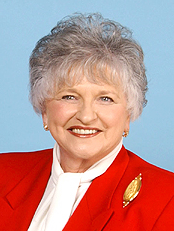
Image result for jimmie lou fisherJimmie Lou Fisher served as a Constitutional officer in Arkansas longer than any other woman in the state’s history (twenty-four years).  Her twenty-two years as Treasurer is also the longest any person has served in that post. (And unless the term limits rules for Constitutional officers are changed, it is a record that is likely to stand.)

Born in Delight, she grew up in Paragould and graduated from high school in Vilonia. (Her father was a coach and school administrator who moved the family around as he took new jobs.)  She attended what is now Arkansas State University.

Interested in politics from an early age, in 1970, she was elected Greene County Treasurer. She held that position until 1979 when she was appointed by Governor Bill Clinton to be the Auditor of Arkansas. (He had appointed longtime Auditor Jimmie “Red” Jones to be Adjutant General of the Arkansas National Guard.)

Gov. Clinton had hardly picked her from obscurity.  She had been active in his successful race for governor in 1978. Previously she was vice chair of the Democratic State Committee and a member of the Democratic National Committee from 1976 to 1978 and a member of the Credentials Committee of the National Convention in 1976.

Since Fisher had been appointed, she could not run to succeed herself.  When longtime Treasurer Nancy Hall announced she would not seek re-election, Fisher jumped into that race. She easily won the race and was re-elected each time until term limits took effect in 2002.

After announcing her retirement from politics (where she had been respected by both Democrats and Republicans for her handling of state finances), Fisher was pressed into service to be the Democratic Party standard bearer in the race for governor against incumbent Mike Huckabee.

Though not the first woman to seek a major party’s nomination for governor, she was the first to be a major party nominee.  She ran a close election, but was defeated by Huckabee.

In 2013, she moved back to Greene County to be closer to some family members there.

MACARTHUR MUSEUM TO EXPAND HOURS OPEN TO PUBLIC

Effective April 1, the MacArthur Museum of Arkansas Military History will expand its hours of operation and remain open until 5 p.m. daily.  The museum was closed for renovations during much of 2018, and reopened to the public last fall.

“The increase in our hours comes exactly one year after the museum closed to undergo a $1.55 million renovation,” says Museum Director Stephan McAteer.  “We are delighted to be open more, allowing local, state, national and international visitors additional opportunities to visit the historic Arsenal Building and exhibits relating our state’s rich military heritage.”

A deciding factor in the decision to expand hours was the hiring of additional staffing.  Reveille Isgrig was hired to assist current staff with school tours, the museum’s reading program, and publicity.  Ms. Isgrig has a B.A. in English Literature from the University of Arkansas at Little Rock and a M.A. in Modern Art History, Theory, and Criticism from Azusa Pacific University. For 10 years she worked at the UALR Survey Research Center and has extensive experience in maintaining data archives.  As a volunteer with the Mac Park Group, she coordinated “MacArthur 125,” commemorating the anniversary of MacArthur Park’s creation, in conjunction with the museum’s reopening.

New hours for the museum, beginning April 1, will be Monday – Friday, 9 a.m. to 5 p.m., Saturday, 10 a.m. to 5 p.m. and Sunday, 1 p.m. to 5 p.m. The MacArthur Museum of Arkansas Military History is located at 503 E. 9th St. in downtown Little Rock’s MacArthur Park. The museum is operated under the City’s Parks and Recreation Department.

Women Making History – Adolphine Fletcher Terry

Photos from the collection of the Butler Center

Adolphine Fletcher Terry was born on November 3, 1882 to former Little Rock Mayor John Gould Fletcher and his wife Adolphine Krause Fletcher.

Raised in Little Rock, in 1889 she moved into the Albert Pike House on East 7th Street, when her aunt transferred the title to her father. That house would be her primary residence the rest of her life.  Her sister Mary Fletcher Drennan never lived in Arkansas as an adult after marriage. Her brother John Gould Fletcher spent much of his adulthood in Europe before returning to Little Rock and establishing his own house, Johnswood.

At age 15, Adolphine attended Vassar. She later credited that experience as broadening her views on many issues.  After graduating at age 19, she returned to Little Rock.  Her parents both died prior to her 1910 wedding to David D. Terry, which took place at what was then known as the Pike-Fletcher House (and today is known as the Pike-Fletcher-Terry House).

She is perhaps best known today for establishing the Women’s Emergency Committee in 1958 and for her subsequent deeding of the family house to the City for use by the Arkansas Arts Center.  But her entire life was based on civic engagement.

She was instrumental in establishing the first juvenile court system in Arkansas and helped form the first school improvement association in the state. She was long an advocate for libraries, serving 40 years on the Little Rock public library board.  Through her leadership, the library opened its doors to African Americans in the early 1950s. Today a branch of the Central Arkansas Library System (the successor the Little Rock public library) is named after her.  Another branch is named after her Pulitzer Prize winning brother.

Adolphine formed the Little Rock chapter of the American Association of University Women, the Pulaski County tuberculosis association and the Community Chest.

In 1958, when the Little Rock public high schools were closed instead of allowing them to be desegregated again, she called Harry Ashmore the editor of the Gazette and exclaimed, “the men have failed us…it’s time to call out the women.”  With this, she formed the Women’s Emergency Committee to Open Our Schools. This group played a major role in getting the four high schools open the following year.

From 1933 to 1942, David Terry served in the U.S. Congress. During that time, Adolphine alternated her time between Washington DC and Little Rock. But she spent much time in Little Rock raising her five children.

After her husband’s death in 1963, she continued to remain active in civic affairs. In the 1960’s, she and her sister deeded the Pike-Fletcher-Terry House to the City of Little Rock for use by the Arkansas Arts Center upon both their deaths.  Following Adolphine Fletcher Terry’s death in 1976, Mary turned over the title to the City.

Adolphine Fletcher Terry is buried in Mount Holly Cemetery alongside her husband. Three of her children are also buried in that plot.  Her parents and brother are buried in a nearby plot.

Her granddaughters and their families carry on Adolphine Fletcher Terry’s commitment to making Little Rock better.

Women Making History – Hattie Caraway

CARAWAY, Hattie WyattHattie Wyatt Caraway served for 14 years in the U.S. Senate. She was the first woman to be elected to a seat in the United States Senate.

Born in Tennessee in 1878, she entered Dickson Normal College at age 14. For several years, she and her fiancé Thaddeus Caraway taught school.  The couple married in 1902.

A fiery orator, Thaddeus, became politically active in Arkansas. He served as a prosecuting attorney before serving four terms in Congress. In 1920, he ran for, and was elected to the US Senate. In 1931, Thaddeus Caraway died. Arkansas Governor Harvey Parnell appointed Hattie Caraway to fill out the remainder of her husband’s term.

She had been a trusted adviser to her husband and worked hart behind the scenes in his campaigns. While she later downplayed her political involvement (apparently to appear as a “poor, little widow”), she had been active in her campaigns and during his service in Washington.

After the appointment, Governor Parnell also endorsed her for the special election to fill out the remainder of the term (which expired in fourteen months).  By winning that over two independent candidates, Hattie Caraway made history as the first woman to be elected to the U S Senate.

Few, if any, in the Democratic establishment expected Hattie to run in the 1932 election for a full Senate term. Most of the state’s political heavyhitters had an eye on the seat.  To their surprise, on the last day to file for the Democratic primary, she threw her hat in the ring against six men.  Without the backing of the Arkansas Democratic political structure, she called upon her friend from neighboring Louisiana, Senator Huey P. Long.  Not only was he glad to help an ally, his chief rival in the Senate was Arkansas’ other senator, Joe T. Robinson.  Long positioned her as a champion for the downtrodden. This seemed to work, she received 44.7percent of the vote and carried 61 of 75 counties.

Caraway set a number of firsts for women in the Senate. In 1933, she was named chair of the Enrolled Bills Committee; the first woman ever to chair a Senate committee, she remained there until she left Congress in 1945. Caraway became the first woman to preside over the Senate, the first senior woman Senator (when Joe Robinson died in 1937), and the first woman to run a Senate hearing.

Most observers, including some of her supporters, believed Caraway would retire in 1939. But she upset expectations again by declaring her candidacy for the 1938 election. In the Democratic primary, Caraway faced two–term Representative John L. McClellan, a 42–year–old lawyer who declared, “Arkansas Needs Another Man in the Senate.” Senator Caraway ran on her record of supporting New Deal legislation to alleviate the economic hardships for the state’s largely agrarian economy.  She eked out a victory of 8,000 votes out of the 260,000 cast.

In her quest for a third term, Caraway finished fourth of the four candidates.  J. William Fulbright won the seat.  President Roosevelt and President Truman appointed her to positions in their governments. She continued her public service in those capacities until her death in 1950.

Frida Unbound program at Arkansas Arts Center tonight

Nickolas Muray, American (Szeged, Hungary, 1892 – 1965, New York, New York), Frida Kahlo on White Bench, New York (2nd Edition), 1939, color carbon print, 19 x 14 ½ inches. Courtesy of Throckmorton Fine Art, New York, New York.

DePaul Art Museum Director Julie Rodrigues Widholm will examine Kahlo’s continued relevance to international artists who address the performance of gender, issues of national identity, the political body, among other themes. Frida Kahlo is one of the most famous artists in the world.

The program begins at 6pm tonight (March 14) in the Lecture Hall at the Arkansas Arts Center.

Her reputation and persona have grown immensely since her death in 1954, yet posthumously she has been turned into a stereotype of Latin American art. This predicament, along with her celebrity status, often overshadows the confrontational and boldly transgressive nature of her paintings, and ultimately undermines the revolutionary intent of her work.

At the time it was made, Kahlo’s unabashedly intimate portrayal of her physical and psychological experiences and her appropriation of Mexican folk art aesthetics challenged the bourgeois European mainstream. Her work subverted accepted notions of gender, sexuality, social class, and ethnicity, and was prophetic in anticipating the broader cultural concerns—postcolonialism, feminism, civil rights, multiculturalism, and globalization—that reached a crescendo in the 1960s and continue to be relevant today.

Following the lecture, guests are invited to view the galleries, shop in the Museum Shop or enjoy dinner at Watercolor in the Park.

Seating is limited. Tickets are required. Call 501-372-4000 for tickets.