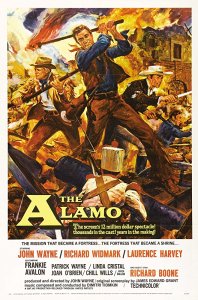
Rock the Oscars 2019: THE ALAMO

One of the early settlers in Little Rock was a man from Tennessee named Davy Crockett.  He did not stay in Little Rock very long. He and several others ventured to the Republic of Texas.  His final days are depicted (with more liberties than the original Texans had under Mexican control), in the film The Alamo.

(While Stephen F. Austin does not appear in the movie, he was actually one of Little Rock’s founding fathers before becoming a founder of Texas.)

The very fictionalized, grandiose, and jingoistic movie starred John Wayne as Crockett, Richard Widmark as Col Jim Bowie (another Arkansas traveler who left his impact on the state), Laurence Harvey as Col. William Travis, along with Frankie Avalon, Patrick Wayne, Chill Wills, Ken Curtis, and Denver Pyle.

Though one of the top grossing films of the year, it was still a financial flop due to its excessive cost.  However, when Oscar time came around, the film received seven nominations. They were Best Picture, Supporting Actor (Wills), Cinematography-Color, Film Editing, Sound, Song, and Scoring of a Dramatic or Comedy Picture.

Wills took out an ad claiming that his fellow Alamo actors were praying for him to win even harder than the original Alamo soldier had prayed for victory.  There was much backlash.  It was felt that this may have affected award chances in all categories.  It only won the Award for Best Sound – which went to Gordon Sawyer and Fred Hynes.

The remake/new version of The Alamo received no Oscar nominations.

Little Rock Look Back: John Herndon Hollis

On February 5, 1870, future Little Rock alderman and acting mayor John Herndon Hollis was born shortly before his family moved to what is now Cleveland County. His parents were originally from Georgia and came from prosperous and longtime families there.

The Hollis family came to Arkansas after the Civil War and settled in Union County. A portion of that county was carved off and became Dorsey County (named after a Republican US Senator from Arkansas) but was renamed Cleveland County after Grover Cleveland was elected President. Cleveland was the first Democrat to be elected President in over 20 years. This name change also reflected the political shift in Arkansas from the Reconstruction-led Republican politics to the Democratic Party politics which would dominate for the next century.

John Herndon Hollis was one of six children, and the only one with a middle name. Herndon had been his mother’s maiden name. As one of his brothers described their childhood in Cleveland County, “they all went to country schools in their home neighborhood, worked hard on the farm in the summertime, and were inside their little Methodist Church every time the doors were open.”

Around 1900, Hollis and his new wife Malinda M. “Linda” Taliaferro Hollis (formerly of Rison) moved to Little Rock.  Together the couple had six children. In Little Rock, Hollis worked in the banking industry. For years he worked for People’s Building and Loan Association.

Hollis was first elected to the Little Rock City Council in April 1904. He would serve as one of the Aldermen from the city’s Fourth Ward until April 1918.  This was on the western border of Little Rock at the time. The family lived at 1510 S. Schiller, which is one block east of Central High, though at the time neither the school nor its predecessor (West End Park) existed.  From 1907 until 1913 he also served on the Little Rock School Board.

In April 1908, at the first City Council meeting in the new City Hall, Mayor W. E. Lenon announced his resignation. Because the resignation was effective immediately, there was a vacancy in the office of mayor.  Hollis was selected by his colleagues to serve as acting mayor until a successor could be elected. So from April 1908 through June 1908, Hollis was the City’s chief political and executive leader.

Though he was never formally mayor (and did not resign his position as alderman), since 1908, Hollis’ name has appeared on the list of mayors of Little Rock. The reason seems to be as a sign of respect since there was a vacancy.

There previously had been acting mayors when the mayor would be absent on business or due to illness. But in those instances, the mayor had not resigned. This is the only instance in Little Rock history when a mayor resigned immediately with no successor in place. So John Herndon Hollis holds a unique role in Little Rock history.

After leaving the City Council, Hollis remained active in civic affairs.  He co-chaired a successful campaign in 1929, to raise a tax for a variety of civic issues.

Hollis’ wife died in 1920.  He later married Ann Jewell of Little Rock (who was a cousin of his first wife). They were married until his death on October 23, 1941.  Ann Hollis lived in Little Rock until her death in 1980.  The Hollis family is entombed in the mausoleum at Mount Holly Cemetery.

Both of John Herndon Hollis’ wives are distant cousins of the Culture Vulture, so he is particularly fond of John Herndon Hollis.

Super Bowl Sunday look at the Copper Bowl

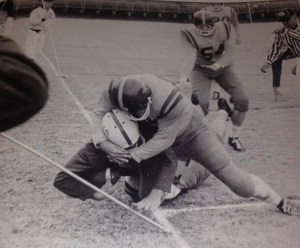
Today is Super Bowl Sunday, so it seems to be a good time to remember the five year series of football games in Little Rock known as the Copper Bowl.

A Little Rock police officer tackles a NLR player in one of the Copper Bowls.

A Little Rock police officer tackles a NLR player in one of the Copper Bowls.

From December 1959 through December 1963, the Little Rock Police Department played the North Little Rock Police Department in a series of football games.  The Copper Bowl games were fundraisers to help the LRPD provide food and presents for needy families during the Christmas season.

The agreement was that the teams would play for five years. The team with the most wins would permanently receive the Copper Bowl trophy.  The LRPD was outfitted with uniforms from Little Rock University and Louisiana State University (thanks to the efforts of Sgt. Harold Zook).  The games were played at Quigley Stadium.

Before the final game on December 1, 1963, the series was tied at 2-2.  The LRPD team won the game and permanently captured the trophy.  Over the five year period several thousand dollars were raised.

Little Rock Look Back: Mayor George Wimberly

On February 3, 1920, future Little Rock Mayor George Wimberly was born in Star City. He served his country first in the Civilian Conservation Corps and later aboard a U.S. Naval Department hospital ship in the Pacific during World War II.

Wimberly was first elected to the Little Rock City Board in November 1968.  He was re-elected in November 1972 and served until December 1976.  In January 1971, he was selected to serve as Little Rock Mayor through December 1972.

In a rare move, he was again selected to serve as Mayor from January 1975 through December 1976.  During the era of the City Board selecting one of their own members to serve as Mayor, George Wimberly was the only one selected to two non-sequential terms.

In 1978, he was elected to the State House of Representatives and served until December 1988.  While in the House he led the effort for smoking to be banned in the House chambers (a move that predated many public smoking bans of the 1990s and onward).

For over fifty years he was an employee and later owner of Buice Drugstore located on Markham in the Stifft Station neighborhood. In 1986 he received the Arkansas Pharmacist of the Year Award and the Lifetime Achievement Award in 2009.

Mayor Wimberly died on February 5, 2012, two days after his 92nd birthday.

Little Rock Look Back: Opening of Little Rock Public Library

On February 2, 1910, the Little Rock Public Library officially opened its doors.  There had been an open house the night before, but this was the first day of acquiring a library card and checking out books.

Various private libraries had existed sporadically in Little Rock throughout the 19th Century.  In November 1900, a Little Rock School District committee made the first inquiry into the the creation of a Carnegie Library in Little Rock.  Over the next several years, numerous entreaties were made, but funding for the City’s portion was an obstacle.  On December 17, 1906, the Little Rock City Council passed an ordinance to move forward with building, furnishing and equipping a library.  Finally, in February 1908, the City approved acceptance of $88,100 from Andrew Carnegie.  The building would be designed by Edward Tilton, who designed Carnegie libraries, working with local architect Charles Thompson.

Mary Maud Pugsley was hired as the first librarian for Little Rock in May 1909. She began her duties on September 15, 1909, in order to get ready for the opening of the library at the southwest corner of 7th and Louisiana Streets.

On February 2, 1910, formal circulation of books began.  J. N. Heiskell was issued library card number 1.  He was secretary of the Library’s Board of Trustees and had long been an advocate for a public library in Little Rock.  He had often used his bully pulpit as editor of the Arkansas Gazette to advocate for a public library since arriving in Little Rock in 1902.  (Years later — he lived until 1972 — he received a replica of the library card made out of gold.)

That first day of operation, 500 people had applied for library cards. The application process required one to be a Little Rock property owner or to have a property owner sign the application.

Within the first year of operation, 2.5% of Little Rock’s population of 45,951 had applied for a library card.

For more on the history of the transformation of the Little Rock Public Library into the Central Arkansas Library System, read Shirley Schuette and Nathania Sawyer’s From Carnegie to Cyberspace — 100 Years at the Central Arkansas Library System, published by Butler Center Books.

Macaws predict arrival of Spring today at Little Rock Zoo

Don’t watch a groundhog look for his shadow, experience the first EVER public flight of the Little Rock Zoo’s macaws!

The newest addition to the our Zoo Program, Zoo staff have been training them for public flight.

These beautiful birds will let Little Rock know if it will experience more winter by flying to our Ice Queen or if citizens should get ready for warmer weather by flying to our Princess of Fire.

Saturday February 2, 2019, at 11am at the Little Rock Zoo in Café Africa.

Regular admission to the Zoo applies.

African Americans and Sports in Arkansas focus of Black History Commission of Arkansas program today (2/2)

Image may contain: one or more people and textThe Black History Commission of Arkansas presents “African Americans and Sports in Arkansas.”  The program runs from 9:45 am to 3 pm today at the Mosaic Templars Cultural Center.

Speakers: Evin Demirel, Jimmy Cunningham Jr., Dr. Wilbert Gaines, and Kenneth (Muskie) Harris. Lunch will be provided. Teachers can earn up to four professional development hours. Registration is required.

10 a.m.
Evin Demirel, author of “African-American Athletes in Arkansas: Muhammad Ali’s Tour, Black Razorbacks and Other Forgotten Stories”
• The legacy of African American sports in Jim Crow era with an emphasis on the now-defunct, all-black high school’s athletic association and stories from his book.

11 a.m.
Jimmy Cunningham, Jr., author of “African Americans of Pine Bluff and Jefferson County”
• Highlights and stories about three African American athletes from Jefferson County, including Boid “One Arm” Buie, Willie Roaf and Ivie Moore.

12:45 p.m.
Dr. Wilbert Gaines, former Arkansas State University professor
• Personal experiences and surmounting challenges and obstacles as a pioneer and trailblazer in sports, sports-related activities and academia.

1:45 p.m.
Kenneth “Muskie” Harris, community activist and former Razorback
• The history of the Razorbacks and integration of athletes, including facts about all 17 sports at the University of Arkansas and some of the first African Americans to receive sports scholarships.

For those unable to attend, footage from the programs will be on the Arkansas State Archives Facebook page in the coming days.

The Black History commission of Arkansas is an advisory board of the Arkansas State Archives, a division of the Department of Arkansas Heritage.