Black History Month Spotlight – Arkansas Studies Institute

ASI CALS UALRThe new Arkansas Civil Rights History Audio Tour was launched in November 2015. Produced by the City of Little Rock and the University of Arkansas at Little Rock allows the many places and stories of the City’s Civil Rights history to come to life an interactive tour.  This month, during Black History Month, the Culture Vulture looks at some of the stops on this tour which focus on African American history.

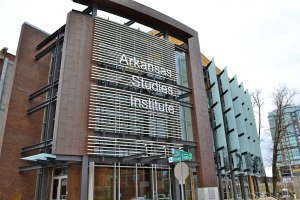
The Arkansas Studies Institute building is a Central Arkansas Library System (CALS) facility. It houses both the Butler Center for Arkansas Studies (a CALS department) and the Center for Arkansas History and Culture, a department of the University of Arkansas at Little Rock (UALR).

Exterior and interior panels are featured showing Arkansas African American life through historic photographs. Both archives offer genealogy and photography collections, and visual, audio and reference materials relating to African American history and civil rights topics in Arkansas. The Encyclopedia of Arkansas History and Culture, a Butler Center project, has many entries on African American history.

The Arkansas Sounds music collection contains materials relating to black musicians William Grant Still, Florence Price, Louis Jordan, Sister Rosetta Tharpe, and Al Bell. The Butler Center’s galleries feature local art, jewelry and crafts, many by Arkansas black artists.

The UALR Center for Arkansas History and Culture contains extensive archives, including virtual exhibits relating to the Civil War, Gov. Winthrop Rockefeller, and the city of Little Rock. Adding another dimension to the struggle for civil rights are documents and art from the World War II Japanese American Relocation Camps at Rohwer and Jerome, Arkansas, and two large Jewish history collections.

The app, funded by a generous grant from the Arkansas Humanities Council, was a collaboration among UALR’s Institute on Race and Ethnicity, the City of Little Rock, the Mayor’s Tourism Commission, and KUAR, UALR’s public radio station, with assistance from the Little Rock Convention and Visitors Bureau.
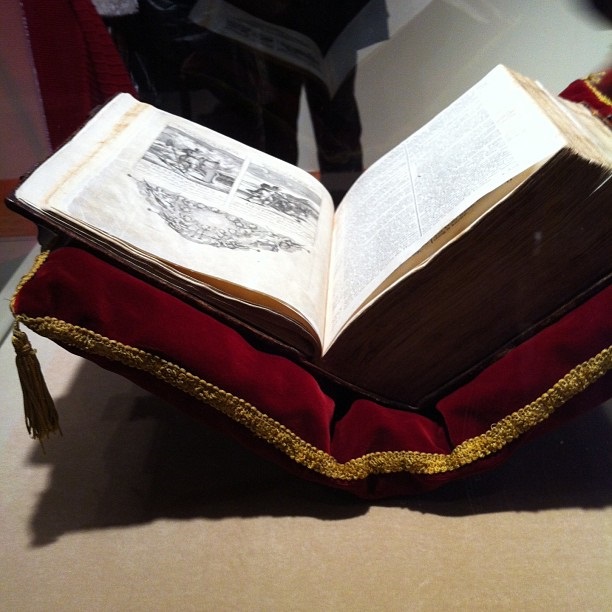
Little Rock Look Back: George Washington

The Washington Inaugural Bible

Washington1George Washington was born on February 22, 1732, in Westmoreland, Virginia. He is one of only two American Presidents to not have any authority over the land now known as Little Rock. Washington never ventured west of the Mississippi River, so never visited Arkansas.

As the first President and Father of his Country, he has many things named after him. In Little Rock, Washington Street is named in his honor.

In 2013, two Little Rock museums highlighted George Washington artifacts. Historic Arkansas Museum displayed the Washington family Bible for several months. At the start of that time, they also showcased the Bible on which Washington swore his first oath as President (the inaugural inaugural?).

A few months later, the Clinton Presidential Center featured Washington’s personal annotated copy of the 1789 “Acts Passed at a Congress of the United States of America.” This artifact had been purchased by the Mount Vernon Ladies Association in 2012.

Black History Month Spotlight – Old State House Museum

OSH logoThe new Arkansas Civil Rights History Audio Tour was launched in November 2015. Produced by the City of Little Rock and the University of Arkansas at Little Rock allows the many places and stories of the City’s Civil Rights history to come to life an interactive tour.  This month, during Black History Month, the Culture Vulture looks at some of the stops on this tour which focus on African American history.

The 1836 Old State House, the oldest standing state capitol building west of the Mississippi River, was a center of political activity for many years. During the Civil War, Union and Confederate forces alternately occupied it. During Reconstruction, with many black men registering to vote, eight African Americans were delegates to the 1868 Constitutional Convention, held in this building.

The new constitution recognized the equality of all persons before the law, provided suffrage for freedmen, and required a system of free public education for blacks and whites (in separate schools.) By 1874, twenty black men were serving in the Arkansas General Assembly. In 1891, African American Senator George W. Bell and Representative John Grey Lucas gave inspiring speeches against the Separate Coach Law.

Now a museum, the Old State House exhibits include ones relating to African American history. “On the Stump: Arkansas Political History“ explains civil rights issues from statehood (1836) into the twentieth century. Its collections, which are searchable on-line, include quilts by black Arkansans, photographs by African American photographer Geleve Grice, and music by Louis Jordan. Portions of the Arkansas Slave Narratives, collected by the Works Progress Administration in the 1940s, are available on the web-site.

The app, funded by a generous grant from the Arkansas Humanities Council, was a collaboration among UALR’s Institute on Race and Ethnicity, the City of Little Rock, the Mayor’s Tourism Commission, and KUAR, UALR’s public radio station, with assistance from the Little Rock Convention and Visitors Bureau.
Black History Month Spotlight – Historic Arkansas Museum

hamlogoThe new Arkansas Civil Rights History Audio Tour was launched in November 2015. Produced by the City of Little Rock and the University of Arkansas at Little Rock allows the many places and stories of the City’s Civil Rights history to come to life an interactive tour.  This month, during Black History Month, the Culture Vulture looks at some of the stops on this tour which focus on African American history.

The Historic Arkansas Museum interprets early Arkansas history through Little Rock’s oldest buildings, a medicinal herb garden, and modern exhibits. “Giving Voice” is a permanent memorial to the 138 men, women and children enslaved by Nineteenth Century landowners where the museum now stands. An African American character representing the mid-1800s is regularly included in the living history presentations.

Changing exhibits in the museum’s seven galleries often include ones related to African American history and local artists with African American heritage. On-line exhibits and educational materials relate to this history. “We Walk in Two Worlds,” a permanent exhibit, tells the story of the Caddo, Osage, and Quapaw tribes who first lived in Arkansas. The Native American voice shapes the exhibit, which includes pottery, clothing, and weapons.

The app, funded by a generous grant from the Arkansas Humanities Council, was a collaboration among UALR’s Institute on Race and Ethnicity, the City of Little Rock, the Mayor’s Tourism Commission, and KUAR, UALR’s public radio station, with assistance from the Little Rock Convention and Visitors Bureau.

Little Rock Look Back: The first Elvis concert at Robinson Auditorium

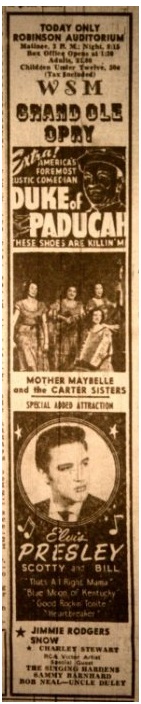
eap feb 55 adSixty-one years ago today, on February 20, 1955, Elvis Presley made his first appearance on stage in Little Rock. He performed at Joseph Taylor Robinson Memorial Auditorium.

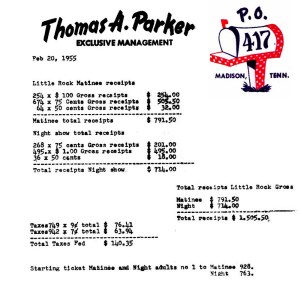
eap receits 05-little.rock_.feb_.55He was billed as “an added attraction” to a Grand Ole Opry Show headlined by the Duke of Paducah.  Others on the bill included Mother Maybelle and the Carter Sisters, Jimmie Rodgers Snow, Charlie Stewart, the Singing Hardens, Sammy Barnhart, Bob Neal, Uncle Dudley and Smilin’ Mac Cyclone. (It is interesting to note that at least some of the advance tickets billed it as The Elvis Presley Show, though the newspaper ads billed the Duke of Paducah as the headliner.)

This concert was part of a weeklong tour of Arkansas and Louisiana.  There were two shows that day – one at 3p.m. and the other at 8:15p.m.  Tickets on the day of the concert were $1.00 for adults and fifty cents for children.  Advanced tickets had sold for 75 cents at Walgreens.

The night before, Elvis played the Louisiana Hayride in Shreveport.  Following his Little Rock appearance (for which he and his band were paid $350 instead of their usual $200), they played in Camden, Hope, and Pine Bluff.

eap 02-little.rock_It is believed that Elvis’ parents attended this concert in Little Rock. Gladys Presley was a big fan of the Duke of Paducah. Elvis apparently also wanted his parents to meet with Colonel Tom Parker, who would become inexorably linked with Elvis’ career.

Black History Month Spotlight – Central High School Neighborhood

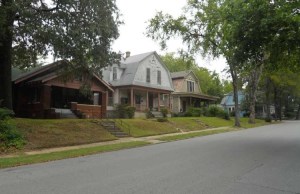
CHS neighborhoodThe new Arkansas Civil Rights History Audio Tour was launched in November 2015. Produced by the City of Little Rock and the University of Arkansas at Little Rock allows the many places and stories of the City’s Civil Rights history to come to life an interactive tour.  This month, during Black History Month, the Culture Vulture looks at some of the stops on this tour which focus on African American history.

The Central High School Neighborhood Historic District developed in the late 1880s, after a streetcar company built West End Park there in 1885. The area was a middle-class, interracial, mixed-use neighborhood with large homes and cottages and several schools and churches. Union and Capitol Hill schools educated the African American residents. St. Bartholomew’s Catholic Church and school served an African American congregation. African American and white residents worked as clergymen, barbers, chauffeurs, mail carriers, clerks, and with the railroad and service industries. The neighborhood was also home to white and black lawyers, doctors, teachers and businessmen.

By 1894, West End Park included a baseball field, becoming home to the city’s first minor league baseball team, the Little Rock Travelers. Negro League teams, including the Little Rock Reds, Cadets, and Greys, also played there. In the late 1920s, the park site was chosen for the new Little Rock High School for white students. Quigley Stadium, the school’s football field, was built in 1936 by the Works Progress Administration (WPA), replacing Kavanaugh Baseball Field. The neighborhood continues to have a vibrant mix of working class blacks and whites.

The app, funded by a generous grant from the Arkansas Humanities Council, was a collaboration among UALR’s Institute on Race and Ethnicity, the City of Little Rock, the Mayor’s Tourism Commission, and KUAR, UALR’s public radio station, with assistance from the Little Rock Convention and Visitors Bureau.
Black History Month Spotlight – Central High School National Historic Site

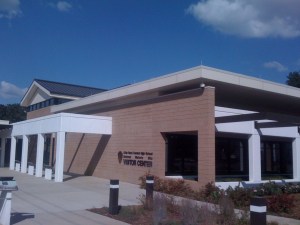
Little Rock 2011 036The new Arkansas Civil Rights History Audio Tour was launched in November 2015. Produced by the City of Little Rock and the University of Arkansas at Little Rock allows the many places and stories of the City’s Civil Rights history to come to life an interactive tour.  This month, during Black History Month, the Culture Vulture looks at some of the stops on this tour which focus on African American history.

In September 1957, Central High School was at the center of international attention when Gov. Orval E. Faubus ordered the National Guard to prevent nine black students from attending. President Dwight D. Eisenhower later federalized the National Guard and sent in federal troops to escort the students to class. The school became a crucial battleground in the struggle for civil rights. Dramatic media images of the conflict seared themselves into public memory.

The Little Rock Central High School National Historic Site and Visitor Center opened in September 2007 to mark the fiftieth anniversary of the school’s desegregation. The interactive displays include interviews with the Little Rock Nine and historic video clips. The Center presents a broad view of civil and human rights struggles in the United States and around the world. Central High School is the only functioning high school in the United States to be located within the boundary of a national historic site.

The app, funded by a generous grant from the Arkansas Humanities Council, was a collaboration among UALR’s Institute on Race and Ethnicity, the City of Little Rock, the Mayor’s Tourism Commission, and KUAR, UALR’s public radio station, with assistance from the Little Rock Convention and Visitors Bureau.