
Evenings with History return tonight with Dr. Edward Anson: The Augustan Transformation of Ancient Rome

Ed-AnsonThe UALR History Institutes’ Evenings with History returns for a new year tonight.  This nationally recognized series has featured a variety of subjects.  The sessions take place at the Ottenheimer Auditorium of Historic Arkansas Museum. Refreshments are served at 7 with the program beginning at 7:30 pm. The cost is $50 for admission to all six programs.

Tonight’s program features Dr. Edward Anson speaking on “The Augustan Transformation of Ancient Rome.”

Augustus, grandnewphew, adopted son, and heir of Gaius Julius Caesar, founded the Roman Empire and was its first Emperor.  In this talk Dr. Anson shows how Augustus gained control of the state while at the same time appearing to maintain Republican traditions and serve the needs of the people.  His creation of institutions brought him power but at the same time also solved problems that had long festered during the Republic.  While his adoptive father brought about the end of the Republic, it was the adoptive son who created the governmental structure known as the Empire.

Edward M. Anson has authored or edited eight books, fifteen book chapters, and over fifty encyclopedia articles.  He is the editor of the Alexander the Great and the Hellenistic World series for Lexington Books (Rowman and Littlefield), associate editor of the Ancient History Bulletin, and an Assessor for Classics for the Australian Research Council, an agency of the Australian national government that awards grants to researchers.  He received his PhD from the University of Virginia and is currently Professor of History, a faculty senator, and a former President of the University Assembly/Senate.

Friday, Eldredge, & Clark and the Union Pacific Railroad help make these lectures possible. Other sponsors are the Ottenheimer Library, University of Arkansas at Little Rock; Historic Arkansas Museum, a museum of the Department of Arkansas Heritage; UALR Public Radio—KUAR-KLRE; UALR public television; and Grapevine Spirits.
 

Little Rock Look Back: Pre-Opening Dance at Robinson Auditorium

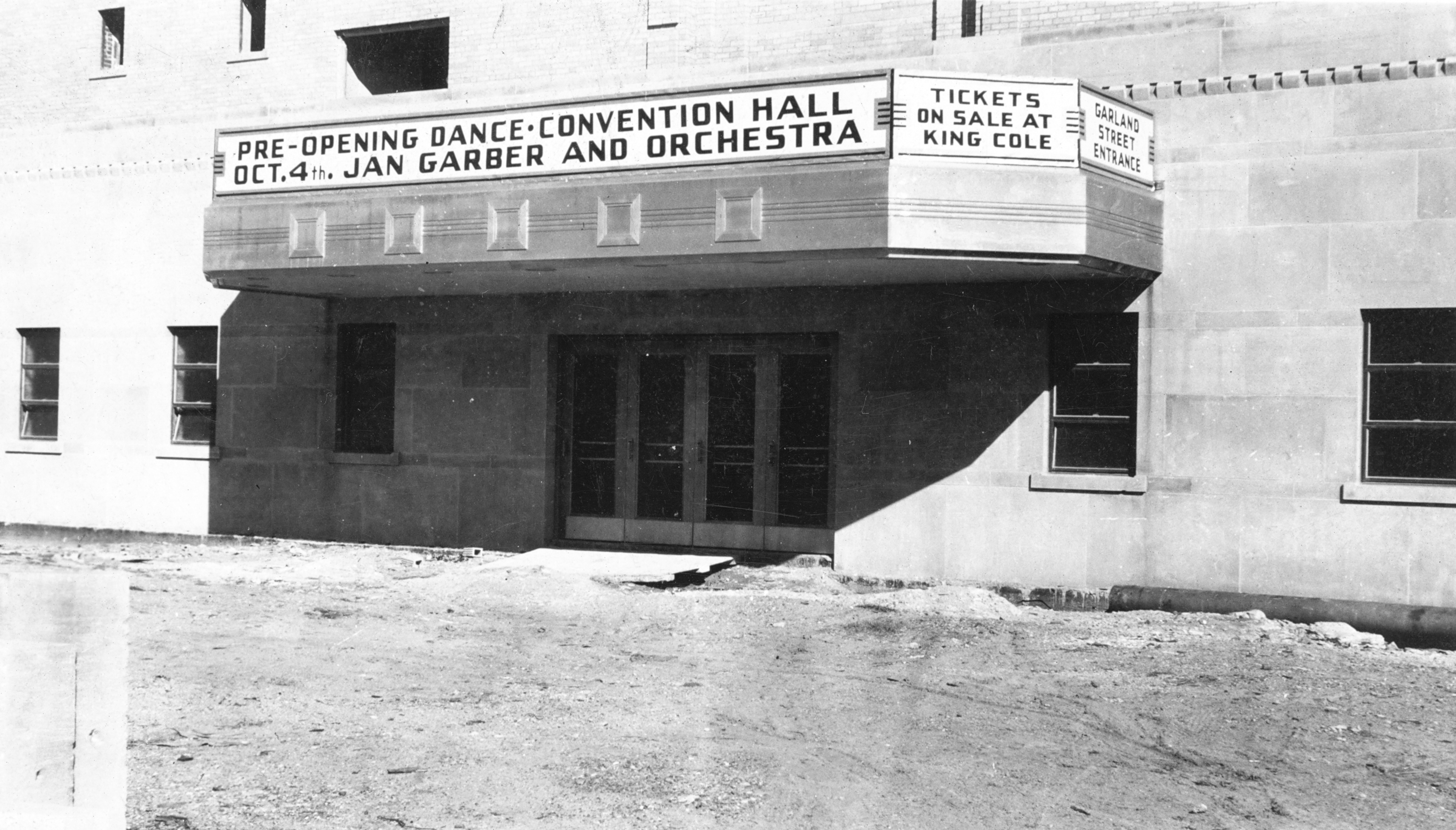
RC-pre-opening-signIn October 1939, it looked as if Robinson Auditorium would never open.  The construction had run out of money.  But in an effort to generate a little revenue and give the public the chance to see the building, a few events were booked in the lower level.

At the time, the entrance to the lower level was off of Garland Street which ran to the north of the structure.

While Mayor J. V. Satterfield and other leaders were in Washington seeking additional funding, the Joseph Taylor Robinson Memorial Auditorium hosted its first event.  On October 4, 1939, the convention hall on the lower level was the site of a preview dance.  The pecan block flooring had been installed just the week before.

RC-dance-orchestraThe first four people to enter the building as paying guests were Mr. and Mrs. Alfred Wilheim, Frances Frazier and Bill Christian.  Reports estimated 3,200 people attended and danced to the music of Jan Garber and His Orchestra.  By happenstance, Garber and his musicians had also played in Little Rock on January 26, 1937, the date of the election which approved the auditorium bonds.  Since Little Rock then did not have a suitable space, that appearance had been on the stage of the high school auditorium.
The event was a success.  But as the building had no heating or cooling mechanism at the time, there were limits as to how long even the lower level could be in use.  After a few weeks, the PWA, which was still in charge of the construction site, halted all future bookings.

Little Rock Look Back: JFK in the ARK

JFK LROn October 3, 1963, President John F. Kennedy delivered remarks at the Arkansas State Fairgrounds.  Only a few weeks later, he would be felled by an assassins bullet in Texas.  In the speech, the President praised Arkansas’ congressional delegation including Senators John McClellan and J. William Fulbright and Congressmen Took Gathings, Bill Trimble, Wilbur Mills and Oren Harris.  Each of these men held senior leadership positions in key committees.

The main focus of the speech was to discuss President Kennedy’s vision for a new economy in the South.  He tied that to improvements in the state’s universities and colleges as well as public works projects.

The President was actually in the state to speak at the dedication of the Greers Ferry Dam. He agreed to make that appearance as a part of a negotiation with Congressman Mills as they were deadlocked over changes to the tax code.  He had previously visited Little Rock in 1957 when he came to the state to address the Arkansas Bar Association meeting in Hot Springs.

He arrived at the Little Rock Air Force Base, then only a few years old, and proceeded to Heber Springs via helicopter. Students and civic leaders from nearby Batesville were present to help welcome the President and his entourage.  Following the ceremony at Greers Ferry, he and his party ventured to Little Rock.

It was an exceptionally hot October day (temperatures were in the lower 90s), but all else seemed perfect according to media reports.  The Little Rock School District dismissed classes on that day (which was a Thursday) so students could attend the President’s remarks at the Fairgrounds.

Anne Frank Tree exhibit to be dedicated today at Clinton Center

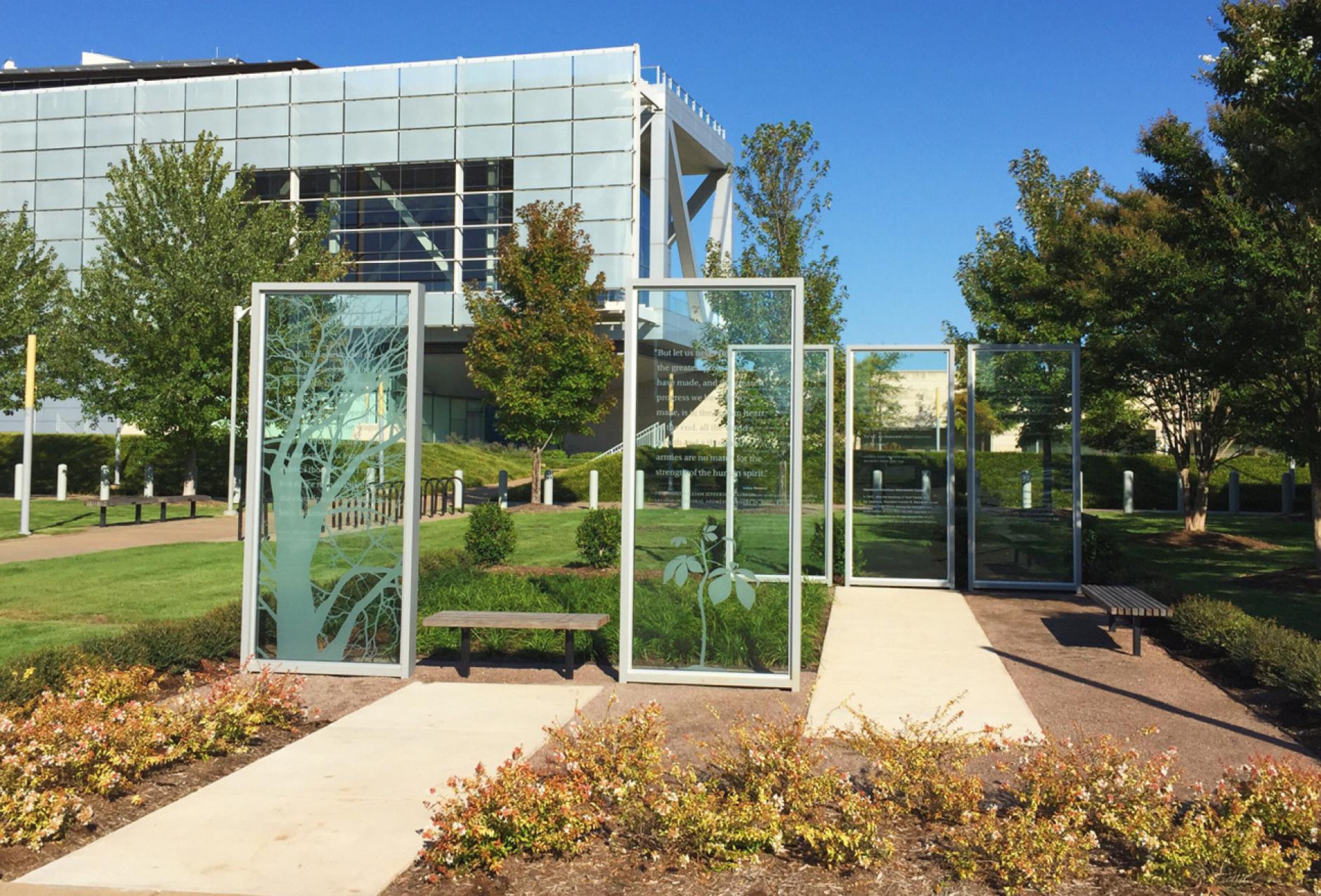
AnneFrankTreeThe Clinton Foundation and the Sisterhood of Congregation B’nai Israel, in conjunction with the Anne Frank Center USA, have joined together to create a new powerful exhibit, The Anne Frank Tree, which will be located on the grounds of the Clinton Presidential Park.  The permanent installation, which will surround the Anne Frank Tree sapling, will open today.

In 2009, the Clinton Center was one of 11 entities in the United States to be awarded a young chestnut tree by the Anne Frank Center USA’s “Sapling Project.” The sapling was taken from the white horse chestnut tree that stood outside Anne Frank’s Secret Annex when she and her family were in hiding from the Nazis during World War II. The young writer cherished and wrote about the tree frequently in her famous diary.

“As long as this exists,” Anne wrote on February 23, 1944, “how can I be sad?” During the two years she spent in the Secret Annex, the solace Anne found in her chestnut tree provided a powerful contrast to the Holocaust unfolding beyond her attic window. And as war narrowed in on Anne and her family, her tree became a vivid reminder that a better world was possible.

Anne’s tree would outlive its namesake by more than 50 years before being weakened by disease and succumbing to a windstorm in 2010. But today, thanks to dozens of saplings propagated in the months before its death, Anne’s tree lives on in cities and towns around the world. The Anne Frank tree saplings provide an opportunity for these sites to tell the story of Anne Frank and connect it to incidents of injustice witnessed in each locale. To date, seven saplings have been planted at locations as diverse as the U.S. Capitol and the Children’s Museum of Indianapolis.

The Center’s installation consists of five framed, etched glass panels – arranged to evoke the feeling of being inside a room – surrounded by complementary natural landscaping. The two front panels feature quotes from Anne Frank and President Clinton. The three additional panels will convey the complex history of human rights in Arkansas through descriptions of the Indian Removal Act of 1830, the internment of Japanese Americans during World War II, and the Little Rock Central High School desegregation crisis of 1957. These panels will feature quotes from Chief Heckaton, hereditary chief of the Quapaw during Arkansas’ Indian Removal; George Takei, Japanese-American actor who was interned at the Rohwer Relocation Center in Desha County in 1942; and Melba Patillo Beals, member of the Little Rock Nine.

In collaboration with the Clinton Foundation, Little Rock landscape architect Cinde Drilling and Ralph Appelbaum Associates, exhibit designer for both the Center and The National Holocaust Museum, assisted in the design of the exhibit. The installation has been made possible thanks to the support of the Ben J. Altheimer Charitable Foundation and other generous partners.

The Center’s sapling is currently housed in a local nursery where it is acclimating to Arkansas’s environment. And although it will be present during the ceremony, it will be returned to the nursery where it will be cared for until it has matured and can thrive in its new home, located on the grounds of the Park. A similar chestnut tree will be temporarily planted in its place until the Anne Frank tree can be permanently transplanted.

Sandwich in History today at the White-Baucum House

ahpp White-Baucum HouseThe monthly architectural history program “Sandwiching in History” visits the White-Baucum House, located at 201 South Izard Street. The program begins at noon today.  A historian with the Arkansas Historic Preservation Program delivers a brief lecture about the church before leading guests on a tour.

This Italianate-style house was built in 1869-1870 for Robert J. T. White, then-Arkansas secretary of state, and was enlarged in the mid-1870s by its second owner, businessman George F. Baucum. The White-Baucum House was recently rehabilitated using federal and state tax incentives to serve as office space.

Sandwiching in History is a program of the Arkansas Historic Preservation Program, an agency of the Department of Arkansas Heritage.  The AHPP is responsible for identifying, evaluating, registering and preserving the state’s cultural resources. Other DAH agencies are the Arkansas Arts Council, the Delta Cultural Center in Helena, the Old State House Museum, the Mosaic Templars Cultural Center, the Arkansas Natural Heritage Commission and the Historic Arkansas Museum.

Vintage Military Vehicles at MacArthur Park this afternoon

macmusMore than 60 vintage military vehicles on a cross-country convoy will be stopping in Little Rock on Wednesday, Sept. 30.

The Military Vehicle Preservation Association is retracing the route of the 1920 Transcontinental Motor Convoy, which also stopped in Little Rock during its 3,300-mile journey from Washington, D.C., to San Diego.

While the convoy is in Little Rock, vintage vehicles will be on display at the south end of MacArthur Park, along with vehicles from the Arkansas Military Vehicle Preservation Association.

The convoy is expected to arrive around noon.

Happy 50th Birthday to the National Endowment for the Arts & National Endowment for the Humanities

NEANEH50On September 29, 1965, President Lyndon Baines Johnson signed into law the National Foundation on the Arts and the Humanities Act of 1965 at a White House Rose Garden ceremony, attended by scholars, artists, educators, political leaders, and other luminaries.

The law created the National Endowment for the Humanities as an independent federal agency, the first grand public investment in American culture. It identified the need for a national cultural agency that would preserve America’s rich history and cultural heritage, and encourage and support scholarship and innovation in history, archeology, philosophy, literature, and other humanities disciplines.

On this occasion, President Johnson said: “Art is a nation’s most precious heritage. For it is in our works of art that we reveal ourselves, and to others, the inner vision which guides us as a nation. And where there is no vision, the people perish.”

This new law was the fruit of two presidents, several senators and representatives, and four previous pieces of legislation. Separate bills had been introduced, in previous years, into the House by Representative Frank Thompson (D-NJ), and into the Senate by Senators Hubert Humphrey (D-MN) and Jacob Javits (R-NY). Senator Claiborne Pell (D-RI) had overseen hearings on some of this preliminary legislation, beginning in October 1963, before the death of President John F. Kennedy.

Over the years, the NEA and NEH have awarded millions of dollars to Little Rock based institutions, organizations and individuals through direct appropriations.  They have also impacted Little Rock cultural life through funding of the Mid-America Arts Alliance, Arkansas Arts Council, Department of Arkansas Heritage, Arkansas Department of Parks & Tourism, and U.S. Conference of Mayors among others. These groups have either re-granted the dollars to Little Rock entities or undertaken projects which have directly impacted and improved life in Little Rock.