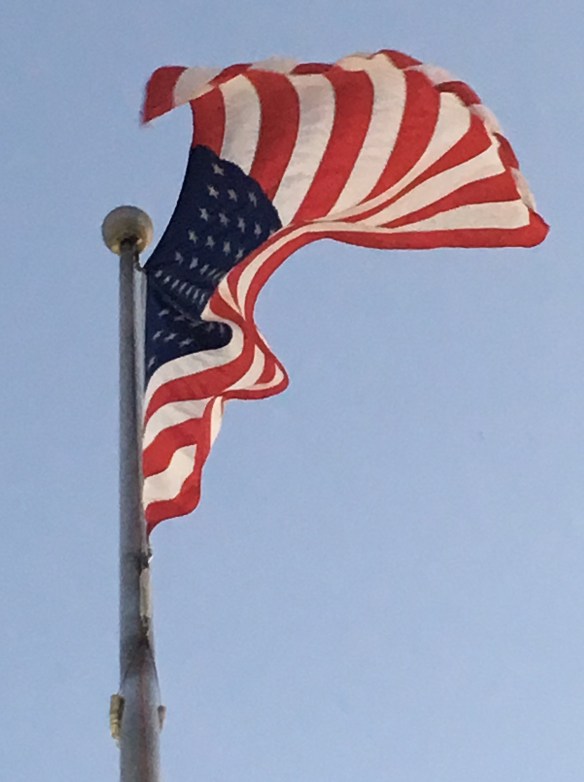
Flag Day 2019

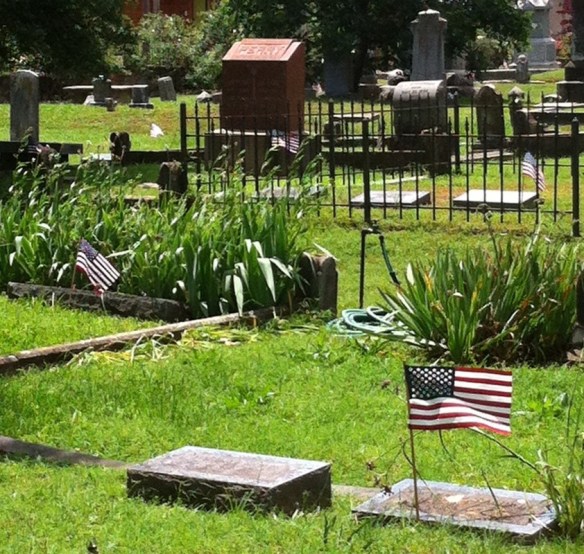
Flags mark graves at Mount Holly Cemetery

Flag at the Clinton Presidential Center

Flag at Robinson Center

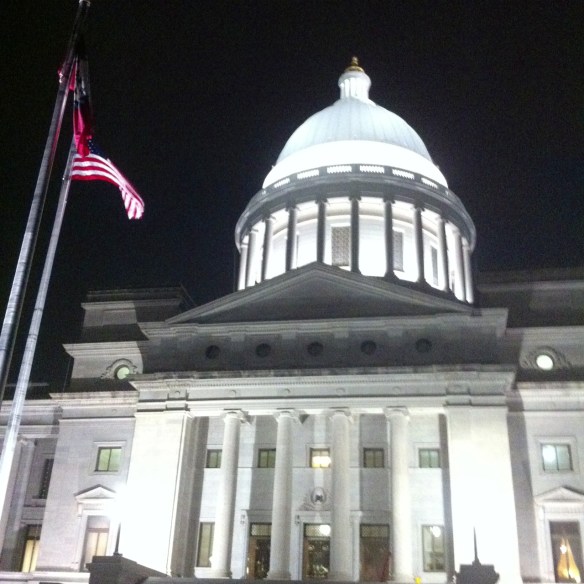
The red, white and blue stand out against the night sky and limestone of the Arkansas State Capitol.

The flag on the Capital Hotel balcony at Christmastime

Memorial Day – Remember the Fallen

Today is Memorial Day – a time to pay tribute to the men and women in uniform who died in service to their country.

As a way to give this recognition, today would be a good day to visit a cemetery. One of Little Rock’s most storied cemeteries is Mount Holly Cemetery. There are numerous persons buried there who died while in service to their country.

One of them is 2Lt Carrick W. Heiskell, son of Arkansas Gazette editor J. N. Heiskell.  2Lt Heiskell died while flying for the Air Transport Command in the Himalayas during World War II.  He was posthumously the recipient of the Distinguished Unit Emblem, Purple Heart, and the Air Medal.

Founded in 1843, Mount Holly has been called “The Westminster Abbey of Arkansas.” Thousands of visitors come each year. Those interested in history come to see the resting places of the territorial citizens of the state, including governors, senators, generals, black artisans, and even a Cherokee princess. For others the cemetery is an open air museum of artistic eras: Classical, Victorian, Art Deco, Modern––expressed in gravestone styles from simple to elaborate. Some come to read the epitaphs that range from heartbreaking to humorous to mysterious.

Though a City of Little Rock facility, the cemetery is maintained by the Mount Holly Cemetery Association, a non-profit organization with a volunteer Board of Directors. The cemetery is located at 1200 South Broadway in Little Rock. Gates are open from 8 a.m. until 5 p.m. in the summer and from 8 a.m. until 4 p.m. in the winter.

Little Rock’s Founding Mother: Eliza Wilson Bertrand Cunningham

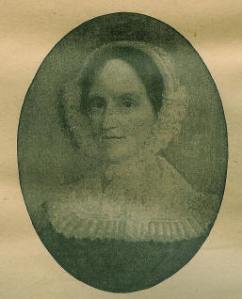
Eliza Wilson Bertrand Cunningham was the First Lady of Little Rock.  She literally was the first lady and the founding mother.

She became the first permanent female resident when she joined her husband Matthew Cunningham in Little Rock.  She gave birth to Chester Ashley Cunningham, the first baby born in Little Rock, as well as several other children with Cunningham.

When he became the first Mayor of Little Rock, she was the first First Lady of Little Rock. They hosted the first Little Rock Council meeting at their house on what is now the block downtown bounded by Third, Main, Fourth and Louisiana Streets.  Her son Charles P. Bertrand, from her first husband, later served as Mayor of Little Rock, making her the only woman to be married to a Mayor and be mother of a Mayor.

Born in Scotland in December 1788, she emigrated with her parents to the United States as a young girl.  In 1804 or 1805, she married a French businessman, Pierre Bertrand in New York City.  She lived in New York City, while he traveled to his various business ventures.  He never returned from a trip to his coffee plantation in Santo Domingo and was presumed to have died in 1808 or 1809.  She and Bertrand had three children, Charles Pierre, Arabella and Jane. (Jane may have died in childhood, because records and lore only indicated Charles and Arabella coming to Little Rock with their mother.)

Eliza married Dr. Matthew Cunningham in New York City.  He later moved to Saint Louis and settled in Little Rock in early 1820.  Eliza and her two children came to Little Rock in September 1820.  In 1822, she gave birth to Chester Ashley Cunningham, the first documented baby born in Little Rock.  (There are unsubstantiated reports that at least one slave child may have been born prior to Chester.)  She and Matthew also had Robert, Henrietta, Sarah and Matilda.  The latter married Peter Hanger, after whom the Hanger Hill neighborhood is named.

Dr. Cunningham died in June 1851.  Eliza died in September 1856. They and Chester (who died in December 1856) are buried in the Hanger family plot at Mount Holly Cemetery.

Easter Parade of Bunnies

Little Rock has at least four different sculptures of rabbits.  Since today is Easter Sunday and the Easter Bunny is making his rounds, it seems a good day to highlight these sculptures.

RB MonThe newest sculpture is Dan Ostermiller’s R. B. Monument.  A gift to the citizens of Little Rock by the Little Rock Garden Club, it was dedicated in 2017.

Located at the southeast corner of Kavanaugh and Pierce, this rabbit has quickly become a landmark. It is a favorite for kids and adults as they walk or drive by.  The rabbit is situated so that people can easily pose for photos with it, without the photographer having to stand in the street.  At Christmas and Easter, the rabbit has been bedecked with an appropriate wreath to add to its festive nature.

Bun BumIn the Vogel Schwartz Sculpture Garden, Laurel Peterson Gregory’s Bunny Bump has been providing whimsy since 2010.

After she sculpts an animal in wax or oil-based clay, traditional lost-wax casting processes immortalize the design in bronze. One aspect of particular interest to me, and one for which I plan early in the sculpting phase, is the complex and rich patinas that constitute another hallmark of my limited-edition sculptures. Multiple layers of chemicals and oxides are applied to the heated bronze to achieve a range of unique effects, both translucent and opaque, that complement each design.

Two stylized rabbits make for an interesting piece of artwork when they are not only dancing, but also doing the butt bump while dancing. The smooth surface and color of the bronze add to the illusion. This small piece has been placed on a pedestal to elevate more to eye level.
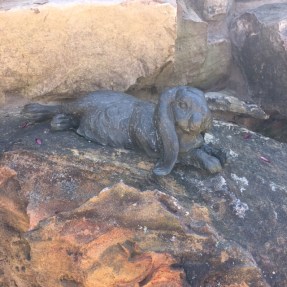
LopsA few yards from the bumping bunnies, James Paulsen’s Lopsided presents a much more laconic rabbit.

Paulsen is a self-taught artist. Alternately studying the wilds of the northern forest, and the open beauty of the American Southwest, he concentrates his work on natural subjects he has grown up with, and is heavily influenced by his family’s artistic background, being raised by an artist-illustrator and an author. In his work, he explores merging the beauty he sees in the natural world with the expressiveness of clay and bronze.

While having most of his work in galleries or private collections across the country, he has recently completed two public commissions

And at the corner of President Clinton Avenue and Sherman Street, Tim Cherry’s Rabbit Reach welcomes visitors to the River Market.

The sculpture is located at the corner of Sherman Street and President Clinton Avenue across from the Museum of Discovery.

The sculpture is a gift from Whitlow Wyatt and the Carey Cox Wyatt Charitable Foundation. It was given in memory of George Wyatt and Frank Kumpuris.  Those two gentlemen were the fathers of Whitlow Wyatt and Dean & Drew Kumpuris.

Cherry’s sculpture was selected for this spot because of its proximity to children at the Museum and in the River Market district.  The design and size of the sculpture encourages children to climb on it and to play around the rabbit.  While some public art is situated so it cannot be touched, this one is situated to be touched as part of the appreciation experience.

Tartan Day – BRIGADOON appears in Little Rock for the first time in 1951

April 6 is Tartan Day – a chance to pay tribute to the achievements of Scots in the U.S.  It is also a good chance to wear plaid.

On January 17 and 18, 1951, the Broadway musical Brigadoon materialized at Robinson Memorial Auditorium for its first visit to Little Rock.  This musical by Alan Jay Lerner and Frederick Loewe is a Scottish fantasy about a town that materializes for one day every 100 years.

First performed on Broadway in 1947, it was revived at New York City Center in 1950. It was that production that toured in 1951 to Little Rock.  The production was produced by John Yorke (who had worked on the original Broadway production) and brought to Little Rock by Metropolitan Attractions.

The cast was led by future Tony nominee Susan Johnson.  Others in the cast were Elizabeth Early, Robert Busch, Betty Logue and Thaddeus Clancy. All had appeared at City Center, though some in different roles than on the tour.  This touring production featured the original Broadway creative team from 1947 with direction by Robert Lewis, choreography by Agnes de Mille (who won a Tony for it, at the first ceremony), scenery by future Tony winner Oliver Smith, costumes by Tony winner David Ffolkes, lighting by Peggy Clark, and orchestrations by Ted Royal.

Over the years, Brigadoon has resurfaced in Little Rock in community theatre and school productions.  But this was the first time that tartans of the MacLaren, Dalrymple, Brockie and Anderson clans first appeared in Little Rock.

Tartan Day, celebrate all things Scottish, visit the Brownlee House at HAM

Photo by Larry Pennington

Today is Tartan Day, designated to celebrate the contributions of Scots everywhere.

One of Little Rock’s oldest structures, the Brownlee House was built by a Scotsman.  The Brownlee House is one of the restored structures at Historic Arkansas Museum.

Robert Brownlee built this Federal style brick house in the late 1840s for his brother and sister-in-law. A Scottish stonemason, Brownlee came to Little Rock in 1837 to help build the State House (now the Old State House Museum). He pursued a number of careers before leaving for California in the 1849 Gold Rush. From the late 1840s through 1852, the home’s residents were James and Isabelle Brownlee and Tabby, a woman enslaved by James Brownlee.

Brownlee had the wooden mantels in the parlor and bedroom marbleized, a popular decorative art of the time. The home’s furnishings reflect the mid-19th century.

This house is a project of The National Society of the Colonial Dames of America in the State of Arkansas.

Historic Arkansas Museum is open seven days a week.  The galleries are free, but the tours of the historic structures have a nominal fee.  It is an agency of the Department of Arkansas Heritage.