Little Rock Look Back: Sam Wassell, LR’s 51st Mayor

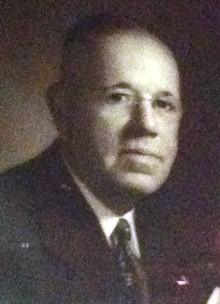
IMG_5025On this date in 1883, future Little Rock Mayor Sam M. Wassell was born.  His grandfather John W. Wassell had been appointed Mayor of Little Rock in 1868.  He is the only Little Rock Mayor to be a grandson of another Little Rock Mayor.

Sam Wassell served on the Little Rock City Council from 1928 through 1934 and again from 1940 through 1946.  He is one of the few 20th Century Little Rock Mayors who previously served on the City Council.

Wassell was an attorney.  He practiced law privately and also served as an Assistant US Attorney.  In 1930, he ran unsuccessfully for the Democratic nomination for the US Congress representing the 5th Congressional District, which at the time included Little Rock.

Wassell ran for Mayor in 1947 and was unopposed in the general election.  He was unopposed in his bid for re-election in 1949.  During his second term, President Harry S. Truman visited Little Rock.  In 1951, he sought a third term as Mayor.  No Little Rock Mayor had sought a third consecutive term since 1923.  Though he received the Democratic nomination, the Republican party nominated Pratt Remmel who defeated Wassell by a 2 to 1 margin.

With a new USS Little Rock under construction, it is interesting to note that Mrs. Sam Wassell christened the previous USS Little Rock in 1944.  At the time, she was a City Councilor’s wife.

Mayor Wassell died on December 23, 1954 and is buried at Roselawn Cemetery in Little Rock.

Little Rock Look Back: Charles E. Moyer, Little Rock’s 44th and 49th Mayor

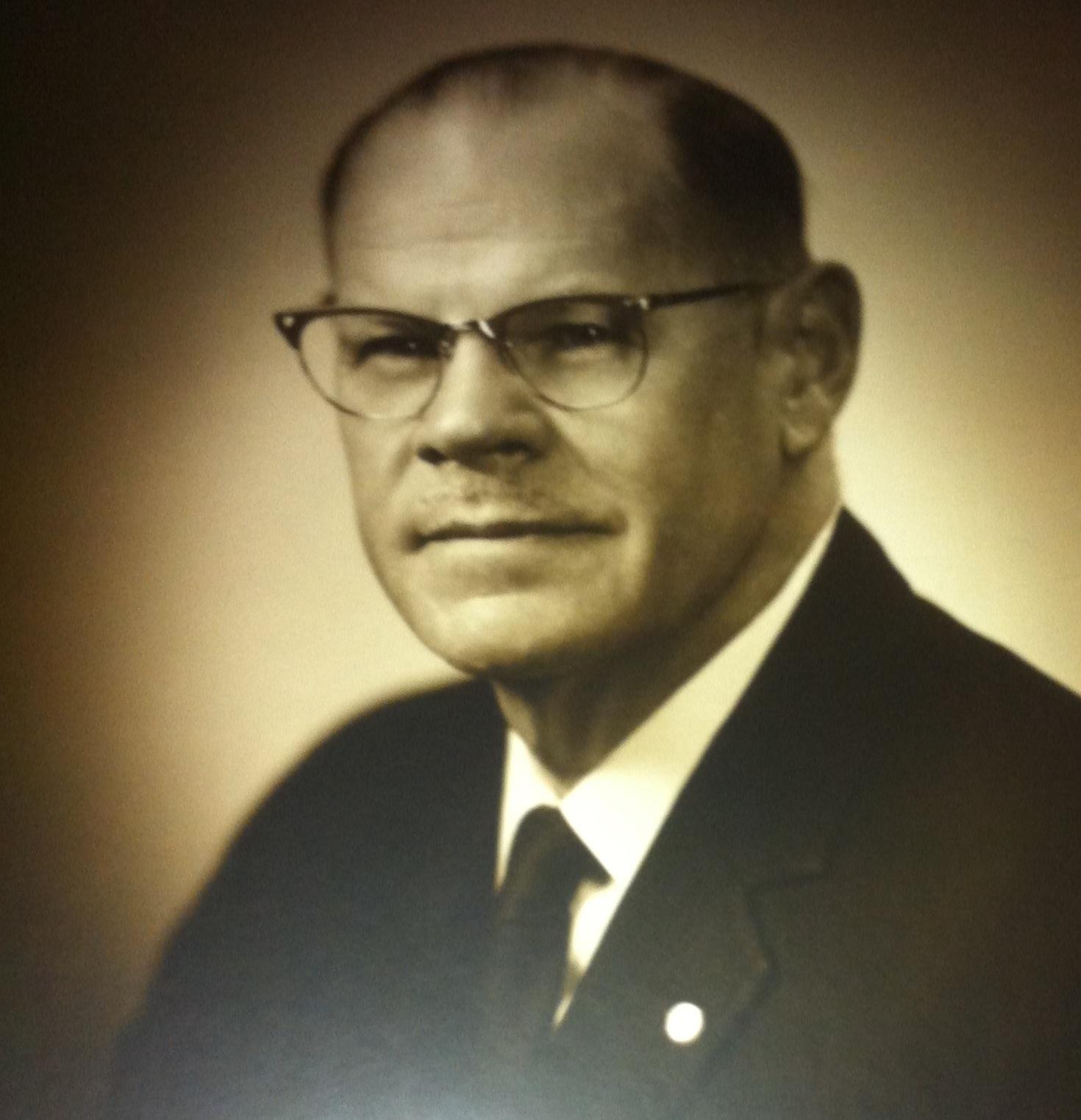
Mayor MoyerOn April 18, 1880, future Little Rock Mayor Charles E. Moyer was born in Glenwood, Minnesota. A man of contradictions, he was both a candidate backed by (and probably personally involved in) the Ku Klux Klan, yet he also brought the Goodwill Industries organization to Little Rock and Arkansas to help those less fortunate.

He came to Little Rock shortly after the turn of the 20th century as a clerk in the Post Office, and later served as a mail carrier. He then worked for Plunkett-Jarrell Wholesale Grocer Company in Little Rock. On January 1, 1921, he took office as County Judge for Pulaski County. In 1924, he ran against incumbent mayor Ben Brickhouse in the Democratic primary. Since Brickhouse had displeased the Klan, which was an active part of Democratic politics in Little Rock and throughout the nation at the time, Moyer won the primary.

Mayor Moyer led the City of Little Rock from April 1925 through April 1929. In 1927, the last lynching in Little Rock took place. While race-baiting crowds were surrounding City Hall demanding an African American prisoner be released to them for vigilante justice, Mayor Moyer was in hiding at an undisclosed location. Not able to get the prisoner they wanted, they took out their venom on another man who had assaulted a white woman and her daughter.

After leaving office in 1929, Moyer moved for a time to Batesville. He returned to Little Rock and was a chief deputy sheriff. From 1937 to 1941, he served as Pulaski County Assessor. In 1941, he returned to the office of Little Rock Mayor after J. V. Satterfield opted to serve only one term and did not seek re-election. Mayor Moyer led Little Rock through most of World War II. He left office in April 1945 and died on May 29, 1945, barely only one month after leaving City Hall.

Little Rock Look Back: 106 Years at LR City Hall

CityHa78106 years ago today, Little Rock City Hall officially opened at the corner of Markham and Broadway.

On April 15, 1908, the Italian Renaissance Revival style building, which had been designed by local architect Charles Thompson, played host to an open house. Staff had started moving into the building in March of that year.   This was, as often is the case, behind schedule.  The date in the cornice toward the top of the building is 1907, but the building was not completed until 1908.

In 1903, W. E. Lenon became Mayor of Little Rock. Back then, the terms were two-year terms.  By the start of his second term in 1905, he realized that the City was outgrowing City Hall, which was, at the time, on the northeast corner of Markham and Louisiana – where part of the Statehouse Convention Center sits today.

In February 1906, Mayor Lenon appointed a committee of five aldermen to over see the planning for the building of a new City Hall. In July 1906, the City Council approved plans, which called for a City Hall with an municipal auditorium wing. There was some hue and cry about wasteful spending and a resulting lawsuit, so, in September 1906, those plans were scrapped and a simpler City Hall was approved for the cost of $175,000.

The last resolution in the old City Hall called for the banning of smoking in the new Council Chambers – while the Council was in session. This may well have been the first smoking ban in a public government building in the history of Arkansas.

When the building opened, the third floor was not finished out. The space was not needed. When the Museum of Natural History and Antiquities (now the Museum of Discovery) moved into City Hall in 1929, they had to finish out their space.

In 1913, the new Central Fire Station, designed in the Beaux Arts style, was constructed adjacent to City Hall. During the 1930s, as the City grew, more space was needed. A garage, designed in the “austere, utilitarian” style was built in 1936 and a City Jail Annex, built by the WPA in the modified Art Deco style was built in 1938.
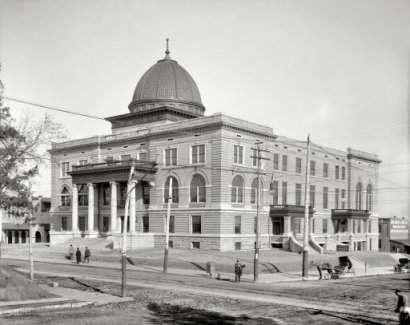
City Hall prior to 1912

By 1955, the copper-clad dome which sat on top of City Hall needed severe repairs. The wooden supports and the copper cladding were both in dire shape. Mayor Pratt Remmel set aside money for the dome to be repaired. After defeating Remmel in his bid for a third term, Mayor Woodrow Mann scrapped plans for the repair and, indeed, scrapped the dome.

Following the lead of County Judge Arch Campbell who had removed the tower at the County Courthouse, Mann proposed removal of the dome. He had an informal survey which had three options: repair the dome, replace the dome with an aluminum one, or remove it. This was open to anyone to respond – voting eligibility or Little Rock residency did not matter. By a slim margin, remove the dome won – so the dome was removed.

In 1960, as air conditioning was installed, windows were bricked in to promote energy efficiency. At the time, the feeling was that a new City Hall would be constructed in the 1970s somewhere more central to the growing city. Relocation talk persisted throughout the 1970s and early 1980s. By that time, City Hall had been modified a great deal – with no thought about historic preservation. When the Police and Fire Department had moved out into their new facilities, their old spaces had become storage.

By 1984, the decision was made to stay at Markham and Broadway. An extensive renovation and restoration effort was undertaken. In 1988, the building reopened, and the interior had been restored to its 1908 appearance.

Little Rock Look Back: U S Grant speaks in Little Rock

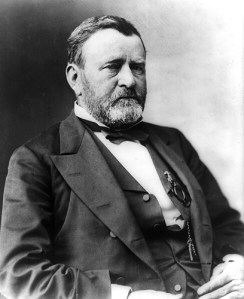
US_Grant_fOn April 15, 1880, former president Ulysses S. Grant spoke in Little Rock as part of his world tour. While here he made a couple of appearances and participated in a parade. It was Grant’s first visit to Arkansas either as a soldier or a politician.

At his outdoor speech, his remarks followed brief comments by Governor William R. Miller and Mayor John Gould Fletcher (erroneously referred to as John C. Fletcher in the Memphis Appeal story the next day). Grant’s comments were brief and flowery. He thanked Arkansans for a warm welcome, praised the future prospects of Arkansas and discussed the demise of what he termed “sectionalism” which was undoubtedly a reference to the division between the Union and and former Confederate states.

Also that day, Grant addressed a banquet in Concordia Hall (now part of the Arkansas Studies Institute complex on the Central Arkansas Library downtown campus). His was one of fifteen toasts that evening. It was simply “The United States of America, forever United.” He expounded briefly on the theme of unity of citizens from all states. He also discussed immigration noting, “All foreigners find a welcome here. We make them American citizens. After we receive them, it is but one generation until they are Americans.” He noted that he could speak much more on the topic, but that since he was but one of fifteen toasts and that there was to be music after each toast, “It will be to-morrow (sic) orning when we get through if we all take as much time as the subjects admit of.”

Marker at the Capital Hotel noting Grant's visit. Note that it refers to him as General instead of President.  At the time, only sitting Presidents were referred to as President.

Marker at the Capital Hotel noting Grant’s visit. Notice that it refers to him as General instead of President. At the time, only sitting Presidents were referred to as President.

Grant arrived in Little Rock on the night of April 14 and lodged at the Capital Hotel. He undoubtedly enjoyed some whiskey and cigars while at the Capital. Grant had originally planned on departing in the afternoon of April 15, but Little Rock leaders pled with him to stay so that he could be honored at the banquet. He assented.

Not everyone was thrilled to have the former commander of the Union Army in Little Rock. The story goes that when he was parading down the street, some Little Rock women (in a display of Souther un-hospitality) sat in chairs with their backs to the parade route. But all in all, it appears to have been a successful visit for the man who was the only Republican in the 19th Century to win Arkansas’ Electoral votes.

Little Rock Look Back: A Man and a Rock (LaHarpe sees the Little Rock)

IMG_4805On April 9, 1722, French explorer Jean-Baptiste Bénard de La Harpe rounded the bend of the Arkansas River and saw La Petite Roche and Le Rocher Français.  He had entered the mouth of the Arkansas River on February 27 after traveling up the Mississippi River from New Orleans.

Though La Harpe and his expedition are the first Europeans documented to have seen La Petite Roche, the outcropping of rocks was well-known to the Quapaw Indians in the area.  The outcropping jutted out in the Arkansas River and created a natural harbor which provided a perfect place for boats to land.

The rock outcropping is the first one visible along the banks of the Arkansas River.  It marks the place where the Mississippi Delta meets the Ouachita Mountains.  Geologists now believe that the Little Rock is not the same type of rock as the Ouachita Mountains and more closely matches the composition and age of mountains in the western US.

In 1813, William Lewis became the first European settler to live near La Petite Roche but only stayed a few months.  Speculators and trappers continued to visit the area throughout the 1810s. During that time, the outcropping became known informally as the Little Rock.

La Petite Roche had become a well-known crossing when the Arkansas Territory was established in 1819. The permanent settlement of ‘The Rock’ began in the spring of 1820, and the first building has been described as a cabin, or shanty, and was built on the bank of the river near the ‘Rock.’ In March 1820, a Post Office was established at the ‘Rock’ with the name “Little Rock.”

Over the years, La Petite Roche was altered.  In 1872, Congress authorized the building of a railroad bridge. A pier for the bridge was built at the location of the La Petite Roche which caused the removal of several tons of rock.  The bridge was never built.  When the Junction Bridge was built in 1899, even more rock was removed in the process of erecting part of the bridge on top of the rock.  It was not viewed as being disrespectful of the City’s namesake at the time.  Indeed, it was viewed as a testament to the sturdiness of the rock.

In 2010, La Petite Roche plaza opened in Riverfront Park.  It celebrates the history of La Petite Roche and explores its importance to various aspects of Little Rock’s history and geography.

Little Rock Look Back: SOUTH PACIFIC opens on Broadway

southpacific_obcSixty-five years ago today, a fictional Little Rock heroine took the stage of a Broadway megahit when South Pacific opened at the Majestic Theatre on April 7, 1949. It settled in for a run of 1925 performances. Based on the James Michener Pulitzer Prize winning novel Tales of the South Pacific, it featured a book by Oscar Hammerstein II and Joshua Logan, songs by Richard Rodgers and Hammerstein and direction by Logan. It was produced by Rodgers, Hammerstein, Logan and Leland Hayward. Set in the titular islands, it concerned the relationships of sailors, nurses, island natives and other island inhabitants.

The musical starred recent Tony winner Mary Martin as Little Rock native Nellie Forbush, opera star Ezio Pinza, stage veterans Myron McCormick and Juanita Hall, and stage newcomers William Tabbert and Betta St. John. Cloris Leachman was Martin’s understudy and would later succeed her in the part of Little Rock, Arkansas native Nellie Forbush.

Like other Rodgers and Hammerstein musicals, this show tackled tough themes – this one being prejudice. That did not set well with some theatergoers. Indeed, some potential investors did not put money into the show because of its stance. But Rodgers, Hammerstein, Logan and Hayward persisted. Their diligence paid off when the musical received the 1950 Pulitzer Prize in Drama, only the second musical to receive this designation. It is also the only Pulitzer Prize for Drama winner to be based on Pulitzer Prize winning source material. This was the first Rodgers & Hammerstein musical to not feature big dance numbers. In fact, there was no choreographer. The dance steps which existed were created by Martin, who had taught dance in her native Texas as a young mother.

Opening late in the season, South Pacific was named the 1949 New York Drama Critics Circle Best Musical, but was not part of the Tony Awards until 1950. (Though Jo Mielziner, who designed the set for South Pacific received a Tony for his set designs of shows during the 1948-49 season and South Pacific was one of the titles listed.) At the 1950 Tonys, it received six Tony Awards (sometimes listed as eight because Book and Score were not broken separate from Best Musical that year—but some sources incorrectly separate them.) It was named Best Musical, Actor in a Musical (Pinza), Actress in a Musical (Martin), Featured Actor in a Musical (McCormick), Featured Actress in a Musical (Hall), and Director (Logan). This is the only time that all four acting awards in the musical category went to performers in the same production. In fact, the other two acting trophies that year were incorrectly engraved as being from South Pacific out of habit.

Logan’s win was also the first time that the Director Tony went for a musical, since at the time that award was not separated out among plays and musicals. Hall was the first African American to win a Tony Award for Acting. Martin would reunite with Hayward, Rodgers & Hammerstein ten years later for The Sound of Music. Pinza and Tabbert reunited in 1954 for Fanny which would be the final Broadway credit for each gentleman. McCormick stayed with the show the entire run, except for vacations.

In 1999 for the 50th anniversary and in 2008 for the opening of the first Broadway revival remaining cast members from the original production had reunions in New York City. At the 50th anniversary ceremony, a proclamation from Little Rock Mayor Jim Dailey was read declaring it South Pacific day in Little Rock and honoring the show. It is interesting to note that in 1949, there were two heroines on the Broadway stage from Little Rock: Nellie Forbush from South Pacific and Lorelei Lee from Gentlemen Prefer Blondes.

In 2008, Lincoln Center Theatre produced the first revival of South Pacific on Broadway. It opened on April 3, just four days shy of the musical’s 59th anniversary.  The cast was led by Paulo Szot, Kelli O’Hara (as Little Rock girl Nellie Forbush), Matthew Morrison (before “Glee”), Danny Burstein and Loretta Ables Sayre.  The production restored a song which had been written for the original Broadway production that had been dropped. “My Girl Back Home” was featured in the movie version and in this Broadway revival. In it O’Hara and Morrison sang of their hometowns of Little Rock and Philadelphia.  The production was nominated for 11 Tony Awards and won 7: Best Musical Revival, Actor in a Musical (Szot), Director of a Musical (Bartlett Sher), Scenic Design (Michael Yeargan), Costume Design (Catherine Zuber), Lighting Design (Donald Holder) and Sound Design (Scott Lehrer).

Little Rock Look Back: Werner Knoop – LR’s 54th Mayor

Mayor KnoopTo Little Rock citizens under a certain age, the name Knoop means Knoop Park — a picturesque park tucked away in a pocket of Hillcrest.  There are, however, still many who remember Werner C. Knoop as a business and political leader who helped shape Little Rock as a modern city.

Knoop was born on March 30, 1902.

In 1946, Knoop joined with Olen A. Cates and P. W. Baldwin to form Baldwin Construction Company in Little Rock.  Knoop had previously founded Capital Steel Company and established his business reputation there.  From 1945 through 1951, he served on the Little Rock School Board.

Following a series of political scandals, efforts were undertaken for Little Rock to shift from Mayor-Council to City Manager form of government.  Even before the desegregation of Little Rock Central put the city in the eyes of the world, an election for new leaders had been set for November 1957.  Knoop was on a “Good Government” slate and was one of the members elected.

At the first meeting of the new City Board, Werner C. Knoop was chosen by his fellow directors to serve as Little Rock Mayor.  Knoop served as Mayor until December 1962.  For the first several months in office, Little Rock had no City Manager so Knoop oversaw the transition of City staff as the forms of government changed.

Though City Hall generally stayed out of school district matters, that did not mean that the public viewed the two entities separately.  In September 1959, the Baldwin Construction offices were bombed as part of a series of terrorist activities protesting the desegregated reopening of all Little Rock high schools.

After two terms on the City Board, Knoop decided against seeking a third term.  He concluded his elected public service on December 31, 1962.  Following his time on the City Board, Knoop did not retire from Civic Affairs.  In 1970, he served as Chairman of the Little Rock Chamber of Commerce.   The previous year he served as President of the Arkansas Chapter of Associated General Contractors.

Mayor Knoop died in July 1983.  He is buried at Roselawn Memorial Park next to his wife Faith Yingling Knoop.

In the 1930s, Knoop moved into an Art Moderne house on Ozark Point in Hillcrest.  It was adjacent to Little Rock Waterworks property which was developed around the same time.  Eventually much of the land was deeded to the City for creation of a park.  In 1989, it was named in tribute to long-time neighbor Knoop in honor of his lifetime of service to Little Rock.

LR from Knoop Park

Downtown Little Rock as viewed from Knoop Park