Little Rock Look Back: Mrs. Adolphine Fletcher Terry

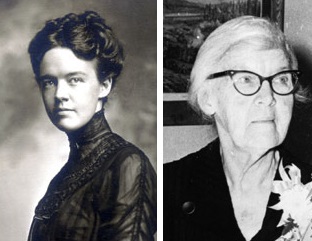
Photos from the collection of the Butler Center

Photos from the collection of the Butler Center

Adolphine Fletcher Terry was born on November 3, 1882 to former Little Rock Mayor John Gould Fletcher and his wife Adolphine Krause Fletcher.

Raised in Little Rock, in 1889 she moved into the Albert Pike House on East 7th Street, when her aunt transferred the title to her father. That house would be her primary residence the rest of her life.  Her sister Mary Fletcher Drennan never lived in Arkansas as an adult after marriage. Her brother John Gould Fletcher spent much of his adulthood in Europe before returning to Little Rock and establishing his own house, Johnswood.

At age 15, Adolphine attended Vassar. She later credited that experience as broadening her views on many issues.  After graduating at age 19, she returned to Little Rock.  Her parents both died prior to her 1910 wedding to David D. Terry, which took place at what was then known as the Pike-Fletcher House (and today is known as the Pike-Fletcher-Terry House).

She is perhaps best known today for establishing the Women’s Emergency Committee in 1958 and for her subsequent deeding of the family house to the City for use by the Arkansas Arts Center.  But her entire life was based on civic engagement.

She was instrumental in establishing the first juvenile court system in Arkansas and helped form the first school improvement association in the state. She was long an advocate for libraries, serving 40 years on the Little Rock public library board.  Through her leadership, the library opened its doors to African Americans in the early 1950s. Today a branch of the Central Arkansas Library System (the successor the Little Rock public library) is named after her.  Another branch is named after her Pulitzer Prize winning brother.

Adolphine formed the Little Rock chapter of the American Association of University Women, the Pulaski County tuberculosis association and the Community Chest.

In 1958, when the Little Rock public high schools were closed instead of allowing them to be desegregated again, she called Harry Ashmore the editor of the Gazette and exclaimed, “the men have failed us…it’s time to call out the women.”  With this, she formed the Women’s Emergency Committee to Open Our Schools. This group played a major role in getting the four high schools open the following year.

From 1933 to 1942, David Terry served in the U.S. Congress. During that time, Adolphine alternated her time between Washington DC and Little Rock. But she spent much time in Little Rock raising her five children.

After her husband’s death in 1963, she continued to remain active in civic affairs. In the 1960’s, she and her sister deeded the Pike-Fletcher-Terry House to the City of Little Rock for use by the Arkansas Arts Center upon both their deaths.  Following Adolphine Fletcher Terry’s death in 1976, Mary turned over the title to the City.

Adolphine Fletcher Terry is buried in Mount Holly Cemetery alongside her husband. Three of her children are also buried in that plot.  Her parents and brother are buried in a nearby plot.

Her son William Terry and his wife Betty continue to reside in Little Rock. Their daughters and their families also carry on Adolphine Fletcher Terry’s commitment to making Little Rock better.

Creative Class 2016: Phillip Rex Huddleston

cc16-huddlestonRenaissance Man is probably the best way to describe Phillip Rex Huddleston.  He is a writer, a musician, a composer, an artist, a teacher, an arts promoter, and so many other things.

By day, he is the Visual Art Specialist for eStem Middle School.  There, he teaches his students a variety of styles of art.  His own visual art style varies from realistic sketches, to caricatures, to comic strips and witty distillations of epic literature into a few frames.

As a guitarist and pianist he can often be found performing with his many talented friends throughout Little Rock’s live music scene in formal settings and on front porches.  As a composer, he has contributed compositions and performances to a variety of films made in Arkansas. His most recent effort was in Mark Thiedeman’s White Nights, which premiered in August.

A graduate of the University of Central Arkansas with a BA in Philosophy and an MA in English Literature, he was an Adjunct Instructor at UCA in the English Department before beginning his stint at eStem.  While at UCA, he also worked with the Arkansas Shakespeare Theatre.

For several years, he and friends and roommates would host regular Garland House Shows, named for the street on which their house was located. These combined visual art exhibits with live music in celebrations of the art they created and the friends who created and appreciated it.

Brown Bag lecture at Old State House today focuses on Robinson Center construction

robinson-auditorium-by-scott-carterToday (Thursday, October 6) at noon at the Old State House, the Brown Bag lecture focuses on the construction of the Joseph Taylor Robinson Memorial Auditorium.

After three decades of failed attempts to build a municipal auditorium in Little Rock, the New Deal finally offered the opportunity to build a structure for performances and conventions. But there were still many roadblocks on the way to the opening of the Joseph Taylor Robinson Memorial Auditorium.

For this Brown Bag Lunch Lecture, Scott Whiteley Carter will examine the changes and chances from October 1935 to April 1940 leading up to the opening of Robinson Auditorium. The period featured a reluctant but triumphant mayor, a crusading newspaper editor, political intrigue, financial chaos, and a plethora of frustration — all ultimately leading to a monument to civic pride.

A native of Little Rock, Carter is Special Projects Administrator at the City of Little Rock. Among his duties in this capacity are research and functioning as the city’s historian.

Canvas unveiled as new Arkansas Arts Center restaurant

aac-canvas-dinner-01Canvas, at the Arkansas Arts Center, officially launched Thursday, September 29 with a special dinner seating during Art After Hours. Formerly Best Impressions, Canvas features an updated space, along with several new menu items, including shrimp and grits, a grilled salmon salad and pimento cheese. New dishes incorporate a selection of locally-sourced ingredients; a Boursin cheeseburger with Grass Roots CoOp ground beef, a blackened chicken salad with Crystal Lake Farms chicken, shrimp and grits with Kent Walker cheddar.

Canvas owner Brian Kearns has been in the restaurant business for 15 years. Originally from St. Louis, Mo., Kearns moved to Little Rock in 2008 to open Ya Ya’s Euro Bistro in Chenal. Throughout his career, he has made a mark on several local restaurants, including Arthur’s Prime Steakhouse, Oceans at Arthur’s, Kemuri and the Country Club of Little Rock. Along with Canvas, he is also the owner of Simply the Best Catering.

“We want Canvas to be a fun, relaxed environment where you can enjoy food prepared with the best ingredients we can procure,” Kearns said.

Canvas Restaurant Hours
Tuesday – Friday, 11 a.m. – 2 p.m., Saturday & Sunday, 10 a.m. – 2 p.m.

For reservations or more information, please call 501-907-5946.

Arkansas Heritage Month – On Armed Forces Day visit the City of Little Rock’s MacArthur Museum of Arkansas Military History

MacPark ArsenalToday is Armed Forces Day.  It is a good day to visit Little Rock’s museum devoted to Arkansas’ military heritage.  Located in the historic Arsenal Tower in MacArthur Park, the MacArthur Museum of Arkansas Military History honors the Arkansans who have served in the armed forces.  Exhibits feature artifacts, photographs, weapons, documents, uniforms and other military items that vividly portray Arkansas’s military history at home and abroad.

The exhibits include:

  • From Turbulence to Tranquility: The Little Rock Arsenal
  • Capital In Crisis and Celebration: Little Rock and the Civil War
  • Alger Cadet Gun
  • Camden Expedition
  • David Owen Dodd
  • Through the Camera’s Eye: The Allison Collection of World War II Photographs
  • By the President in the Name of Congress: Arkansas’ Medal of Honor Recipients
  • Conflict and Crisis: The MacArthur- Truman Controversy
  • Duty, Honor and Country: General Douglas MacArthur
  • The Sun Never Sets on the Mighty Jeep: The Jeep During World War II
  • War and Remembrance: The 1911 United Confederate Veterans Reunion
  • First Call – American Posters of World War I
  • Undaunted Courage, Proven Loyalty: Japanese American Soldiers in World War II
  • Vietnam, America’s Conflict

The MacArthur Museum of Arkansas Military History is a museum of the City of Little Rock.  It is led by executive director Stephan McAteer who works with the MacArthur Military History Museum Commission.  The museum is open Tuesday through Friday from 9am to 4pm, Saturday from 10am to 4pm and Sunday from 1pm to 4pm.

Arkansas Heritage Month – The architecture of AIA/ALA award winning CALS libraries by Polk Stanley Wilcox

To encourage excellence in the architectural design and planning of libraries, the AIA and the American Library Association/Library Administration and Management Association created this award to distinguish accomplishments in library architecture.  In 2011 and again in 2015, Polk Stanley Wilcox won the award for projects designed for the Central Arkansas Library System.

AIA ALA PSW ASIThe 2011 award went to for work on the Arkansas Studies Institute.  This actually combines three buildings of three different centuries and construction types into one architectural timeline, evoking imagery of pages of an opening book.

The Arkansas Studies Institute is a repository for 10 million historic documents and the papers of seven Arkansas Governors, including President Bill Clinton. Located in a thriving entertainment district comprised of rejuvenated warehouses near the Arkansas River, the design combines significant, but neglected buildings from the 1880’s and 1910’s with a new technologically expressive archive addition. This creates a pedestrian focused, iconic gateway to the public library campus – and the public face of Arkansas history.

The design philosophy is based literally on the book – a physical container of information, with pages flowing into a site-sensitive narrative of the building’s function. Taking cues from the medium for which the Institute was created, the entrance acts as an abstract book cover, pulled away from the building as a double wall, defusing western sunlight and heat in the atrium beyond.

Public Spaces – galleries, a café, museum, and meeting rooms – enliven streetscape storefronts, while the great library research hall encompasses the entire second floor of the 1914 warehouse building. A thin atrium pulls the new structure away to protect the old, stretching the building’s length and flooding all levels with light – a key sustainable strategy. 100 historic images in glass handrails signify that architecture can and should actively engage in storytelling. Suspended bridges span the gap between new and old, open and secure, today and yesterday.

The Arkansas Studies Institute weaves history, research, pedestrians, and a restored streetscape together, healing a gaping wound in the urban fabric, while expanding environmental stewardship into the public realm and serving as a beacon of knowledge.

AIA ALA PSW HRCCLCIn 2015, the award went to PSW for their work on the Hillary Rodham Clinton Children’s Library and Learning Center.

Based on experiential learning where hands-on education teaches life skills needed to become responsible adults, a new Children’s Library and Learning Center boosts hopes for a neglected neighborhood, serves as an exemplary tale of urban renewal, and acts as a beacon of hope for an entire city.

This “community embedded, supportive learning center” offers not only books, but also a performance space, teaching kitchen, greenhouse, vegetable garden, and an arboretum. It is the state’s first library holistically imagined as a children’s education destination. The Library Director’s challenge was to create a “playground without equipment” where nature and imagination create grand adventures on an abandoned six acre site in the heart of the capital city. A charrette with youth uncovered a surprising and heartbreaking result: their top desire wasn’t for the latest video game technologies… it was food security. They wanted to learn how to feed themselves. Children also desired a place that was uplifting, inspirational and full of natural light, while in contrast feeling safe, secure, and sheltered. They wanted a place that “lifted expectations”.

An interstate highway—the railroad tracks of our generation—split Little Rock 40 years ago and destroyed a unified city grid, contributing to racial and socioeconomic divisions that separated citizens physically and emotionally. The site’s border condition became a national symbol for gang violence when featured in a 1990’s HBO documentary. Its opposite side, however, continued to be the city’s version of New York City’s Central Park—the place to live, work, and play. The design team’s overarching idea was centered on three moves: bridge the gap by stretching the park across the highway, create a library that is “the place to be” for all children, and develop civic pride in an underserved neighborhood, helping to mend partitions that have plagued the city for so long.

Landscape ecology and urban connectivity themes provide experiential education. Children see natural vegetation representing the state’s varied ecological regions from the Ozark Highlands to the Mississippi Delta. Two bus lines within a quarter mile assure access from distances, while the hundreds of children living within a half mile can walk or bike. An instructional greenhouse, gardens, and teaching kitchen allow children to cultivate, harvest, prepare meals, and sell produce in a planned farmer’s market. A full time ‘Environmental Educator’ oversees programs, teaching proper use of water, energy, and resources, and how we keep healthy through decisions made within the built environment. The lobby’s smart monitors can display real time water and energy consumption. Mechanical and structural systems are purposefully exposed so operations and construction methods can be discussed.

While this Library exceeded expectations by achieving LEED Gold, the true measure of success beyond points is the neighborhood’s feel, which shifted from dangerous to full of life and pride. The library is a safe zone and home to a sustainable-minded community.

Arkansas Heritage Month – Celebrities and Celebrations open Arkansas Arts Center on May 18, 1963

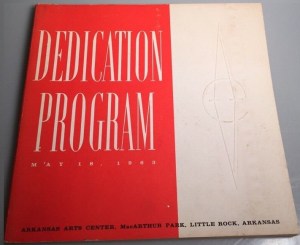
AAC opening programOn Saturday, May 18, 1963, amidst fanfare and fans of the arts, the Arkansas Arts Center officially opened its doors.  (This was thirty-five years and three days after the Fine Arts Club had opened the first permanent art gallery in Arkansas in the Pulaski County Courthouse).

The dedication ceremonies on May 18 featured U.S. Senator J. William Fulbright (who was in the midst of championing what would soon be known as the John F. Kennedy Center for the Performing Arts), Congressman Wilbur Mills, Governor Orval Faubus, Little Rock Mayor Byron Morse, Winthrop Rockefeller and Jeanette Rockefeller.

On Friday, May 17, 1963, film star Gordon MacRae performed two separate concerts in the theatre space.  There were other assorted small events and tours on May 16 and 17.

The culmination of the weekend was the Beaux Arts Bal.  This black tie event, featured Oscar winner Joan Fontaine, cartoonist Charles Addams (creator of The Addams Family), James Rorimer of the Metropolitan Museum, and Dave Brubeck.  Chaired by Jeane Hamilton, the event set a new standard for events in Little Rock.

Among the exhibits at the Arkansas Arts Center for the grand opening was a special exhibit from the Metropolitan Museum of Art in New York entitled Five Centuries of European Painting.  In Little Rock for six months, this exhibit featured works by El Greco, Titian, Claude Monet, Odilon Redon, Pierre Renoir, Paul Signac, Edgar Degas, and Paul Gauguin among many others and spanned from the fifteenth century Early Renaissance era to the nineteenth century.

Prior to the opening, a profile on the Arts Center in The Christian Science Monitor touted the building as one of the first regional arts centers in the country to be completed. Benefiting from national ties of the Rockefeller family, the events in May 1963, set a high standard for the institution, and for other regional art museums.