
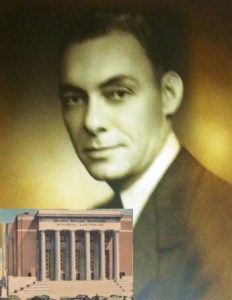
Arkansas Heritage Month – LR Mayor Satterfield oversees opening of Robinson Auditorium

Satterfield AuditUpon taking office as mayor in April 1939, J. V. Satterfield felt he was getting a handle on Little Rock’s precarious financial situation. He would soon discover that it was more unstable than he had imagined.  Included in this was Robinson Auditorium, currently under construction across the street from his office in City Hall.  Mayor Satterfield disclosed that he had voted against the auditorium in 1937 because he felt the finances were not sufficient. But as the mayor, he promised to open the building.

By the summer of 1939, it was becoming apparent that there would not sufficient money to finish the construction.  Even with the issuance of the final round of approved bonds (which had been held back as a reserve), there would not be enough money.  The Mayor and Harvey Couch made plans to go to Washington DC to try to get more money from the federal government.  Mr. Couch was a personal friend of President Roosevelt as well as head of Arkansas Power & Light.  The pair made the trip but returned with no additional money.

At the same time, the Auditorium Commission, which had been appointed by Mayor Overman to oversee the governance of the building, resigned as a group. They said they had been appointed to administer a building, not a construction site. Since it was uncertain as to when the building would open, they stepped down.

Mayor Satterfield was able to negotiate a series of deals to get the necessary work completed for construction of the building to be completed. Part of it involved issuing another round of bonds after the building had been officially opened to finish furnishing the building as well as complete the landscaping.  In January 1940, with a new opening date becoming a stronger possibility, the mayor appointed a new Auditorium Commission.

At the same time, regular events started to take place in the lower level exhibition hall.  There had been a few in November and December, but with a lack of utilities and ongoing construction upstairs in the music hall, those were curtailed.

On February 16, 1940, Joseph Taylor Robinson Memorial Auditorium officially opened. Mayor Satterfield was joined onstage for the ribbon cutting with Senator Robinson’s widow and her sister-in-law, who was a member of the Auditorium Commission.

In April 1940, Little Rock voters approved the final round of bonds which allowed for the building to be finished.

After only two years in office, Mayor Satterfield chose not to seek another term. He left City Hall in April 1941 with finances in order and a new municipal auditorium across the street.

Arkansas Heritage Month – LR Mayor Overman and a municipal auditorium

Overman AuditR. E. Overman assumed the office of Little Rock mayor in April 1935. Around that time, a new wave of New Deal programs were filtering down from Washington DC to cities.  It can be said of Mayor Overman that he did not meet a New Deal program he did not like.  From rebuilding the sewer system, to creating a public water utility, to constructing of structures for the Museum of Fine Arts, Little Rock Zoo, and Boyle Park, Mayor Overman signed the City up for program after program.

While the programs were all worthwhile, and in some cases absolute necessities, Mayor Overman did not seem to consider how these massive projects running concurrently would impact the City finances.  In November 1935, he submitted a proposal to the Public Works Administration for the construction of a new municipal auditorium to be located at the northeast corner of the intersection of Scott Street and Capitol Avenue. It would have taken up three/quarters of that block and wrapped around the Women’s City Club building (now the Junior League of Little Rock headquarters).  Because of other projects in the works, he did not pursue any further action on the auditorium project at the time.

In November 1936, Mayor Overman asked the City Council to place three bond issues on a special election ballot for January 1937, one of which was a municipal auditorium. Though a location had previously been identified in 1935, at this point in time supporters made a concerted effort to disclose that no location had been selected.  After the election was called, there was a concerted effort by supporters of the three separate bond issues to collaborate.  Voters overwhelmingly approved all three issues, and Little Rock’s journey to a municipal auditorium at last was underway. Perhaps.

Over the summer, architects and lawyers were selected. In the autumn, a consultant was hired to help with the selection for the site.  The month of October was consumed with City Council battles over the auditorium site.  Mayor Overman favored a location at Markham and Spring Streets (now site of the Cromwell Building and the Bankruptcy Courthouse). Because the Federal Government owned half the site and did not want to sell it, that location was deemed not feasible – though that did not stop Mayor Overman and others from repeatedly citing it as their first choice.  The only person who favored the location at Markham and Broadway did not have a vote: Planning Commission Chair J. N. Heiskell. Though he had no vote, he had the twin bully pulpits of Planning Commission and the Arkansas Gazette. As other sites fell by the wayside, he kept advocating for it.  Finally, the City Council approved of Heiskell’s choice, and the auditorium had a site.

The groundbreaking had to take place by January 1, 1938, or the money would be rescinded. After finalizing a location, planning could get underway.  With a week to spare, the ground was broken on December 24, 1937.  Mrs. Joseph T. Robinson, widow of the recently deceased US Senator from Arkansas, joined Mayor Overman in the groundbreaking. This ceremony was the first mention of the building being named in memory of the fallen senator, who had died in the summer of 1937.

Construction progressed throughout 1938 and into 1939.  Because of the precarious state of the City’s finances, Mayor Overman lost the support of the business community.  In November 1938, he lost his bid for the Democratic nomination for Mayor and was denied a third two-year term.  He left office in April 1939.

Arkansas Heritage Month – LR Mayor Pat L. Robinson and a municipal auditorium

PLR AuditIn April 1929, at the age of 29, Pat L. Robinson (no relation to Senator Joe T. Robinson) was inaugurated as Little Rock’s mayor.  Shortly after he took office, a variety of City Council committees and city interest groups started making proposals for projects to be funded by City bonds.  The decision was made to put a municipal bond issue before voters in August 1929.

The Young Business Men’s Association proposed a municipal auditorium be included.  In his 1929 inaugural address, Mayor Robinson had commented that an auditorium would be a worthwhile project for the city, should funding be available.  Another proposal, which seemed to have mayoral support, was the Civic Center plan (including land for an auditorium) which J. N. Heiskell had started shopping in the waning days of the Moyer administration.

The City Council approved the calling of the election and the submission of eleven different items.  Mayor Robinson then invoked the ire of the aldermen by noting he would only support four of the eleven proposals. Over the ensuing weeks, he and the aldermen traded charges and parliamentary ploys.  In July, the Council voted to cancel the election, which the mayor vetoed.  Though the Council had the votes to override the veto (and therefore not have the election), they let the veto stand.  The election proceeded as planned in August.

Hobbled by a lack of a cohesive campaign to begin with which was exacerbated by the City Hall infighting, it was probably no surprise that the few of the election proposals were approved by voters.  The marvel is probably that any were actually approved.  This appears to have been the first municipal bond election put forth after the 1926 approval of the new amendment to the Arkansas constitution.

Neither the Auditorium nor the Civic Center proposals were approved.  Throughout his term, the Hotel Marion continued to be the main site in Little Rock for conventions, while Little Rock High School’s auditorium was the showcase for performances.

No further proposals for an auditorium were put forth during the remainder of the Pat L. Robinson administration.  After continuing to alienate the Democratic power structure, he was challenged in the November 1930 primary, and failed to receive the nomination to be the Democratic nominee for mayor in 1931.

Arkansas Heritage Month – LR Mayor Moyer and a Municipal Auditorium

Moyer AuditIn anticipation of the November 2016 reopening of Robinson Center Music Hall, this week’s Arkansas Heritage Month entries look at seven Little Rock Mayors who worked on proposals for a municipal auditorium between 1904 and 1940.

After having served as Pulaski County Judge, Charles Moyer was elected Little Rock Mayor in April 1925.  He concluded his inaugural address later that month with a request that all Little Rock voters should support the auditorium district proposal in the May 1925 special election.  Voters approved the auditorium, but the concept of an auditorium district was thrown out by the Arkansas Supreme Court after a legal challenge.

Mayor Moyer then led a statewide effort to get a Constitutional amendment approved to allow for public bonds to be used on auditoriums and a host of other structures, as long as voters approved the issuance of bonds.  This was approved by voters in October 1926.  Though Mayor Moyer publicly advocated for an auditorium after that election, he did not lead a subsequent effort to create one.  During his tenure, conventions were largely centered around the Hotel Marion.  A new Little Rock High School was built (now Little Rock Central High) with that auditorium supplanting its predecessor as the location of choice for large-scale performances.

He left office in April 1929.  In the final weeks of Mayor Moyer’s second term, Planning Commission Chair J. N. Heiskell (editor of the Arkansas Gazette) started discussing the need for a civic center for Little Rock which would include space for a municipal auditorium.

Charles Moyer returned to the office of mayor for an additional two terms in the 1940s. By that time Robinson Auditorium had been opened.

Arkansas Heritage Month – LR Mayor Brickhouse and a Municipal Auditorium

Brickhouse AuditIn anticipation of the November 2016 reopening of Robinson Center Music Hall, this week’s Arkansas Heritage Month entries look at seven Little Rock Mayors who worked on proposals for a municipal auditorium between 1904 and 1940.

Former Alderman Ben D. Brickhouse took office as mayor in April 1919.  As an alderman, he had been party to the discussions and hand-wringing over the existing “temporary” auditorium, which was twelve years old at the time.  In June 1920, he and the City Council authorized City Engineer James Rice to have the building demolished.  (Rice’s grandson Jim Rice is an integral member of the team overseeing the restoration of Robinson Center Music Hall.)

On what seemed to be an annual basis, Brickhouse entertained options for a new municipal auditorium.  Sometimes it would be private groups, on at least one occasion, Mayor Brickhouse himself led the effort.  Funding and location always seemed to be stumbling blocks.  Arkansas law forbade the use of public dollars on an auditorium, so the money would have to be raised privately. Few private entities had the money for this type of project.  Another temporary auditorium had been proposed for City Park (now MacArthur Park), but aldermen balked at the expense for a temporary building.

During the Brickhouse administration, the Hotel Marion was the main site for conventions. The auditorium at the Little Rock High School (later East Side Junior High) was used frequently for performances.

Mayor Brickhouse worked behind the scenes to have the Arkansas General Assembly pass legislation to allow for the creation of an auditorium taxing district, much like a street improvement district. In May 1925 Little Rock voters would be given the chance to approve this.  But Brickhouse would not be mayor by the time that election came around.  He was defeated in his bid for a fourth term and left office in April 1925.

Ben D. Brickhouse did return to public service in 1938, when he was elected to the Arkansas General Assembly.  He was reelected in 1940 and died in June 1941.

Arkansas Heritage Month – LR Mayor Taylor and a Municipal Auditorium

Taylor AuditIn anticipation of the November 2016 reopening of Robinson Center Music Hall, this week’s Arkansas Heritage Month entries look at seven Little Rock Mayors who worked on proposals for a municipal auditorium between 1904 and 1940.

Charles Taylor became Little Rock’s mayor in April 1911.  He inherited the temporary auditorium that was already showing signs of wear and tear after four years.  Throughout the eight years he was in office, he and the City Council wrestled with the question of what to do about the auditorium.

Time and time again, there would be calls to tear the building down. Its proximity to the 1913 fire station was causing the insurance rates on that building to be increased. It was viewed as structurally unsound and had outlived its useful life.  However, without that building, there would be no public space for conventions and community meetings.  While the Hotel Marion offered convention facilities in its ballroom, it did not necessarily lend itself to trade shows. In addition, as a private entity, it was able to set its own rules without necessary regard to the general public.

A 1913 proposal by planner John Nolen had called for an auditorium to be built on a new plaza area near City Hall.  Due to funding issues, that plan never gained traction, despite repeated attempts by its backers to push for it.

At the time he left office in April 1919, Mayor Taylor had still not been able to solve the problem of a municipal auditorium.

Arkansas Heritage Month – LR Mayor Lenon and a Municipal Auditorium

Mayor Lenon with the plans for the original City Hall/Auditorium and the temporary auditorium.

Mayor Lenon with the plans for the original City Hall/Auditorium and the temporary auditorium.

In anticipation of the November 2016 reopening of Robinson Center Music Hall, this week’s Arkansas Heritage Month entries look at seven Little Rock Mayors who worked on proposals for a municipal auditorium between 1904 and 1940.

In 1904, Little Rock Mayor W. E. Lenon first proposed that Little Rock construct at municipal auditorium.  After considering some options, he decided it would be easiest to build it in conjunction with a new City Hall and Jail.  In 1906 plans proceeded in that direction until a lawsuit by J.N. Heiskell to stop it. Following a judge’s ruling that a municipal auditorium was not deemed a proper use for public monies, the City changed course and constructed only a City Hall and Jail (sans auditorium) at the corner of Markham and Broadway. This building opened in 1908.

In 1906, the City gave permission to a private developer to build a temporary auditorium (which also served as a roller skating rink when the chairs were removed) adjacent to the City Hall site.  This opened in 1907.

Mayor Lenon left office in 1908.  He would later chair a committee involved in an auditorium proposal in 1925, but that one would come to naught, as well.  However, he planted the seed and started the public discourse which lasted for 36 years.