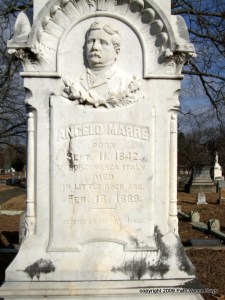
 On September 11, 1842, future Little Rock Alderman Angelo Marre was born in Borzonaca, Italy. He immigrated to Tennessee with his parents in 1854.
During the Civil War, he served in the Confederate Army. From 1865 to 1868, Angelo Marre worked for the Memphis Police Department but was forced to resign after he was accused of killing a man during an argument. After his acquittal, he returned to the saloon business. In 1872 Marre was convicted of stealing money and sentenced to three years in prison.
Tennessee Governor John Brown granted Marre a full pardon two years into his sentence, and he regained his citizenship in 1879.
After getting out of prison, he claimed an inheritance and joined his brothers in Little Rock. He worked as a bartender at the Metropolitan Hotel. He later opened a saloon and billiard parlor.
By the mid-1880s, Marre owned two saloons, a liquor import business, an office building in downtown LR, 3,000 sharesof stock in mining companies operating in Garland and Montgomery counties, and he was the first president of Edison Electric Company of LR.
In 1883, he was elected as an alderman on the Little Rock City Council. He lost is bid for reelection in 1885. In 1888, he was an unsuccessful candidate for Pulaski County Sheriff.
 Angelo Marre died February 18, 1889, as a result of his infection. He is buried at Calvary Cemetery in LR. His custom designed, marble monument was ordered from Florence, Italy, and cost $5,000.
Marre is probably best known today as the builder of the structure now known as the Villa Marre. Built in 1881, it is designed in the Italianate and Second Empire styles. It was built in 1881 and 1882 on Block 21, Lots 5 & 6 of the Original City of Little Rock. The cost was $5,000.
It was originally a red brick structure and has been modified and expanded several times as well as painted white. It did not bear the name Villa Marre until the 1960s when historic preservation advocate Jimmy Strawn gave it that name.
After serving as the headquarters for the Quapaw Quarter Association for several years, it was returned to a private residence. It is now available for special events and rentals.
The Villa Marre is probably best known locally and nationally for serving as the facade for the Sugarbaker design firm on the CBS sitcom “Designing Women.” Though the interior of the house does not match the interior on TV, the building was featured in the opening credits as well as in exterior shots each week.

 Arkansas and Mexico each became political entities in the first decades of the 19th century. Both before and after Mexican Independence, Arkansans looked for commercial and political opportunities in Mexico.
 Little Rock’s 70th mayor, Sharon Priest, celebrates her birthday on September 12.
 As all sectors did, the Little Rock arts and culture community responded to September 11.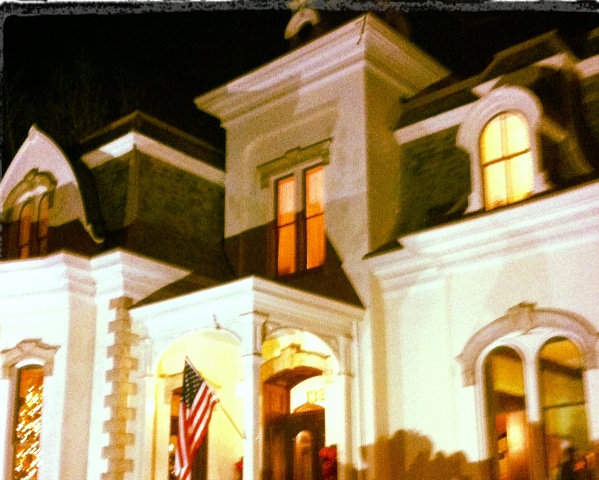
 On September 11, 1941, Minnijean Brown was born.
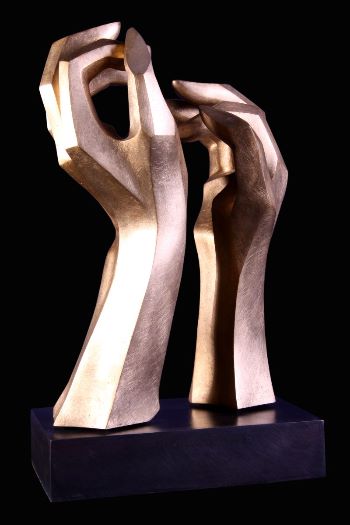 A new exhibit is now open at the Clinton Presidential Center. José Sacal: A Universal Mexican is presented in celebration of the CCIX Anniversary of the Independence of Mexico and National Hispanic Heritage Month
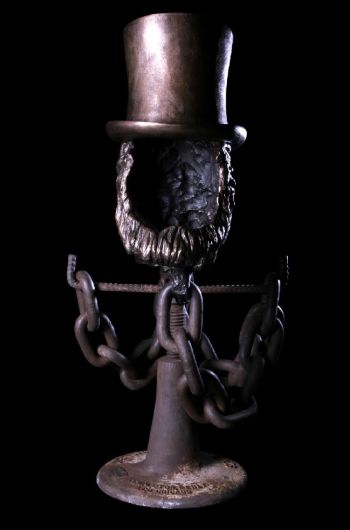 José Sacal: A Universal Mexican includes two groups of the artist’s work: sculptures inspired by other works of art and portraits of historical figures. In his works, Sacal finds the essence of each character or work. It can be a detail or an object, but the rest is something deeper. By recreating them, Sacal gives them a new meaning and establishes an artistic dialogue at a higher level. In his intelligent observation of art and history, Sacal reveals himself as a universal Mexican.
 Little Rock Culture Vulture