
Birthday of Hall High and Ark Arts Center alum Daniel Davis

On November 26, 1945, future actor Daniel Davis was born in Gurdon.  As a child, his family moved to Little Rock where his parents ran a movie theatre.  As a child, he appeared on “Betty’s Little Rascals” local TV show with Betty Fowler.

While a student at Hall High, Davis had the lead as Horace Vandergelder in The Matchmaker (which would soon be musicalized on Broadway in Hello, Dolly!), appeared in Judgment at Nuremburg, sang in the Hallmarks (concert choir), and was a Harlequin Player (drama club). He was also on the staff of the Warrior (yearbook), War Whoop (newspaper), and Inkwell (literary magazine). His fellow members of the class of 1963 voted him the Wittiest boy in the class.
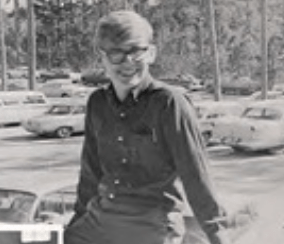
Davis at Hall in 1963

After graduating from Hall, Davis remained in Little Rock and enrolled in the new Arkansas Arts Center school of Art and Drama, a degree granting program.  While there, he appeared in numerous plays.

One of them was The Persecution and Assassination of Jean-Paul Marat as Performed by the Inmates of the Asylum of Charenton under the Direction of the Marquis de Sade.  National theatre critic Henry Hewes of the Saturday Review came to Little Rock to review the production, which was presented a year after the play had won a Tony for Best Play.  Hewes actually liked the Little Rock production better.

After completing studies at the Arts Center, Davis worked with the Oregon Shakespeare Festival, American National Theatre Academy, Stratford Festival, and American Conservatory Theatre. He also started appearing in television, including a stint in the soap “Texas” and guest starring in many TV series. In 1993, he started a six year, 145 episode run as Niles the butler in “The Nanny.”  His British accent on the show caused many in the public to think he was from England instead of Arkansas.

Davis has continued to act frequently on stage.  In 1969, he made his Broadway debut as the Dauphin in Henry V followed by an appearance in Othello.  He was a replacement as Salieri in the original production of Amadeus.   In 2003, he received an Obie Award for his appearance in Alan Bennett’s Talking Heads.  Three years earlier he was nominated for a Tony for his appearance in Wrong Mountain.  Other recent Broadway appearances include The Invention of Love, The Frogs, La Cage aux Folles and Noises Off.

Birth of Little Rock’s 46th Mayor – Horace Knowlton – on Nov. 25, 1872

On November 25, 1872, future Little Rock Mayor Horace A. Knowlton Jr. was born.

In April 1920, he was elected City Clerk of Little Rock.  He served in that position until April 1931.  That year, he was chosen as the Democratic nominee for Mayor, denying incumbent Mayor Pat L. Robinson a second term.

The primary race against Mayor Robinson was close.  When the results were first announced, it looked as if Mayor Robinson had prevailed.  But after challenging ballots, Mr. Knowlton was declared the winner.  Since Little Rock was primarily a Democratic Party city, unsurprisingly Mr. Knowlton was elected Mayor in April 1931 and served two terms as Mayor.

He oversaw the start of some of President Roosevelt’s New Deal programs in Arkansas during his tenure.  In 1934, he negotiated the purchase of Gillam Park for the City which established the first public park in Little Rock for African Americans.  While a segregated park would today be wrong, in the 1930s he was viewed as very progressive for providing a public park for African Americans.  One of his final acts as Mayor was to participate in the groundbreaking for the Museum of Fine Arts building in City Park (now a portion of the Arkansas Arts Center building in MacArthur Park).

Following his departure from public office, Mayor Knowlton and his wife (who had been an elementary school teacher) eventually moved to Florida and resided in the Tampa Bay area.  His son and grandson (Horace III and Horace IV) have both been lawyers in the Tampa Bay area.  Mayor Knowlton died on February 14, 1965.  He is buried in the Oak Grove cemetery in Conway.

Arkansas Arts Center Museum School annual sale today from 9am to 3pm

The Arkansas Arts Center Museum School will be having its annual Sale on Saturday, November 23 from 9am to 3pm at the Hall of Industry, 2600 Howard Street.

Scores of Museum School students and faculty (and faculty who are also students) will be selling artwork in all varieties of shapes, sizes, media and price ranges.

It is a perfect chance to get a start on holiday shopping as well as to support local artists. Several of the artists have been taking classes and selling at the sale for years, while there will be others who are first timers.   Artists accept cash and checks; many also accept credit or debit cards.

43 years ago, Arkansas Rep opened first show: THE THREEPENNY OPERA

On November 11, 1976, the curtain went up on the first Arkansas Repertory Theatre production.  It was the Kurt Weill-Bertolt Brecht musical The Threepenny Opera.  Rep founder Cliff Baker directed the show and played the leading role of Macheath aka Mack the Knife.

Others in the cast included local attorney Herb Rule, Jean Lind, Theresa Glasscock, Connie Gordon and Guy Couch.  Byl Harriell was the technical director and production designer while Donia Crofton was the costume designer.

The production took place in the Rep’s home which was the converted former home of Hunter United Methodist Church on the eastern edge of MacArthur Park.  (Harriell’s business Bylites is now in that location.)

Baker had previously worked at the Arkansas Arts Center theatre when it was attached to a degree granting MFA program. He had also directed shows in other parts of Arkansas.  He returned to Little Rock and founded the Arkansas Philharmonic Theatre which performed in Hillcrest.  The Arkansas Repertory Theatre was a step forward with the establishment of a professional repertory company.

The first season of the Rep would include Company, Suddenly Last Summer, Marat/Sade, and Stop the World–I Want to Get Off. Season tickets for a total of seven shows were $30.

Baker served as Artistic Director of Arkansas Rep from 1976 until 1999.

Artober – Art that Changed Me. The 1937 Museum of Fine Arts Entrance

October is Arts and Humanities Month nationally and in Little Rock. Americans for the Arts has identified a different arts topic to be posted for each day in the month.  We end today with “Art That Changed Me.”

So many possibilities:  Oliver!, the first production I saw; reading The Comedy of Errors (first Shakespeare play I read); the Missouri State University production of The Normal Heart; seeing George Seurat’s Sunday Afternoon on the Island La Grand Jatte or a Jackson Pollock piece both at the Art Institute of Chicago; Diego Rivera’s Two Women in the Arkansas Arts Center collection; hearing David Belcher play the piano in Rhapsody in Blue or the Arkansas Symphony playing Firebird Suite; the list goes on an on.

I grew up with the arts. I grew up valuing the arts. Art has moved me, made me laugh, made me cry, made me think, pretty much my entire life. All art changes me in some fashion.

So, I’ll cheat and talk about Art that Changed Little Rock.  Again, many choices, but it is easier to be more objective about that.  With the recent re-exposure of the original 1937 facade of the Museum of Fine Arts, that made me think of photos of the original building which were sent to me by Lally Brown. She is a granddaughter of Nettie Robinson, who was the first (and longtime) director of the Museum of Fine Arts.

For many years, this facade was inside a gallery of the Arkansas Arts Center. I have long said this facade was one of my favorite pieces in the Arkansas Arts Center collection. Now, it will once again be a portal through which people will enter and experience the arts.

Photo from the collection of Lally Brown.

The Museum of Fine Arts changed Little Rock. It was the first cultural institution that was an art facility. It provided a place to take classes and started to inspire people to aspire for more and better art.  It served as the foundation for the Arkansas Arts Center and all that it has offered. Most of Little Rock’s performing and visual arts entities can trace their heritage to the Museum of Fine Arts.

It all started here.

Photo by the Arkansas Arts Center