
“200th Anniversary of Gazette” Historic Newspaper 1819 page 1
On Saturday, November 20, 1819, a recent transplant to the Arkansas Territory published the first issue of a new newspaper in Arkansas Post, along the Arkansas River a little ways upstream from the Mississippi River.
Originally a French settlement, earlier in 1819, it had been selected as the first capital of the new Arkansas Territory. At the time, newspapers would often be used as the official publisher of government business, so it would make sense for the new Arkansas Territory to have a newspaper located in its capital to publish official notices and actions of the territorial government.
Born on Long Island, New York in 1795, Woodruff was apprenticed to a Brooklyn newspaper man when he was 14. At the age of 23 he headed west working for newspapers in Kentucky and Tennessee. In 1819, he landed in Arkansas Post.
In 1820, the Territorial legislature decided to move the capital to Little Rock (first permanently settled earlier that year) and in June 1821, the governmental headquarters of the state shifted up the Arkansas River to the center of the state. Woodruff, ever the opportunist, moved his operations to Little Rock, as well. Since much of his business relied on government printing, it made sense to move when the government did. In December 1821, he published the first edition of the Arkansas Gazette in Little Rock.
Throughout the 19th Century, the ownership of the Arkansas Gazette changed numerous times. Woodruff family members sold and bought back the paper repeatedly. In 1902, Judge Carrick Heiskell of Memphis purchased the paper. Two of his sons, J. N. and Fred moved to Little Rock to run the newspaper along with longtime newspaper employee Fred Allsopp.
From 1902 until his death at age 100 in 1972, J. N. Heiskell was editor of the paper. (He eschewed the title of Publisher.) Following the death of his brother Fred and Fred Allsopp in the 1930s and 1940s, Mr. Heiskell was eventually joined by his son-in-law Hugh Patterson in leading the paper. (Hugh was given the title of Publisher in 1948 and held it until his retirement in 1986.)
In 1984, Patterson and the Gazette sued rival newspaper Arkansas Democrat in an antitrust lawsuit. After the court ruled in favor of the Democrat and its owner Walter E. Hussman, Jr., in 1986, Patterson decided the only way the Gazette could remain open would be to sell it. Later that year, Gannett Corporation bought the Arkansas Gazette and Patterson retired.
Following a revolving door of newspaper executives, each of whom seemed less certain of how to run the paper, in October 1991, Gannett sold the assets of the Gazette to Hussman and the Democrat. The next day, the Arkansas-Democrat emerged as the new newspaper touting the legacy of both of its parent papers.
Interestingly, in 1909 and 1910, Mr. Heiskell owned both the then-morning Gazette and the then-afternoon Democrat for several months. He had no desire to keep both papers permanently, but felt like he should purchase the Democrat to keep it open until another suitable owner could be found. He felt it was important for Little Rock to have both a morning and an afternoon paper.
Today the Arkansas Democrat-Gazette is celebrating 200 years since the first edition of the Arkansas Gazette. Over the years the size of the newspaper and the number of columns o a page has varied wildly. As this bicentennial is being marked, in recognition of the way the industry continues to change, the newspaper is in the process of transitioning to printing a paper edition only on Sundays, with an electronic-only version being offered Mondays through Saturdays.
Woodruff would not recognize the newspaper industry today. But then, he probably would have not recognized the newspaper industry of 1919. The early Gazette was little more than a publication of official government notices, classified ads, often out-of-date news stories from other cities, and partisan ramblings with inflammatory language masquerading as news stories. There was no pretense of impartiality even in the news coverage. And if a newspaper did not get a contract from a governmental body, it was highly unlikely to give that body much coverage at all.

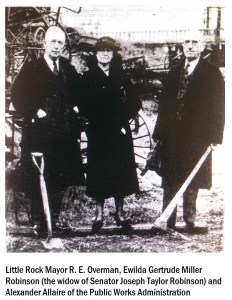 On December 24, 1937, at 11:30 a.m., Little Rock Mayor R. E. Overman, Ewilda Gertrude Miller Robinson (the widow of Senator Joseph Taylor Robinson) and Alexander Allaire of the PWA turned dirt to participate in the brief groundbreaking ceremony for Little Rock’s municipal auditorium.
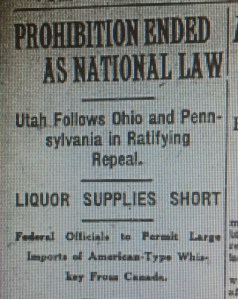 On December 5, 1933, Ohio, Pennsylvania and Utah provided the necessary support to officially repeal “the great experiment.”
 Walter E. Hussman Jr., is the publisher of the Arkansas Democrat-Gazette and a third-generation newspaperman whose family acquired a chain of newspapers stretching from Tennessee to Missouri.

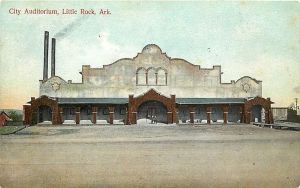 Following the court decision which forbade the City of Little Rock from using public dollars to construct a municipal auditorium, a temporary solution was sought. On August 20, 1906, the City Council approved plans for such a structure.
 Little Rock Culture Vulture