New mural by Matt McLeod dedicated today on Main Street Creative Corridor

Photo taken from a Cranford Co. video shot by Chris Cranford

Photo taken from a Cranford Co. video shot by Chris Cranford

The City of Little Rock in conjunction with the Downtown Little Rock Partnership will hold a ceremony to celebrate the completion of a new piece of public art within the heart of Little Rock’s Main Street Creative Corridor. This large-scale acrylic mural, titled Beneath the Surface by Little Rock local artist Matt McLeod, is located at the corner of Sixth and Main streets.

The 30-foot-by-142-foot mural was painted along the side of the Bennett’s Military Supplies building. More than 30 students from the Urban Garden Montessori School are expected to be in attendance. The mural is located in the same block as the school.

The event will also mark the start of the Main Street Food Truck Fridays at Main Street and Capitol Avenue.

It will take place at 11:30 a.m. In case of rain, the dedication will take place at McLeod Fine Art (108 West Sixth Street).

New logo, social media presence unveiled for LR Creative Corridor

 The City of Little Rock unveiled today the Main Street Creative Corridor logo and social media sites. Located on Main Street, the Creative Corridor is an area where arts and culture will anchor a vibrant, mixed-use place in the center of the capital city’s downtown.


The logo was selected by arts groups who will eventually relocate to Main Street, in collaboration with representatives from the city. The new logo will be used on all promotional materials for the Creative Corridor. 

The Creative Corridor now has a social media presence on the following networks: 

  • Facebook: CreativeCorridorLittleRock
  • Instagram: @MainStreetLR
  • Twitter: @MainStreetLR
  • Hashtag: #creativecorridorLR

A Creative Corridor website was also launched at creativecorridorlittlerock.wordpress.com.

“Little Rock’s Creative Corridor is revitalizing Main Street one block at a time, stimulated by the arts rather than a traditional retail base,” said Little Rock Mayor Mark Stodola. “The Creative Corridor is rapidly becoming a mixed-use, work-live environment that is sensitive to the historical context of Main Street, while at the same time celebrating the amazing art organizations that are assembling along the area.”

As one of the art initiatives of the Creative Corridor, the City of Little Rock is soliciting designers for a large-scale banner art competition. Two full-color, large rectangular banner designs will be selected. The winning designs will be installed vertically on the parking deck located in the 200 block of Main Street. Each winning design will be awarded a $1,000 cash prize. The deadline for submissions is noon on May 18, 2015. For more information on how to submit a design visit creativecorridorlittlerock.wordpress.com/art-competitions/.


Initial Planning and design for the Creative Corridor was funded by a 2011 Our Town grant from the National Endowment for the Arts. The plan, created by the University of Arkansas Community Design Center and Marlon Blackwell Architects, has received awards from the American Institute of Architects and The American Society of Landscape Architects, among many others.

Certain blocks on Main Street are in the process of being reconstructed to include low-impact development streetscapes with funding provided by a grant from the Arkansas Natural Resources Commission. Once completed, the Corridor will include rain gardens, porous pavers, bioswales, and other techniques to improve water quality.

An increasing number of public, private and nonprofit groups have already invested in Main Street in recent years.  Funding for a wide variety of art and lighting installations for the Corridor is being provided by ArtPlace America and the Educational Foundation of America.

Little Rock Look Back: LR Mayor Charles Moyer

Mayor MoyerOn April 18, 1880, future Little Rock Mayor Charles E. Moyer was born in Glenwood, Minnesota. A man of contradictions, he was both a candidate backed by (and probably personally involved in) the Ku Klux Klan, yet he also brought the Goodwill Industries organization to Little Rock and Arkansas to help those less fortunate.

He came to Little Rock shortly after the turn of the 20th century as a clerk in the Post Office, and later served as a mail carrier. He then worked for Plunkett-Jarrell Wholesale Grocer Company in Little Rock. On January 1, 1921, he took office as County Judge for Pulaski County. In 1924, he ran against incumbent mayor Ben Brickhouse in the Democratic primary. Since Brickhouse had displeased the Klan, which was an active part of Democratic politics in Little Rock and throughout the nation at the time, Moyer won the primary.

Mayor Moyer led the City of Little Rock from April 1925 through April 1929. In 1927, the last lynching in Little Rock took place. While race-baiting crowds were surrounding City Hall demanding an African American prisoner be released to them for vigilante justice, Mayor Moyer was in hiding at an undisclosed location. Not able to get the prisoner they wanted, they took out their venom on another man who had assaulted a white woman and her daughter.

After leaving office in 1929, Moyer moved for a time to Batesville. He returned to Little Rock and was a chief deputy sheriff. From 1937 to 1941, he served as Pulaski County Assessor. In 1941, he returned to the office of Little Rock Mayor after J. V. Satterfield opted to serve only one term and did not seek re-election. Mayor Moyer led Little Rock through most of World War II. He left office in April 1945 and died on May 29, 1945, barely only one month after leaving City Hall.

Little Rock Look Back: 107 years of City Hall at Markham & Broadway

CityHa78107 years ago today, Little Rock City Hall officially opened at the corner of Markham and Broadway.

On April 15, 1908, the Italian Renaissance Revival style building, which had been designed by local architect Charles Thompson, played host to an open house. Staff had started moving into the building in March of that year.   This was, as often is the case, behind schedule.  The date in the cornice toward the top of the building is 1907, but the building was not completed until 1908.

In 1903, W. E. Lenon became Mayor of Little Rock. Back then, the terms were two-year terms.  By the start of his second term in 1905, he realized that the City was outgrowing City Hall, which was, at the time, on the northeast corner of Markham and Louisiana – where part of the Statehouse Convention Center sits today.

In February 1906, Mayor Lenon appointed a committee of five aldermen to over see the planning for the building of a new City Hall. In July 1906, the City Council approved plans, which called for a City Hall with an municipal auditorium wing. There was some hue and cry about wasteful spending and a resulting lawsuit, so, in September 1906, those plans were scrapped and a simpler City Hall was approved for the cost of $175,000.

The last resolution in the old City Hall called for the banning of smoking in the new Council Chambers – while the Council was in session. This may well have been the first smoking ban in a public government building in the history of Arkansas.

When the building opened, the third floor was not finished out. The space was not needed. When the Museum of Natural History and Antiquities (now the Museum of Discovery) moved into City Hall in 1929, they had to finish out their space.

In 1913, the new Central Fire Station, designed in the Beaux Arts style, was constructed adjacent to City Hall. During the 1930s, as the City grew, more space was needed. A garage, designed in the “austere, utilitarian” style was built in 1936 and a City Jail Annex, built by the WPA in the modified Art Deco style was built in 1938.
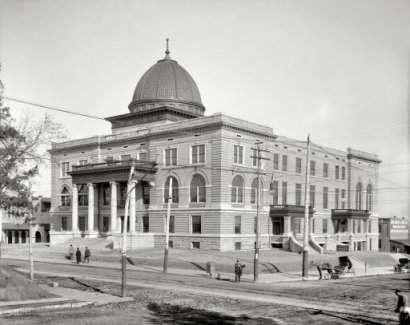
City Hall prior to 1912

By 1955, the copper-clad dome which sat on top of City Hall needed severe repairs. The wooden supports and the copper cladding were both in dire shape. Mayor Pratt Remmel set aside money for the dome to be repaired. After defeating Remmel in his bid for a third term, Mayor Woodrow Mann scrapped plans for the repair and, indeed, scrapped the dome.

Following the lead of County Judge Arch Campbell who had removed the tower at the County Courthouse, Mann proposed removal of the dome. He had an informal survey which had three options: repair the dome, replace the dome with an aluminum one, or remove it. This was open to anyone to respond – voting eligibility or Little Rock residency did not matter. By a slim margin, remove the dome won – so the dome was removed.

In 1960, as air conditioning was installed, windows were bricked in to promote energy efficiency. At the time, the feeling was that a new City Hall would be constructed in the 1970s somewhere more central to the growing city. Relocation talk persisted throughout the 1970s and early 1980s. By that time, City Hall had been modified a great deal – with no thought about historic preservation. When the Police and Fire Department had moved out into their new facilities, their old spaces had become storage.

By 1984, the decision was made to stay at Markham and Broadway. An extensive renovation and restoration effort was undertaken. In 1988, the building reopened, and the interior had been restored to its 1908 appearance.


Little Rock Look Back: LaHarpe Sees a Rock

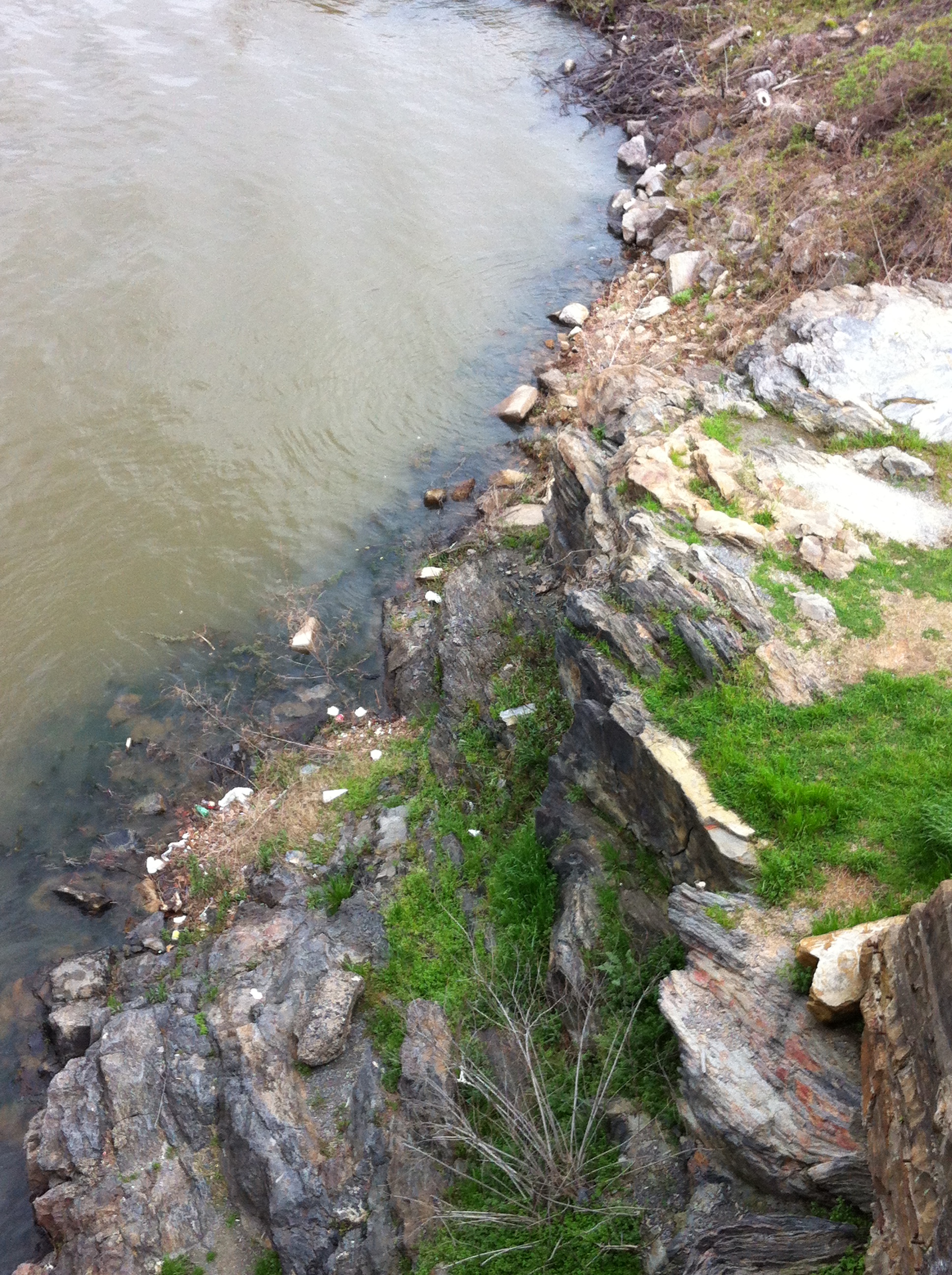
IMG_4805On April 9, 1722, French explorer Jean-Baptiste Bénard de La Harpe rounded the bend of the Arkansas River and saw La Petite Roche and Le Rocher Français.  He had entered the mouth of the Arkansas River on February 27 after traveling up the Mississippi River from New Orleans.

Though La Harpe and his expedition are the first Europeans documented to have seen La Petite Roche, the outcropping of rocks was well-known to the Quapaw Indians in the area.  The outcropping jutted out in the Arkansas River and created a natural harbor which provided a perfect place for boats to land.

The rock outcropping is the first one visible along the banks of the Arkansas River.  It marks the place where the Mississippi Delta meets the Ouachita Mountains.  Geologists now believe that the Little Rock is not the same type of rock as the Ouachita Mountains and more closely matches the composition and age of mountains in the western US.

In 1813, William Lewis became the first European settler to live near La Petite Roche but only stayed a few months.  Speculators and trappers continued to visit the area throughout the 1810s. During that time, the outcropping became known informally as the Little Rock.

La Petite Roche had become a well-known crossing when the Arkansas Territory was established in 1819. The permanent settlement of ‘The Rock’ began in the spring of 1820, and the first building has been described as a cabin, or shanty, and was built on the bank of the river near the ‘Rock.’ In March 1820, a Post Office was established at the ‘Rock’ with the name “Little Rock.”

Over the years, La Petite Roche was altered.  In 1872, Congress authorized the building of a railroad bridge. A pier for the bridge was built at the location of the La Petite Roche which caused the removal of several tons of rock.  The bridge was never built.  When the Junction Bridge was built in 1899, even more rock was removed in the process of erecting part of the bridge on top of the rock.  It was not viewed as being disrespectful of the City’s namesake at the time.  Indeed, it was viewed as a testament to the sturdiness of the rock.

In 2010, La Petite Roche plaza opened in Riverfront Park.  It celebrates the history of La Petite Roche and explores its importance to various aspects of Little Rock’s history and geography.

Tonight at the MacArthur Museum of Arkansas Military History, a FREE film: LAST DAYS IN VIETNAM

IMG_5596

In partnership with AETN, the MacArthur Museum of Arkansas Military History will host a preview screening of the “American Experience: Last Days in Vietnam.”  The screening starts at 6:30pm tonight at the museum in MacArthur Park.

Free admission. Free popcorn and beverages provided.

During the chaotic final days of the Vietnam War, the North Vietnamese Army closes in on Saigon as South Vietnamese resistance crumbles. The United States has only a skeleton crew of diplomats and military operatives still in the country. As Communist victory becomes inevitable and the U.S. readies to withdraw, some Americans begin to consider the certain imprisonment and possible death of their South Vietnamese allies, co-workers, and friends.

Meanwhile, the prospect of an official evacuation of South Vietnamese becomes terminally delayed by Congressional gridlock and the inexplicably optimistic U.S. Ambassador. With the clock ticking and the city under fire, a number of heroic Americans take matters into their own hands, engaging in unsanctioned and often makeshift operations in a desperate effort to save as many South Vietnamese lives as possible.

Last Days in Vietnam was produced and directed by Rory Kennedy, an Emmy Award-winning independent documentary filmmaker and co-founder and president of Moxie Firecracker Films. Her work has been shown on PBS, HBO, A&E, MTV, and Lifetime.

The MacArthur Museum of Arkansas Military History is a program of the City of Little Rock’s Parks and Recreation Department.


Little Rock Look Back: Special Election to finish funding Robinson Auditorium construction

jtrma-c.jpgThough Joseph Taylor Robinson Memorial Auditorium opened in February 1940, there was still money that needed to be raised to finish the construction and the building’s furnishing.  Ten days after the auditorium opening, the City Council approved an ordinance to call a special election on April 2, 1940, for the purposes of approving bonds for three separate projects.  One of these was for $30,000 for the completion of the auditorium; the bonds would not require any additional tax levy.

At the same meeting, a letter was read from the Young Men’s Business Association expressing support for the auditorium in the election, which was to be held in conjunction with the annual municipal general election. The Auditorium Commission had previously asked the City Council to consider issuing the bonds to pay for additional equipment for the building.  In their request to the aldermen, the members stressed that due to the current bond structure, these new bonds would not necessitate any tax increase.

The campaign for the new bonds used a similar structure and message as the 1937 election to build the auditorium.  There were newspaper ads by the steering committee (this time simply called the Citizen’s Committee and led by Omar Throgmorton) and support from civic organizations.  One thing very different from the 1937 campaign was the presence of an actual building.  On Sunday, March 31, just two days before the election, there was an open house for the public to explore the edifice.  From 1:00 p.m. to 9:00 p.m., members of various Little Rock Boy Scout troops led 4,000 visitors on tours of the auditorium.  Visitors were shown all over the building; one scout calculated that the walking tour equated to two miles.  Though most people were from Little Rock, the guest registry indicated visitors from California and Pennsylvania.

On April 2, 1940, Little Rock voters approved the new bonds 1,413 to 423.  Every precinct in every ward of the city voted in favor of the new bonds.  Shortly after the election, the bonds were issued.  The auditorium construction which had first been broached in 1904 was now completed in 1940.