Little Rock Look Back: Mayor David Fulton

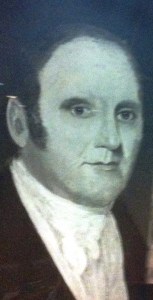
MayorFultonOn January 2, 1771 in Ireland, future Little Rock Mayor David Fulton was born.

He served as the fourth and final mayor of the Town of Little Rock in 1835. His term was cut short by the transition of Little Rock from town to city status. Once that happened in November 1835, a new election had to be held.

Mayor Fulton was also proprieter of the Tan Yard, a tanning operation in Little Rock.   He later served as a judge and was appointed as  Surveyor General of Public Lands in Arkansas by President Martin Van Buren in 1838.

Mayor Fulton married Elizabeth Savin in June 1795 in Maryland.  She died in November 1829, while they resided in Alabama.  Among their children was William Savin Fulton who served as Territorial Governor of Arkansas in 1835 and 1836 and was one of Arkansas’ first US Senators upon statehood in 1836.  Mayor Fulton was serving as Mayor at the same time his son was Governor.

Mayor Fulton came to Little Rock in 1833.  His daughter Jane Juliet Shall and her four children came to Little Rock as well.  The family made the move to be nearer to the future governor.  The Fultons and Shalls rented the Hinderliter House (now part of Historic Arkansas Museum) in 1834.

In addition to serving as Mayor, he was president of the Anti-Gambling Society and a Pulaski County Justice of the Peace.  From 1836 until 1838, he was County Judge of Pulaski County.

Mayor Fulton died on August 7, 1843 and is buried at Mount Holly Cemetery as are several other members of his family.

2015 In Memoriam – Parker Westbrook

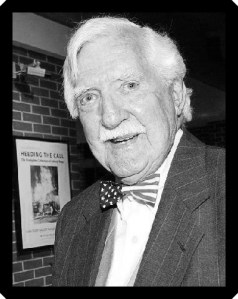
1515 WestbrookParker Westbrook WAS Mr. Preservation for Arkansas. But even though he is gone, it does not mean that preservation efforts in Arkansas are dormant.  Quite the contrary.  Like any good teacher, Parker used his knowledge to inspire others to share his interest in preservation.

It is no surprise that the organization he helped found, the Historic Preservation Alliance of Arkansas (now called Preserve Arkansas), names its lifetime achievement award after him.  He was not only the founding President of Preserve Arkansas, he was active in it until his final days.  It was not his only founding: he was a founder of Pioneer Washington Foundation (the oldest historic preservation organization in the state), the Main Street Arkansas Advisory Board, Historic Arkansas Museum Commission, the Arkansas State Capitol Association, and the Arkansas State Review Board for Historic Preservation. He served on the latter board from 1975 until his death this year, with the exception of five years from 2002 to 2007.  In recognition of his work in the field of heritage tourism, he was a 2007 inductee into the Arkansas Department of Parks and Tourism’s Hall of Fame.

His work was not limited by the boundaries of his home state.  He was an Advisor Emeritus to the National Trust for Historic Preservation and a 2001 recipient of a Preservation Honor Award from the Trust. Rep. Mike Ross declared him a “National Treasure” in the Congressional Record. He also served for two terms on the President’s Advisory Council on Historic Preservation and was named Chairman of the Committee on National Historic Landmarks on the National Park System Advisory Board.

A public servant, he worked for several federal officials from Arkansas, most notably Senator J. William Fulbright. He returned to Arkansas to work for Governor David Pryor.  But whether he worked in Washington DC; Little Rock; or his beloved hometown of Nashville, he was always interested in ensuring the past came alive. It might be through historic preservation, or it might be recounting a colorful moment of Arkansas history. Either way, Parker was a proponent of living history. He did not want it to be relegated to a musty, dusty book or building.
In 2007, he donated papers collected by his late sister Lucille and himself. The Lucille and Parker Westbrook Arkansas and Genealogy Collection is housed in the $20 million Arkansas Studies Institute, a joint project of the Central Arkansas Library System (CALS) and the University of Arkansas at Little Rock.  This collection has three parts: the first part focuses on Southwest Arkansas and contains genealogical sources and 3,000 historic photographs; the second highlights his public service and political career including much about the state’s architectural history; the third part consists of family papers, letters and photographs which document the Westbrooks’ deep roots in Arkansas.
He was the epitome of the Southern gentleman.  Not only did he look the part, he acted it. He was gracious in sharing credit with others; generous with his time, labor and talent; and did his best to keep up the lost art of writing letters and notes.

2015 In Memoriam – Mary Fletcher Worthen

In these final days of 2015, we pause to look back at 15 who influenced Little Rock’s cultural scene who left us in 2015.

1515 WorthenMary Fletcher Worthen cultivated history and music with the same grace and skill as she cultivated gardens.

Born outside of Scott, she attended Vassar and Little Rock Junior College. After marrying banker Booker Worthen, she devoted her life to improving Little Rock. Together with Stella Boyle and George Smith, she and Booker helped found the precursor to the Arkansas Symphony Orchestra.  Through its many iterations, she was a steadfast supporter and later was named a life member of the ASO Board.  She was also a supporter of many other music organizations in Little Rock including the Chamber Music Society of Little Rock, of which she was a founder.

Another hallmark of her involvement was Mount Holly Cemetery Association.  For over 50 years she served on the board of this body.  Without notes, she could recite the history of practically every resident buried there.  The tours she led with the late Peg Newton Smith were hot commodities when auctioned at fundraisers.  These two loving and lifelong friends would sometimes remember things differently. They playfully prodded and needled each other as they wended and winded their way through the headstones and history regaling rapt audiences with yarns of yore, quips and quotes, plus an anecdote or two.

She also served on the Old State House Museum Board and the Pulaski County Historical Society Board.  As a historian, she literally wrote the book on Trinity Episcopal Cathedral.  She combined her interest in herb gardening and history with the creation of the Medicinal Garden at Historic Arkansas Museum, which is now named in her honor.

Born in 1917, up until her final days Mary Worthen continued to learn new facts, share her love of history and music, and work to cultivate the next generations of cultural enthusiasts.

11th EVER Historic Arkansas Museum Nog-Off tonight

thnogoff_tstWhat began as a spirited and good-natured rivalry between the offspring of two longtime Little Rock families has given birth to one of the most anticipated holiday events of each year.

Get in the holiday spirit with Historic Arkansas Museum’s 11th Ever Nog-off, a culinary celebration of a favorite holiday drink and friendly competition for the best eggnog in town. Guests will also enjoy a new exhibit by Arkansas artist Ray Parker, holiday shopping in the Museum Store, roasted pecans in the Brownlee kitchen, caroling and storytelling around a fire pit on the museum’s historic grounds. Music will be provided by Heather Smith.

This year’s 11th Ever Nog-off will be judged by Capi Peck (Trio’s), Scott McGehee (Yellow Rocket Concepts) and Marcella Dalla Rosa who won the opportunity to judge this popular competition at Historic Arkansas Museum’s 20th Candlelight Gala

Noggers:
One Eleven at the Capital Hotel
Cache Restaurant
Loblolly Creamery
Bill Worthen
Stone’s Throw/Heritage Grille
John Selig and Leah Elenzweig
Rock City Eats featuring Chef Ken Dempsey and Greg Henderson

Each year, HAM announces a Nogger Emerita who has won this competition too many times!
This year’s Nogger Emerita is Bridget Fennell Farris! She has been a fierce Nog-off competitor with her famous “John Robert Jackson’s Egg-nog”

Ray Parker
Ray Parker is an oil painter from Fayetteville whose subject matter focuses on human portraiture in a style that is both naturalistic and expressive. Parker’s intimate portrayal of the human form intends “to address both the timeless and temporal character of life, I place my subjects in contexts that allow me to investigate their emotional and psychological nature …”

The 48th Annual Christmas Frolic this afternoon at Historic Arkansas Museum

HAM-frolicWhen the Culture Vulture was just a Culture Chick, his parents took him to then-Arkansas Territorial Restoration Christmas Open House.

Thankfully, this event continues and celebrates Christmas as it was in the 1800s with living history, carols, reenactments, live music, dancing and more. Visitors come from across the state every year for our famous hot cider and ginger cake, as well as Arkansas-made holiday shopping in the Museum Store.

Activities:

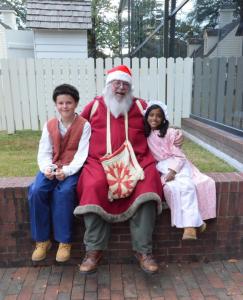
  • Have your photo taken with Father Christmas from 1:30 to 2pm and from 2:30 to 3 pm.
  • Crafts and cards in the Hands On History classroom
  • Live music performances in our atrium and galleries.
  • McVicar House: Readings of “The Night Before Christmas” (originally published in 1823) at 1:30, 2:15, 2:45 and 3:15 pm. Readings will alternate with appearances by Capt. James McVicar.
  • Print Shop: Learn what apprentices looked forward to about the holiday; make a wax seal
  • Brownlee Kitchen: caroling
  • Hinderliter Grog Shop: dancing
  • Farmstead: Blacksmith Shop open, Early Arkansas Reenactors will be doing a variety of pioneer demonstrations, cider and gingercake in the parlor, crafts in the bedroom, reindeer food on the porch.
  • There will be games on the historic grounds and at the farmstead.

The fun continues from 1pm until 4pm today.  Watch for HAM director Bill Worthen to dance the Virginia Reel, which members of his family have been dancing in Arkansas since the 1820s.

Today at noon – Bill Worthen discusses Historic Arkansas Museum for Butler Center Legacies & Lunch

Bill-Worthen_K0A4687-webAt Legacies & Lunch, Bill Worthen, director of the Historic Arkansas Museum, will discuss the museum’s history, placing emphasis on Louise Loughborough, founder of the museum, and Ed Cromwell, who led the museum after Loughborough’s death.

Worthen, a Little Rock native, is a graduate of Hall High School and Washington University, St. Louis. After teaching high school in Pine Bluff for three years, Worthen became director of what was then known as the Arkansas Territorial Restoration in 1972. In 1981, the organization became the first history museum in Arkansas to be accredited by the American Association of Museums. The museum was renamed the Historic Arkansas Museum in 2001 to reflect its expanded facility and mission. Worthen’s current research interests are the bowie knife, sometimes called the Arkansas toothpick, and the Arkansas Traveler, in its many forms.

Legacies & Lunch is free, open to the public, and supported in part by the Arkansas Humanities Council. Programs are held from noon-1 p.m. on the first Wednesday of each month. Attendees are invited to bring a sack lunch; drinks and dessert are provided. For more information, contact 918-3033.

Learn more about Native American Heritage at Historic Arkansas Museum

HAMCollectionHeadPotNovember is Native American Heritage Month.  It’s a great time of year to visit Historic Arkansas Museum and explore their permanent exhibit “We Walk In Two Worlds: The Caddo, Osage and Quapaw in Arkansas.”

And remember – Admission to the galleries at Historic Arkansas Museum is FREE!

This exhibit tells the story of Arkansas’s first people–the Caddo, Osage and Quapaw Indian tribes–from early times to today. More than 150 objects, such as pottery, clothing and weapons, are on display.

The exhibit has six thematic areas that are arranged chronologically.  Along with objects and a historical timeline are passages of relevant research from archeologists, historians and ethnographers.

Throughout the exhibit, is the dominant presence of the Native American voice, from each of Arkansas’s three prominent tribes. During the two years of exhibit development, many tribal members were interviewed and it is this voice that informs, educates and guides visitors through the exhibit. Historic Arkansas Museum chief curator and deputy director Swannee Bennett said, “What makes this exhibit unique is that it is a story of the Arkansas Native American told in large part with an Indian voice.”

This permanent exhibit enables the museum to tell the bigger story of Arkansas’s frontier history. “We Walk in Two Worlds is a milestone as the State of Arkansas officially partners with the Caddo, Osage and Quapaw Nations and the Smithsonian’s National Museum of the American Indian to tell this story of struggle and endurance.” said museum director Bill Worthen.