RobinsoNovember: Emily Miller

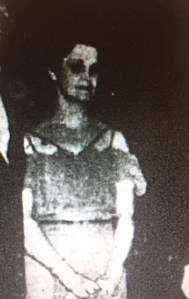
emilyFrom January 1940 until December 1971, Emily Miller served on the Robinson Auditorium Commission.  She was the longest serving member of that body and had one of the longest tenures of any person on any City of Little Rock commission.  In keeping with the times, she was always referred to publicly as Mrs. Grady Miller. Probably the only time she was ever listed in a newspaper as Emily Sturges Miller was her obituary in 1993.

Born in Ohio in 1903, she studied at Smith College in Massachusetts. In 1925, she visited Washington DC for the presidential inauguration of Calvin Coolidge. While there she met Grady Miller, who was the brother-in-law of Senator Joseph T. Robinson.  After marrying Mr. Miller, she moved to Arkansas and made it her home for the next seven decades.

Throughout the 1930s and 1940s, she was active in the PTA, Junior League of Little Rock, and Colonial Dames.  Mrs. Miller was also active in Second Presbyterian Church.  As her two children became older, she and her husband traveled extensively.

Because she was related to Senator Robinson’s widow, Mayor J. V. Satterfield asked Mrs. Miller to serve on the Auditorium Commission.  She was subsequently reappointed every time her term came up.  For the 1940 ribbon cutting, Mrs. Miller joined her sister-in-law and Mayor Satterfield on the stage.  They were the only participants.  (It had been Mrs. Miller who informed Mrs. Robinson of her husband’s death.  Mr. Miller had called Mrs. Miller, who was visiting family in Ohio at the time, to inform her.  She then called her sister-in-law to extend her sympathies, not realizing that no one had yet informed Mrs. Robinson who was in Little Rock preparing for a trip.)

Several decades later as a Sunday School teacher in her late 60s, Mrs. Miller was not in favor of the musical HAIR being performed at Robinson.  When a federal judge ruled that it had to be allowed, Mrs. Miller was the only member of the Auditorium Commission who would speak to the press. Her response is one of the Culture Vulture’s favorite statements ever made to a member of the media.  “Oh dear,” was her only reply. She refused further elaboration.  While the Commission was wrong in opposing the show, the fact that none of her fellow commissioners (all men) would speak to the press, shows a lot of moxie on her behalf.

RobinsoNovember: Mayor R. E. Overman

Overman AuditR. E. Overman assumed the office of Little Rock mayor in April 1935. Around that time, a new wave of New Deal programs were filtering down from Washington DC to cities.  It can be said of Mayor Overman that he did not meet a New Deal program he did not like.  From rebuilding the sewer system, to creating a public water utility, to constructing of structures for the Museum of Fine Arts, Little Rock Zoo, and Boyle Park, Mayor Overman signed the City up for program after program.

While the programs were all worthwhile, and in some cases absolute necessities, Mayor Overman did not seem to consider how these massive projects running concurrently would impact the City finances.  In November 1935, he submitted a proposal to the Public Works Administration for the construction of a new municipal auditorium to be located at the northeast corner of the intersection of Scott Street and Capitol Avenue. It would have taken up three/quarters of that block and wrapped around the Women’s City Club building (now the Junior League of Little Rock headquarters).  Because of other projects in the works, he did not pursue any further action on the auditorium project at the time.

In November 1936, Mayor Overman asked the City Council to place three bond issues on a special election ballot for January 1937, one of which was a municipal auditorium. Though a location had previously been identified in 1935, at this point in time supporters made a concerted effort to disclose that no location had been selected.  After the election was called, there was a concerted effort by supporters of the three separate bond issues to collaborate.  Voters overwhelmingly approved all three issues, and Little Rock’s journey to a municipal auditorium at last was underway. Perhaps.

Over the summer, architects and lawyers were selected. In the autumn, a consultant was hired to help with the selection for the site.  The month of October was consumed with City Council battles over the auditorium site.  Mayor Overman favored a location at Markham and Spring Streets (now site of the Cromwell Building and the Bankruptcy Courthouse). Because the Federal Government owned half the site and did not want to sell it, that location was deemed not feasible – though that did not stop Mayor Overman and others from repeatedly citing it as their first choice.  The only person who favored the location at Markham and Broadway did not have a vote: Planning Commission Chair J. N. Heiskell. Though he had no vote, he had the twin bully pulpits of Planning Commission and the Arkansas Gazette. As other sites fell by the wayside, he kept advocating for it.  Finally, the City Council approved of Heiskell’s choice, and the auditorium had a site.

The groundbreaking had to take place by January 1, 1938, or the money would be rescinded. After finalizing a location, planning could get underway.  With a week to spare, the ground was broken on December 24, 1937.  Mrs. Joseph T. Robinson, widow of the recently deceased US Senator from Arkansas, joined Mayor Overman in the groundbreaking. This ceremony was the first mention of the building being named in memory of the fallen senator, who had died in the summer of 1937.

Construction progressed throughout 1938 and into 1939.  Because of the precarious state of the City’s finances, Mayor Overman lost the support of the business community.  In November 1938, he lost his bid for the Democratic nomination for Mayor and was denied a third two-year term.  He left office in April 1939.

RobinsoNovember: Mayor W. E. Lenon

Mayor Lenon with the plans for the original City Hall/Auditorium and the temporary auditorium.

In 1904, Little Rock Mayor W. E. Lenon first proposed that Little Rock construct at municipal auditorium.  After considering some options, he decided it would be easiest to build it in conjunction with a new City Hall and Jail.  In 1906 plans proceeded in that direction until a lawsuit by J.N. Heiskell to stop it.

Following a judge’s ruling that a municipal auditorium was not deemed a proper use for public monies, the City changed course and constructed only a City Hall and Jail (sans auditorium) at the corner of Markham and Broadway. This building opened in 1908.

In 1906, the City gave permission to a private developer to build a temporary auditorium (which also served as a roller skating rink when the chairs were removed) adjacent to the City Hall site.  This opened in 1907.

Mayor Lenon left office in 1908.  He would later chair a committee involved in an auditorium proposal in 1925, but that one would come to naught, as well.  However, he planted the seed and started the public discourse which lasted for 36 years.  His daughter, Vivion, would be married to Joseph Brewer a nephew and aide of Joseph T. Robinson, after whom the eventual auditorium would be named.

RobinsoNovember: Senator Joseph Taylor Robinson

150px-joseph_t-_robinson_croppedThis month, Robinson Center Music Hall will reopen after a two year renovation/restoration/remodeling/reconstruction.  To commemorate that, each day in November, the Culture Vulture will look at a person or event connected to Robinson Center Music Hall.

Up first, the eponym for the building.

Senator Joseph Taylor Robinson was born in Lonoke in 1872.  In 1894 Robinson was elected to the Arkansas General Assembly for one term.  From 1903 until 1913, he served in the US House of Representatives as a Congressman from Arkansas’ then-Sixth District.

He chose not to seek another term in Congress and ran for Governor in 1912.  On January 3, 1913, sitting US Senator Jeff Davis died in office.  Robinson was sworn in as Governor on January 16, 1913. Twelve days later he was chosen by the Arkansas General Assembly to become the next US Senator. He became the final US Senator to be selected by a legislator instead of popular vote.  At the time, Senate terms started in March, so Robinson served as governor until March 8, 1913.

He rose through the ranks of the Senate and eventually became the first person to hold the title of Senate Majority Leader.  In 1928, he was the Vice Presidential nominee for the Democratic Party.  Four years later, he rode with Franklin and Eleanor Roosevelt to the inauguration ceremonies before FDR took the oath.  He would be President Roosevelt’s go-to man on legislative issues.


Senator Robinson died in Washington D.C. on July 14, 1937.  His wife was in Little Rock making preparations for a trip the couple was to take. Following his demise, Mrs. Robinson went to Washington to accompany her husband’s body back to Arkansas.

The Senator was honored with a memorial service in the Senate chambers on Friday, July 17.  President Roosevelt and the cabinet joined members of the senate on the floor in what was described as a state funeral without pomp.  Mrs. Robinson sat with her brothers and two nephews as well as Bernard Baruch and Arkansas Power & Light’s Harvey Couch, who were Senator Robinson’s closest friends.  Eleanor Roosevelt was one of the many crowded in the senate galleries observing the service.  Following the service his body remained in the chambers until it was transferred to a train to make the journey to Little Rock.

The funeral train bore his body, his family, 50 senators and over twenty congressmen. It reached Little Rock around 8am on Sunday the 19th.  From there, Senator Robinson’s body was taken to his house on Broadway Street until noon.  It subsequently lay in state at the Arkansas State Capitol until being escorted by military to First Methodist Church.

As the funeral procession reached Roselawn Cemetery, thunder echoed. The skies which had alternated between sun and rain that day, returned to rain. A deluge greeted the end of the service and sent visitors hurrying for shelter at the end.

It was not until December 1937, that Senator Robinson’s name became attached to the municipal auditorium which Little Rock voters had approved in January 1937.

Brown Bag lecture at Old State House today focuses on Robinson Center construction

robinson-auditorium-by-scott-carterToday (Thursday, October 6) at noon at the Old State House, the Brown Bag lecture focuses on the construction of the Joseph Taylor Robinson Memorial Auditorium.

After three decades of failed attempts to build a municipal auditorium in Little Rock, the New Deal finally offered the opportunity to build a structure for performances and conventions. But there were still many roadblocks on the way to the opening of the Joseph Taylor Robinson Memorial Auditorium.

For this Brown Bag Lunch Lecture, Scott Whiteley Carter will examine the changes and chances from October 1935 to April 1940 leading up to the opening of Robinson Auditorium. The period featured a reluctant but triumphant mayor, a crusading newspaper editor, political intrigue, financial chaos, and a plethora of frustration — all ultimately leading to a monument to civic pride.

A native of Little Rock, Carter is Special Projects Administrator at the City of Little Rock. Among his duties in this capacity are research and functioning as the city’s historian.

Little Rock Look Back: Cornice placed on Robinson Auditorium

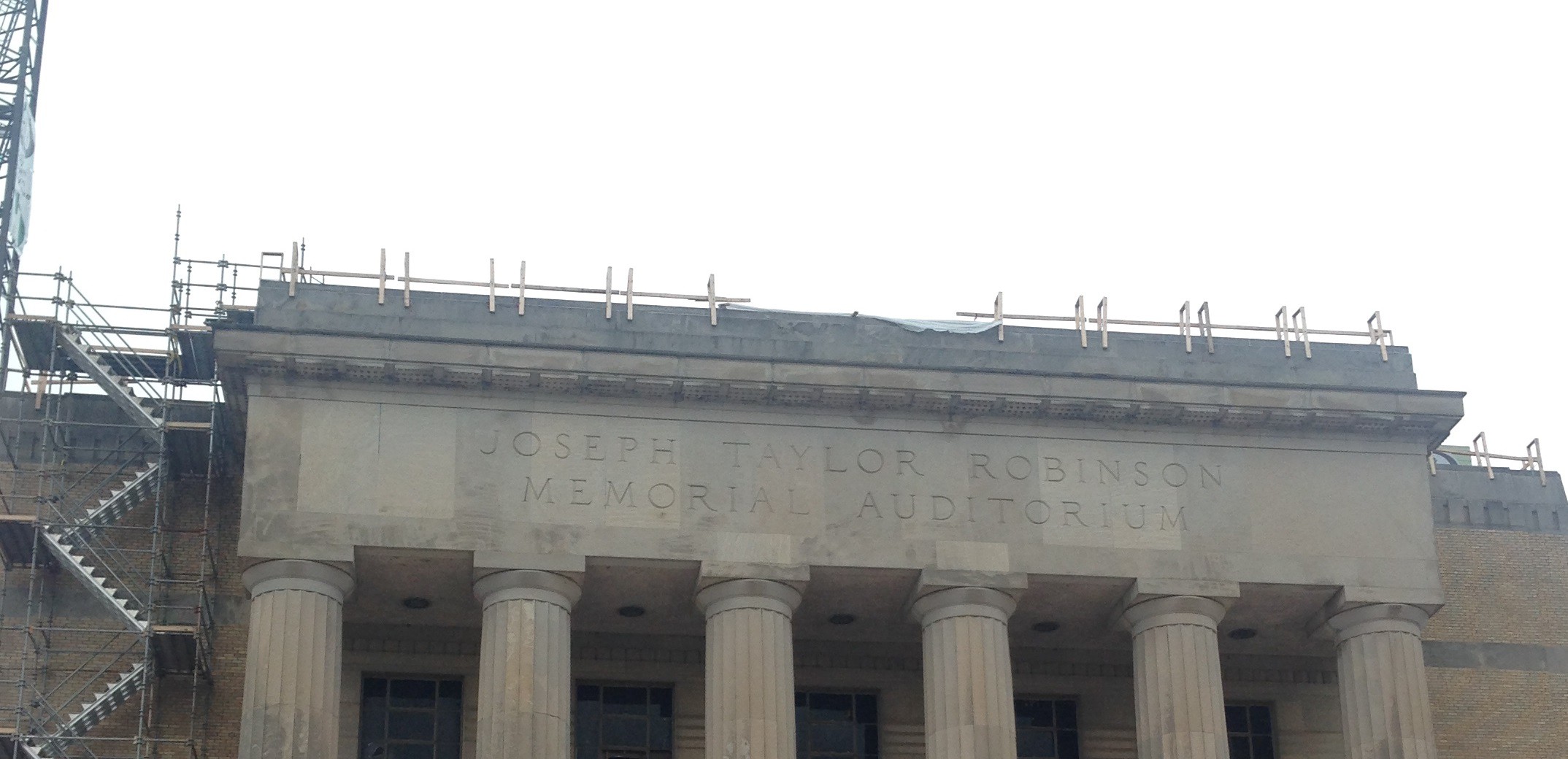
JTR CorniceOn June 1, 1939, the cornice was installed on Robinson Auditorium.  This granite slab noted the name of the building as the Joseph Taylor Robinson Memorial Auditorium.  (It is interesting to note that it used the more modern “u” instead of the classical “v” which was often used in buildings during prior decades – as evidenced by the Pvlaski Covnty Covrt Hovse across the street.)

This was a milestone marking the completion of the front facade of the structure.  Much work would continue on the interior of the structure.  This step in the construction was considered major enough that the Arkansas Gazette mentioned it in a news article.

Today the cornice is again surrounded by construction materials and braces. The front lobby, the cornice and columns are pretty much the only parts of the building not currently under construction as Robinson Center is readied for its second act.  It is scheduled to open in November 2016.

Arkansas Heritage Month – LR Mayor Overman and a municipal auditorium

Overman AuditR. E. Overman assumed the office of Little Rock mayor in April 1935. Around that time, a new wave of New Deal programs were filtering down from Washington DC to cities.  It can be said of Mayor Overman that he did not meet a New Deal program he did not like.  From rebuilding the sewer system, to creating a public water utility, to constructing of structures for the Museum of Fine Arts, Little Rock Zoo, and Boyle Park, Mayor Overman signed the City up for program after program.

While the programs were all worthwhile, and in some cases absolute necessities, Mayor Overman did not seem to consider how these massive projects running concurrently would impact the City finances.  In November 1935, he submitted a proposal to the Public Works Administration for the construction of a new municipal auditorium to be located at the northeast corner of the intersection of Scott Street and Capitol Avenue. It would have taken up three/quarters of that block and wrapped around the Women’s City Club building (now the Junior League of Little Rock headquarters).  Because of other projects in the works, he did not pursue any further action on the auditorium project at the time.

In November 1936, Mayor Overman asked the City Council to place three bond issues on a special election ballot for January 1937, one of which was a municipal auditorium. Though a location had previously been identified in 1935, at this point in time supporters made a concerted effort to disclose that no location had been selected.  After the election was called, there was a concerted effort by supporters of the three separate bond issues to collaborate.  Voters overwhelmingly approved all three issues, and Little Rock’s journey to a municipal auditorium at last was underway. Perhaps.

Over the summer, architects and lawyers were selected. In the autumn, a consultant was hired to help with the selection for the site.  The month of October was consumed with City Council battles over the auditorium site.  Mayor Overman favored a location at Markham and Spring Streets (now site of the Cromwell Building and the Bankruptcy Courthouse). Because the Federal Government owned half the site and did not want to sell it, that location was deemed not feasible – though that did not stop Mayor Overman and others from repeatedly citing it as their first choice.  The only person who favored the location at Markham and Broadway did not have a vote: Planning Commission Chair J. N. Heiskell. Though he had no vote, he had the twin bully pulpits of Planning Commission and the Arkansas Gazette. As other sites fell by the wayside, he kept advocating for it.  Finally, the City Council approved of Heiskell’s choice, and the auditorium had a site.

The groundbreaking had to take place by January 1, 1938, or the money would be rescinded. After finalizing a location, planning could get underway.  With a week to spare, the ground was broken on December 24, 1937.  Mrs. Joseph T. Robinson, widow of the recently deceased US Senator from Arkansas, joined Mayor Overman in the groundbreaking. This ceremony was the first mention of the building being named in memory of the fallen senator, who had died in the summer of 1937.

Construction progressed throughout 1938 and into 1939.  Because of the precarious state of the City’s finances, Mayor Overman lost the support of the business community.  In November 1938, he lost his bid for the Democratic nomination for Mayor and was denied a third two-year term.  He left office in April 1939.