Little Rock Look Back: Central & Hall Football at 2-0

lrchs-lrhhsAfter two weeks of prep gridiron (that is high school football to those who don’t write like a 1950s inky wretch), Little Rock Central and Little Rock Hall are both posting records of 2 wins and 0 losses.  This feat has not been achieved in quite a while.

How long?  37 seasons!  It was 1979, the last time that the Tigers and Warriors were both out of the gate at 2-0.

1979

Jimmy Carter was in the White House. Bill Clinton was in his first term as Governor. First Lady Hillary Rodham was several months pregnant with Chelsea. Hall High and Razorback standout Webb Hubbell was Mayor of Little Rock.  The City’s population was in the 150,000s (it would be 159,151 after the 1980 census).  Little Rock had an area of approximately 80 square miles.  (Today it is approximately 200,000 citizens over 122 square miles.)

Lou Holtz was coaching the Arkansas Razorbacks in the Southwest Conference.  Harry Hall was in his first season as Commissioner of the Arkansas Intercollegiate Conference.  Rex Nelson was a student at Ouachita.  Paul Eells was in his second year with KATV, while Dave Woodman was finishing his first decade at KARK.  Gary Hogan was anchoring sports for KTHV.  Hogs football games were broadcast on KAAY radio.  While Bob Buice and Jim Elder were ruling the airwaves at KARN, Craig O’Neill was dominating mornings at KLAZ.

Orville Henry, Jim Bailey, and Wadie Moore covered college and high school sports for the Arkansas Gazette.  The Arkansas Democrat had switched to morning delivery and hired John Robert Starr as editor.  Both papers carried ads for Kempners, Golds, M.M. Cohn, Skaggs Albertsons, Minute Man, Union National Bank, Commercial National Bank, Worthen National Bank, and First National Bank.

Metrocentre Mall existed with bricked over streets on Main and Capitol. The Grady Manning Hotel and Hotel Marion still stood (though in their twilight days before their February 1980 date with demolition.)

So a lot has changed since Central and Hall previously achieved this.  In the interval, Central has been 2-0 a dozen times and Hall has achieved that a brace. But the schools never managed it during the same season.  Three times the schools both managed 1-1 seasons and seven times they each started at 0-2.

The 1979 Warriors were helmed by C. W. Keopple, who would lead the team from the 1960s into the 1980s winning four conference/state titles. (When your conference is statewide, winning one got you the other.)  Bernie Cox was in his fifth season as the Tigers’ mentor, with two state championships already under his belt, five more would be in his future.

The teams stayed tied through the fourth week. But in the fifth week, while Central won, Hall lost to Parkview by a score of 7-0.  The following week, the Warriors rebounded, while the Tigers settled for a 0 to 0 tie with Ole Main.  Weeks seven through ten saw both teams notching another win each week.  This set up a Thanksgiving Day classic with the state’s top two teams facing off.  Central was slightly favored, but season records seldom carried any weight when the two cross-town rivals played on Thanksgiving afternoon.  In an upset, Hall bested Central by a score of 17 to 0.

From 1987 to 1990, the second game of the season was the Hall-Central matchup, which meant that it would have been impossible to both start with a 2-0 record.  This second week matchup was made necessary by the fact that not only could the two teams no longer face off on Thanksgiving after 1982, but the two schools were not in the same conference from 1983 through 2000. So the faceoff was early in the season, during the non-conference portion.

Due to subsequent restructurings by the Arkansas Activities Association, the two schools have not played a football game since 2005.  The bell from the “Battle of the Bell” which was supposed to replace the pageantry and intense rivalry of the Thanksgiving Day matchups, sat forlornly and largely forgotten in the trophy case at Central following the 2005 edition which Central won by a score of 24 to 7.  (That season Central started at 0-2 on the way to a 5-5 record and Hall started at 1-1 on the way to a 3-7 record.)  UPDATE: As noted in a comment on this piece, the Bell has now been refurbished and sits proudly at Quigley Stadium.  Thank you Belinda Stilwell for the information!

Who knows how the 2016 season will turn out for these two teams?  In the past 2-0 has led both to State Championships and to a 6-4 record.  But for two schools that have struggled in the past few seasons, to start with a 2-0 record is quite an accomplishment. For both to start with that record is remarkable.


While the blog hiatus and a restructuring continue, this was a bit of history that needed mentioning.

Arkansas Heritage Month – LR Mayor Pat L. Robinson and a municipal auditorium

PLR AuditIn April 1929, at the age of 29, Pat L. Robinson (no relation to Senator Joe T. Robinson) was inaugurated as Little Rock’s mayor.  Shortly after he took office, a variety of City Council committees and city interest groups started making proposals for projects to be funded by City bonds.  The decision was made to put a municipal bond issue before voters in August 1929.

The Young Business Men’s Association proposed a municipal auditorium be included.  In his 1929 inaugural address, Mayor Robinson had commented that an auditorium would be a worthwhile project for the city, should funding be available.  Another proposal, which seemed to have mayoral support, was the Civic Center plan (including land for an auditorium) which J. N. Heiskell had started shopping in the waning days of the Moyer administration.

The City Council approved the calling of the election and the submission of eleven different items.  Mayor Robinson then invoked the ire of the aldermen by noting he would only support four of the eleven proposals. Over the ensuing weeks, he and the aldermen traded charges and parliamentary ploys.  In July, the Council voted to cancel the election, which the mayor vetoed.  Though the Council had the votes to override the veto (and therefore not have the election), they let the veto stand.  The election proceeded as planned in August.

Hobbled by a lack of a cohesive campaign to begin with which was exacerbated by the City Hall infighting, it was probably no surprise that the few of the election proposals were approved by voters.  The marvel is probably that any were actually approved.  This appears to have been the first municipal bond election put forth after the 1926 approval of the new amendment to the Arkansas constitution.

Neither the Auditorium nor the Civic Center proposals were approved.  Throughout his term, the Hotel Marion continued to be the main site in Little Rock for conventions, while Little Rock High School’s auditorium was the showcase for performances.

No further proposals for an auditorium were put forth during the remainder of the Pat L. Robinson administration.  After continuing to alienate the Democratic power structure, he was challenged in the November 1930 primary, and failed to receive the nomination to be the Democratic nominee for mayor in 1931.

Arkansas Heritage Month – LR Mayor Moyer and a Municipal Auditorium

Moyer AuditIn anticipation of the November 2016 reopening of Robinson Center Music Hall, this week’s Arkansas Heritage Month entries look at seven Little Rock Mayors who worked on proposals for a municipal auditorium between 1904 and 1940.

After having served as Pulaski County Judge, Charles Moyer was elected Little Rock Mayor in April 1925.  He concluded his inaugural address later that month with a request that all Little Rock voters should support the auditorium district proposal in the May 1925 special election.  Voters approved the auditorium, but the concept of an auditorium district was thrown out by the Arkansas Supreme Court after a legal challenge.

Mayor Moyer then led a statewide effort to get a Constitutional amendment approved to allow for public bonds to be used on auditoriums and a host of other structures, as long as voters approved the issuance of bonds.  This was approved by voters in October 1926.  Though Mayor Moyer publicly advocated for an auditorium after that election, he did not lead a subsequent effort to create one.  During his tenure, conventions were largely centered around the Hotel Marion.  A new Little Rock High School was built (now Little Rock Central High) with that auditorium supplanting its predecessor as the location of choice for large-scale performances.

He left office in April 1929.  In the final weeks of Mayor Moyer’s second term, Planning Commission Chair J. N. Heiskell (editor of the Arkansas Gazette) started discussing the need for a civic center for Little Rock which would include space for a municipal auditorium.

Charles Moyer returned to the office of mayor for an additional two terms in the 1940s. By that time Robinson Auditorium had been opened.

Arkansas Heritage Month – Cannes Critics Loving Jeff Nichols’ LOVING Film

NicholsThe early reviews are starting to come in from the Cannes screening of Little Rock native (and Central High grad) Jeff Nichols’ latest opus LOVING.

The film screened on Monday in Cannes.  Oscar buzz has already started for the film, Nichols and his performers.

Here is what some of the critics had to say:

Vox says that the film’s: “subdued tone delivers a wealth of emotions in the film’s final minutes.”  It also declares “Loving is a period piece that feels eerily relevant today.”

IndieWire notes:

“In an impressive body of work accumulated over the past 10 years, Jeff Nichols has emerged as a skilled filmmaker who relishes in the poetry of Southern life. It was only a matter of time of time before he explored its history. With “Loving,” the director moves from the combination of otherworldly lyricism and genre storytelling in “Take Shelter,” “Mud” and “Midnight Special” toward more conventional drama — namely, the backstory of Loving v. Virginia, the 1967 Civil Rights case that overturned laws against interracial marriage. — by exploring the intimate details behind its legacy.”

And also credits “Nichols’ elegant screenplay, which pares down the events so that the emphasis is taken off the legal proceedings and avoids any overdone speechifying.”

loving-teaser-posterVariety calls the movie “a film of utmost sensitivity” and declares, “Though it will inevitably factor heavily in year-end Oscar conversations, Nichols’ film is seemingly less interested in its own glory than in representing what’s right.”

The Hollywood Reporter opines: “writer-director Jeff Nichols takes an appealingly low-key approach to an important American civil rights story in Loving.”  It also praises his “way of underplaying racism, even as he firmly notes its constant presence in daily life and makes it the overriding subject of his film, is refreshing as well as rare in the realm of socially conscious cinema,indicating a respect for his audience’s intelligence and a desire not to hit viewers over the head.”

THR concludes its review by stating “Nichols has delivered a timely drama that, unlike most films of its type, doesn’t want to clobber you with its importance. It just tells its story in a modest, even discreet way that well suits the nature of its principal characters.”

The Daily Beast notes “An anguished, but low-key, meditation on race—American’s ongoing obsession—Loving is the most high-minded sort of Oscar bait.”

In The Telegraph, Robbie Collins declares that Nichols “calmly dodges every expectation you have for the genre. Loving is short on grandstanding and hindsight, long on tenderness and honour, and sticks carefully to the historical record.”  He also says that, “The film’s determination not to overcook any single scene means the tears it eventually draws feel honestly come by.”

While Cannes tries to focus on art and not awards or commercialism, the positive early reviews for Loving, coupled with Focus Features’ November release date, should poise the film for awards season in late 2016 and early 2017. More importantly, this will continue to raise the profile of Jeff Nichols, who continues to make Little Rock proud.


Arkansas Heritage Month – Little Rock’s Jeff Nichols at Cannes

NicholsLittle Rock native Jeff Nichols’ latest film, Loving, premieres at Cannes today. The film showed at 8:30 am and 11:30 am Cannes time. (That would be at 1:30am and 4:30am, Little Rock time). It also shows at 7pm Cannes time (12 noon, Little Rock).

Loving, which was written and directed by Nichols, tells the story of the Mildred and Richard Loving, an interracial married couple who were sentenced to prison in Virginia in 1958. It is set for national release in November and is being distributed by Focus Features.

Nichols was first brought the project by Martin Scorsese. A 1997 graduate of Little Rock Central High, he was intrigued by the story and the opportunities it provided him as a filmmaker.

The film stars Joel Edgerton and Ruth Negga as the central couple. Others in the cast include Michael Shannon, Nick Kroll, and Bill Camp.  Edgerton, Shannon and Camp are part of Nichols’ informal repertory company of actors. Interestingly, Shannon and Camp are both nominated for Tony Awards in the same category (Featured Actor in a Play) for work they have done on Broadway this spring in American classics: Shannon in O’Neill’s Long Day’s Journey into Night and Camp in Miller’s The Crucible.

This is Nichols’ third film to screen at Cannes, following 2012’s Mud (which like Loving was in contention for the Palm d’Or) and 2011’s Take Shelter (which won the top prize at Cannes’ Critics Week).  His first feature film was 2007’s Shotgun Stories.

With Loving’s screening at Cannes, Nichols is in a select group of directors to have one film screen at the Berlin International Film Festival (where he showcased Midnight Special) and another at Cannes in the same year.

Arkansas Heritage Month – The Architecture of Little Rock Central High School

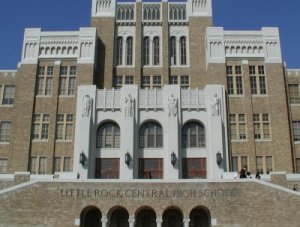
centralentranceArchitecture is often overlooked when considering the arts, but it is definitely an art form.

Built in 1927 as Little Rock Senior High School, Central was named “America’s Most Beautiful High School” by the American Institute of Architects. The New York Times called it the most expensive high school built at the time.

Designed as a mix of Art Deco and Collegiate Gothic architectural styles, the building is two city blocks long and includes 150,000 square feet of floor space. The project involved most of Little Rock’s leading architects who were still practicing at the time: John Parks Almand, George H. Wittenberg and Lawson L. Delony, Eugene John Stern, and George R. Mann.  Over the years, different architects would take credit for various facets of the building.  Given the size of the project, there was plenty of work for each architect to do.

More than 36 million pounds of concrete and 370 tons of steel went into the building’s construction. The building contained 150,000 square feet of floor space, upon its completion. It cost $1.5 million to construct in 1927. The school received extensive publicity upon its opening. An article in the Arkansas Gazette said, “we have hundreds of journalists in our fair city for the dedication” of the new high school.

At its construction, the auditorium seated 2,000 people between a main level and a balcony.  The stage was sixty feet deep and 160 feet long so that it could be used gymnasium. From 1927 until the opening of Robinson Auditorium in 1940, the auditorium would be Little Rock’s main site for hosting performances by musical and theatrical groups.

Subsequent additions would include a separate gymnasium, a library, and a football stadium. In 1953 the school’s name was changed to Little Rock Central High School, in anticipation of construction of a new high school for students, Hall High School.

In 1977, the school was listed on the National Register of Historic Places, and it was designated a National Historic Landmark in 1982. These were in recognition of desegregation events which took place in the school in 1957.

In 1998, President William Jefferson Clinton signed legislation designating the school and visitor center across the street as a National Historic Site to “preserve, protect, and interpret for the benefit, education, and inspiration of present and future generations…its role in the integration of public schools and the development of the Civil Rights movement in the United States.”

Arkansas Heritage Month – Jeane Hamilton

Photo taken for SOIREE

Photo taken for SOIREE

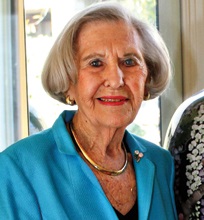
Happy Mother’s Day.  Today as part of Arkansas Heritage Month, we salute Jeane Hamilton — the “mother” of the Arkansas Arts Center.  In 2007, she was awarded the Arkansas Arts Council’s Lifetime Achievement Governor’s Arts Award.

Arriving in Little Rock a young wife in 1952, she immediately set about to become involved in her new community as she and her husband James set up a household.  In the mid-1950s, the Junior League of Little Rock tapped her to chair the initiative to create a new art museum for Little Rock.  The two decades old Museum of Fine Arts was threadbare through years of neglect and unfocused programming and collecting.

Hamilton, along with Junior League President Carrie Remmel Dickinson and Vice President Martha McHaney, approached Winthrop Rockefeller (then a relatively new resident) to lead the fundraising effort for the new museum.  He agreed on a few conditions: one was that a base amount had to be raised in Little Rock first, and second that the museum would be for the entire State of Arkansas and not just Little Rock.

Hamilton and her colleagues set about to raise the funds. They raised $645,000 at the same time Little Rock’s business climate was stymied by the aftereffects of the Central High crisis.

Now a lifetime honorary member of the Arkansas Arts Center Board, Hamilton has spent much of her life working on Arkansas Arts Center projects since that visit in 1959.  She has served on the Board, chaired committees, chaired special events, served hot dogs, helped kids paint and danced the night away at countless fundraisers.  She was on the committee which hired Townsend Wolfe as executive director and chief curator.  Jeane has led art tours for the Arts Center to a number of countries over the years.

When she is not at the Arts Center, she is often seen at the Rep, the Symphony or any number of other cultural institutions.  While she enjoys seeing old friends at these events, she also loves to see a room full of strangers – because that means that new people have become engaged in the cultural life of Little Rock.