

City Hall circa 1908
110 years ago today, Little Rock City Hall officially opened at the corner of Markham and Broadway.
On April 15, 1908, the Italian Renaissance Revival style building, which had been designed by local architect Charles Thompson, played host to an open house. Staff had started moving into the building in March of that year. This was, as often is the case, behind schedule. The date in the cornice toward the top of the building is 1907, but the building was not completed until 1908.
An open house took place on April 15, 1908, presided over by Mayor John Herndon Hollis and his wife as well as former Mayor W. E. Lenon and his wife. (Mayor Hollis’ wife is a distant cousin of the Culture Vulture.)
In 1903, W. E. Lenon became Mayor of Little Rock. Back then, the terms were two-year terms. Before the start of his second term in 1905, he realized that the City was outgrowing City Hall, which was, at the time, on the northeast corner of Markham and Louisiana – where part of the Statehouse Convention Center sits today.
In February 1906, Mayor Lenon appointed a committee of five aldermen to over see the planning for the building of a new City Hall. In July 1906, the City Council approved plans, which called for a City Hall with an municipal auditorium wing. There was some hue and cry about the cost spending and a resulting lawsuit, so, in September 1906, those plans were scrapped and a simpler City Hall was approved for the cost of $175,000.
The last resolution in the old City Hall called for the banning of smoking in the new Council Chambers – while the Council was in session. This may well have been the first smoking ban in a public government building in the history of Arkansas.
When the building opened, the third floor was not finished out. The space was not needed. When the Museum of Natural History and Antiquities (now the Museum of Discovery) moved into City Hall in 1929, they had to finish out their space.
In 1913, the new Central Fire Station, designed in the Beaux Arts style, was constructed adjacent to City Hall. During the 1930s, as the City grew, more space was needed. A garage, designed in the “austere, utilitarian” style was built in 1936 and a City Jail Annex, built by the WPA in the modified Art Deco style was built in 1938.
By 1984, the decision was made to stay at Markham and Broadway. An extensive renovation and restoration effort was undertaken. In 1988, the building reopened, and the interior had been restored to its 1908 appearance.
 On April 7, 1893, the Arkansas Gazette ran stories about the final day of horse racing at Clinton Park racetrack (the park stretched roughly from what is today’s Clinton Presidential Park through the East Village to Clinton National Airport), the men who were soon to take office as aldermen met to plan for their upcoming City Council terms, and a preview of a new sport coming to Little Rock.
 On February 5, 1870, future Little Rock alderman and acting mayor John Herndon Hollis was born shortly before his family moved to what is now Cleveland County. His parents were originally from Georgia and came from prosperous and longtime families there.
 On February 2, 1910, the Little Rock Public Library officially opened its doors. There had been an open house the night before, but this was the first day of acquiring a library card and checking out books.
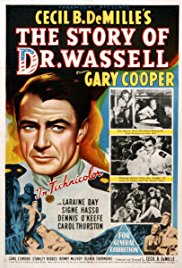 From April 24 to 26, 1944, future Oscar winner Cecil B. DeMille was in Little Rock for the world premiere screening of The Story of Dr. Wassell. This 1944 Paramount Pictures Technicolor release told the story of wartime hero Dr. Corydon Wassell. It would be nominated for the Oscar for Best Special Effects.
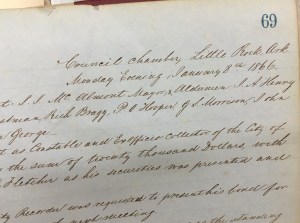 One hundred and fifty two years ago today, Little Rock City Hall resumed functioning after the Civil War. The City government had disbanded in September 1863 after the Battle of Little Rock. From September 1863 through the end of the war (on on through part of Reconstruction), Little Rock was under control of Union forces.
 Little Rock Culture Vulture