
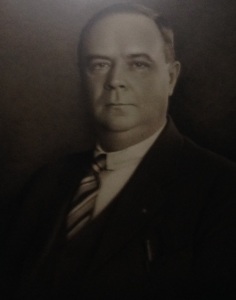
Little Rock Look Back: 44th and 49th Mayor Charles Moyer

On April 18, 1880, future Little Rock Mayor Charles E. Moyer was born in Glenwood, Minnesota. A man of contradictions, he was both a candidate backed by (and probably personally involved in) the Ku Klux Klan, yet he also brought the Goodwill Industries organization to Little Rock and Arkansas to help those less fortunate.

He came to Little Rock shortly after the turn of the 20th century as a clerk in the Post Office, and later served as a mail carrier. He then worked for Plunkett-Jarrell Wholesale Grocer Company in Little Rock. On January 1, 1921, he took office as County Judge for Pulaski County. In 1924, he ran against incumbent mayor Ben Brickhouse in the Democratic primary. Since Brickhouse had displeased the Klan, which was an active part of Democratic politics in Little Rock and throughout the nation at the time, Moyer won the primary.

Mayor Moyer led the City of Little Rock from April 1925 through April 1929. In 1927, the last lynching in Little Rock took place. While race-baiting crowds were surrounding City Hall demanding an African American prisoner be released to them for vigilante justice, Mayor Moyer was in hiding at an undisclosed location. Not able to get the prisoner they wanted, they took out their venom on another man who had assaulted a white woman and her daughter.

After leaving office in 1929, Moyer moved for a time to Batesville. He returned to Little Rock and was a chief deputy sheriff. From 1937 to 1941, he served as Pulaski County Assessor. In 1941, he returned to the office of Little Rock Mayor after J. V. Satterfield opted to serve only one term and did not seek re-election. Mayor Moyer led Little Rock through most of World War II. He left office in April 1945 and died on May 29, 1945, barely one month after leaving City Hall.

Little Rock City Hall at 110

LR City Hall circa 1908

City Hall circa 1908

110 years ago today, Little Rock City Hall officially opened at the corner of Markham and Broadway.

On April 15, 1908, the Italian Renaissance Revival style building, which had been designed by local architect Charles Thompson, played host to an open house. Staff had started moving into the building in March of that year.   This was, as often is the case, behind schedule.  The date in the cornice toward the top of the building is 1907, but the building was not completed until 1908.

An open house took place on April 15, 1908, presided over by Mayor John Herndon Hollis and his wife as well as former Mayor W. E. Lenon and his wife.  (Mayor Hollis’ wife is a distant cousin of the Culture Vulture.)

In 1903, W. E. Lenon became Mayor of Little Rock. Back then, the terms were two-year terms.  Before the start of his second term in 1905, he realized that the City was outgrowing City Hall, which was, at the time, on the northeast corner of Markham and Louisiana – where part of the Statehouse Convention Center sits today.

In February 1906, Mayor Lenon appointed a committee of five aldermen to over see the planning for the building of a new City Hall. In July 1906, the City Council approved plans, which called for a City Hall with an municipal auditorium wing. There was some hue and cry about the cost spending and a resulting lawsuit, so, in September 1906, those plans were scrapped and a simpler City Hall was approved for the cost of $175,000.

The last resolution in the old City Hall called for the banning of smoking in the new Council Chambers – while the Council was in session. This may well have been the first smoking ban in a public government building in the history of Arkansas.

When the building opened, the third floor was not finished out. The space was not needed. When the Museum of Natural History and Antiquities (now the Museum of Discovery) moved into City Hall in 1929, they had to finish out their space.

In 1913, the new Central Fire Station, designed in the Beaux Arts style, was constructed adjacent to City Hall. During the 1930s, as the City grew, more space was needed. A garage, designed in the “austere, utilitarian” style was built in 1936 and a City Jail Annex, built by the WPA in the modified Art Deco style was built in 1938.


By 1984, the decision was made to stay at Markham and Broadway. An extensive renovation and restoration effort was undertaken. In 1988, the building reopened, and the interior had been restored to its 1908 appearance.

Little Rock Look Back: First Council Meeting in 1908 City Hall

City Hall circa 1908

On April 6, 1908, the first City Council meeting took place in the new Little Rock City Hall.  Located at the corner of Markham and Broadway Streets, this three story structure was designed by Charles L. Thompson.

The idea of a new City Hall had first been raised by Mayor W. E. Lenon in 1904.  After a couple of false starts and delays, the project finally got underway in the autumn of 1906.  (The date on the front of the building is the optimistic and ultimately wrong 1907.  But it is etched in stone and set into the exterior.)

City offices started moving in during January and February 1908 while construction continued.  By the end of March, the building was complete and all offices moved in.  The final City Council meeting in the 1868 City Hall took place on March 30.  One week later, the body reassembled in their new space.

All sixteen of the aldermen were present for this meeting, which was a rare occurrence.  The regular order of business was dispensed with except for approval of payments for the bills and payroll for March.  That totaled $25,719.56. (This is the equivalent of $664,729.65 in 2018).

The floor was then turned over to Mayor Lenon to make an announcement.  In his remarks, the Mayor praised the new building, and then stated he was resigning immediately.  His business interests were such that he did not have time to be mayor.

The Council reluctantly accepted the resignation.  Because there was over a year remaining in the term, a special election would need to be called to select a successor.  If Mayor Lenon had waited two more weeks to resign, the Council would have appointed a new mayor for the duration of the term.

Alderman John Herndon Hollis was chosen to serve as mayor until the special election could be held.  First elected in 1904, he was about to start his third term as an alderman.  Though he did not have to give up his seat (and in fact served as an alderman until 1918), he was referred to as Mayor Hollis during his brief tenure.  He is counted as one of Little Rock’s mayors.  Unlike other times where there was an acting mayor while a mayor was out of town, in 1908, there was no other mayor for whom Mayor Hollis was acting in absentia.

After the selection of the new mayor, a committee was appointed to draft a resolution praising retiring Mayor Lenon.  The final business at the meeting was the reading of a resolution memorializing longtime City Clerk H. Clay Jones.  The former city official had died in March.

Little Rock Look Back: Final City Council meeting in 1868 City Hall

On March 30, 1908, the Little Rock City Hall held its final meeting in the 1868 City Hall.  The new city hall, located at Markham and Broadway streets, was nearing completion.  The meeting was presided over by Mayor W. E. Lenon.

The aldermen present were: John A. Adams, John Brod, A. B. Hightower, W. H. Jarrett, Christopher Ledwidge, Louie Miller, Jonathan S. Odom, R. C. Powers, A. L. Smith, George Stratman, Jonathan H. Tuohey, Louis Volmer, and L. N. Whitcomb.  Three aldermen missed the meeting: John Herndon Hollis, A. B. Poe and Benjamin S. Thalheimer.

The meeting was filled with typical requests for zoning and street improvements.  There was actually nothing out of the ordinary about the meeting.  If there was mention that it would be the final meeting, it did not make it into the minutes.

There was a request by the Arkansas Association of Pharmacists to have a meeting at the new building on May 12, 13 and 14.  It was referred to the City Hall Committee.  At prior meetings, there had also been requests by other groups to hold conferences at the new edifice.

At the conclusion of the meeting, it was noted that former City Clerk Clay Jones had died. A resolution memorializing him was proposed to be presented and adopted at the next meeting.

And with that, the meeting ended.  Forty years of City Council meetings at 120 to 122 West Markham came to a close.

LR Women Making History – Kathy Webb

While Kathy Webb has had many titles over her career in public service, Advocate for Others probably encompasses all of them.
One of the most important committees at the Arkansas General Assembly is the Joint Budget Committee.  It is chaired by a senator and a representative.  In 2011 and 2012, as a state representative, Kathy Webb became the first woman to chair the committee.  

Considering that the first woman to be sworn in to the Arkansas General Assembly (Erle Chambers) was from Little Rock, and the first woman to chair a standing committee of the General Assembly (Myra Jones) was from Little Rock, it is fitting that the first woman to chair Joint Budget was also from Little Rock.

While women had been chairing committees for two decades, no female had ever led this committee.  During her tenure, Rep. Webb received praise from people in both houses and both parties for her leadership.  She served in the Arkansas General Assembly from 2007 until 2012.  During that time, she was also named the most effective legislator by Talk Business

Now, she is Vice Mayor of Little Rock.  Vice Mayor Webb is in her first term representing Ward 3 of Little Rock.  She will be vice mayor until December 2018.  Vice-Mayor Webb grew up in Arkansas and graduated from Little Rock Hall High. She earned a degree from Randolph-Macon Woman’s College and attended graduate school at the University of Central Arkansas. She has also participated in the Senior Executives in State and Local Government program at the John F. Kennedy School of Government at Harvard University.

After working in political advocacy in Washington D.C. and throughout the U.S. for several years, she spent over 20 years in the restaurant industry in Illinois, Tennessee, and Arkansas.

Her community involvement includes service on the UAMS College of Medicine Board of Visitors, Arkansas Hospice, and First United Methodist Church of Little Rock. She was the founding president of the Chicago-area affiliate of Susan G. Komen for the Cure.

Vice Mayor Webb has been honored by the Arkansas Kids Count Coalition, Just Communities of Arkansas, Arkansas Judicial Council, National Association of Women Business Owners, Sierra Club, Arkansas AIDS Foundation, Arkansas Chapter of the National Association of Social Workers, Pulaski County CASA, Interfaith Alliance for Worker Justice, Arkansas AARP, Arkansas Hospitality Association, Arkansas Municipal League, Hendrix College and Black Methodists for Social Renewal.

She is the Executive Director of the Arkansas Hunger Relief Alliance. The Alliance is the statewide umbrella organization for Feeding America food banks, food pantries and agencies and hunger activists and the education and advocacy clearinghouse on hunger issues in Arkansas

LR Women Making History – Lucy D. Dixon

Photo courtesy Little Rock School District

Lucy Dixon was elected to the initial Little Rock Board of Directors in November 1957.  She previously had served for six years on the Little Rock School Board.

Mrs. Dixon is the only woman to have served on both the governing boards of the City and the school district.  Mrs. Dixon chose not to seek a second term and left the City Board on December 31, 1960.

With her election in 1957, Mrs. Dixon became the first woman to be elected to a City position without her husband having previously held that position.

Her father had a lumber business, in which she worked off and on throughout her lifetime. She served not only as an officer of the business, but had a desk at the office and participated in the daily business.  She was also very active in Methodist Woman functions in Little Rock and Arkansas.

Little Rock Look Back: March 20 in City of Little Rock history

For much of Little Rock’s history, the City Council did not meet on March 20.  (Under City Council rules, meetings were often once a month, and later moved to twice a month – usually second and fourth Monday).  Since switching to the City Manager form of government, meetings moved to the first and third weeks of the month.  The first instance of the First Day of Spring being a City Board meeting was in 1961.

At that meeting, there were the usual zoning issues. There were also proposals to close several streets, in anticipation of industrial development.  That Little Rock was anticipating industrial development was indeed news.  After the 1957 crisis, the city had no new businesses locate to Little Rock for several years.  One of the longtime tenants in Little Rock, Westinghouse Corporation, was experiencing legal issues on the national level.  As a way to show that Little Rock was open for business, the City Board passed a resolution on March 20, 1961, to thank Westinghouse Corporation for their continued commitment to Little Rock.

The next City Board meeting on March 20 was in 1973.  In addition to the usual zoning issues, there were a couple of items of note for future projects which would impact Little Rock in the late 1970s and beyond.  The first was to enter into an agreement with the US Army Corps of Engineers regarding a park at Murray Lock and Dam.  The second dealt with the planning for Metrocentre Mall.  There was also a lengthy discussion about the proposed annexation of 55 square miles in southwest Little Rock.

Six years later, on March 20, 1979, topics addressed included upgrades to University Park and Greyhound bus service to Texarkana and Memphis.  $316,800 was appropriated to reconstruct Markham from Ellis Drive to I-430, a distance of 0.4 miles.  Rules and regulations for the Fire Department were also approved.  In addition, some citizens spoke about the Batty Glass collection, which was then at the Museum of Science and Natural History.   In 1984, if Big Brother was watching on March 20, most of the items were routine.  Southwestern Bell did have a request for a project on Hinson Road in anticipation of future growth in that area.

The location for a future west Little Rock park took up much time at the March 20, 1990, City Board meeting.  Several sites were under consideration. Each of the seven City Directors seemed to have his or her own favorite.  Ultimately no final decision would be made that evening.  Parks were a topic at the next March 20 meeting, in 2001.  Parks Director Bryan Day (who was celebrating a birthday that day) was recognized for being the Outstanding Parks professional in a five state region.  There was a lengthy discussion that evening about additional funding for the Pulaski County Regional Detention Facility, which ultimately passed.  At the end of the meeting, there were updates on the proposed Summit Mall.

On March 20, 2007, the City Board spent time discussing potential projects for a short-term financing bond issuance.  Items included HVAC repairs to the Dunbar Community Center and Central Fire Station, improving the elephant exhibit at the Zoo, new city vehicles and computer software upgrades.  Five years later, Milton Crenchaw was recognized with the Spirit of Little Rock Award for his role as an instructor to the Tuskegee Airmen and other accomplishments in the fields of aviation and Civil Rights.