Arkansas Heritage Month – LR Mayor Lenon and a Municipal Auditorium

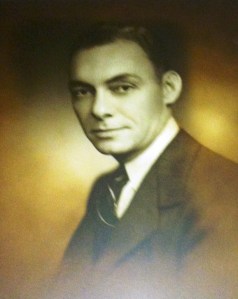
Mayor Lenon with the plans for the original City Hall/Auditorium and the temporary auditorium.

Mayor Lenon with the plans for the original City Hall/Auditorium and the temporary auditorium.

In anticipation of the November 2016 reopening of Robinson Center Music Hall, this week’s Arkansas Heritage Month entries look at seven Little Rock Mayors who worked on proposals for a municipal auditorium between 1904 and 1940.

In 1904, Little Rock Mayor W. E. Lenon first proposed that Little Rock construct at municipal auditorium.  After considering some options, he decided it would be easiest to build it in conjunction with a new City Hall and Jail.  In 1906 plans proceeded in that direction until a lawsuit by J.N. Heiskell to stop it. Following a judge’s ruling that a municipal auditorium was not deemed a proper use for public monies, the City changed course and constructed only a City Hall and Jail (sans auditorium) at the corner of Markham and Broadway. This building opened in 1908.

In 1906, the City gave permission to a private developer to build a temporary auditorium (which also served as a roller skating rink when the chairs were removed) adjacent to the City Hall site.  This opened in 1907.

Mayor Lenon left office in 1908.  He would later chair a committee involved in an auditorium proposal in 1925, but that one would come to naught, as well.  However, he planted the seed and started the public discourse which lasted for 36 years.

Little Rock Look Back: J V Satterfield

SatterfieldOn May 14, 1902, future Little Rock Mayor John Vines Satterfield, Jr. was born in Marion.   He grew up in Little Rock and Earle. J.V. was a star quarterback for the Earle football team and is featured in a painting of that team by respected painter Carroll Cloar.

Following high school, J.V. taught (including, much to his family’s amusement, a course in penmanship) and coached and sold Fords.  He then moved to Little Rock and sold insurance and later securities.  In 1931 he opened his own business; that same year he built a house at 40 Beverly Place in Little Rock, which would serve as his home until his death.

J. V. Satterfield was elected to serve as Mayor of Little Rock in 1939 and served one term, until 1941.  He was credited with saving the City from bankruptcy because of his fiscal policies. Among his efficiencies were the creation of a central purchasing office and using grass moved from the airport to feed the Zoo animals.  Though as a private citizen he had voted against the creation of a municipal auditorium in 1937, Mayor Satterfield fought valiantly to ensure that Robinson Auditorium opened to the public once he took office.  Shortly after he became Mayor, it was discovered that there were not sufficient funds to finish the construction. After the federal government refused to put in more money, he was able to negotiate with some of the contractors to arrange for the building to be completed. He also oversaw a successful special election to raise the money to finish the project.

Satterfield was a staunch supporter of the airport and worked to expand it.  He would serve as the chair of the first Municipal Airport Commission.  He also established the Little Rock Housing Authority (on which he would later serve on the board).  Mayor Satterfield also served as President of the Arkansas Municipal League in 1941.

Following the outbreak of World War II, Satterfield enlisted in the Army and was given the rank of a Major. He later was promoted to a Colonel and worked in the Pentagon during its early days.

In the late 1940s Satterfield became president of a small Little Rock bank called People’s Bank.  The bank changed its named to First National Bank when it moved into new offices at 3rd and Louisiana in 1953.  By focusing on smaller customers and courting corporate customers, Satterfield grew the bank into one of the state’s largest banks.  He maintained his desk in the lobby of the bank so he could interact with the customers and ensure they were having a positive experience.

Due to chronic health issues, Satterfield retired from the bank in 1964. He died in March 1966.

Arkansas Heritage Month – Jim Dailey

cna_commissioner_daileyDuring his years of public service, Little Rock Mayor Jim Dailey was a dedicated supporter of the arts. He has been involved in support of the arts prior to and after leaving office, but he was a 2005 Governor’s Arts Awards recipient in recognition of his work while in office.

Mayor Dailey’s understanding of the importance of the arts was essential to the revitalization of downtown Little Rock and the development of the River Market district. Little Rock’s arts district has become home to several art galleries and the 2nd Friday Night Art Walk and provides venues for local and regional musicians.

Other examples of Mayor Dailey’s leadership in the arts include the City of Little Rock’s support of the expansion and renovation of the Arkansas Arts Center and support of the establishment of the Kramer School Artists Cooperative, which provides residential and studio space for artists.  He was also a key player in the location of the Clinton Presidential Center in Little Rock.

The City of Little Rock doubled the number of art institutions it helps fund under Mayor Dailey’s tenure and has developed an Arts & Culture Commission to continue to integrate the arts into the daily fabric of city life. Mayor Jim Dailey has demonstrated outstanding leadership and commitment to the development of the arts community in Little Rock.

While in office, most Tuesday nights he would be a City Hall presiding over a City Board meeting. But many Monday nights he would be found at the Arkansas Arts Center taking a class a the museum school.

Since leaving office, Mayor Dailey has continued to explore art galleries and museums as he travels throughout the United States.  He also served as one of the three co-chairs for the successful campaign to renovate Robinson Center Music Hall. The building is set to reopen in November 2016.

Little Rock Look Back: Lottie Shackelford

Lottie at Civil RightsWhile this headline may say “Little Rock Look Back,” Lottie Shackelford is still very much focused on the present and the future!

On April 30, 1941, future Little Rock Mayor Lottie Shackelford was born. Throughout her career in public service she has been a trailblazer.

Active in community activities and politics, she ran for the City Board in 1974 and lost.  But she was appointed to the Little Rock City Board in September 1978 to fill a vacancy.  This made her the first African American woman to serve on he City Board, and indeed on any governing board for the City (during Reconstruction, there were at least three African Americans on the City Council, but they were all men.) She was subsequently elected to a full-term on the City Board in 1980 winning 55% of the vote over three male candidates.

She was subsequently re-elected in 1984 (unopposed) and in 1988 (with 60% of the vote).

In January 1987, Shackelford became the first female mayor of Little Rock when she was chosen by her colleagues on the City Board to serve in that position. She was Mayor until December 1988.

From 1982 until 1992, she served as Executive Director of the Arkansas Regional Minority Purchasing Council.  She left that position to serve as Deputy Campaign Manager of Clinton for President.  She subsequently served on the Clinton/Gore transition team. She later served on the Overseas Private Investment Corporation from 1993 to 2003. She was the first African American to be in that position.

A graduate of Philander Smith College, she has also studied at the Arkansas Institute of Politics at Hendrix College and the Kennedy School of Government at Harvard University.

Mayor Shackelford has also served on numerous boards including the Little Rock Airport Commission, Philander Smith College, Chapman Funds (Maryland) and Medicis Pharmaceutical Corporation (Arizona).  She has been the longest serving Vice-Chair of the Democratic National Committee.

Mayor Shackelford was in the first class of inductees for the Arkansas Black Hall of Fame.  In 2015, she was inducted into the Arkansas Civil Rights Heritage Trail.

Little Rock City Hall – 108 years at Markham and Broadway

108 years ago today, Little Rock City Hall officially opened at the corner of Markham and Broadway.

On April 15, 1908, the Italian Renaissance Revival style building, which had been designed by local architect Charles Thompson, played host to an open house. Staff had started moving into the building in March of that year.   This was, as often is the case, behind schedule.  The date in the cornice toward the top of the building is 1907, but the building was not completed until 1908.

An open house took place on April 15, 1908, presided over by Acting Mayor John Herndon Hollis and his wife as well as former Mayor W. E. Lenon and his wife.

In 1903, W. E. Lenon became Mayor of Little Rock. Back then, the terms were two-year terms.  Before the start of his second term in 1905, he realized that the City was outgrowing City Hall, which was, at the time, on the northeast corner of Markham and Louisiana – where part of the Statehouse Convention Center sits today.

In February 1906, Mayor Lenon appointed a committee of five aldermen to over see the planning for the building of a new City Hall. In July 1906, the City Council approved plans, which called for a City Hall with an municipal auditorium wing. There was some hue and cry about the cost spending and a resulting lawsuit, so, in September 1906, those plans were scrapped and a simpler City Hall was approved for the cost of $175,000.

The last resolution in the old City Hall called for the banning of smoking in the new Council Chambers – while the Council was in session. This may well have been the first smoking ban in a public government building in the history of Arkansas.

When the building opened, the third floor was not finished out. The space was not needed. When the Museum of Natural History and Antiquities (now the Museum of Discovery) moved into City Hall in 1929, they had to finish out their space.

In 1913, the new Central Fire Station, designed in the Beaux Arts style, was constructed adjacent to City Hall. During the 1930s, as the City grew, more space was needed. A garage, designed in the “austere, utilitarian” style was built in 1936 and a City Jail Annex, built by the WPA in the modified Art Deco style was built in 1938.
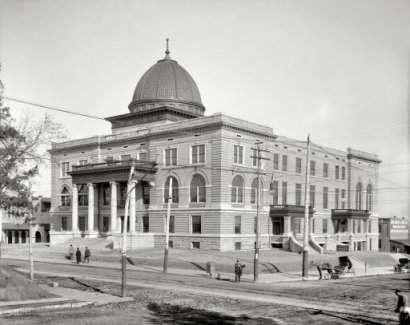
City Hall prior to 1912

By 1955, the copper-clad dome which sat on top of City Hall needed severe repairs. The wooden supports and the copper cladding were both in dire shape. Mayor Pratt Remmel set aside money for the dome to be repaired. After defeating Remmel in his bid for a third term, Mayor Woodrow Mann scrapped plans for the repair and, indeed, scrapped the dome.

Following the lead of County Judge Arch Campbell who had removed the tower at the County Courthouse, Mann proposed removal of the dome. He had an informal survey which had three options: repair the dome, replace the dome with an aluminum one, or remove it. This was open to anyone to respond – voting eligibility or Little Rock residency did not matter. By a slim margin, remove the dome won – so the dome was removed.

In 1960, as air conditioning was installed, windows were bricked in to promote energy efficiency. At the time, the feeling was that a new City Hall would be constructed in the 1970s somewhere more central to the growing city. Relocation talk persisted throughout the 1970s and early 1980s. By that time, City Hall had been modified a great deal – with no thought about historic preservation. When the Police and Fire Department had moved out into their new facilities, their old spaces had become storage.

By 1984, the decision was made to stay at Markham and Broadway. An extensive renovation and restoration effort was undertaken. In 1988, the building reopened, and the interior had been restored to its 1908 appearance.

Little Rock Look Back: First plans for a Municipal Auditorium

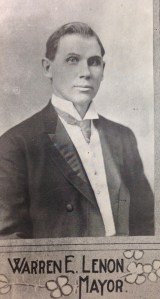
Mayor LenonOn April 12, 1904, Mayor W. E. Lenon made what was the first official proposal for a municipal auditorium in Little Rock.  Little did he know at the time that it would take from April 1904 until February 1940 to make this dream a reality.

Elected as a progressive, Lenon was focused on not just providing city services, but also had an interest in initiatives which would move the city forward.  With that background it is not surprising that Mayor Lenon would be a champion for the construction of both a new city hall as well as a municipal auditorium building.  During his first annual address to the City Council in April 1904 he noted:

Recently a number of our citizens have taken an active interest in building an auditorium in our city.  This being a project of such worthy consideration should not go unnoticed by us.  Apparently this is one of the greatest needs.  Our business, social, commercial and financial interests, in fact, our entire city, would be benefitted by the building of same.  It has therefore occurred to me that an auditorium might be built in conjunction with a new city hall.

The mayor further discussed that these new structures could either be built on the site of the current City Hall or at a new location.  He also touched on possible financing options including the collection of a one percent assessment.

The mayor would bring this up again in his 1905 annual address.  It would not be until December 1905 that the City Council would officially take any action on the plan.

Little Rock Look Back: St. Patrick’s Day with Mayor Pat L. Robinson

IMG_4517On this date in 1900, future Little Rock Mayor Pat L. Robinson was born.  While I cannot verify that he was indeed named after St. Patrick, it would be fairly reasonable to assume there might be a connection.

Robinson was a rising star of Little Rock Democratic politics.  In April 1929, just weeks after his 29th birthday, he was elected Mayor.  He had twice been elected as City Attorney (1926 and 1928) and was one of the youngest to serve in that position.

During Mayor Robinson’s tenure, he announced plans to construct a new airport.  That project led to the creation of what is now the Bill and Hillary Clinton National Airport.  Mayor Robinson was also involved in helping Philander Smith College secure the property where it is now located.  In addition, during his tenure, what is now the Museum of Discovery was folded into the City of Little Rock.  Shortly after taking office, he championed several projects for approval by Little Rock voters. The projects he supported were approved; the ones he did not support did not pass.

Single at the time he was in office and generally considered good looking, Mayor Robinson was sometimes referred to as the “Jimmy Walker of the Southwest.” Walker was the handsome and charming Mayor of New York City at the time.

Mayor Robinson ran afoul of some of the Democratic party leaders. Records don’t seem to indicate exactly what actions he took or did not take.  One thing that is brought up is that the City went into financial distress during his tenure.  Considering the Wall Street crash happened shortly after he took office, that financial state was not unique to Little Rock.

IMG_4532During this era in Little Rock, it was customary for an incumbent mayor to be given a second term. But City Clerk Horace Knowlton challenged Robinson in the primary.  It was a bitter campaign with Robinson linking Knowlton to disreputable denizens and Knowlton charging Robinson with “an orgy of spending.”  Robinson initially came out 17 votes ahead. But after a review and a lawsuit, it was found that Knowlton ended up with 10 more votes and became the nominee.  At the time, being the Democratic nominee was tantamount to election.

After he left office, Robinson practiced law for a few years in Little Rock and then left the city.  Records do not indicate where he went but he no longer appeared in the City of Little Rock directory by the early 1940s.  In the 1940 census he is listed as divorced and a lodger living with a couple.