Arkansas Heritage Month – Celebrities and Celebrations open Arkansas Arts Center on May 18, 1963

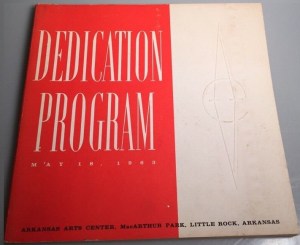
AAC opening programOn Saturday, May 18, 1963, amidst fanfare and fans of the arts, the Arkansas Arts Center officially opened its doors.  (This was thirty-five years and three days after the Fine Arts Club had opened the first permanent art gallery in Arkansas in the Pulaski County Courthouse).

The dedication ceremonies on May 18 featured U.S. Senator J. William Fulbright (who was in the midst of championing what would soon be known as the John F. Kennedy Center for the Performing Arts), Congressman Wilbur Mills, Governor Orval Faubus, Little Rock Mayor Byron Morse, Winthrop Rockefeller and Jeanette Rockefeller.

On Friday, May 17, 1963, film star Gordon MacRae performed two separate concerts in the theatre space.  There were other assorted small events and tours on May 16 and 17.

The culmination of the weekend was the Beaux Arts Bal.  This black tie event, featured Oscar winner Joan Fontaine, cartoonist Charles Addams (creator of The Addams Family), James Rorimer of the Metropolitan Museum, and Dave Brubeck.  Chaired by Jeane Hamilton, the event set a new standard for events in Little Rock.

Among the exhibits at the Arkansas Arts Center for the grand opening was a special exhibit from the Metropolitan Museum of Art in New York entitled Five Centuries of European Painting.  In Little Rock for six months, this exhibit featured works by El Greco, Titian, Claude Monet, Odilon Redon, Pierre Renoir, Paul Signac, Edgar Degas, and Paul Gauguin among many others and spanned from the fifteenth century Early Renaissance era to the nineteenth century.

Prior to the opening, a profile on the Arts Center in The Christian Science Monitor touted the building as one of the first regional arts centers in the country to be completed. Benefiting from national ties of the Rockefeller family, the events in May 1963, set a high standard for the institution, and for other regional art museums.

Arkansas Heritage Month – Cannes Critics Loving Jeff Nichols’ LOVING Film

NicholsThe early reviews are starting to come in from the Cannes screening of Little Rock native (and Central High grad) Jeff Nichols’ latest opus LOVING.

The film screened on Monday in Cannes.  Oscar buzz has already started for the film, Nichols and his performers.

Here is what some of the critics had to say:

Vox says that the film’s: “subdued tone delivers a wealth of emotions in the film’s final minutes.”  It also declares “Loving is a period piece that feels eerily relevant today.”

IndieWire notes:

“In an impressive body of work accumulated over the past 10 years, Jeff Nichols has emerged as a skilled filmmaker who relishes in the poetry of Southern life. It was only a matter of time of time before he explored its history. With “Loving,” the director moves from the combination of otherworldly lyricism and genre storytelling in “Take Shelter,” “Mud” and “Midnight Special” toward more conventional drama — namely, the backstory of Loving v. Virginia, the 1967 Civil Rights case that overturned laws against interracial marriage. — by exploring the intimate details behind its legacy.”

And also credits “Nichols’ elegant screenplay, which pares down the events so that the emphasis is taken off the legal proceedings and avoids any overdone speechifying.”

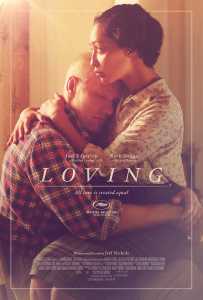
loving-teaser-posterVariety calls the movie “a film of utmost sensitivity” and declares, “Though it will inevitably factor heavily in year-end Oscar conversations, Nichols’ film is seemingly less interested in its own glory than in representing what’s right.”

The Hollywood Reporter opines: “writer-director Jeff Nichols takes an appealingly low-key approach to an important American civil rights story in Loving.”  It also praises his “way of underplaying racism, even as he firmly notes its constant presence in daily life and makes it the overriding subject of his film, is refreshing as well as rare in the realm of socially conscious cinema,indicating a respect for his audience’s intelligence and a desire not to hit viewers over the head.”

THR concludes its review by stating “Nichols has delivered a timely drama that, unlike most films of its type, doesn’t want to clobber you with its importance. It just tells its story in a modest, even discreet way that well suits the nature of its principal characters.”

The Daily Beast notes “An anguished, but low-key, meditation on race—American’s ongoing obsession—Loving is the most high-minded sort of Oscar bait.”

In The Telegraph, Robbie Collins declares that Nichols “calmly dodges every expectation you have for the genre. Loving is short on grandstanding and hindsight, long on tenderness and honour, and sticks carefully to the historical record.”  He also says that, “The film’s determination not to overcook any single scene means the tears it eventually draws feel honestly come by.”

While Cannes tries to focus on art and not awards or commercialism, the positive early reviews for Loving, coupled with Focus Features’ November release date, should poise the film for awards season in late 2016 and early 2017. More importantly, this will continue to raise the profile of Jeff Nichols, who continues to make Little Rock proud.


Little Rock Look Back: Elvis in his final Robinson Auditorium Show

Photo by Wayne Cranford

Photo by Wayne Cranford


After two visits in 1955 where he was down on the bill, Elvis Presley made his third and final appearance at Robinson Auditorium on May 16, 1956.  This time he was the star and Robinson was packed. The tickets were $1.50 in advance at Walgreens and $2.00 at the box office.

The ads featured 8 great acts in “his” variety show which consisted of the Jordonaires; Rick and Emil Flaim and their orchestra; vocalists Frankie Conners and Jackie Little and comedian-magician Phil Maraquin. A second show was added at 9:30 p.m. to accommodate the ticket demand.

About 30 minutes late, due to a missed flight, Elvis appeared on stage in a purple blazer and started singing “Heartbreak Hotel.”  The crowd rushed the stage. Little Rock police officers were able to control them eventually and get the teenagers back to their seats.  While the crowd was impressed, the police officers were less so.  One of the patrolmen told the Arkansas Gazette reporter: “I wouldn’t know him if I saw him. And I wouldn’t be here unless I was being paid.”

Disc jockey Ray Green recorded the concert that night.  Copies of the concert on CD (which also includes an interview with Presley) are prized possessions of Presley collectors.

The Arkansas Democrat-Gazette has a special section on its website containing quotes from some of the concert attendees.

Arkansas Heritage Month – Little Rock’s Jeff Nichols at Cannes

NicholsLittle Rock native Jeff Nichols’ latest film, Loving, premieres at Cannes today. The film showed at 8:30 am and 11:30 am Cannes time. (That would be at 1:30am and 4:30am, Little Rock time). It also shows at 7pm Cannes time (12 noon, Little Rock).

Loving, which was written and directed by Nichols, tells the story of the Mildred and Richard Loving, an interracial married couple who were sentenced to prison in Virginia in 1958. It is set for national release in November and is being distributed by Focus Features.

Nichols was first brought the project by Martin Scorsese. A 1997 graduate of Little Rock Central High, he was intrigued by the story and the opportunities it provided him as a filmmaker.

The film stars Joel Edgerton and Ruth Negga as the central couple. Others in the cast include Michael Shannon, Nick Kroll, and Bill Camp.  Edgerton, Shannon and Camp are part of Nichols’ informal repertory company of actors. Interestingly, Shannon and Camp are both nominated for Tony Awards in the same category (Featured Actor in a Play) for work they have done on Broadway this spring in American classics: Shannon in O’Neill’s Long Day’s Journey into Night and Camp in Miller’s The Crucible.

This is Nichols’ third film to screen at Cannes, following 2012’s Mud (which like Loving was in contention for the Palm d’Or) and 2011’s Take Shelter (which won the top prize at Cannes’ Critics Week).  His first feature film was 2007’s Shotgun Stories.

With Loving’s screening at Cannes, Nichols is in a select group of directors to have one film screen at the Berlin International Film Festival (where he showcased Midnight Special) and another at Cannes in the same year.

Arkansas Heritage Month – The Architecture of Little Rock Central High School

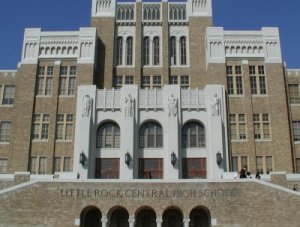
centralentranceArchitecture is often overlooked when considering the arts, but it is definitely an art form.

Built in 1927 as Little Rock Senior High School, Central was named “America’s Most Beautiful High School” by the American Institute of Architects. The New York Times called it the most expensive high school built at the time.

Designed as a mix of Art Deco and Collegiate Gothic architectural styles, the building is two city blocks long and includes 150,000 square feet of floor space. The project involved most of Little Rock’s leading architects who were still practicing at the time: John Parks Almand, George H. Wittenberg and Lawson L. Delony, Eugene John Stern, and George R. Mann.  Over the years, different architects would take credit for various facets of the building.  Given the size of the project, there was plenty of work for each architect to do.

More than 36 million pounds of concrete and 370 tons of steel went into the building’s construction. The building contained 150,000 square feet of floor space, upon its completion. It cost $1.5 million to construct in 1927. The school received extensive publicity upon its opening. An article in the Arkansas Gazette said, “we have hundreds of journalists in our fair city for the dedication” of the new high school.

At its construction, the auditorium seated 2,000 people between a main level and a balcony.  The stage was sixty feet deep and 160 feet long so that it could be used gymnasium. From 1927 until the opening of Robinson Auditorium in 1940, the auditorium would be Little Rock’s main site for hosting performances by musical and theatrical groups.

Subsequent additions would include a separate gymnasium, a library, and a football stadium. In 1953 the school’s name was changed to Little Rock Central High School, in anticipation of construction of a new high school for students, Hall High School.

In 1977, the school was listed on the National Register of Historic Places, and it was designated a National Historic Landmark in 1982. These were in recognition of desegregation events which took place in the school in 1957.

In 1998, President William Jefferson Clinton signed legislation designating the school and visitor center across the street as a National Historic Site to “preserve, protect, and interpret for the benefit, education, and inspiration of present and future generations…its role in the integration of public schools and the development of the Civil Rights movement in the United States.”

Arkansas Heritage Month – Robert Hupp

HuppRobert Hupp is in his final months of his seventeenth and final season as producing artistic director of Arkansas Rep.  In recognition of all of his service and artistic excellence, in 2013 he was the Individual Artists recipient of the Governor’s Arts Awards.

During his tenure in Little Rock, Hupp has overseen continued growth and development at The Rep. Since he assumed the producing artistic director’s position in 1999, the theatre has tripled its budget (currently at $4 million annually), increased contributed income by 100%, completed a successful capital campaign, and broadened the company’s artistic and economic base through co-productions with other nonprofit theatres and partnerships with institutions of higher education and community organizations. Under Hupp’s leadership, the theatre and actor housing apartments underwent a complete renovation in 2011. The Rep also renovated a new downtown scenic construction facility and recently opened The Annex, a black box theatre and education space, in Main Street’s Creative Corridor.

Hupp’s artistic stewardship at The Rep has been marked by seasons that reflect the great diversity of the theatrical canon. Shakespeare and American classics join new and contemporary works, and seasons always include musicals or plays with music. The current season contains the regional theatre premiere of The Bridges of Madison County, a new adaptation of The Little Mermaid, as well as a new comedy, Windfall, directed by Seinfeld’s Jason Alexander. The theatre also recently produced a new musical, Because of Winn Dixie, by Duncan Sheik and Nell Benjamin. Hupp has directed 28 productions while at The Rep, including The Grapes of Wrath, God’s Man in Texas, Les Miserables, August: Osage County, and all of The Rep’s recent Shakespearean productions.

In addition to his duties at The Rep, Hupp has shown a strong commitment to serving the central Arkansas community. He has served on numerous civic committees in Little Rock, including Little Rock’s Arts and Culture Commission, the Advisory Board of the ACANSA Arts Festival, and Vision Little Rock. He has collaborated with the Arkansas Symphony Orchestra, Wildwood Park for the Arts, and the Arkansas Arts Center.  In 2012, he was named “Nonprofit Executive of the Year” at the Arkansas Business of the Year Awards, and also received the Arkansas Public Relations Society of Arkansas (PRSA) Diamond Award. Hupp has also been a panelist and on-site evaluator for the National Endowment for the Arts and has served in various capacities for the Theatre Communications Group, including a term as vice president of the Board of Directors. Hupp has taught and directed at several Arkansas colleges and universities, including Hendrix College, University of Central Arkansas, and University of Arkansas at Little Rock where he also served as the Interim Chair of the Department of Theatre in 2005.

Little Rock Look Back: J V Satterfield

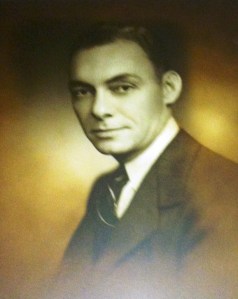
SatterfieldOn May 14, 1902, future Little Rock Mayor John Vines Satterfield, Jr. was born in Marion.   He grew up in Little Rock and Earle. J.V. was a star quarterback for the Earle football team and is featured in a painting of that team by respected painter Carroll Cloar.

Following high school, J.V. taught (including, much to his family’s amusement, a course in penmanship) and coached and sold Fords.  He then moved to Little Rock and sold insurance and later securities.  In 1931 he opened his own business; that same year he built a house at 40 Beverly Place in Little Rock, which would serve as his home until his death.

J. V. Satterfield was elected to serve as Mayor of Little Rock in 1939 and served one term, until 1941.  He was credited with saving the City from bankruptcy because of his fiscal policies. Among his efficiencies were the creation of a central purchasing office and using grass moved from the airport to feed the Zoo animals.  Though as a private citizen he had voted against the creation of a municipal auditorium in 1937, Mayor Satterfield fought valiantly to ensure that Robinson Auditorium opened to the public once he took office.  Shortly after he became Mayor, it was discovered that there were not sufficient funds to finish the construction. After the federal government refused to put in more money, he was able to negotiate with some of the contractors to arrange for the building to be completed. He also oversaw a successful special election to raise the money to finish the project.

Satterfield was a staunch supporter of the airport and worked to expand it.  He would serve as the chair of the first Municipal Airport Commission.  He also established the Little Rock Housing Authority (on which he would later serve on the board).  Mayor Satterfield also served as President of the Arkansas Municipal League in 1941.

Following the outbreak of World War II, Satterfield enlisted in the Army and was given the rank of a Major. He later was promoted to a Colonel and worked in the Pentagon during its early days.

In the late 1940s Satterfield became president of a small Little Rock bank called People’s Bank.  The bank changed its named to First National Bank when it moved into new offices at 3rd and Louisiana in 1953.  By focusing on smaller customers and courting corporate customers, Satterfield grew the bank into one of the state’s largest banks.  He maintained his desk in the lobby of the bank so he could interact with the customers and ensure they were having a positive experience.

Due to chronic health issues, Satterfield retired from the bank in 1964. He died in March 1966.