
Little Rock Look Back: Thanksgiving Day Football in 1918

100 years ago, the Little Rock High School Tigers football game on Thanksgiving was against a group of soldiers from Camp Pike.

The game took place on Thursday, November 28, 1918. The Great War had ended a little over a fortnight earlier, but the game had been scheduled while hostilities were still going.

The Tigers, who had never lost on Thanksgiving Day after starting a tradition of playing on the day in 1914, were for the first time the underdogs. The soldiers of the 13th Training Battalion were slightly older and much bigger – an average of 20 pounds bigger per player.

Going into the game, the Little Rock High School team was down a key player. Julian Adams was out with wrenched knee.  Another player John Ward was also absent (though the newspaper accounts do not indicate why).

Coach George H. Wittenberg was missing along the sidelines due to illness. He was not the first coach to be absent that season.  The regular coach, Earl Quigley, had been drafted and was stationed in South Carolina during the season.  Wittenberg, was a faculty member at the time. He had lettered for the football team when he had been a student a decade or so earlier. Later, as an architect, he would be one of the designers of the new Little Rock High School, now Central High School.

The game took place at Kavanaugh Field (a baseball field also used for football).  Though it is now the site of current Central’s storied Quigley Stadium, this was nearly a decade before the high school moved from Scott Street to Park Street.

The Camp Pike gridiron team dominated the game before a crowd of 1,000. The soldiers made three touchdowns in the first quarter, two in the second, one in the third, and one more to cap off the game in the fourth.

The closest the Tiger eleven got to scoring was in the second quarter when Hershell Riffel caught the ball at the 12 yard line and team captain and quarterback Alvin Bell advanced another six yards.  Camp Pike held them there.  Just before the game ended, Bell injured his knee and was taken out of the game.

Also that day, the University of Arkansas beat Kendall College (now the University of Tulsa) in Tulsa by a score of 23 to 6, West Tennessee Normal (now University of Memphis) defeated the Jonesboro Aggies (now Arkansas State Red Wolves) by a score of 37 to 0, and Hendrix College bested Henderson-Brown (now Henderson State University) by a score of 9 to 7.

Thanks to Brian Cox’s book Tiger Pride: 100 Years of Little Rock Central High Football for filling in some of the players names which were omitted in the newspaper coverage.

Little Rock Look Back: Mayoral Race of 1928

Robinson

After serving two, 2-year terms, Mayor Charles Moyer sought a third term in the Democratic primary of 1928. There were three people standing in his way of a new term:  City Attorney Pat Robinson, School Board member H. T. “Will” Terry, and Alderman Joe H. Bilheimer, Jr.

Robinson had been elected City Attorney at the age of 27.  He was viewed as a rising star in not only the Democratic Party of Little Rock, but for the state as well.  He was no relation to US Senator Joe T. Robinson, who hailed from Lonoke County. Pat Robinson had roots in Clark County.  Alderman Billheimer had served on the Little Rock City Council since 1917, while Mr. Terry had been on the School Board for several years and been president of that body.

As the incumbent, Mayor Moyer spent most of the campaign on the defensive. His policies and programs were attacked. What was not attacked (or even mentioned) was his disappearance from Little Rock during the 1927 lynching of James Carter.  Mayor Moyer promoted his efforts for the successful amendment to the Arkansas Constitution which expanded the bonding capacity of cities. He also was proud of having established the Planning Commission for Little Rock.

Moyer largely ignored Bilheimer in his remarks. But he charged Robinson with dereliction in duty as City Attorney. He also questioned Terry’s business acumen.  Terry for his part stressed his work as a man who had started driving a milk wagon and then rose to become the head of a large dairy.  He took a swipe at single Robinson by stressing that he was a person with family ties.

Bilheimer questioned Moyer’s expenditures including $4,000 a year to keep City Hall clean. He claimed that was a payoff for a political contribution. He also noted that during Terry’s tenure on the school board, the Little Rock schools were only able to purchase milk from his dairy.  He also charged Terry with campaign violations. At the time, state law set that campaign expenditures could not exceed the salary of the position being sought. At the time, Little Rock paid $5,000 per year to the mayor.  Bilheimer charged that Terry was exceeding that.

Other than defend his record as City Attorney, Robinson fairly successfully stayed above the fray. He admitted that he was not aggressive prosecuting bootleggers or others connected to Prohibition offenses.

Rallies and radio were the order of the day as the campaign wound down.  On November 26, 1928, the primary took place.  Robinson won every precinct.  He captured 4,077 votes to 1,682 for Moyer, 1,518 for Terry, and 298 for Bilheimer.

The polls closed at 6pm.  By 8:30pm, the results were known and a Robinson victory parade filled the streets.  It marched down Main Street and then down Markham to City Hall.  On the steps, Mr. Robinson remarked, “I shall try always to be the same old Pat.”


Little Rock Look Back: The 2004 opening of the Clinton Presidential Center

wjc library openingIt has been fourteen years since the Clinton Presidential Center opened on a wet, cold Thursday.
The days leading up to it had been glorious.  And while the weather may have literally dampened spirits a bit, it was still an important day for Little Rock and Arkansas.

The events leading up to the opening included a concert by Aretha Franklin with the Arkansas Symphony Orchestra and an appearance by Senator John Glenn at the Museum of Discovery.  Events were hosted by the Arkansas Arts Center, Arkansas Repertory Theatre, Historic Arkansas Museum, and Old State House Museum.  There were scores of receptions and parties as Hollywood, New York, and DC descended on Little Rock.

November 18 dawned rainy and cool.  As the day continued on the precipitation continued while the temperature did not warm up.  Years of planning for a grand opening ceremony came down to this.  But at the appointed time, festivities began.

On the site of an abandoned warehouse district and unofficial dump which had previously been a train station, many leaders of the free world were gathered.  They rubbed shoulders with thousands of Arkansans from probably every county in the state.

It had been seven years and eleven days since Bill Clinton had announced the site of his presidential library.  It had been five years since artifacts and articles started arriving from Washington DC in Little Rock.  There had been lawsuits, threats of lawsuits, the threat of a Counter-Clinton Library, and countless meetings.

After speeches from Presidents Carter, Bush 41 and Bush 43, remarks from President Clinton and then-Senator Clinton (who was made even wetter by water pouring off an ill-placed umbrella), and even a musical performance by Bono and The Edge, Chelsea Clinton turned over the ceremonial key from the Clinton Foundation to the National Archives to officially open the Clinton Presidential Center.

In his capacity leading the Clinton Foundation, Skip Rutherford oversaw the planning for the Clinton Library and the grand opening festivities.  He, along with the foundation’s Executive Director Stephanie S. Streett, oversaw a phalanx of volunteers and staff to anticipate every detail.  The 1,000 days countdown sign that had been on the construction site (the brainchild of Tyler Denton) finally reached 0.

Isabelle Rodriguez, Shannon Butler, Mariah Hatta, Jordan Johnson, Lucas Hargraves, Ben Beaumont, Denver Peacock — among others — had been putting in twelve plus hour days for months on end to get ready for the opening.  City Manager Bruce T. Moore led a team of City officials who had assisted on the planning and execution of the site preparation and making sure Little Rock was ready to welcome the world.  Moore and City Director Dean Kumpuris had been appointed by Little Rock Mayor Jim Dailey to lead Little Rock’s efforts to land the library.  After Clinton’s announcement of the site, Dailey, Kumpuris and Moore continued to work together to ensure the library would be successful.

Among those present were Oscar winning actors Barbara Streisand, Robin Williams, and (of course) Arkansan Mary Steenburgen.  Future Oscar winner Morgan Freeman was also in attendance. Among the Oscar nominees who were present were Bono and The Edge (who performed at the ceremony) and Alfre Woodard.  It was the first public appearance by Senator John Kerry after his loss earlier in the month to President George W. Bush. Scores of Senators and members of Congress as well as countless Clinton Administration staffers were also in attendance.

While the weather on November 18, 2004, may have been a disappointment, the people who were gathered knew they were witnesses to history.  And fourteen years later, is a day people still talk about.


Little Rock Look Back: Aretha Franklin with the Arkansas Symphony Orchestra at Robinson Center

On November 16, 2004, the rafters of Robinson Center Music Hall were shaken by the vocal prowess of Aretha Franklin.
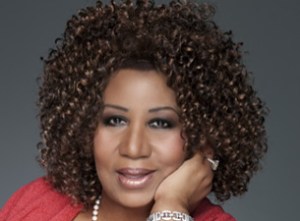
She shared the Robinson stage with the Arkansas Symphony Orchestra.  The ASO brought Miss Franklin to town as part of the festivities surrounding the opening of the presidential library.  Long a favorite of the Clintons, Miss Franklin sang at his 1993 inaugural festivities the night before he took the oath of office.

Resplendent in a series of white dresses, Miss Franklin was in top form feeding off the love from the audience.  While backstage she may have been dealing with back and knee issues (which the Culture Vulture saw first hand), when she stepped on to the stage she was giving her all as she rolled through hit after hit from her starry career.  She sang, she played the piano, she entertained!

It was a sold out house and her voice and energy reached the last row of the balcony.

Prior to her appearance, the ASO played a few selections including variations on “Hail to the Chief” and “America.”

Earlier in the day, I had the privilege of picking up several copies of Bill Clinton’s autobiography for her to get signed by him.  I delivered them to her as she was resting between rehearsals. She was preparing for an interview with Craig O’Neill, and I hated disturbing her. But I wanted to be sure she got the books.  She was gracious and very appreciative.

Little Rock Look Back: Robinson Auditorium Commission abolished; Duties transferred to LRCVB

aud-com-abol

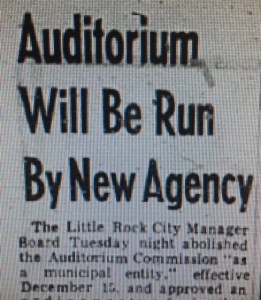
On November 16, 1971, the City of Little Rock Board of Directors abolished the Auditorium Commission which oversaw Robinson Auditorium and transferred duties to the Advertising and Promotion Commission.

This was done with the full support of both commissions.  The transfer took place immediately, with all assets and loose ends to be wrapped up by December 15, 1971.

With the adoption of a hospitality sales tax, by state statute, Little Rock had to have an A&P Commission.  By 1971 plans were afoot to use the A&P tax to build a conference center using some of the existing space in Robinson and adding space.  It did not make sense to have two separate commissions overseeing the same building.

For the Auditorium Commission members, it was possibly a relief.  For years, overseeing the building had been a quiet duty.  But with the social changes of the 1960s, they had been confronted ending the policy of segregation as well as changes in content and subject matter of acts booked at Robinson.  Being agents of social change was doubtful what any of them had envisioned when they joined the commission.  Emily Miller had been a member of the body since January 1940 and others had been on it for many years.

Transferring Robinson to the A&P Commission ushered in a new era for the building. It saw increased booking of meetings which led to a better revenue stream.  The use of the A&P tax would mean the opportunity to give the building an upgrade from 1972 to 1974.

Robinson would eventually prove to be inadequate for all of Little Rock’s needs, which led to the creation and subsequent expansion of Statehouse Convention Center.  But the action 45 years ago today set the stage for the transformation Robinson has undergone as it reopened in November 2016.

The Thea Foundation honored as 2018 Outstanding Foundation by AFP

The Arkansas Chapter of the Association of Fundraising Professionals honored the Thea Foundation as the 2018 Outstanding Foundation.

The Thea Foundation’s mission is to advocate for the importance of the arts in the development of youth. This statewide organization awards 36 scholarships to Arkansas high school seniors annually. It also provides grants of $50,000 each year for creative material and artistic supplies to teachers across the state through Thea’s Art Closet.

Through its Art Reconstruction Program, the Thea Foundation creates new and augments existing arts programs in schools.  The Thea Foundation also sponsors the Thea Paves the Way event, student and community art exhibitions in their gallery, and hosts the quarterly Thea Art Department which showcases emerging Arkansas artists.

All of this work is undertaken by a staff of five full-time staff members, an active board, and ardent volunteer base.

The Arkansas Arts Center’s Kelly Fleming honored as Fundraising Professional of the Year

At the 2018 AFP National Philanthropy Day, Kelly Kinard Fleming of the Arkansas Arts Center was honored by the Arkansas Chapter of the Association of Fundraising Professionals as the Fundraising Professional of the Year!

(This honor also garnered her the front cover of this month’s INVITING ARKANSAS – featured with this entry.)

As the AAC’s Director of Development, Kelly is a proven fundraising professional with a commitment to philanthropy.  She leads a staff which continues to surpass annual goals of approximately $2 million, as well as surpassing special event goals, and founded the Townsend Wolfe Society, a planned giving program.

Kelly is an integral part of the AAC’s recent completion of its strategic plan, its re-accreditation, and its aggressive building project and capital campaign.

Prior to coming to the Arkansas Arts Center, Kelly served in fundraising at the Arkansas Repertory Theatre and Heifer Foundation. She is a member of the Little Rock Arts+Culture Commission, and has been an active supporter of many Little Rock arts organizations.