July 9, 1906 – plans for new Little Rock City Hall are approved. And the fun has just begun

The 1906 plans for City Hall with the Municipal Auditorium on the left portion.

On July 9, 1906, the Little Rock City Council approved Resolution 281 and Ordinance 1,295. These actions approved the plans for a new City Hall complex to be constructed on land at the northwest corner of Markham and Broadway Streets.  A few days later, the contract was awarded for the construction of the new building.

Mayor Warren E. Lenon had first called for a new city hall complex in his annual address in April 1904. He repeated his request in April 1905.   The City Council took up Mayor Lenon’s quest for a new city hall in December of 1905.  The Council appropriated money for the purchase of land for a city hall, jail and auditorium.

In response to this, the Arkansas Gazette daily newspaper ran a story featuring the viewpoints of a few civic leaders weighing in on the need for a new city hall complex which would also include a new jail and a city auditorium.  Two of the respondents, L. B. Leigh and P. Raleigh, stressed the need for paved streets and better sewers instead of a new city hall and auditorium.

The other three businessmen interviewed were more favorable to Mayor Lenon’s proposal.  Morris M. Cohn, a former Little Rock City Attorney, stated “I do not think we can make a better investment than in a fine city hall and auditorium.”  (Mr. Cohn, though an M. M. Cohn, was not related the M. M. Cohn who was the namesake for the longtime Little Rock department store.) County Judge William Marmaduke Kavanaugh offered his satisfaction with the action of the City Council on that matter.  R. E. Walt, a banker, opined that he thought $150,000 was not enough; he suggested $200,000 should be spent.

Later that month the Gazette reported that a site had been selected for the city hall and auditorium complex.  The proposed location was most of a city block located at the corner of Markham and Broadway Streets.  Mayor Lenon was vague as to the details of the deal because negotiations were still underway with the property owners

As 1906 dawned, Mayor Lenon and other city leaders continued to take steps to build the new city hall and auditorium.  They invited three local architects to make presentations for the chance to design the new complex.  The three were Charles L. Thompson, Frank W. Gibb and George R. Mann.  Mr. Thompson was chosen to receive the assignment.

On February 5, 1906, Mayor Lenon announced the creation of a special committee to work on the planning for a future city hall complex.  This committee consisted of Aldermen Louis Walther, A. B. Poe, L. N. Whitcomb, Christopher Ledwidge, and John A. Adams.

Mayor Lenon further stated that the new city hall complex and several private developments would “put us in that march of progress with which nothing can prevent us from having a 100,000 population in a few years.”

The saga to get the building built was just starting.

Planning to create Arkansas Arts Center authorized by City of Little Rock

Twenty-two years after authorizing the creation of the Museum of Fine Arts in City Park, the Little Rock City Council was asked to consider expanding the facility.
By 1957, the existing structure was felt to be inadequate.   There was a desire for more gallery space as well as for more space for educational programming.

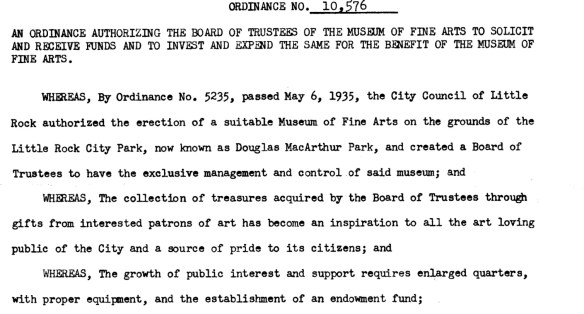
On July 8, 1957, the Little Rock City Council passed an ordinance authorizing the Board of the Museum of Fine Arts to be able to raise the funds for an expansion.  This was merely the start of the process which would eventually lead to the creation of the Arkansas Arts Center.

The ordinance allowed for the expansion or extension of the building. It also authorized the museum’s board to accept gifts for the project and to invest those gifts for the purpose of the museum.  Since the museum only received City funds for maintenance and salary, the ability to raise funds for the expansion was key to the future of the institution.

Lastly, the ordinance gave the museum’s board the ability to increase its membership by up to six positions without having to get additional approval by the City Council.  With a fundraising drive underway and a larger facility planned, these additional board members could certainly prove to be key.

The ordinance passed with nine Ayes, zero Noes, and one absent.

Stained Glass windows focus of tonight QQA Preservation Conversation

The Quapaw Quarter Association is hosting its next “Preservation Conversation” tonight.
Jay King’s talk will cover history of stained glass, the care and maintenance of antique windows, what a basic repair job entails as opposed to full scale restoration,and the commission process.
The program starts at 6pm, with a 5:30pm reception preceding it.  It will be in the Mixing Room at the Old Paint Factor in the East Village (1306 East 6th Street).
Jay King began his career in glass repairing antique stained glass windows in Chicago’s Old Town. In 1974 he moved to Austin, Texas where he learned the art of constructing windows while working at Renaissance Glass Co. and several other local studios. In 1988 he set his sites for Eureka Springs, AR, but found too much to fall in love with in Little Rock, so has been here ever since. He decided to start up his own stained glass studio, Arkansas Glassworks, in 1993.
As Arkansas Glassworks, Jay has built stained glass windows for numerous homes and churches around the state. These days, churches are his main focus, but he continues to both build and repair windows for homes as well. He still manages to make the occasional window that calls him to build, regardless of commission. He’s also known to teach his craft to the few who are still around who want to learn it.

Parking: There is parking directly in front of the doors that are marked “live,” “print,“ “meet.” If those spots are taken. park in the parking lot to the right. There is also street parking in front of the building.

Entrance: Enter the event space through the door facing 6th Street marked “meet.”

Questions? Call 501-371-0075 ext. 3 or email qqa@quapaw.com<

FREE Admission this evening to ESSE Purse Museum in conjunction with Purses with Purpose: Girl Scouts through the Decades exhibit

This Friday, June 7th, from 4-8 pm ESSE Purse Museum will host a reception for our newest temporary exhibit, Purses with Purpose: Girl Scouts through the decades. FREE admission to the museum and refreshments will be provided.

This show spans from the 1930s to the present. With her creativity and tenacity Juliette Gordon Low, founder of the Girl Scouts, was able to foresee what girls and woman are capable of with the guidance and support of this organization.

Many would claim that cookies are the first thing that comes to mind when speaking of the Girl Scouts. The courage, confidence, and character that are synonymous with these young woman is seen through the handbags, uniforms, and objects on display. The remarkable history of the Girl Scouts is presented alongside a unique perspective of women’s history.

The artifacts on display are on loan from the GSUSA, GS – Diamonds of Arkansas, Oklahoma and Texas, ESSE Purse Museum, and from the personal collections of Kathleen Pate and Marsha Stone.

Regular museum admission ($10, $8 seniors, students, and military) includes the special exhibit. Summer hours are 11 a.m. to 4 p.m. Tuesday through Friday, 10 a.m. to 5 p.m. Saturday, and 11 a.m. to 4 p.m. Sunday.

Sandwich in History today (6/7) at the Irv Daniel House

Image may contain: house, tree, sky and outdoor

The Arkansas Historic Preservation Program each month sponsors a Sandwiching in History tour which familiarize people who live and work in central Arkansas with the historic structures and sites around us.

The tours take place on Fridays at noon, last less than an hour, and participants are encouraged to bring their lunches so that they can eat while listening to a brief lecture about the property and its history before proceeding on a short tour.

Today (June 7) at 12 noon, this month’s tour is at the Irv Daniels House, located at 1622 Waterside Drive.

Constructed in 1965, the Irv Daniel House in North Little Rock is one of only 10 designs created by architect Frank Doughty in the state of Arkansas. The architecture of the house was heavily influenced by the work of Frank Lloyd Wright and E. Fay Jones, whom Doughty worked for at one time.

IMPORTANT NOTE: There is very limited parking available along Waterside Drive. There is an area of public parking located to the northeast of the house, along Waterside Drive, and additional parking is available along streets to the east and at the park at the intersection of Waterside Drive and Avondale Road

The Arkansas Historic Preservation Program is an agency of the Department of Arkansas Heritage.

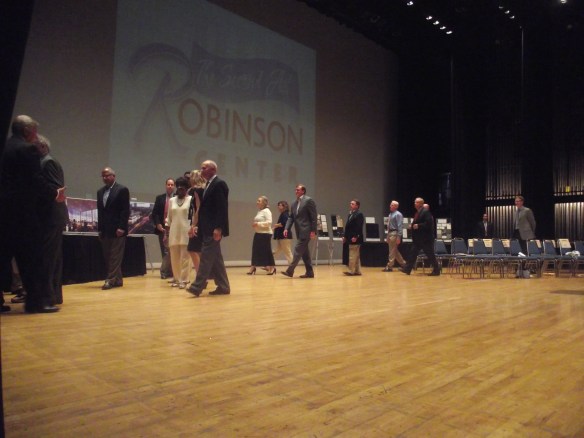
Robinson Auditorium cornice installed on June 1, 1939

Eighty years ago today, on June 1, 1939, the cornice was installed on Robinson Auditorium.

This granite slab noted the name of the building as the Joseph Taylor Robinson Memorial Auditorium.  (It is interesting to note that it used the more modern “u” instead of the classical “v” which was often used in buildings during prior decades – as evidenced by the Pvlaski Covnty Covrt Hovse across the street.)

This was a milestone marking the completion of the front facade of the structure.  Much work would continue on the interior of the structure.  This step in the construction was considered major enough that the Arkansas Gazette mentioned it in a news article.

June 1, 1939, was also the first day on the job for the auditorium’s first director – William T. Clemons.  A former Little Rock resident who came from Rochester NY.  The Auditorium Commission which hired him would not disclose the sources of his salary, but assured Mayor J. V. Satterfield the money did not come from City coffers.

On this date in 2015 and 2016, the cornice was again surrounded by construction materials and braces. But the restoration of Robinson Center finished in November 2016. Once again, the cornice stands proudly atop the six columns with no impediments around it.