
Arkansas Gives today from 8am to 8pm

If you are like me, you’ve been receiving notifications about Arkansas Gives Day for months.  Well, today is the day!  From 8am until 8pm, you can help grow the love for Arkansas’s nonprofit organizations by making a donation to the charity of your choice.  The event is sponsored by the Arkansas Community Foundation.

As a special incentive to give, each gift made through ArkansasGives on April 6, 2017, will be matched with additional bonus dollars; the more you give, the more bonus dollars your favorite charity will receive.

Nonprofit organizations and other tax-exempt charitable organizations may participate if they:

  • Are headquartered in Arkansas or have a base of operations in Arkansas.
  • Have 501(c)(3) tax exempt status under IRS code AND are qualified as a 509(a)(1), (a)(2) or (a)(3) organization or as a private operating foundation.

The minimum amount is $25; there is no maximum amount you may give. You may designate up to 10 charities per transaction.

Accepted Forms of Payment: Visa, MasterCard, Discover and American Express credit cards online.
You will receive an email receipt of your gift; please retain it for tax purposes. Unless you choose to remain anonymous, your donor information will be sent to the nonprofits to which you give.

Here is a list of cultural organizations which offer services within the boundaries of the City of Little Rock.


There are MANY MANY MANY other worthy nonprofits which are participating. But since this is a culture blog, only the cultural institutions are listed.  But please consider visiting the website and perusing the entire list.

Little Rock Look Back: Little Rock reacts to death of Martin Luther King, Jr.

On April 4, 1968, Dr. Martin Luther King, Jr., was assassinated in Memphis.  Thankfully Little Rock did not see the unrest that many cities did.

Part of that was probably due to quick action by Governor Winthrop Rockefeller. The Governor released a statement fairly quickly expressing his sorrow at the tragedy and calling for a day of mourning. He also made the State Capitol available for the NAACP to have a public memorial, as well as worked with a group of ministers to host an interdenominational service.

Little Rock Mayor Martin Borchert issued a statement as well:

We in Little Rock are disturbed about the incident in Memphis. We are disturbed regardless of where it had happened.  Killing is not the Christian solution to any of our problems today.

In Little Rock, we feel we have come a long way in 10 years toward solving some of our problems of living and working together regardless of race, creed or color.

The city Board of Directors in Little Rock has pledged itself toward continuing efforts to make Little Rock a better place in which to live and work for all our citizens.

We feel the efforts of all thus far have proved we can live in harmony in Little Rock and are confident such an incident as has happened will not occur in Little Rock.  We will continue our most earnest efforts toward the full needs of our citizens.

The day after Dr. King was assassinated, a group of Philander Smith College students undertook a spontaneous walk to the nearby State Capitol, sang “We Shall Overcome” and then walked back to the campus.  President Ernest T. Dixon, Jr., of the college then hosted a 90 minute prayer service in the Wesley Chapel on the campus.

On the Sunday following Dr. King’s assassination, some churches featured messages about Dr. King.  As it was part of Holy Week, the Catholic Bishop for the Diocese of Little Rock had instructed all priests to include messages about Dr. King in their homilies. Some protestant ministers did as well. The Arkansas Gazette noted that Dr. Dale Cowling of Second Baptist Church downtown (who had received many threats because of his pro-integration stance in 1957) had preached about Dr. King and his legacy that morning.

Later that day, Governor Rockefeller participated in a public memorial service on the front steps of the State Capitol. The crowd, which started at 1,000 and grew to 3,000 before it was over, was racially mixed. At the conclusion of the ceremony, Governor and Mrs. Rockefeller joined hands with African American ministers and sang “We Shall Overcome.”

That evening, Trinity Episcopal Cathedral was the site of an interdenominational service which featured Methodist Bishop Rev. Paul V. Galloway, Catholic Bishop Most Rev. Albert L. Fletcher, Episcopal Bishop Rt. Rev. Robert R. Brown, Rabbi E. E. Palnick of Temple B’Nai Israel, Gov. Rockefeller, Philander Smith President Dixon, and Rufus King Young of Bethel AME Church.

Earlier in the day, Mayor Borchert stated:

We are gathered this afternoon to memorialize and pay tribute to a great American….To achieve equality of opportunity for all will require men of compassion and understanding on the one hand and men of reason and desire on the other.

Women’s History Month – Janis Kearney, first presidential diarist

Janis Kearney is the only person to have held the title of U.S. Presidential Diarist. In 1995 she was appointed to that position by President Bill Clinton.
After graduating from the University of Arkansas, she was hired by the State of Arkansas as a program manager.  Nine years later, she became managing editor for the Arkansas State Press. She later purchased it from owner Daisy Bates.

In 1992, she took a leave from the paper to work on the Clinton presidential campaign.  Following the election, she worked in the transition office, the White House, and the U.S. Small Business Administration until her appointment as Presidential Diarist.

In 2001, she moved to Chicago and started working on a book, while also having fellowships at Harvard and DePaul.  In 2004, she founded Writing Our World Press and published her first book, Cotton Field of Dreams.  Her Clinton biography, Conversations: William Jefferson Clinton-From Hope to Harlem was published in 2006.  Since then she has also published a novel, a biography of Daisy Bates, and the second part of her memoirs.


Little Rock Look Back: Robinson Auditorium’s first Open House

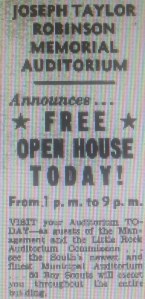
On March 31, 1940, the City of Little Rock and the Auditorium Commission threw open the doors of Joseph Taylor Robinson Memorial Auditorium to the public for an open house.
The building had officially opened in February 1940, and events had been taking place in the lower level since October 1939. But this was the first time that the public could tour the entire facility from top to bottom.

The event took place on a Sunday from 1pm to 9pm.  Curiously, it took place two days before a special election to approve the bonds to finish the auditorium. Though no one at the time was cynical enough to comment on the connection.

Members of various Little Rock Boy Scout troops led 4,000 visitors on tours of the auditorium.  Visitors were shown all over the building; one scout calculated that the walking tour equated to two miles.  Though most people were from Little Rock, the guest registry indicated visitors from California and Pennsylvania.  Among the last guests to sign the register were Mayor J. V. Satterfield and his family.

The idea for the open house had first been floated in December by Alderman E. W. Gibb after taking a tour of the construction site. He had enthusiastically professed that everyone should be able to tour and see what a magnificent structure it was going to be.  Mayor Satterfield had to tamper the alderman’s enthusiasm. He agreed with Mr. Gibb that it was a fine building but stated that a public open house could not be scheduled for a few weeks because there was still much work to be done.  Mayor Satterfield noted that the seats in the music hall were going to have to be removed and then reinstalled because they needed to be anchored better.

Women’s History Month – Bernie Babcock

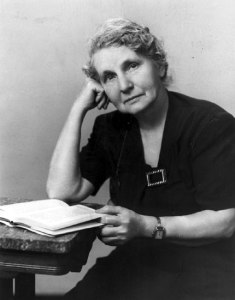
Julia Burnelle “Bernie” Smade Babcock was an author and museum founder.  When her husband died, leaving her with five children, she starting writing for money. She published several temperance novels and later wrote for the Arkansas Democrat.  She also published a magazine, wrote plays which were performed in New York, and authored a poetry anthology.  She later became recognized as an expert on Abraham Lincoln and wrote several books about him, as well as other historical figures.  For her writing skills, she became the first Arkansas woman to be included in Who’s Who in America.

In 1927, after professional curmudgeon H. L. Mencken wrote derisively of Arkansas, she decided to start a museum. The Museum of Natural History and Antiquities was first located in a Main Street storefront.  In 1929, she “gave the City of Little Rock a Christmas present” by giving the museum to the city.  It was relocated to the unfinished third floor of City Hall, with her as its employee. After being closed during part of the Great Depression, she relocated the museum to the Arsenal Building and reopened it as the Museum of Natural History.  She was involved in the efforts to rename City Park in honor of Douglas MacArthur (who had been born there) and welcomed him when he came to Little Rock in 1952.

Following her retirement in 1953, she moved to Petit Jean Mountain where she wrote and painted.

After more name changes and a relocation, her museum is now known as the Museum of Discovery and is an anchor in the River Market district.

Women’s History Month – Raye Montague

Last month, Raye J. Montague, RPE was recognized on “Good Morning America” for her work as a pioneering scientist. She was not only the first woman to design a U.S. Naval ship using a computer, or the first African American to do so, she was the first PERSON to do so.
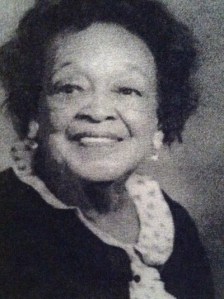
She began a career in Washington, DC with the United States Navy in 1956 and retired in 1990 after serving in numerous leadership roles during her tenure of thirty-three and one-half years. Her work designing the FFG-7 Class in the early 1970s revolutionized naval ship design.  She also served as the first female Program Manager of Ships in the US Navy and was the first female professional engineer to receive the Society of Manufacturing Engineers Achievement Award.

Throughout her career she received many honors, and was often the first woman of any race to achieve statuses in the engineering profession.

In 2006, she returned to Arkansas.  She is involved with numerous civic activities including mentoring students in the sciences at UALR and also eStem Public Charter School.  She was inducted into the Arkansas Black Hall of Fame in 2013.

Women’s History Month – Sue Cowan Williams

Sue Cowan Williams was an educator who fought for fair treatment.

After being educated in Alabama and Illinois, she returned to Arkansas, and began her teaching career in 1935 at Dunbar High School in Little Rock.  In 1942, Williams became the plaintiff in a lawsuit aimed at equalizing the salaries of black and white teachers in the Little Rock School District. The NAACP’s Legal Defense Fund, including its director-counsel Thurgood Marshall, assisted in the case. The trial ended after a week with a verdict against Williams, and her teaching contract was not renewed for the 1942-43 school year. Other black educators left the school as a result of their involvement in the lawsuit.

In 1945, Williams successfully appealed the verdict to the Eighth Circuit Court of Appeal in St. Louis, which ordered equal pay for black and white teachers in Little Rock. Dr. Christophe, the new principal of Dunbar High School, demanded Williams’s reinstatement in the fall of the same year, but it was not granted until 1952. In the intervening years, she taught classes at what is now UAPB and Arkansas Baptist College as well as at the Ordnance Plant in Jacksonville.  Upon returning to the LRSD, Williams taught at Dunbar until 1974, when she retired. She died in 1994.

The Central Arkansas Library Branch located in the Dunbar neighborhood was named for her when it opened in 1997.  She is honored with inclusion in the Arkansas Civil Rights Heritage Trail.