Little Rock Look Back: James Buchanan

On April 23, 1791, future President James Buchanan was born in Pennsylvania.  Prior to becoming President, he served as a congressman, a senator and a diplomat.  To date, he is the most recent Secretary of State to later serve as President.

It was perhaps his quest for diplomatic reconciliations which led him to repeatedly make blunders during his presidency when it came to policies in the US. He realized that slavery was a weakness for the US morally, but refused to step in and do anything to stop it.  In addition to vacillating on issues of slavery, he vetoed the Morrill Act and Homestead Act (both of which his successor, Abraham Lincoln signed).  The Homestead Act accelerated westward expansion, while the Morrill Act accelerated agricultural and engineering research and education to develop the young nation.

He served only one term (1857 to 1861) and was not seriously considered for renomination by the divided Democratic Party in its 1860 convention.  Several Democrats ran in November 1860 including southerner John C. Breckenridge (Buchanan’s Vice President) and Illinois Senator Stephen Douglas, who was Buchanan’s nemesis.  Buchanan backed Breckenridge. Abraham Lincoln handily won the 1860 election, and Buchanan spent the rest of his life pretty much in exile.

Buchanan Street in Little Rock is named for him.

Rebecca Wells headlines first day of 12th Annual Arkansas Literary Festival

2015 ALF 1The 12th annual Arkansas Literary Festival kicks off today.

  • From 5pm to 7pm, there will be a book sale preview party at River Market Books & Gifts in the Cox Creative Center.
  • At 5:30, the exhibit “Page Turners” featuring Bryan Collier will open at Hearne Fine Art.
  •  At 6pm, there will be a Summer Reading Club Preview on the 3rd floor of the Main Library.
  •  Rebecca Wells will discuss “Divine Secrets” at 7pm on stage at the Ron Robinson Theatre. She is the author of the “Ya Ya Sisterhood” books. She will also return to Little Rock in 2016 to perform her one-woman show at the Arkansas Rep.

Through the Writers In The Schools (WITS) initiative, the Festival will provide presentations by several authors for Pulaski county elementary, middle, and senior high schools and area colleges.

Support for the Literary Festival is provided by sponsors including Central Arkansas Library System, Friends of Central Arkansas Libraries (FOCAL), Arkansas Humanities Council, Fred K. Darragh Jr. Foundation, Mosaic Templars Cultural Center, ProSmart Printing, Little Rock Family, KUAR FM 89.1, Arkansas Democrat Gazette, Sync, Arkansas Life, Clinton Foundation, MacArthur Museum of Arkansas Military History, Windstream, Arkansas Federal Credit Union, Arkansas Times, Wright, Lindsey & Jennings LLP, Hampton Inn Downtown/McKibbon Hotel Group, Capital Hotel, Historic Arkansas Museum , TransAmerica, Witt Stephens Jr. Central Arkansas Nature Center, Arkansas Library Association, Pulaski Technical College, Union Pacific, Sequoyah National Research Center, Gibbs Elementary School, Rockefeller Elementary School, Hendrix College, Hendrix College Project Pericles Program, Arkansas Women’s Forum, Philander Smith College, University of Arkansas Clinton School of Public Service, East Harding, University of Arkansas at Little Rock English Department, University of Arkansas at Little Rock Department of Rhetoric and Writing, Pyramid Art, Books & Custom Framing/Hearne Fine Art, Stickyz Rock ‘n’ Roll Chicken Shack, Literacy Action of Central Arkansas, Christ Episcopal Church, and Lamar Advertising. The Arkansas Literary Festival is supported in part by funds from the Arkansas Humanities Council and the National Endowment for the Humanities.

The Arkansas Literary Festival is a project of the Central Arkansas Library System. The Festival’s mission is to encourage the development of a more literate populace. A group of dedicated volunteers assists Festival Coordinator Brad Mooy with planning the Festival. Katherine Whitworth is the 2015 Festival Chair. Other committee chairs include Kevin Brockmeier, Talent Committee; Susan Santa Cruz, Festival Guides; Laura Stanley, Hospitality Gifts; and Amy Bradley-Hole, Moderators.

“Target Tokyo: Jimmy Doolittle and the Raid that Avenged Pearl Harbor” tonight at the Clinton School

UACS TokyoThe Doolittle Raid is a feat of legend: a daring, some thought suicidal, bombing mission designed to avenge the attack on Pearl Harbor by taking the fight to the heart of the Japanese Empire—Tokyo. The raid’s success became a rallying point for the United States, destroyed Japan’s sense of its own invulnerability, and helped force a confrontation at Midway, a critical turning point in the Pacific War.

Shrouded in secrecy at the time, the raid quickly entered the realm of myth, almost literally: the White House and the American press began using “Shangri-La,” the name of a fictional mountaintop utopia, as a stand-in for the undisclosed launching point of the operation. In “Target Tokyo,” award-winning historian James Scott strips away the layers of the legend and provides the first truly comprehensive account of the raid, one that’s based on new interviews and scores of never-before published records drawn from archives across four continents.

The presentation will begin at 6pm this evening at the Clinton School.

New logo, social media presence unveiled for LR Creative Corridor

 The City of Little Rock unveiled today the Main Street Creative Corridor logo and social media sites. Located on Main Street, the Creative Corridor is an area where arts and culture will anchor a vibrant, mixed-use place in the center of the capital city’s downtown.


The logo was selected by arts groups who will eventually relocate to Main Street, in collaboration with representatives from the city. The new logo will be used on all promotional materials for the Creative Corridor. 

The Creative Corridor now has a social media presence on the following networks: 

  • Facebook: CreativeCorridorLittleRock
  • Instagram: @MainStreetLR
  • Twitter: @MainStreetLR
  • Hashtag: #creativecorridorLR

A Creative Corridor website was also launched at creativecorridorlittlerock.wordpress.com.

“Little Rock’s Creative Corridor is revitalizing Main Street one block at a time, stimulated by the arts rather than a traditional retail base,” said Little Rock Mayor Mark Stodola. “The Creative Corridor is rapidly becoming a mixed-use, work-live environment that is sensitive to the historical context of Main Street, while at the same time celebrating the amazing art organizations that are assembling along the area.”

As one of the art initiatives of the Creative Corridor, the City of Little Rock is soliciting designers for a large-scale banner art competition. Two full-color, large rectangular banner designs will be selected. The winning designs will be installed vertically on the parking deck located in the 200 block of Main Street. Each winning design will be awarded a $1,000 cash prize. The deadline for submissions is noon on May 18, 2015. For more information on how to submit a design visit creativecorridorlittlerock.wordpress.com/art-competitions/.


Initial Planning and design for the Creative Corridor was funded by a 2011 Our Town grant from the National Endowment for the Arts. The plan, created by the University of Arkansas Community Design Center and Marlon Blackwell Architects, has received awards from the American Institute of Architects and The American Society of Landscape Architects, among many others.

Certain blocks on Main Street are in the process of being reconstructed to include low-impact development streetscapes with funding provided by a grant from the Arkansas Natural Resources Commission. Once completed, the Corridor will include rain gardens, porous pavers, bioswales, and other techniques to improve water quality.

An increasing number of public, private and nonprofit groups have already invested in Main Street in recent years.  Funding for a wide variety of art and lighting installations for the Corridor is being provided by ArtPlace America and the Educational Foundation of America.

On Pulitzer Day – Prizing Mount Holly

The Pulitzer Prizes are to be announced today.  Mount Holly Cemetery not only touts that it is the site of a whole host of elected officials, it is also the only place in Arkansas where two Pulitzer Prize recipients are buried. The cemetery is open every day, but a special visit to these two prize winner gravesites can be made next Sunday during the Mount Holly Cemetery Association’s annual “Rest in Perpetuity” fundraiser picnic.

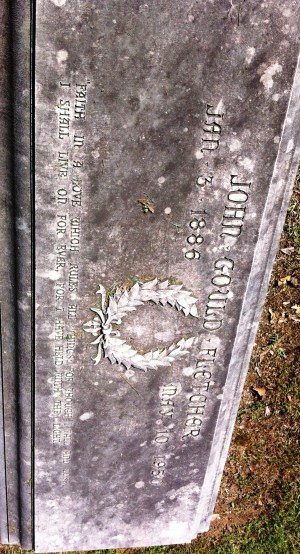
In 1939, John Gould Fletcher became the first Southern poet to win the Pulitzer Prize for Poetry.  He was born into a prominent Little Rock family in 1886.  Fletcher was awarded the prize for his collection Selected Poems which was published by Farrar in 1938.  Two years earlier, he had been commissioned by the Arkansas Gazette to compose an epic poem about the history of Arkansas in conjunction with the state’s centennial.

Fletcher is buried next to his wife, author Charlie May Simon and his parents (his father was former Little Rock Mayor John Gould Fletcher).  Other relatives are buried nearby in the cemetery.

The other Pulitzer Prize winner buried in Mount Holly is J. N. Heiskell, the longtime editor of the Arkansas Gazette.  It was Heiskell, in fact, who asked Fletcher to compose the poem about Arkansas.  Heiskell served as editor of the Gazette from 1902 through 1972.  He died at the age of 100 in 1972.
Under his leadership, the Gazette earned two Pulitzer Prizes for its coverage of the 1957 desegregation of Little Rock Central High.  One was for Harry Ashmore’s editorial writing and the other was for Public Service.

Heiskell remained in charge of the Gazette until his death in 1972.  He is buried alongside his wife with other relatives nearby.  Also not too far from Mr. Heiskell are two of his nemeses, proving that death and cemeteries can be the great equalizer. In the early days of his Gazette stewardship, he often locked horns with Senator (and former Governor) Jeff Davis. Later in Mr. Heiskell’s career, he vehemently disagreed with Dr. Dale Alford, who had been elected to Congress on a segregationist platform.

Emancipation & Reconstruction focus of Civil War 150 Seminar today at Old State House Museum

oldstatehouseAs part of its celebration of the passage of the 13th Amendment in Arkansas, the Old State House Museum and the Arkansas Civil War Sesquicentennial Commission will hold a mini-seminar this afternoon from 1pm to 5pm.  The seminar’s topic will be “Emancipation and Reconstruction.”

1:00 pm Introduction
1:15 pm Speaker – Tom DeBlack, End of the war
2:00 pm Speaker – Angela Walton-Raji, Emancipation
2:4 5pm Break
3:00 pm Speaker – Carl Moneyhon, Reconstruction
3:45 pm Q & A/Wrap-up
4:15 pm Program Ends

The Old State House Museum and the Arkansas Civil War Sesquicentennial Commission are programs of the Department of Arkansas Heritage.

Bio Information:

Tom DeBlack: End of the war
Thomas DeBlack is a professor of history at Arkansas Tech University in Russellville, Arkansas. He is a 1969 graduate of Nashville (Arkansas) High School and holds a B. A. from Southern Methodist University in Dallas, Texas (1973), an M.S.E. from Ouachita Baptist University (1979), and a PhD from the University of Arkansas (1995). Tom taught in the public schools in Arkansas for twelve years. He is a past president of the Arkansas Historical Association and the Arkansas Association of College History Teachers and currently serves on the board of the Arkansas Humanities Council.He is co-author Arkansas: A Narrative History (University of Arkansas Press, 2002; 2nd edition, 2013 ), and author of With Fire and Sword: Arkansas 1861-1874 (University of Arkansas Press, 2003). In 2003 Arkansas: A Narrative History was named the winner of the Arkansas Library Association’s Arkansiana Prize, and With Fire and Sword was named the first winner of the Butler-Remmel Arkansas History Literary Prize. Tom is currently working on a book on Lakeport Plantation in Chicot County and on a centennial history of Arkansas Tech University. He lives in Conway with his wife Susan, an optometrist, and their eleven-year-old daughter, Susannah.

Angela Walton-Raji: Emancipation
Angela Walton-Raji is a genealogist and researcher specializing in the Freedmen of Indian Territory. She is the author of Black Indian Genealogy Research, African Ancestors Among the Five Civilized Tribes and the co-publisher of VOICES of Indian Territory a scholarly journal with focus on the historical documents pertaining to the Freedmen of the Five Tribes. She has spoken at a number of national conferences and institutes throughout the nation. A native of western Arkansas, Ms. Walton-Raji earned a bachelor’s degree in Romance Languages from St. Louis University and a master’s degree from Antioch University. She works at the University of Maryland Baltimore County as Director of Graduate Recruitment, and continues to study, research and lecture on the history of Indian Territory Freedmen.

Carl Moneyhon: Reconstruction
Dr. Moneyhon joined University of Arkansas-Little Rock faculty in 1973 and holds a Ph.D. from the University of Chicago. He is faculty liaison with the University History Institute, an organization that develops closer ties between the department and the community. He also serves on the editorial boards of the Arkansas Historical Quarterly and the Encyclopedia of Arkansas History and Culture. He was won the UALR Faculty Excellent Award for Research and the UALR Faculty Excellence Award for Teaching. Dr. Moneyhon is a specialist in the history of the American Civil War and the South and is widely published in the field. His work has been supported by the National Endowment for the Humanities, and he recently received one of the first College of Arts, Humanities, and Social Sciences Summer Fellowships for Research. He is a Fellow of the Texas Historical Association.

Little Rock Look Back: LR Mayor Charles Moyer

Mayor MoyerOn April 18, 1880, future Little Rock Mayor Charles E. Moyer was born in Glenwood, Minnesota. A man of contradictions, he was both a candidate backed by (and probably personally involved in) the Ku Klux Klan, yet he also brought the Goodwill Industries organization to Little Rock and Arkansas to help those less fortunate.

He came to Little Rock shortly after the turn of the 20th century as a clerk in the Post Office, and later served as a mail carrier. He then worked for Plunkett-Jarrell Wholesale Grocer Company in Little Rock. On January 1, 1921, he took office as County Judge for Pulaski County. In 1924, he ran against incumbent mayor Ben Brickhouse in the Democratic primary. Since Brickhouse had displeased the Klan, which was an active part of Democratic politics in Little Rock and throughout the nation at the time, Moyer won the primary.

Mayor Moyer led the City of Little Rock from April 1925 through April 1929. In 1927, the last lynching in Little Rock took place. While race-baiting crowds were surrounding City Hall demanding an African American prisoner be released to them for vigilante justice, Mayor Moyer was in hiding at an undisclosed location. Not able to get the prisoner they wanted, they took out their venom on another man who had assaulted a white woman and her daughter.

After leaving office in 1929, Moyer moved for a time to Batesville. He returned to Little Rock and was a chief deputy sheriff. From 1937 to 1941, he served as Pulaski County Assessor. In 1941, he returned to the office of Little Rock Mayor after J. V. Satterfield opted to serve only one term and did not seek re-election. Mayor Moyer led Little Rock through most of World War II. He left office in April 1945 and died on May 29, 1945, barely only one month after leaving City Hall.