2nd Friday Art Night – Old State House Museum

Celebrate the New Year with a musical journey!

During 2nd Friday Art Night on January 11, the Bob Boyd Sounds will perform a mix of popular standards, swing, and popular jazz spanning several decades.

Stone’s Throw Brewing will serve Arkansas-made brews, including the award-winning Pre-Prohibition Porter.


2nd Friday Art Night – Historic Arkansas Museum offers Dave Miller and Rocktown Revival

There may not be a Nog Off this month, but 2nd Friday Art Night at HAM still offers a lot of fun!
Historic Arkansas Museum is kicking off the first 2nd Friday Art Night of 2019 with Little Rock’s Dave Miller and Rocktown Revival!

Miller is a musical storyteller, evoking images of places and relationships in the Sotuh and who “entertains audiences with his ready wit and warm expression of a kind of Ozark-bred joy and wonder.”

The Water Buffalo and Buffalo Brewing Company will be serving up the brew for the evening.

Exhibits at the museum include:

  • Face to Face: Contemporary Portraits
  • More or Less: Liz Smith & Katherine Strause
  • History in Color: The Spectrum of Daily Life in Early America

2nd Friday Art Night – Art and Live Music at CALS tonight

The Central Arkansas Library System offers two locations at Library Square tonight for 2nd Friday Arts Night.
At the Bookstore at Library Square (formerly River Market Books & Gifts) the exhibit is Art Not Bombs collected works by artist Victor Wiley. It was curated by local film and event producer Mike Poe. Live music will be provided by Brasher/Morg & Raging Skulls.

Paintings by Terry Brewer: Nepal Maa Dui Barsa Base (Two Years in Nepal, 2008–2010) remains on display at the Galleries at Library Square (formerly Butler Center Galleries), with eclectic instrumental live composition duo Das Loop as the featured musicians. After a twenty-year career as a graphic artist, Terry Brewer made his first trip to Asia in 1998. While in Nepal, he began looking into volunteer opportunities, hoping to return someday to live, work, and explore. In 2008, he returned to Nepal as a volunteer with Habitat for Humanity International and stayed over two years. In between work assignments and treks into the mountains, he set up a studio in Kathmandu and began an ongoing series of portraits and landscapes. The exhibition is on view in the Underground Gallery through March 30, 2019.

2019 Arkansas Food Hall of Fame Finalists announced

The 2019 Arkansas Food Hall of Fame finalists were announced today (January 10) at the Department of Arkansas Heritage headquarters.

This year, the Hall of Fame’s third, over 600 nominations were received in the five categories.  (The first year there were 300 nominations received and last year 450 nominations were submitted.)

As Department of Arkansas Heritage Director Stacy Hurst noted, “The number of nominations confirms that people are indeed opinionated about their food.”  She continued, “Food is woven into our culture and our heritage.”

The 2019 Arkansas Food of the Year is Catfish. Not only is it a staple in many restaurants throughout the state, it is also a major contributor to the state’s economy.

The finalists in four of the five categories were announced. The fifth, the People’s Choice Award, goes to the entity that received the most nomination submittals. It will be announced, along with the winners in the other categories, at the Arkansas Food Hall of Fame ceremony on Monday, February 25 at the CALS Ron Robinson Theater.

The finalists in the other four categories are:

Food Hall of Fame
AQ Chicken House (Springdale)
4-Dice Restaurant (Fordyce)
Bruno’s Little Italy (Little Rock)
Burge’s Restaurant (Lewisville)
Craig Brothers Cafe aka Craig’s (De Valls Bluff)
Doe’s Eat Place (Little Rock)
Keeney’s Food Market (Malvern)
Kream Kastle (Blytheville)
The Ohio Club (Hot Springs)
Star of India (Little Rock)

Proprietor of the Year
Capi Peck, Little Rock (Trio’s)
Loretta Tacker, Marion (Tacker’s Shake Shack)
Peter Brave, Little Rock (Brave New Restaurant)
Sami Lal, Little Rock (Star of India)
Scott McGehee, Little Rock (Yellow Rocket Concepts restaurants)

Food Themed Event
Hope Watermelon Festival
International Greek Food Festival (Little Rock)
Our Lady of the Lake Annual Church Spaghetti Dinner (Lake Village)
Tontitown Grape Festival
World Championship Duck Gumbo Cook Off (Stuttgart)

Gone But Not Forgotten
Klappenbach Baker (Fordyce)
La Scala Italian Restaurant (Little Rock)
Mary Maestri’s Italiano Grillroom (Springdale)
The Shack Barbecue (Little Rock)
Uncle John’s (Crawfordsville)

The members of the Arkansas Food Hall of Fame Committee are:

  • Paul Austin
  • Swanee Bennett
  • Yvette Brady
  • Chip Culpepper
  • Montine McNulty
  • Dr. Cindy Grisham
  • Tim Horton
  • Rex Nelson
  • Tim Nutt
  • Dr Wendy Richter
  • Kat Robinson
  • Christina Shutt

Little Rock Look Back: End of City of Pulaski Heights

103 years ago today, the Pulaski Heights City Council held its final meeting.  Following the January 4 annexation election, Mayor L. H. Bradley convened the Pulaski Height City Council for the final time on January 10, 1916.

Five of the eight aldermen were present for the final meeting.  E. T. Reaves, R. G. Trickett, W.A. Turner, J. B. Webster, and H.C. Locklar.  Absent were J. S. Murphy, J.H. Hicks, and W. H. Keeton.

The City Recorder was A. M. Edwards, while O. E. White was Treasurer and Jonathan P. Streepey was City Attorney.

At the meeting, bills were paid and allowances were made for the transfer of assets and responsibilities to the City of Little Rock.  The minutes do not reflect if there were any valedictory addresses by any of the elected officials, which were common at that era.

Once Mayor Bradley and the Council had worked their way through the agenda, Alderman Reaves made the motion to adjourn the council sine die which was seconded by Alderman Webster. The motion passed unanimously.  With that, the Pulaski Heights City Council, which had first met in 1904, finished its business.

Little Rock Look Back: First six Little Rock Police officers are hired

On January 9, 1866, the new Little Rock City Council held its second meeting after the post-Civil War resumption of municipal government.  At that meeting, a special committee was created to meet with Gen. Williams who was the military commander for Arkansas.  Mayor J. J. McAlmont, Alderman I. A. Henry, and Alderman Henry Ashley were authorized to discuss the creation of a permanent police force in Little Rock.

At the same meeting, the City Council hired the first Little Rock police officers. These six men were hired on a temporary basis until a department could be created. Their pay was $3.00 a day (that would be the equivalent of $47.55 a day in 2019). The first six officers were John O’Brien, Thomas Doyle, James Anderson, John Henry, Fred Kurtz, and Joseph Chears.

Prior to the Civil War, Little Rock had a Constable and volunteers, but no police force.  As the City had continued to grow, even during the Civil War, as the government was reorganizing, it was felt it was time for a permanent police force.

The Little Rock Police Department was officially created on January 15, 1866 by Ordinance 2 of 1866. Two days later, the salary was set at $2.00 a day.  No reason was given as to the reduction from the temporary pay base.

Little Rock Look Back: Post-Civil War government resumes for Little Rock

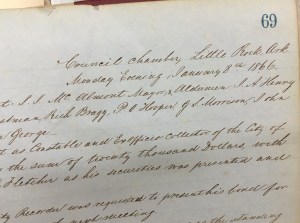
One hundred and fifty three years ago today (on January 8, 1866), Little Rock City Hall resumed functioning after the Civil War.  The City government had disbanded in September 1863 after the Battle of Little Rock.  From September 1863 through the end of the war (on on through part of Reconstruction), Little Rock was under control of Union forces.

Following the April 1865 conclusion of the Civil War, plans were made to restart local government in Little Rock.  Even though Arkansas would not have Congressional representation in Washington until June 1868 (becoming the second Confederate state after Tennessee), the establishment of local government took place in January 1866.  (It was supposed to have started earlier, but the local elections set for November 1865 were cancelled on the day they were originally set to take place.)

The first City Council meeting took place on Monday, January 8, 1866. The council met again on Tuesday, January 9 and Monday, January 15 as they were trying to establish committees and rules for the new government.

The first post-Civil War mayor was Dr. J. J. McAlmont, who was a physician and pharmacist. Following his service as the city’s chief executive, he would later be a co-founder of what is now UAMS.  The initial aldermen were I.A. Henry (who had been on the City Council when it ceased in 1863), Henry Ashley, M. H. Eastman, Rick Bragg, Dr. P. O. Hooper, G. S. Morrison, John Collins and Alexander George.

Their first action was to approve the bond of Thomas C. Scott as Constable and City Collector.  Vouching for him were S. H. Tucker and future LR mayor John Gould Fletcher.  The Recorder was asked to present his bond and the next meeting.

The Mayor then established several committees of the City Council and named his appointments. Among the committees were Finances, Streets, Ordinances, Mount Holly Cemetery, Fire Department and Police.

That meeting and the following two meetings, the City continued to approve motions, resolutions and ordinances to set up the duties and responsibilities of a government.

Ordinance Number 1 established the rates of Licenses for 1866.  Among those were:

  • $100 for the privilege of selling goods at auction
  • $20 for a one-horse wagon, paid quarterly
  • $35 for a two-horse wagon, paid quarterly
  • $50 for a four-horse wagon, paid quarterly
  • $25 to run a cab or bus (which would have been in some horse drawn conveyance), paid quarterly
  • $40 a month to sell liquor, wine, ale, beer, etc., by the glass or bottle to be consumed in a store, tavern, shop or store
  • $25 each quarter for each billiard table
  • $50 each quarter for each ten pin alley