 On April 4, 1968, Dr. Martin Luther King, Jr., was assassinated in Memphis. Thankfully Little Rock did not see the unrest that many cities did.
Part of that was probably due to quick action by Governor Winthrop Rockefeller. The Governor released a statement fairly quickly expressing his sorrow at the tragedy and calling for a day of mourning. He also made the State Capitol available for the NAACP to have a public memorial, as well as worked with a group of ministers to host an interdenominational service.
Little Rock Mayor Martin Borchert issued a statement as well:
We in Little Rock are disturbed about the incident in Memphis. We are disturbed regardless of where it had happened. Killing is not the Christian solution to any of our problems today.
In Little Rock, we feel we have come a long way in 10 years toward solving some of our problems of living and working together regardless of race, creed or color.
The city Board of Directors in Little Rock has pledged itself toward continuing efforts to make Little Rock a better place in which to live and work for all our citizens.
We feel the efforts of all thus far have proved we can live in harmony in Little Rock and are confident such an incident as has happened will not occur in Little Rock. We will continue our most earnest efforts toward the full needs of our citizens.
The day after Dr. King was assassinated, a group of Philander Smith College students undertook a spontaneous walk to the nearby State Capitol, sang “We Shall Overcome” and then walked back to the campus. President Ernest T. Dixon, Jr., of the college then hosted a 90 minute prayer service in the Wesley Chapel on the campus.
On the Sunday following Dr. King’s assassination, some churches featured messages about Dr. King. As it was part of Holy Week, the Catholic Bishop for the Diocese of Little Rock had instructed all priests to include messages about Dr. King in their homilies. Some protestant ministers did as well. The Arkansas Gazette noted that Dr. Dale Cowling of Second Baptist Church downtown (who had received many threats because of his pro-integration stance in 1957) had preached about Dr. King and his legacy that morning.
Later that day, Governor Rockefeller participated in a public memorial service on the front steps of the State Capitol. The crowd, which started at 1,000 and grew to 3,000 before it was over, was racially mixed. At the conclusion of the ceremony, Governor and Mrs. Rockefeller joined hands with African American ministers and sang “We Shall Overcome.”
That evening, Trinity Episcopal Cathedral was the site of an interdenominational service which featured Methodist Bishop Rev. Paul V. Galloway, Catholic Bishop Most Rev. Albert L. Fletcher, Episcopal Bishop Rt. Rev. Robert R. Brown, Rabbi E. E. Palnick of Temple B’Nai Israel, Gov. Rockefeller, Philander Smith President Dixon, and Rufus King Young of Bethel AME Church.
Earlier in the day, Mayor Borchert stated:
We are gathered this afternoon to memorialize and pay tribute to a great American….To achieve equality of opportunity for all will require men of compassion and understanding on the one hand and men of reason and desire on the other.

 April 6 is Tartan Day – a chance to pay tribute to the achievements of Scots in the U.S. It is also a good chance to wear plaid.
 If you are like me, you’ve been receiving notifications about Arkansas Gives Day for months. Well, today is the day! From 8am until 8pm, you can help grow the love for Arkansas’s nonprofit organizations by making a donation to the charity of your choice. The event is sponsored by the Arkansas Community Foundation.
 On April 1, 1940, stage and screen star Edward Everett Horton appeared in the comedy Springtime for Henry in the music hall of Robinson Auditorium. This was the first play to be featured on the stage of the Music Hall which had opened six weeks earlier.
 Janis Kearney is the only person to have held the title of U.S. Presidential Diarist. In 1995 she was appointed to that position by President Bill Clinton.
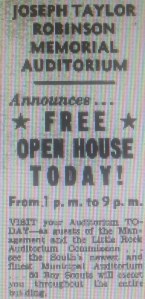 On March 31, 1940, the City of Little Rock and the Auditorium Commission threw open the doors of Joseph Taylor Robinson Memorial Auditorium to the public for an open house.
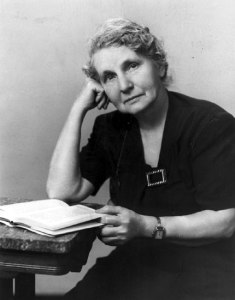 Julia Burnelle “Bernie” Smade Babcock was an author and museum founder. When her husband died, leaving her with five children, she starting writing for money. She published several temperance novels and later wrote for the Arkansas Democrat. She also published a magazine, wrote plays which were performed in New York, and authored a poetry anthology. She later became recognized as an expert on Abraham Lincoln and wrote several books about him, as well as other historical figures. For her writing skills, she became the first Arkansas woman to be included in Who’s Who in America.
 Little Rock Culture Vulture