
Little Rock Look Back: A Dozen Years of the Clinton Library

SkipIt has been twelve years.  Have you warmed up yet?

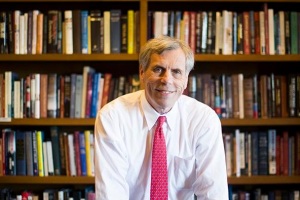
Many remember November 18, 2004, for the rain and cold wind which greeted visitors to the opening of the William Jefferson Clinton Presidential Center and Park.  In the years which lead up to that day, November 18, 2004, was known simply as “Game Day” for a group of people.  The chief one was Skip Rutherford.

Overseeing the planning for the Clinton Presidential Center and the events surrounding it had been the focus of James L. “Skip” Rutherford for many years. A FOB for decades, he had stayed in Little Rock when so many went to Washington DC in 1993.

He oversaw the planning for the Clinton Library and led the Clinton Foundation.  No detail was too small or insignificant for him to consider. For months leading to the opening he led meetings to help restaurants, hotels, and attractions understand the scope of the opening.

Together with Dean Kumpuris and Bruce Moore on behalf of the City of Little Rock and Stephanie Streett of the Clinton Foundation, he reviewed plans for the Clinton Presidential Park and the streets and neighborhoods around the Clinton Presidential Center.

Skip used his connections with the business community in Little Rock and throughout the state to discuss the importance of a Presidential Library regardless of one’s personal political affiliations.  He withstood critics who second-guessed everything from the cost, the design, the location, the purpose, and even the anticipated tourism and economic impacts.

Finally the big day had come.  If the weather was not ideal, that was almost inconsequential. It was still the culmination of more than seven years hard work.  As he remarked later that evening when discussing the weather “Many who attended today go to events like this all the time.  This is one they won’t forget!”

However, the opening of the Clinton Presidential Center was not the end of the task. It merely was the move from one phase to another. A few years later, Skip’s role would change as he would leave the Foundation and become the second Dean of the Clinton School of Public Service.
RobinsoNovember: Auditorium Commission Abolished

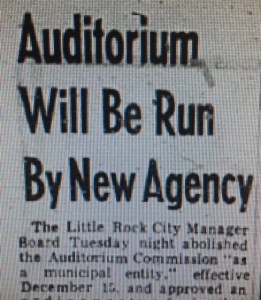
aud-com-abolOn November 16, 1971, the City of Little Rock Board of Directors abolished the Auditorium Commission which oversaw Robinson and transferred duties to the Advertising and Promotion Commission. This was done with the full support of both commissions.  The transfer took place immediately, with all assets and loose ends to be wrapped up by December 15, 1971.
With the adoption of a hospitality sales tax, by state statute, Little Rock had to have an A&P Commission.  By 1971 plans were afoot to use the A&P tax to build a conference center using some of the existing space in Robinson and adding space.  It did not make sense to have two separate commissions overseeing the same building.

For the Auditorium Commission members, it was possibly a relief.  For years, overseeing the building had been a quiet duty.  But with the social changes of the 1960s, they had been confronted ending the policy of segregation as well as changes in content and subject matter of acts booked at Robinson.  Being agents of social change was doubtful what any of them had envisioned when they joined the commission.  Emily Miller had been a member of the body since January 1940 and others had been on it for many years.

Transferring Robinson to the A&P Commission ushered in a new era for the building. It saw increased booking of meetings which led to a better revenue stream.  The use of the A&P tax would mean the opportunity to give the building an upgrade from 1972 to 1974.

Robinson would eventually prove to be inadequate for all of Little Rock’s needs, which led to the creation and subsequent expansion of Statehouse Convention Center.  But the action 45 years ago today set the stage for the transformation Robinson has undergone as it reopened last week.

RobinsoNovember: Carol Channing brings HELLO, DOLLY! to Little Rock

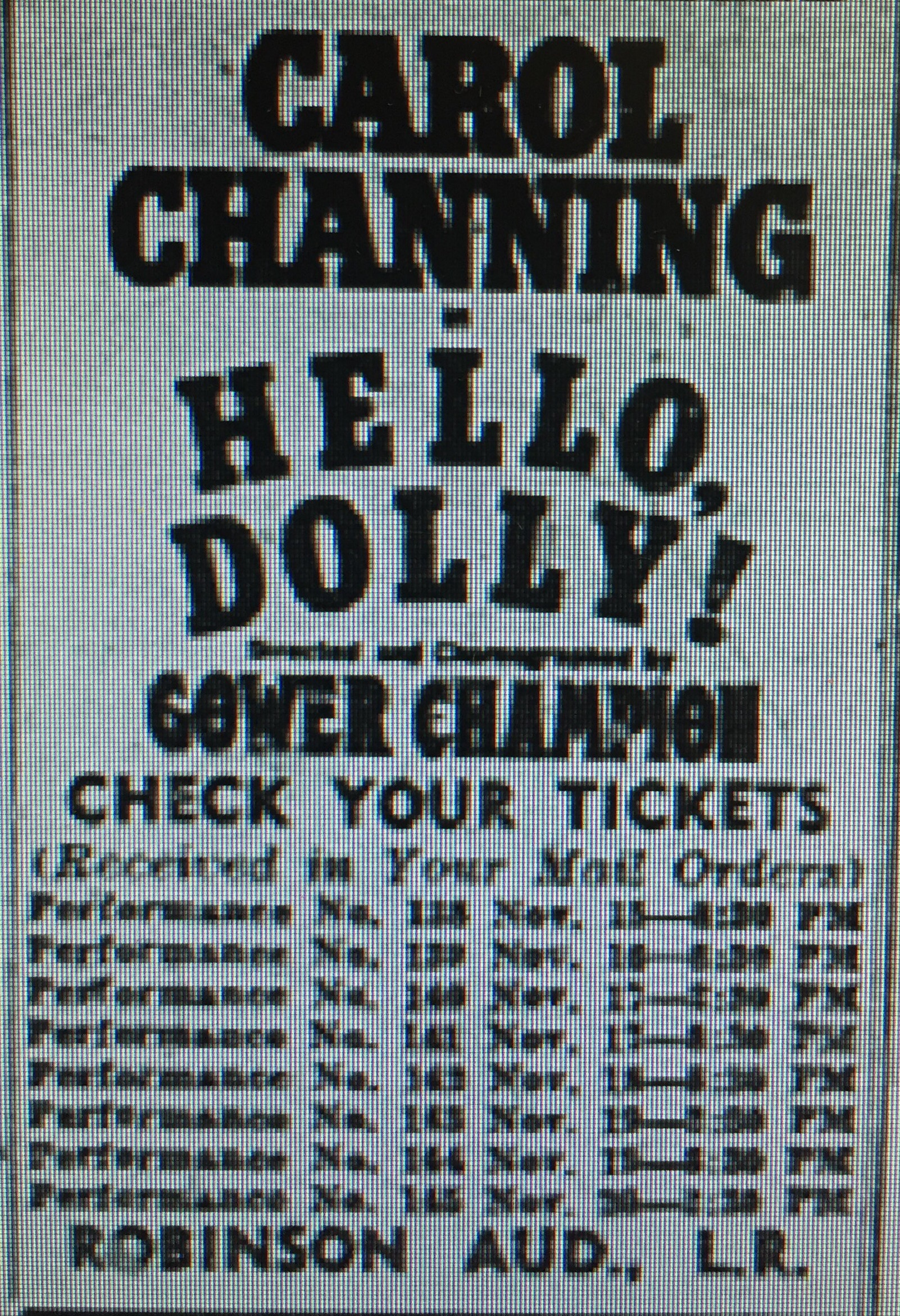
50 years ago tonight, on November 15, 1966, Carol Channing opened a six day stint in HELLO, DOLLY! at Robinson Auditorium.  She would play 8 sold out shows over those six days.

Channing, who had won the 1964 Tony Award for Best Actress in a Musical for her role in this show, had recently returned to the national tour.  She had just wrapped filming THOROUGHLY MODERN MILLIE (for which she would receive an Oscar nomination). She had specifically requested that Little Rock be added to the tour.

Her breakout role was in 1949’s GENTLEMEN PREFER BLONDS. In that show she introduced the song “Little Girl from Little Rock.”  Since it had helped make her a star, she had long felt an affinity for the Arkansas capital.  Therefore when she rejoined the tour, she required that LR be one of her stops before she left the tour.

While in Little Rock, Channing was entertained at the Arkansas Governor’s Mansion and feted at parties.  She was made an honorary citizen of Little Rock, as well.

But she was here to perform. And perform she did. She was rarely known to miss a performance and always gave her utmost.  Bill Lewis, in his review in the ARKANSAS GAZETTE, stated “To hear Channing sing ‘Hello, Dolly!’ Is one of the great experiences of all musical theater to date…”

In assessing the show’s run in Little Rock (which would be seen by more than 20,000 people), Lewis summed up what many felt at the time — and to hear the reminiscences from a half century later, it still is a heartfelt sentiment — “A week’s too little.”

RobinsoNovember: Lawrence Hamilton

LawrenceHamiltonAnother notable former Little Rock performing artist who is memorialized at Robinson Center is Lawrence Hamilton.

The son of the Dr. Oscar and Mae Dell Hamilton, he was born in the small southwest Arkansas town of Foreman With an interest in music stemming from childhood, Hamilton earned a music scholarship to attend Henderson State University in Arkadelphia where he studied piano and voice He graduated in 1976 with a bachelor’s degree in music education.

From Arkansas, Hamilton traveled to Florida to work as a performer at Walt Disney World in Orlando, Florida where he would meet talent manager, Tommy Molinaro. This fateful meeting would prove to be a life-changing encounter, as Molinaro would invite Hamilton to come to New York to audition for the famed actor/director Geoffrey Holder. This marked the beginning of Hamilton’s bold and creative career in the performing arts, leading to performances on Broadway and on tours in Sophisticated Ladies, The Wiz,Uptown – Its Hot, Porgy and Bess, Big River, Play On!, and Jelly’s Last Jam among others. Perhaps his crowning achievement was starring in Ragtime.

Hamilton has been a member of the Southern Ballet Theater, Brooklyn Dance Theater, Ballet Tap USA, and the Arkansas Opera Theater He has performed in concert with the legendary Lena Horne at the White House for President and Mrs. Ronald Reagan, and at the Vatican for Pope John Paul II. Hamilton’s career also led to a stint as musical director for the renowned opera legend Jessye Norman, as well as vocal coach/arranger for the pop group New Kids on the Block

Upon his return to Arkansas, Hamilton served for several years as director of choral music at Philander Smith College. He also appeared in several plays at the Arkansas Repertory Theatre.  In addition, he performed at countless concerts, benefits and galas throughout Arkansas.  In 2003, he was inducted into the Arkansas Black Hall of Fame.  In 2008, he was appointed to the Little Rock Mayor’s Task Force on Tourism.

Hamilton died in New York in April 2014 due to complications from surgery.  Just weeks prior to the surgery, he had appeared in August Wilson’s The Piano Lesson in Cape Fear, North Carolina.  He had also starred in that play at Arkansas Rep a few years earlier.

RobinsoNovember: Dr. William Grant Still

bhm StillLast night, the Arkansas Symphony Orchestra’s Opus Ball was the first public event in the William Grant Still Ballroom of Robinson Center.  This afternoon at 3pm, the Arkansas Symphony Youth Orchestra is playing a Still composition in a performance with Ballet Arkansas at the Albert Pike Memorial Temple on Scott Street.

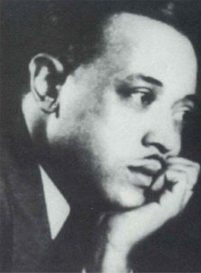
Dr. William Grant Still was a legend in his own lifetime.  Dr. Still, who wrote more than 150 compositions ranging from operas to arrangements of folk themes, is best known as a pioneer. He was the first African-American in the United States to have a symphonic composition performed by a major orchestra. He was the first to conduct a major symphony orchestra in the US; the first to conduct a major symphony in the south; first to conduct a white radio orchestra in New York City; first to have an opera produced by a major company. Dr. Still was also the first African-American to have an opera televised over a national network

Dr. Still was born May 11, 1895 in Woodville, Mississippi to parents who were teachers and musicians. When Dr. Still was only a few months old, his father died and his mother took him to Little Rock. Inspired by RCA Red Seal operatic recordings, his musical education began with violin lessons.

After his studies at Wilberforce University and the Oberlin Conservatory of Music, he played in orchestras and orchestrated for various employers including the great W. C. Handy. For several years he arranged and conducted the “Deep River Hour” over CBS and WOR.

In the 1920’s, Still made his first appearances as a serious composer in New York. Several fellowships and commissions followed. In 1994, his “Festive Overture” captured the Jubilee prize of the Cincinnati Symphony orchestra. In 1953, he won a Freedoms Foundation Award for “To You, America!” which honored West Point’s Sesquicentennial Celebration. In 1961, he received honors for this orchestral work, “The Peaceful Land”. Dr. Still also received numerous honorary degrees from various colleges and universities, as well as various awards and a citation from Arkansas Governor Dale Bumpers in 1972.

In 1939, Dr. Still married journalist and concert pianist Verna Avery, who became his principal collaborator. They remained together until Dr. Still’s death in 1978.  In a proclamation marking the centennial of Dr. Still’s birth, President Bill Clinton praised the composer for creating “works of such beauty and passion that they pierced the artificial barriers of race, nationality and time.”

In 1995, Dr. Still was posthumously inducted into the Arkansas Black Hall of Fame.

RobinsoNovember: First Dance at Robinson Center

RC-dance-orchestra

Jan Garber and his orchestra

Tonight the Arkansas Symphony Orchestra hosts its annual Opus Ball inside the new William Grant Still Ballroom at Robinson Center.  That the first public event in this space will be a dance is only appropriate.  The first public event in the original Robinson was also a dance.  It was held four months before the building even opened.

On October 4, 1939, the convention hall on the lower level was the site of a preview dance.  The pecan block flooring had been installed just the week before.

The first four people to enter the building as paying guests were Mr. and Mrs. Alfred Wilheim, Frances Frazier and Bill Christian.  Reports estimated 3,200 people attended and danced to the music of Jan Garber and His Orchestra.  By happenstance, Garber and his musicians had also played in Little Rock on January 26, 1937, the date of the election which approved the auditorium bonds.  Since Little Rock then did not have a suitable space, that appearance had been on the stage of the high school auditorium.


Little Rock Look Back: Adams Field Dedicated in 1941

adams-field-first-terminalOn November 11, 1941, Adams Field was dedicated in Little Rock.  The ceremony marked the official opening of the airport’s first administration building.  It also marked the official naming of the building in memory of George Geyer Adams.

Adams was captain of the 154th Observation Squadron of the Arkansas National Guard. He also served on the Little Rock City Council from 1927 to 1937.  During that time he helped develop what would become Little Rock’s airport from an airfield first planned in 1929 for military planes to what would become Little Rock’s municipal airport.

Adams left the City Council in April 1937.  Five months later, he was killed in a freak accident when a propeller assembly exploded and sent the propeller careening toward him.

Adams’ family was present at the ceremony on November 11, 1941.  The fact that it was on Armistice Day was no accident.  Little did few realize that US would be plunged into a second world war just a few weeks later.

Top executives from American Airlines came to Little Rock to participate in the festivities.  Others coming to town included members of Arkansas’ congressional delegation.  New Mayor Charles Moyer shared credit for the building with former Mayor J. V. Satterfield who had led the project for most of the time.  (Satterfield would later be the first chairman of the Airport Commission in 1951.) Hundreds turned out for the ceremony.  While they were in town, the congressional delegation and American Airlines executives made the most of interest in them and spoke to various civic clubs and banquets.  They extolled the virtues of airflight and the aircraft industry.

On a personal note:  the terminal building was built by E. J. Carter, a great uncle of the Culture Vulture.