Ernest Green leads event tonight at Clinton School commemorating 100 years since Daisy Bates was born

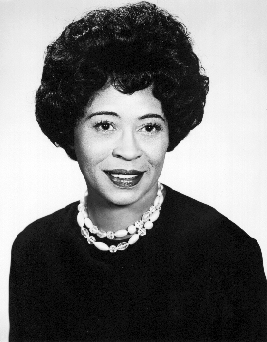
bates daisyDaisy Bates was an American civil rights activist, publisher, journalist, and lecturer who played a leading role in the Little Rock Integration Crisis of 1957. Daisy Bates would be 100 years old on November 11th. To mark the milestone the Clinton School of Public Service is hosting a celebration of Mrs. Bates featuring Ernest Green.

Daisy Lee Gatson Bates and her husband were important figures in the African American community in the capital city of Little Rock.  Realizing her intense involvement and dedication to education and school integration, Daisy was the chosen agent after nine black students were selected to attend and integrate a Little Rock High School.  Bates guided and advised the nine students, known as the Little Rock Nine, when they enrolled in 1957 at Little Rock Central High School. President Clinton presented the Little Rock Nine with the Congressional Gold Medal and spoke at the 40th anniversary of the desegregation while he was in office.  He returned as a speaker for the 50th anniversary and opening of the new museum and historical site in 2007.

Ernest ‘Ernie’ Green was one of the nine African-American students who integrated Central High School in Little Rock and the first of the nine to graduate.  Green is the managing director of public finance for Lehman Brothers in Washington, D.C., has served as the Assistant Secretary of Labor for Employment and Training during President Carter’s administration, Chairman of the African Development Foundation under President Clinton, and Secretary of Education, Richard W. Riley, appointed him Chairman of the Historically Black Colleges and Universities Capital Financing Advisory Board.

The event will take place at 6pm tonight at the Clinton School.

*Reserve your seats by emailing publicprograms@clintonschool.uasys.edu or calling 501-683-5239.
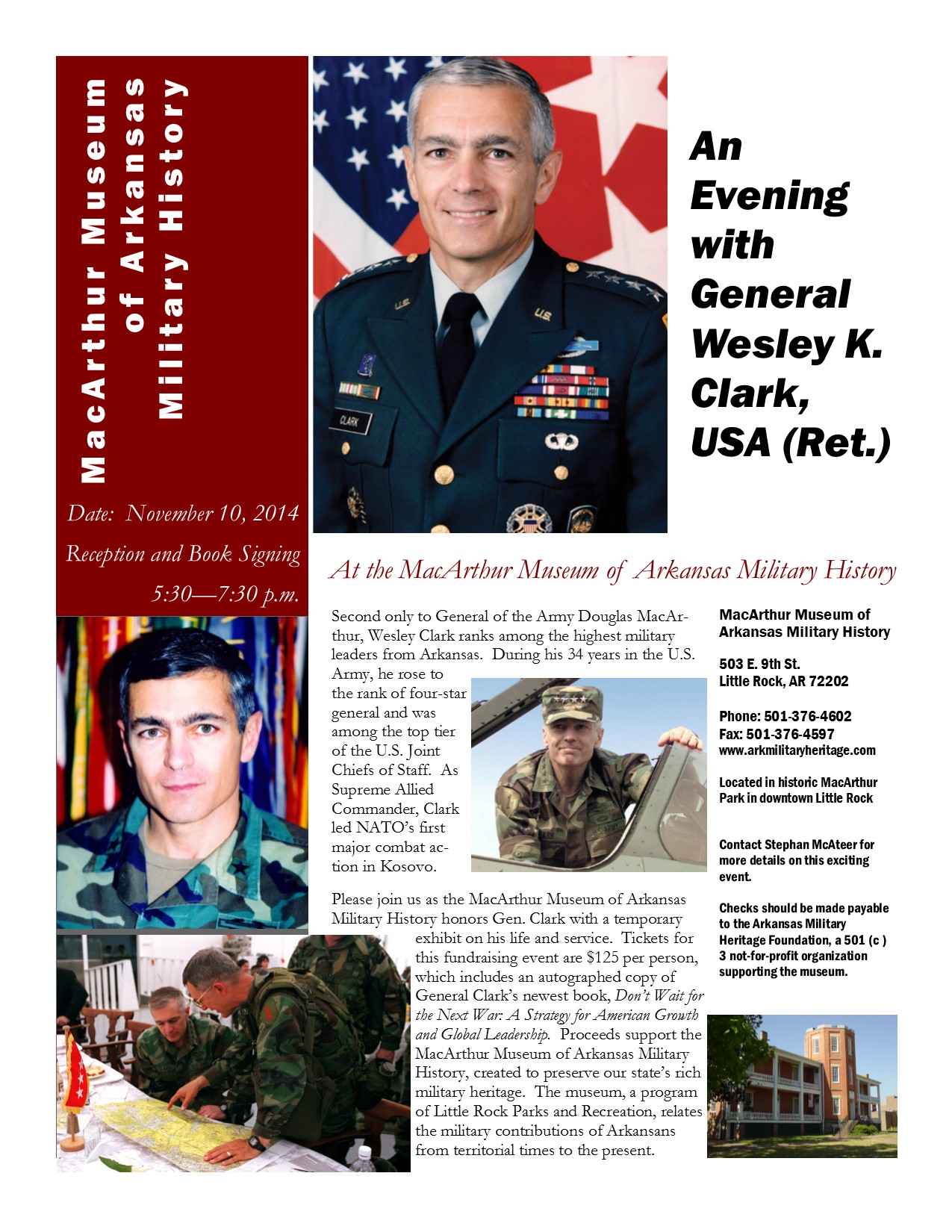
An Evening with General Wesley K. Clark at the MacArthur Museum of Arkansas Military History

Flyer, ClarkSecond only to General of the Army Douglas MacArthur, Wesley Clark ranks among the highest military leaders from Arkansas.  During his 34 years in the U.S. Army, he rose to the rank of four-star general and was among the top tier of the U.S. Joint Chiefs of Staff.  As Supreme Allied Commander, Clark led NATO’s first major combat action in Kosovo.

Tonight at 5:30 pm, the MacArthur Museum of Arkansas Military History honors Gen. Clark with a temporary exhibit on his life and service.

Tickets for this fundraising event are $125 per person, which includes an autographed copy of General Clark’s newest book, Don’t Wait for the Next War: A Strategy for American Growth and Global Leadership.  Proceeds support the MacArthur Museum of Arkansas Military History, created to preserve our state’s rich military heritage.

The museum, a program of Little Rock Parks and Recreation, relates the military contributions of Arkansans from territorial times to the present.


Little Rock Look Back: Happy 183 to Little Rock

LR 183With the stroke of Territorial Governor John Pope’s pen, Little Rock was officially chartered as a town on November 7, 1831. This followed approval by the Arkansas legislature a few days earlier.

As a chartered, officially recognized municipality, the Town of Little Rock was authorized to create a government and to plan for a Mayor and Aldermen to be elected. That election would take place in January 1832 with the initial council meeting later that month.

There are several earlier and later days which could be used to mark Little Rock’s official birth (LaHarpe sighting in 1722, first settler in 1812, permanent settlement in 1820, selection of trustees in 1825, chartered as a City in 1835, chartered as a City of First Class in 1875) — but it is November 7, 1831, which has been the officially recognized and accepted date.

In 1931, Little Rock celebrated her centennial with a series of events.  Likewise, in November 1981, Little Rock Mayor Charles Bussey signed and City Clerk Jane Czech attested Resolution 6,687 which recognized the Little Rock sesquicentennial.

Today at noon Clinton School features 30 Years of Main Street Arkansas with Patrice Frey

Main Street ArkThis year marks the 30th anniversary of Main Street Arkansas being created.  To mark that, the Clinton School of Public Service is hosting Patrice Frey.

She is the first President and CEO of the National Main Street Center. The National Main Street Center, Inc. is an extension of the 33-year-old Main Street program of the National Trust for Historic Preservation, which uses historic preservation as a tool for economic development in downtown and neighborhood commercial districts. More than 2,000 communities have participated in the Main Street program since its inception, leading to more than 235,000 building rehabilitation projects and the creation of nearly 475,000 jobs in those cities and towns.

Since 1984, Main Street Arkansas has been a leading advocate for downtown revitalization providing resources, education and professional assistance to spark life into Arkansas’s traditional commercial areas. Since that time, Main Street Arkansas cities have yielded a net gain of 3,907 jobs, 1,151 new businesses and 1,066 business expansions and relocations into downtown. A total of $145,650,659 in investment has financed 3,272 facade renovations, rehabilitations and new construction projects. The Main Street cities have seen 844 public improvement projects valued at $25,193,767 and 545,536 volunteer hours on Main Street matters.  Main Street Arkansas is a division of the Arkansas Historic Preservation Program, an agency of the Department of Arkansas Heritage.

Patrice Frey is President and CEO of the National Main Street Center, where she oversees the Center’s work, offering technical assistance, research, advocacy, and education and training opportunities for Main Street’s network of approximately 1,100 communities. Based in Chicago, Illinois, the National Main Street Center is a subsidiary of the National Trust for Historic Preservation, and has participated in the renewal of more than 2,000 older commercial districts during its 30-year history. Before joining the National Main Street Center in May 2013, Patrice serviced as the Director of Sustainability at the National Trust for Historic Preservation, where she oversaw the National Trust’s efforts to promote the reuse and greening of older and historic buildings, including research and policy development work through the Seattle-based Preservation Green Lab.

Little Rock Look Back: W. H. “Bill” Walters, LR’s 60th Mayor

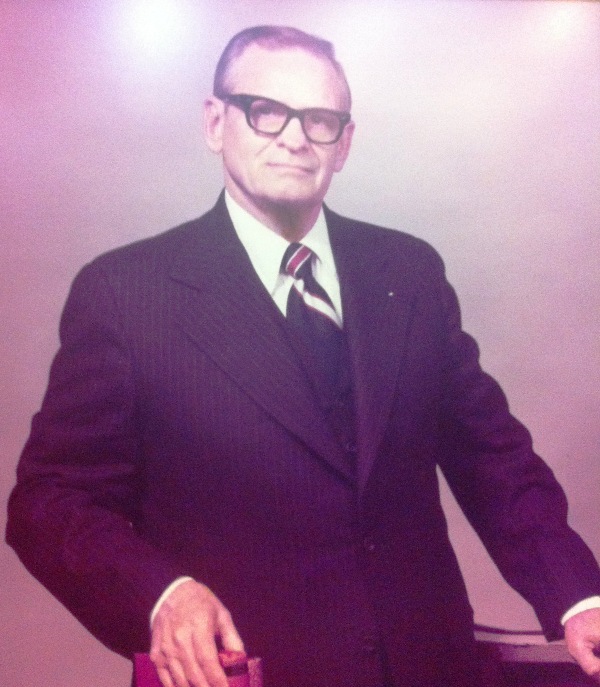
Mayor Walters' official portrait

Mayor Walters’ official portrait

On November 6, 1912, future Little Rock Mayor William H. Walters was born in Clearfield, Pennsylvania.

He ran for the City Board of Directors in 1970 and was unopposed.  Walters took office on January 1, 1971 and served one term on the City Board.  He chose not to run for a second term and left office on December 31, 1974.

In January 1973, he was selected by his colleagues to serve a two year term as Mayor of the City of Little Rock.

Throughout his life, Mayor Walters enjoyed traveling and visiting over 100 countries throughout the world. Mr. Walters had a keen interest in the circus and collected circus memorabilia from many countries.

He was employed by 3M Company. He was Superintendent and Acting Plant Manager beginning January 1, 1951 and 3M Plant Manager beginning February 1, 1972. He retired in 1977.

In addition to serving on the City Board, he had been active in the Little Rock Chamber of Commerce (he served as Chamber President in 1969), Kiwanis Club, Associated Industries of Arkansas and the YMCA among other activities.

Mayor Walters died on February 14, 2005 at the age of 94.

George Washington Gardened Here – Mount Vernon Horticulturalist speaks at Clinton School tonight

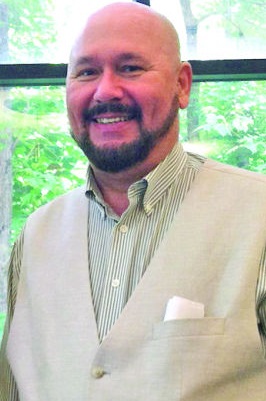
mount vernon nortonTonight at 6pm at Sturgis Hall, Dean Norton, the director of horticulture at Mount Vernon, will give a presentation.

For more than 150 years, people have studied, researched, and dug the earth for clues helping to make the home of George Washington one of the most accurately restored 18th century estates in America. The beauty, the use, and the importance of Mount Vernon’s gardens and landscape will be discussed, as well as preservation over the years with a focus on the most recently restored pleasure garden. Norton’s presentation is an informative and entertaining look at the gardening world of George Washington.

A book signing will follow.

The director of horticulture at Mount Vernon since 1980, Norton calls upon a full-time paid staff of twenty-three and a few volunteers to manage both the fifty-acre parcel open to the public and 450 acres of field and forest. He also supervises the green house and the estate’s livestock operations.

Noon today, the Clinton School and Butler Center’s Legacies & Lunch present Justice Troy Poteete, executive director of the National Trail of Tears Association

PoteeteToday at noon, the Clinton School Speaker Series and the Butler Center’s Legacies & Lunch jointly present a program.  Justice Troy Poteete, executive director of the National Trail of Tears Association will speak at the Ron Robinson Theater.

Troy Poteete was appointed to the Cherokee Nation Supreme Court by Chief Chad Smith in 2007 and is the executive director of the National Trail of Tears Association, an organization he helped found. Justice Poteete also founded the Historical Society in Webbers Falls, Okla., served as executive director of the Cherokee Nation Historical Society, and was a delegate to the Cherokee Nation Constitutional Convention. In 2000, Justice Poteete was appointed executive director of the Arkansas Riverbed Authority, a tribal entity jointly created by the Chickasaw, Choctaw, and Cherokee Nations to administer their interests in the 96-mile section of the Arkansas River between Muskogee, Okla. and Fort Smith, Ark.

The Trail of Tears was actually several trails.  Little Rock is one of the only cities (if not the only city) that members of all six relocated tribes passed through.  Little Rock’s emerging merchant class benefited from the relocation efforts as the Federal government paid for goods and services in Little Rock.