On the First of October learn about the First woman elected to the U.S. Senate (Hint: she is from Arkansas)

legaciesArkansas’s Hattie Caraway, the first woman elected to serve in the U.S. Senate, is the topic of Dr. Nancy Hendricks’ talk at Legacies & Lunch, the Butler Center’s monthly history lecture, on Wednesday, October 1, at noon in the Main Library’s Darragh Center. Copies of Hendricks’ book, Hattie Caraway: An Arkansas Legacy, will be available for sale; Hendricks will sign books after her talk.

Nancy Hendricks is the noted Hattie Caraway scholar and award-winning writer of the book Senator Hattie Caraway: An Arkansas Legacy and the play Miz Caraway and the Kingfish. She has previously been featured at the Arkansas Literary Festival.

Hattie Caraway served in the U.S. Senate from December 9, 1931 – January 3, 1945. She was appointed to as a placeholder following the death of her husband, Senator Thaddeus Caraway.  In early 1932, she was supported in her bid to be elected to complete the remainder of this term.  However, it was expected she would not seek election in November 1932 for a full term. She did, shocking the Democratic Party establishment in Arkansas.  She won that term due in part to the campaigning of populist hero Senator Huey Long of Louisiana.  In 1938, she was challenged in her bid for re-election by Rep. John L. McClellan.  She defeated him (though he would go on to win the other Senate seat in the future and serve until his death in the 1970s).  In 1944, she lost her bid for a third term to J. William Fulbright.

Revisit 40 Years of ARKANSAS TIMES at Historic Arkansas Museum

79covers-2While it has not been around since Arkansas’ territorial days, the Arkansas Times has been on the forefront of many journalism endeavors over the past 40 years.  Historic Arkansas Museum pays tribute to this with a new exhibit celebrating the 40th anniversary of the Arkansas Times.

From a spunky monthly launched with $200 in the bank to, glossy lifestyle magazine, to one of the earliest alternative weeklies, the Arkansas Times has been an essential voice in Arkansas news and culture since 1974. Take a look back at the last 40 years of Arkansas history through the often-irreverent lens of the Times in a collection of archival covers, photos, art and memorabilia.

40 years of Arkansas Times continues in the Second Floor Gallery through December 9, 2014.

Little Rock Look Back: First meeting of Pulaski Heights City Council

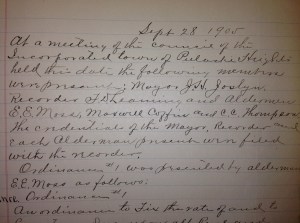
Pul Heights CC minutesOn September 28, 1905, the first meeting of the Pulaski Heights City Council took place.  The newly elected Mayor was J. H. Joslyn, the Recorder was F. D. Leaming, and new Alderman present were E. E. Moss, Maxwell Coffir and C. C. Thompson.  Pulaski Heights had been incorporated on August 1, 1905.  At that time its population was estimated at between 300 and 400.

The first ordinance, which was offered by E. E. Moss, was to set a tax rate and give the City the ability to levy taxes.  Next was a motion to establish a committee to establish rules and procedures for the council. The final business before the Council was to allow the Recorder to order stationary, a seal and a record book (that record book is now in the vault at Little Rock City Hall).

The next meeting would be October 28.  At that meeting, two other Aldermen are mentioned in the minutes (Fauble and Paul) but were absent from that meeting as well.  Mr. C. M. Fauble was present at the third meeting.  Mr. R. O. Paul did not appear until the fifth meeting (December 13, 1905).

Interestingly the Recorder had a vote in the Council meetings (which was not a practice in the City of Little Rock at the time).

The Council did not have a permanent meeting place until the third meeting.  At that point in time, they used space in the offices of Dr. Hockersmith.  They later met in a building which is now part of the Pulaski Heights Baptist Church campus.

Pulaski Heights was a separate City until January 1916.  On January 4, 1916, Little Rock voters approved the annexation of Pulaski Heights by a ten-to-one margin, and the suburb became the city’s ninth ward. This established a couple of precedents for the City of Little Rock which are in effect to this day.  The first is that Little Rock would not be a central city surrounded by a variety of small incorporated towns (in the manner that St. Louis and other cities are).  It was this thought process which has led the City to continue to annex properties.

In addition, this move to annex Pulaski Heights was the first time that the City grew toward the west.  Previous growth had been to the south.  By emphasizing western expansion, this has allowed Little Rock to continue to grow.

Arts in Park and on Stages with ACANSA today

acansaThe ACANSA Arts Festival moves into the weekend with a full day of activities.

ARTISTS IN THE PARK
12:00pm to 6:00 pm
MacArthur Park
FREE

The Arkansas Arts Center will host a visual artist day at MacArthur Park from noon to 6:00 p.m.   This event is free and open to the public.  The first two hours are dedicated to children with a variety of art activities, and entertainment by Brian Kinder, a singer/ songwriter who performs rollicking goodtime concerts for kids.

Family entertainment by a variety of musical groups will begin at 2 p.m. Bands include the Clark Family Trio, the Greasy Greens, and SOULution.  Local food trucks will offer refreshments for purchase.

Artists will produce and sell art throughout the afternoon and will have the option to participate in a friendly Quick Draw Competition during the event.  Artists will be paired off to draw each other and the winner will receive a $500 prize!

The Quick Draw competition is open to anyone.  Know an artist who would like to participate?   Please have them contact Linda Newbern at lnewbern@ACANSAartsFestival.org.

Sponsored by: Arkansas Children’s Hospital, City of Little Rock & Little Rock Convention and Visitors Bureau
 

Acansa PuppetSUSPENDED ANIMATION
7:00 pm to 9:00 pm
Scottish Rite Masonic Temple
$20 to $50

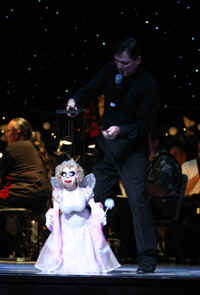
In a cabaret presentation distinctly adult in its sophistication and artistry, internationally acclaimed marionette artist Phillip Huber is in full view of the audience as he controls incredibly compelling characters through a series of variety vignettes revealing humor, pathos, drama and grace.

Phillip Huber is most widely known for his work in the 3-time Academy Award nominated film “Being John Malkovich” and his work in the Disney film “Oz the Great and Powerful,” starring James Franco, Michelle Williams and Mila Kunis. Shimmering with nuance, sophistication and imagination, you won’t want to miss this opportunity to experience a world of sophisticated puppetry designed for entertaining discerning tastes.


Acansa DallasDALLAS BLACK DANCE THEATRE
7:00 pm to 9:00 pm
NLR High School East Campus Auditorium
$10 to $50

Dallas Black Dance Theatre celebrates its 36th season as the oldest, continuously operating professional dance company out of Dallas, Texas. The ensemble, a contemporary modern dance company, consists of 12 professional, full-time dancers performing a mixed repertory of modern jazz, ethnic and spiritual works by nationally and internationally known choreographers.

Sponsored by: Arkansas Black Hall of Fame, City of North Little Rock, North Little Rock Chamber of Commerce, North Little Rock Economic Development Corporation, North Little Rock Visitors Bureau


acansa Mike Disfarmer 3DISFARMER
8:00 pm to 10:00 pm
Argenta Community Theatre
$30

Don’t miss this production of Disfarmer, written by award-winning Arkansas playwright Werner Trieschmann and directed by Bob Hupp of The Rep.  Disfarmer is a comedic portrait which tells the story of Mike Disfarmer, an eccentric photographer from Heber Springs, Arkansas who charged townsfolk and visitors a quarter to have their picture taken in the early forties—and caused a minor speculative mania decades later as New York gallery owners “discovered” his work and descended on the small Arkansas town.

Nothing speaks louder about Mike Disfarmer than his photographs.  Before the play, stop by  Argenta Gallery at 413 Main Street to enjoy an exhibit of Disfarmer photographs. In 1974, Peter Miller purchased the collection of Disfarmer glass negatives from Joe Albright. The Disfarmer prints in this exhibit have been archivally printed from the original Disfarmer glass negatives

Sponsored by: Peter Miller


Acansa St PaulACANSA Late Night II – St. Paul and the Broken Bones
9:00 pm to 11:00 pm
South on Main
SOLD OUT

This Birmingham, Alabama based soul band harkens back to the region’s classic soul roots while extending the form with electrifying potency.  Lead singer, Paul Janeway, takes the soul revival to an equally outrageous place with a voice that hovers between sexy sweet and flat-out dirty.  The horn-fueled Broken Bones re-create one funky groove after another, sounding more like the truth than any band since the Seventies.

Sponsored by:  DOWNSTREAM Casino Resort with staff provided by Oxford American

HOME OF THE BRAVE is feature of 7th Day of 2014 Reel Civil Rights Film Festival

LRFF Home_of_the_Brave_PosterLittle Rock Central High School National Historic Site commemorates the 57th anniversary of the desegregation crisis in September with the Reel Civil Rights Film Festival featuring special guests, panel discussions, and a special commemoration to honor local educators and civil rights activists. All events at local venues are FREE and open to the public

Thursday, September 25, 6:00 p.m. –Mosaic Templars Cultural Center (501 West 9th Street)
Home of the Brave

(Director: Paola di Florio) – Academy Award-nominated filmmaker Paola di Florio directs Home of the Brave, a documentary about the impact of Viola Liuzzo’s murder. A Detroit housewife and mother of five, Liuzzo was a civil rights activist who went to Alabama to help with voter registration in 1965. She was in town during the pivotal march organized by Dr. Martin Luther King Jr. and the Southern Christian Leadership Conference, which ended in violence at the Edmund Pettus Bridge near Selma.

While trying to transport the tear-gassed marchers in her car, she was shot by three members of the Ku Klux Klan. Suspects Eugene Thomas, Collie Leroy Wilkins Jr., and William Orville Eaton were found guilty of civil rights violations and later acquitted. The film also explores the FBI investigation in the aftermath of her death, as well as the reaction in the Liuzzo home.  The film is narrated by Stockard Channing.

The ceremony will be moderated by Dr. Victor Snyder, former seven-term U.S. Congressman (D-AR, 2nd district).

The film will be followed by remarks from Mary Liuzzo Lilleboe and Sally Liuzzo-Prado, daughters of Viola Liuzzo.

Presenting Sponsor –Little Rock Film Festival

Premier Sponsor –Little Rock Central High School National Historic Site

Supporting Sponsors: arfilm|Arkansas Production Alliance, Central High Museum Inc., City of Little Rock, Conyers Institute of Public Policy, Jefferson National Parks Association, Little Rock Central High School, Little Rock Convention and Visitors Bureau, Little Rock School District, Marriott Little Rock, Mosaic Templars Cultural Center, Moses Tucker Real Estate, Riverdale 10 Movies, National Park Service, Sue Smith Vacations/Vacation Valet, North Point Toyota, University of Arkansas Clinton School of Public Service, Philander Smith College, Whole Hog Cafe –North Little Rock, Arkansas Education Television Network, and Arkansas Motion Picture Institute

Little Rock Look Back: Roswell Beebe Given City of Little Rock

Map showing boundaries of original City of Little Rock

Map showing boundaries of original City of Little Rock

On September 25, 1839, businessman Roswell Beebe received title to all of the land in Little Rock.

Starting in the 1810s, there had been much dissension as to who had title to land in what would become Little Rock.  As the settlement developed into a town and city, these disagreements became greater. Often land speculators would sell land to settlers without having the right to do so.

Coming to Little Rock in 1835, Beebe was a witness to the continued uncertainty over land ownership.  In early 1839, he acquired 240 acres which had the only incontestable title in town. This acreage comprised most of Little Rock. He went to Washington DC in 1839 and, on September 25, received the original patent for the town of Little Rock, signed by President Martin Van Buren. It is recorded in the Pulaski county recorder’s office Book L, page 312.

Upon his return, Beebe gave all the people who had bought lots from a certain real estate developer, whom he considered to be fair and honest, title to their land for a dollar. In December 1839, he drew up a plan for Little Rock, laying off blocks and streets. He deeded the streets and alleys to the city for a dollar. He gave the state the title for the land on Markham Street, where the new capitol building (now the Old State House Museum) was located.  He also donated part of the land for Mount Holly Cemetery, the other portion came from his brother-in-law Chester Ashley.

Little Rock Look Back: 57 Years since 1957

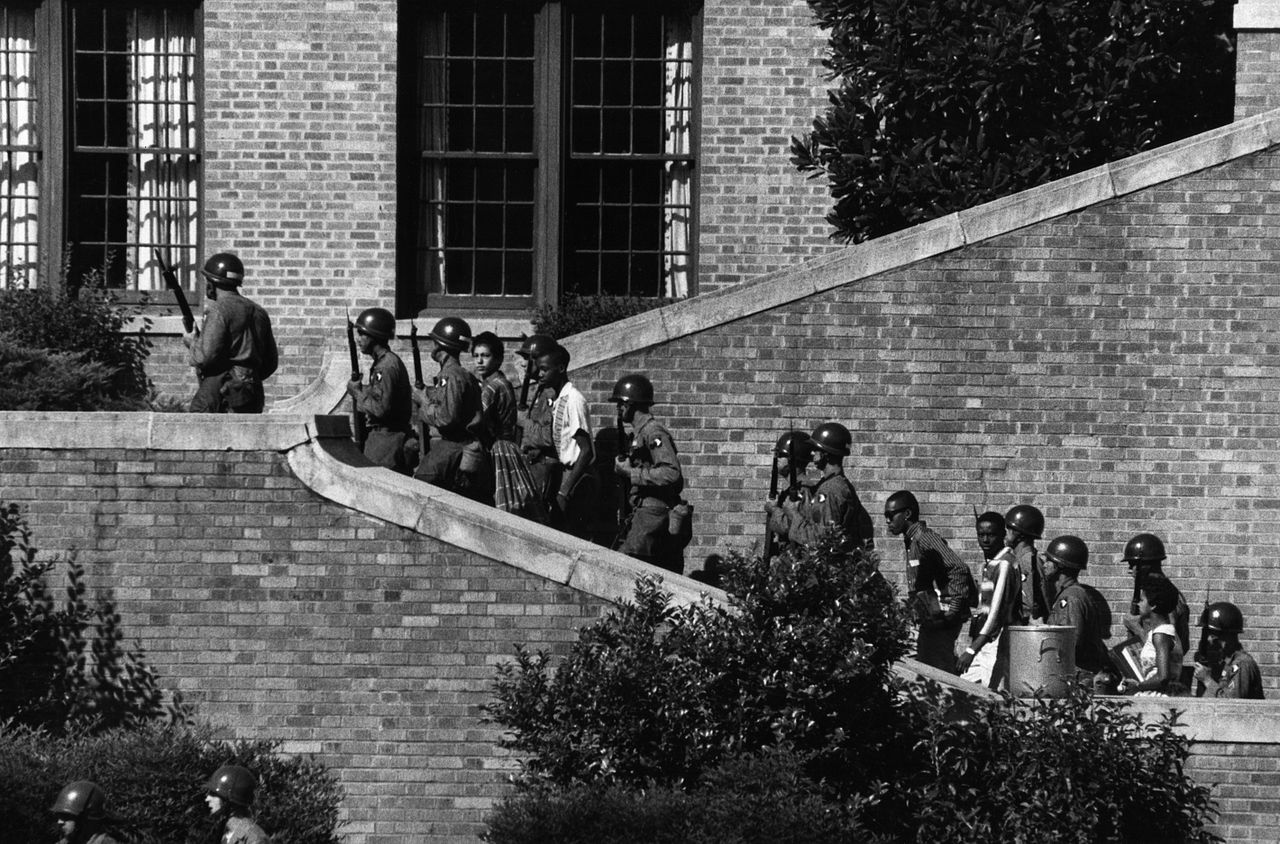
101st_Airborne_at_Little_Rock_Central_HighIt was 57 years ago today that the Little Rock Nine entered Central High School and stayed. On one hand, this brought to the end a nearly month long standoff between segregationists and those who wanted to obey the U.S. Supreme Court’s Brown v. Board decision.

In the bigger picture, the struggle did not end that day.  Throughout the remainder of the school year, the Little Rock Nine were subjected to threats, isolation and hostility.  Outside of the school, while the crowds may had dispersed after September 25, the raw feelings did not subside.

This was evidenced by the fact that the following year the high schools were closed to avoid having them integrated.

But September 25, 1957, was an historic day in the United States. Under guard of members of the 101st Airborne Division of the Army, the Little Rock Nine were escorted into Central High School. This action by President Dwight Eisenhower was the result of the intrusive efforts of Governor Orval Faubus who had used the Arkansas National Guard to keep the nine students out.

The City of Little Rock was largely a bystander in this issue. The form of government was changing from Mayor-Council to City Manager in November 1957. Therefore Mayor Woodrow Mann and the entire City Council were lame ducks. Mann, whose son was a senior at Central, tried to focus on keeping the peace in Little Rock. Most (if not all) of his Council members sided with the Governor.

Congressman Brooks Hays, a Little Rock resident, had tried to broker an agreement between the President and the Governor but was unsuccessful.  Following that, Mayor Mann was in discussions with the White House about the ability of the Little Rock Police Department to maintain order.  Finally, in the interest of public safety, the President federalized the National Guard and removed them. This paved the way for the Army to come in.

Though the school year was not easy, the nine youths who became known worldwide as the Little Rock Nine were finally in school.  They were Minnijean Brown, Elizabeth Eckford, Ernest Green, Thelma Mothershed, Melba Patillo, Gloria Ray, Terrence Roberts, Jefferson Thomas and Carlotta Walls.

In 1997, President Bill Clinton, Governor Mike Huckabee and Mayor Jim Dailey, famously held open the doors of Central High for the Little Rock Nine on the 40th anniversary.  Ten years later, Clinton, Huckabee and Dailey returned joined by current Governor Mike Beebe and Mayor Mark Stodola to host the 50th anniversary events.

Today the school is a National Historic Site, while still functioning as a high school.