2005 film version of RENT on screen at CALS Ron Robinson Theater tonight (2/5)

Rent movie poster.jpgLast week, Fox network screen a “live” version of the musical RENT.  Tonight at the CALS Ron Robinson Theater, the 2005 film version of this Pulitzer and Tony-winning musical will be shown. The film is being shown one day after what would have been the 59th birthday of the composer/writer Jonathan Larson.

Many of the original 1996 Broadway cast members appeared in the film.  Anthony Rapp, Adam Pascal, Jesse L. Martin, Wilson Jermain Heredia, Idina Menzel, and Taye Diggs all recreated their Broadway assignments for the film. Rosario Dawson replaced Daphne Rubin-Vega, and Tracie Thoms replaced Fredi Walker for the film.

Larson’s script was adapted to a screenplay by Stephen Chbosky. Christopher Columbus directed the film and was one of the producers along with Jane Rosenthal, Robert De Niro, Mark Radcliffe, and Michael Barnathan.

The film begins at 7pm at the Ron Robinson Theater. Admission is $5.00.

Rock the Oscars 2019: Nine from Little Rock

On April 5, 1965, the Academy Award for Best Documentary, Short Subject went to the film “Nine from Little Rock.”

Narrated by Jefferson Thomas, Charles Guggenheim’s documentary looks at the nine African-American students who enrolled in Little Rock Central High School in 1957. Thomas, one of the students reflects on the state of race relations in the seven years that had elapsed (up to 1964).  The film also focuses on Ernest Green, Elizabeth Eckford and Thelma Mothershed.

Guggenheim both directed and co-wrote the film. The latter credit was shared with Shelby Storck, who also produced the film.   The film had been commissioned by George Stevens, Jr., for the United State Information Agency.

The Oscar that night was Guggenheim’s first of four.  His others would be for: 1968’s “Robert Kennedy Remembered” (Live Action Short), 1989’s “The Johnstown Flood” (Documentary Short) and 1994’s “A Time for Justice” (Documentary Short).  His son Davis Guggenheim won the Oscar for Documentary, Feature for An Inconvenient Truth.

The film was digitally restored by the Motion Picture Preservation Lab for the 50th anniversary of its win for Best Short Documentary at the 1965 Academy Awards.  It is available for purchase on DVD and can also be viewed in its entirety on YouTube

Little Rock Look Back: Ben Piazza joins cast of WHO’S AFRAID OF VIRGINIA WOOLF? on Broadway

On February 4, 1963, Little Rock native Ben Piazza joined the cast of the original Broadway production of Edward Albee’s Who’s Afraid of Virginia Woolf? replacing George Grizzard.

Grizzard had left the show to play Hamlet during the Guthrie Theatre’s first season.  He had accepted that role prior to the Albee play opening on Broadway and becoming a runaway hit.

Piazza, a friend of Albee’s, had been involved in the play since its early days. At the play’s first read-through, he read the part of Nick (which he would play on Broadway) with Albee and producers Richard Barr and Clinton Wilder reading the other three parts.

Piazza stayed in the role of Nick for the rest of the run of the show until it closed on May 16, 1964. His fifteen months in the role is the longest that anyone has ever played a role in an Albee play on Broadway (or perhaps anywhere).

He joined original cast members Arthur Hill, Uta Hagen and Melinda Dillon (a native of Hope).  Dillon was the next to leave the cast and was followed by Rochelle Oliver in the role of Honey.  As Martha, Hagen was followed by Nancy Kelly, returned to the role, and then left it to star in the London production. Piazza would then play opposite future Little Rock resident (and Arkansas Rep performer) Mercedes McCambridge for the last five months of the run.

As George, Arthur Hill was succeeded by Shepperd Strudwick a month after Hagen left. He returned to the play when Hagen did and joined her in London.  Donald Davis, who had played George in the matinee cast, took over the part in the evenings for the last five months.

ELIJAH by Mendelssohn this evening at Trinity Cathedral

Manuscript of Mendelssohn's Oratorio 'Elijah'.jpgThe Trinity Episcopal Cathedral choir presents excerpts from Mendelssohn’s ELIJAH today at 5pm.
Accompanied on the newly restored organ by New York City Organist Daniel Beckwith, the oratorio will be included in a service of Evensong. British bass Peter Hine will sing the title role. Victoria Mathis Harden, Music Director, will conduct. A gala reception will follow in Morrison Hall. A nursery will be available.

Premiering in 1846 at the Birmingham Festival, it depicts events in the life of the Biblical prophet Elijah.  This piece was composed in the spirit of Mendelssohn’s Baroque predecessors Bach and Handel, whose music he loved.

Super Bowl Sunday look at the Copper Bowl

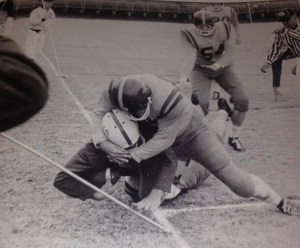
Today is Super Bowl Sunday, so it seems to be a good time to remember the five year series of football games in Little Rock known as the Copper Bowl.

A Little Rock police officer tackles a NLR player in one of the Copper Bowls.

A Little Rock police officer tackles a NLR player in one of the Copper Bowls.

From December 1959 through December 1963, the Little Rock Police Department played the North Little Rock Police Department in a series of football games.  The Copper Bowl games were fundraisers to help the LRPD provide food and presents for needy families during the Christmas season.

The agreement was that the teams would play for five years. The team with the most wins would permanently receive the Copper Bowl trophy.  The LRPD was outfitted with uniforms from Little Rock University and Louisiana State University (thanks to the efforts of Sgt. Harold Zook).  The games were played at Quigley Stadium.

Before the final game on December 1, 1963, the series was tied at 2-2.  The LRPD team won the game and permanently captured the trophy.  Over the five year period several thousand dollars were raised.

Little Rock Look Back: Mayor George Wimberly

On February 3, 1920, future Little Rock Mayor George Wimberly was born in Star City. He served his country first in the Civilian Conservation Corps and later aboard a U.S. Naval Department hospital ship in the Pacific during World War II.

Wimberly was first elected to the Little Rock City Board in November 1968.  He was re-elected in November 1972 and served until December 1976.  In January 1971, he was selected to serve as Little Rock Mayor through December 1972.

In a rare move, he was again selected to serve as Mayor from January 1975 through December 1976.  During the era of the City Board selecting one of their own members to serve as Mayor, George Wimberly was the only one selected to two non-sequential terms.

In 1978, he was elected to the State House of Representatives and served until December 1988.  While in the House he led the effort for smoking to be banned in the House chambers (a move that predated many public smoking bans of the 1990s and onward).

For over fifty years he was an employee and later owner of Buice Drugstore located on Markham in the Stifft Station neighborhood. In 1986 he received the Arkansas Pharmacist of the Year Award and the Lifetime Achievement Award in 2009.

Mayor Wimberly died on February 5, 2012, two days after his 92nd birthday.

Little Rock Look Back: Opening of Little Rock Public Library

On February 2, 1910, the Little Rock Public Library officially opened its doors.  There had been an open house the night before, but this was the first day of acquiring a library card and checking out books.

Various private libraries had existed sporadically in Little Rock throughout the 19th Century.  In November 1900, a Little Rock School District committee made the first inquiry into the the creation of a Carnegie Library in Little Rock.  Over the next several years, numerous entreaties were made, but funding for the City’s portion was an obstacle.  On December 17, 1906, the Little Rock City Council passed an ordinance to move forward with building, furnishing and equipping a library.  Finally, in February 1908, the City approved acceptance of $88,100 from Andrew Carnegie.  The building would be designed by Edward Tilton, who designed Carnegie libraries, working with local architect Charles Thompson.

Mary Maud Pugsley was hired as the first librarian for Little Rock in May 1909. She began her duties on September 15, 1909, in order to get ready for the opening of the library at the southwest corner of 7th and Louisiana Streets.

On February 2, 1910, formal circulation of books began.  J. N. Heiskell was issued library card number 1.  He was secretary of the Library’s Board of Trustees and had long been an advocate for a public library in Little Rock.  He had often used his bully pulpit as editor of the Arkansas Gazette to advocate for a public library since arriving in Little Rock in 1902.  (Years later — he lived until 1972 — he received a replica of the library card made out of gold.)

That first day of operation, 500 people had applied for library cards. The application process required one to be a Little Rock property owner or to have a property owner sign the application.

Within the first year of operation, 2.5% of Little Rock’s population of 45,951 had applied for a library card.

For more on the history of the transformation of the Little Rock Public Library into the Central Arkansas Library System, read Shirley Schuette and Nathania Sawyer’s From Carnegie to Cyberspace — 100 Years at the Central Arkansas Library System, published by Butler Center Books.
