Tartan Day, celebrate all things Scottish, visit the Brownlee House at HAM

Photo by Larry Pennington

Today is Tartan Day, designated to celebrate the contributions of Scots everywhere.

One of Little Rock’s oldest structures, the Brownlee House was built by a Scotsman.  The Brownlee House is one of the restored structures at Historic Arkansas Museum.

Robert Brownlee built this Federal style brick house in the late 1840s for his brother and sister-in-law. A Scottish stonemason, Brownlee came to Little Rock in 1837 to help build the State House (now the Old State House Museum). He pursued a number of careers before leaving for California in the 1849 Gold Rush. From the late 1840s through 1852, the home’s residents were James and Isabelle Brownlee and Tabby, a woman enslaved by James Brownlee.

Brownlee had the wooden mantels in the parlor and bedroom marbleized, a popular decorative art of the time. The home’s furnishings reflect the mid-19th century.

This house is a project of The National Society of the Colonial Dames of America in the State of Arkansas.

Historic Arkansas Museum is open seven days a week.  The galleries are free, but the tours of the historic structures have a nominal fee.  It is an agency of the Department of Arkansas Heritage.

Little Rock Look Back: “Nine from Little Rock” wins an Oscar

On April 5, 1965, the Academy Award for Best Documentary, Short Subject went to the film “Nine from Little Rock.”

Narrated by Jefferson Thomas, Charles Guggenheim’s documentary looks at the nine African-American students who enrolled in Little Rock Central High School in 1957. Thomas, one of the students reflects on the state of race relations in the seven years that had elapsed (up to 1964).  The film also focuses on Ernest Green, Elizabeth Eckford and Thelma Mothershed.

Guggenheim both directed and co-wrote the film. The latter credit was shared with Shelby Storck, who also produced the film.   The film had been commissioned by George Stevens, Jr., for the United State Information Agency.

The Oscar that night was Guggenheim’s first of four.  His others would be for: 1968’s “Robert Kennedy Remembered” (Live Action Short), 1989’s “The Johnstown Flood” (Documentary Short) and 1994’s “A Time for Justice” (Documentary Short).  His son Davis Guggenheim won the Oscar for Documentary, Feature for An Inconvenient Truth.

The film was digitally restored by the Motion Picture Preservation Lab for the 50th anniversary of its win for Best Short Documentary at the 1965 Academy Awards.  It is available for purchase on DVD and can also be viewed in its entirety on YouTube

Little Rock Look Back: How LR reacted to Assassination of Dr. King

On April 4, 1968,  when Dr. King was assassinated, Little Rock did not see the unrest that many cities did.  Part of that was probably due to quick action by Governor Winthrop Rockefeller.

The Governor released a statement fairly quickly expressing his sorrow at the tragedy and calling for a day of mourning. He also made the State Capitol available for the NAACP to have a public memorial, as well as worked with a group of ministers to host an interdenominational service.

Little Rock Mayor Martin Borchert issued a statement as well:

We in Little Rock are disturbed about the incident in Memphis. We are disturbed regardless of where it had happened.  Killing is not the Christian solution to any of our problems today.

In Little Rock, we feel we have come a long way in 10 years toward solving some of our problems of living and working together regardless of race, creed or color.

The city Board of Directors in Little Rock has pledged itself toward continuing efforts to make Little Rock a better place in which to live and work for all our citizens.

We feel the efforts of all thus far have proved we can live in harmony in Little Rock and are confident such an incident as has happened will not occur in Little Rock.  We will continue our most earnest efforts toward the full needs of our citizens.

The day after Dr. King was assassinated, a group of Philander Smith College students undertook a spontaneous walk to the nearby State Capitol, sang “We Shall Overcome” and then walked back to the campus.  President Ernest T. Dixon, Jr., of the college then hosted a 90 minute prayer service in the Wesley Chapel on the campus.

On the Sunday following Dr. King’s assassination, some churches featured messages about Dr. King.  As it was part of Holy Week, the Catholic Bishop for the Diocese of Little Rock had instructed all priests to include messages about Dr. King in their homilies. Some protestant ministers did as well. The Arkansas Gazette noted that Dr. Dale Cowling of Second Baptist Church downtown (who had received many threats because of his pro-integration stance in 1957) had preached about Dr. King and his legacy that morning.

Later that day, Governor Rockefeller participated in a public memorial service on the front steps of the State Capitol. The crowd, which started at 1,000 and grew to 3,000 before it was over, was racially mixed. At the conclusion of the ceremony, Governor and Mrs. Rockefeller joined hands with African American ministers and sang “We Shall Overcome.”

That evening, Trinity Episcopal Cathedral was the site of an interdenominational service which featured Methodist Bishop Rev. Paul V. Galloway, Catholic Bishop Most Rev. Albert L. Fletcher, Episcopal Bishop Rt. Rev. Robert R. Brown, Rabbi E. E. Palnick of Temple B’Nai Israel, Gov. Rockefeller, Philander Smith President Dixon, and Rufus King Young of Bethel AME Church.

Earlier in the day, Mayor Borchert stated:

We are gathered this afternoon to memorialize and pay tribute to a great American….To achieve equality of opportunity for all will require men of compassion and understanding on the one hand and men of reason and desire on the other.

Little Rock Look Back: Voters approve funds for completion of Robinson in 1940

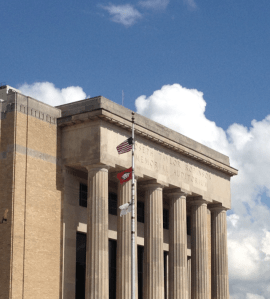
Though Joseph Taylor Robinson Memorial Auditorium opened in February 1940, there was still money that needed to be raised to finish the construction and the building’s furnishing.  Ten days after the auditorium opening, the City Council approved an ordinance to call a special election on April 2, 1940, for the purposes of approving bonds for three separate projects.  One of these was for $30,000 for the completion of the auditorium; the bonds would not require any additional tax levy.
At the same meeting, a letter was read from the Young Men’s Business Association expressing support for the auditorium in the election, which was to be held in conjunction with the annual municipal general election. The Auditorium Commission had previously asked the City Council to consider issuing the bonds to pay for additional equipment for the building.  In their request to the aldermen, the members stressed that due to the current bond structure, these new bonds would not necessitate any tax increase.

The campaign for the new bonds used a similar structure and message as the 1937 election to build the auditorium.  There were newspaper ads by the steering committee (this time simply called the Citizen’s Committee and led by Omar Throgmorton) and support from civic organizations.  One thing very different from the 1937 campaign was the presence of an actual building.  On Sunday, March 31, just two days before the election, there was an open house for the public to explore the edifice.

On April 2, 1940, Little Rock voters approved the new bonds 1,413 to 423.  Every precinct in every ward of the city voted in favor of the new bonds.  Shortly after the election, the bonds were issued.  The auditorium construction which had first been broached in 1904 was now completed in 1940.

Little Rock Look Back: 1940 Open House gives many first view inside Robinson Auditorium

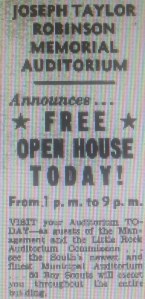
On March 31, 1940, the City of Little Rock and the Auditorium Commission threw open the doors of Joseph Taylor Robinson Memorial Auditorium to the public for an open house.

The building had officially opened in February 1940 (after construction was completed in January), and events had been taking place in the lower level since October 1939. But this was the first time that the public could tour the entire facility from top to bottom.

The event took place on a Sunday from 1pm to 9pm.  Curiously, it took place two days before a special election to approve the bonds to finish the auditorium. Though no one at the time was cynical enough to comment on the connection.

Members of various Little Rock Boy Scout troops led 4,000 visitors on tours of the auditorium.  Visitors were shown all over the building; one scout calculated that the walking tour equated to two miles.  Though most people were from Little Rock, the guest registry indicated visitors from California and Pennsylvania.  Among the last guests to sign the register were Mayor J. V. Satterfield and his family.

The idea for the open house had first been floated in December by Alderman E. W. Gibb after taking a tour of the construction site. He had enthusiastically professed that everyone should be able to tour and see what a magnificent structure it was going to be.  Mayor Satterfield had to tamper the alderman’s enthusiasm. He agreed with Mr. Gibb that it was a fine building but stated that a public open house could not be scheduled for a few weeks because there was still much work to be done.  Mayor Satterfield noted that the seats in the music hall were going to have to be removed and then reinstalled because they needed to be anchored better.

Little Rock Look Back: Airplane explosion shatters Hillcrest calm

An LRPD officer talks to bystanders next to a piece of debris

An LRPD officer talks to bystanders next to a piece of debris

An LRPD officer talks to bystanders next to a piece of debrisThe peaceful morning of March 31, 1960, was interrupted by a horrendous noise over Hillcrest around 6:00am.  A six-engine B47 from the Little Rock Air Force Base exploded mid-air.

Flaming debris fell from Allsopp Park all the way to the State Capitol grounds and stretched from Cantrell to 12th Street.  Other debris was found as far away as the Country Club of Little Rock.  The next day the Arkansas Gazette ran a map which showed the extent of the damage.

Three airmen died in the explosion.  The only survivor from the crew, 1st Lieutenant Thomas Smoak, was found dangling from a tree in his parachute at Kavanaugh and Martin.  He was treated by a nurse, Jimmye Lee Holeman, in whose yard he had landed.

Two civilians on the ground were killed by falling debris.  Many vehicles and homes were damaged, some were destroyed by debris.  The damage estimate was put around $4 million.

Police and fire crews were quickly on the scene to secure impacted areas, fight fires and rescue injured persons.

Those who perished were Captain Herbert Aldridge, Lieutenant Colonel Reynolds Watson, Staff-Sergeant Kenneth Brose, and civilians Alta Lois Clark and James Hollabaugh.

Today, a portion of the crash site is part of the Arkansas Children’s Hospital campus.  Other sites were removed by the I-630 construction.  Other houses were rebuilt or removed.

While there may not be visible reminders of that fateful morning, to those who lost loved ones, there is still a sense of grief over their loss.  It is a reminder that History is not just places, names, and dates: but events that happened to actual people.

B47 Wreck Map

Arkansas Gazette map of debris and damage

Little Rock Look Back: Last City Council meeting in 1868 City Hall

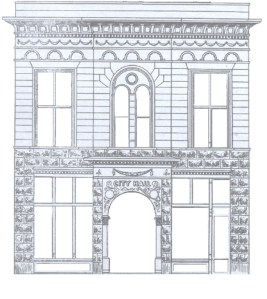
On March 30, 1908, the Little Rock City Hall held its final meeting in the 1868 City Hall.  The new city hall, located at Markham and Broadway streets, was nearing completion.  The meeting was presided over by Mayor W. E. Lenon.

The aldermen present were: John A. Adams, John Brod, A. B. Hightower, W. H. Jarrett, Christopher Ledwidge, Louie Miller, Jonathan S. Odom, R. C. Powers, A. L. Smith, George Stratman, Jonathan H. Tuohey, Louis Volmer, and L. N. Whitcomb.  Three aldermen missed the meeting: John Herndon Hollis, A. B. Poe and Benjamin S. Thalheimer.

The meeting was filled with typical requests for zoning and street improvements.  There was actually nothing out of the ordinary about the meeting.  If there was mention that it would be the final meeting, it did not make it into the minutes.

There was a request by the Arkansas Association of Pharmacists to have a meeting at the new building on May 12, 13 and 14.  It was referred to the City Hall Committee.  At prior meetings, there had also been requests by other groups to hold conferences at the new edifice.

At the conclusion of the meeting, it was noted that former City Clerk Clay Jones had died. A resolution memorializing him was proposed to be presented and adopted at the next meeting.

And with that, the meeting ended.  Forty years of City Council meetings at 120 to 122 West Markham came to a close.