Little Rock Look Back: John Glenn at the Museum of Discovery

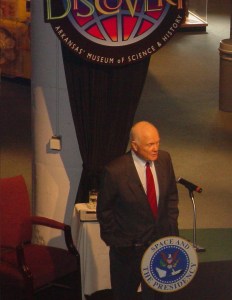
glenn-modIn November 2004, the Museum of Discovery launched an exhibit entitled SPACE AND THE PRESIDENCY.  This was at the museum in conjunction with the opening of the Clinton Presidential Center.  Former astronaut and U.S. Senator John Glenn spoke at the museum the day before the Clinton Center opened.
Senator Glenn, who was accompanied by his wife, was gracious and seemed to very much enjoy the interaction with the school children at a series of events throughout the day.  He was also very accommodating with all the adults who wanted the chance to talk to a true American hero.

While he did not visit the street named after him on that visit, it is important to remember he is the name source for Little Rock’s Colonel Glenn Road. It was named in his honor after he became the first person to orbit the earth.

Little Rock Look Back: 75 Years Ago – the City of Little Rock responds to Pearl Harbor

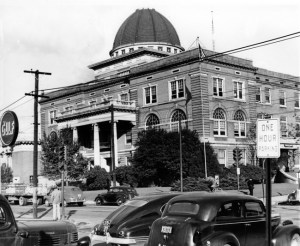
Little Rock City Hall in the 1940s

Little Rock City Hall in the 1940s

On December 8, 1941, one day after Pearl Harbor was attacked, the Little Rock City Council held a regularly scheduled meeting. While much of the business took place as previously planned, there were two actions that night which were in support of the war effort.

By a motion of Alderman Franklin E. Loy, seconded by Alderman L. L. Stewart, the City Council passed a motion to allow the erection of signage for a new Soldier Service Center which was to be set up in the War Memorial Building (now the Old State House Museum).

The same night, an ordinance was introduced for the City to purchase up to $40,000 in War Bonds. This was referred to the City Attorney to review.

Though the U.S. entry into World War II was only hours old, the City was already responding.

The following week, on December 15, 1941, the City Council discussed a plan to create a Civil Defense Coordinator for the City of Little Rock.  Also, City Clerk H.C. “Sport” Graham reported that City employees had purchased $4,819.50 in Defense Savings Stamps and Bonds. There were also pledges for another approximately $20,000. A payroll deduction plan was being set up.

Over the coming weeks and years, many City employees would enlist or be drafted into the armed services. Victory gardens would be planted by City employees and their families. Rationing would take place. Eventually a USS Little Rock battleship would be commissioned.

There would be much to be done to support the war effort. But in the early days, the City was already taking steps to do its part for the war.

Little Rock Look Back: AETN goes on the air

Happy 50th Birthday to AETN!

On December 4, 1966, AETN officially went on the air and launched what has been 50 years of arts, history, and educational programming.

KETS, the flagship station, broadcast only in black and white from 1966 until 1972. The focus was only in Central Arkansas until other stations started going on the air in 1976. Today there are a total of six PBS affiliate stations in Arkansas covering not only the entire state, but also portions of the surrounding states.

In the early days, the programming was focused in instructional supplements to teachers.  From 1966 to 1970, AETN was affiliated with the National Educational Television network.  With the advent of PBS, AETN’s programming expanded as many other public television offerings were available.

AETN has brought the best of Broadway, opera houses, ballet, and symphonic halls into houses in Arkansas.  It has broadcast sweeping historical programs which have educated, enlightened and entertained audiences.  The educational programming has nurtured creativity in budding artists.

Quite simply, without AETN, the cultural landscape of Arkansas would be vastly different.

Little Rock Look Back: SPRINGTIME FOR HENRY is first play at Robinson

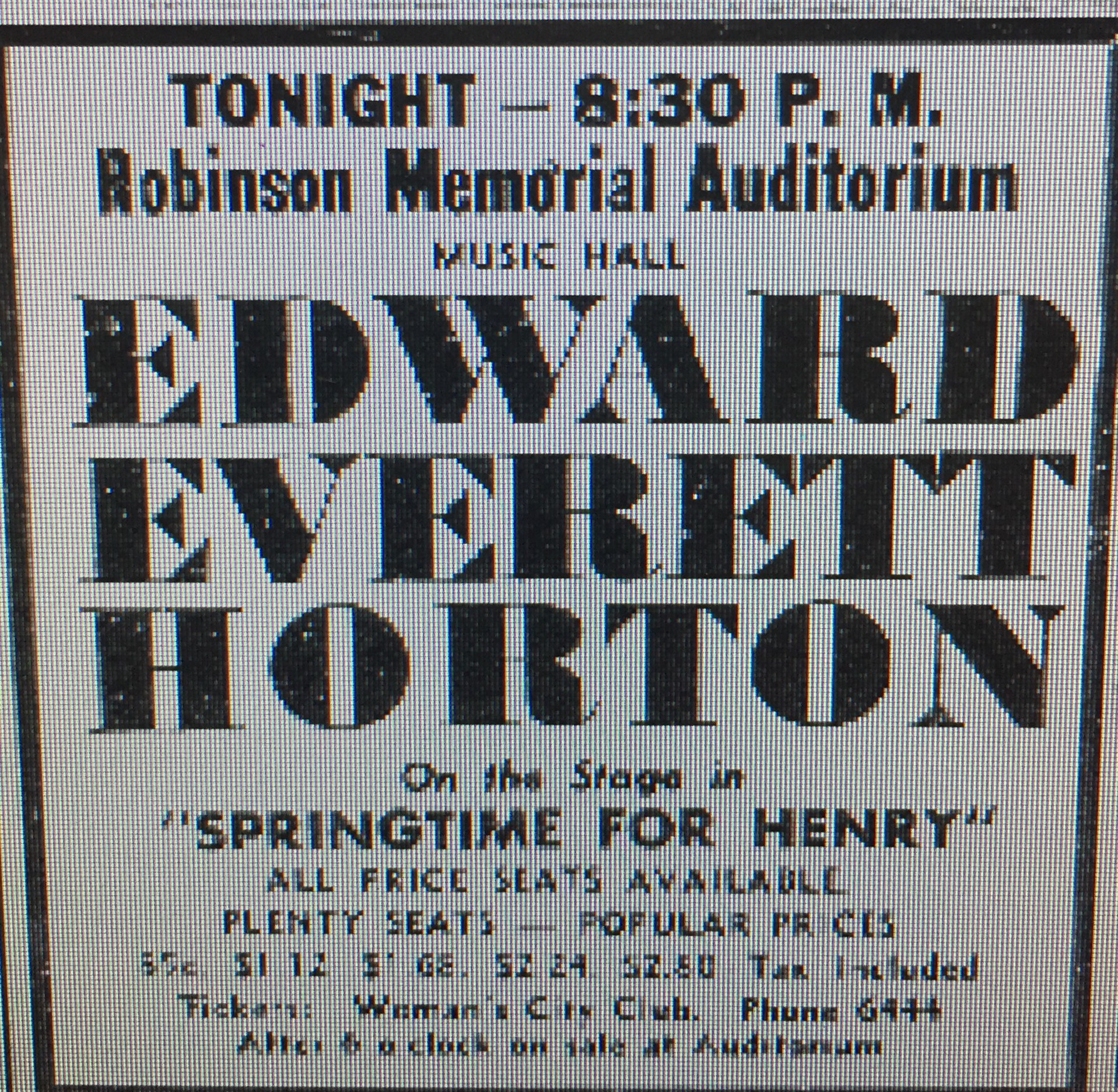
Since ELF is opening today as the first musical in the new Robinson Center Performance Hall, it seems appropriate to look back at the first play performed in the building’s earlier incarnation.  

On Monday, April 1, 1940, Edward Everett Horton came to Little Rock in the comedy SPRINGTIME FOR HENRY.  This was a play in which he had appeared regularly on tours and in summer stock. He would create productions of it in between film roles from the 1930s to the 1950s.  

The play concerned a industrial heir whose dalliances put his family’s business in jeopardy.  It was a boulevard comedy (or a sex comedy—without the sex).  Originally performed on Broadway in 1931, it was written by Benn W. Levy.  He would later serve as a member of Parliament.  

By the time Horton arrived in Little Rock, he was an accomplished stage and screen actor.  He was a staple of many Astaire-Rogers films. 

The performance at Robinson did not go off without a hitch.  Because Spring had arrived in Little Rock, it was warmer outside.  This necessitated the air conditioner being turned on.   The fans rumbling through the vents made such a noise that it was difficult for the audience to hear the actors.  The air cooler was turned off for the remainder of the performance.  In the days after the performance, the Auditorium staff put buffering in the vents in the muffle the noise.  

Little Rock Look Back: Adams Field Dedicated in 1941

adams-field-first-terminalOn November 11, 1941, Adams Field was dedicated in Little Rock.  The ceremony marked the official opening of the airport’s first administration building.  It also marked the official naming of the building in memory of George Geyer Adams.

Adams was captain of the 154th Observation Squadron of the Arkansas National Guard. He also served on the Little Rock City Council from 1927 to 1937.  During that time he helped develop what would become Little Rock’s airport from an airfield first planned in 1929 for military planes to what would become Little Rock’s municipal airport.

Adams left the City Council in April 1937.  Five months later, he was killed in a freak accident when a propeller assembly exploded and sent the propeller careening toward him.

Adams’ family was present at the ceremony on November 11, 1941.  The fact that it was on Armistice Day was no accident.  Little did few realize that US would be plunged into a second world war just a few weeks later.

Top executives from American Airlines came to Little Rock to participate in the festivities.  Others coming to town included members of Arkansas’ congressional delegation.  New Mayor Charles Moyer shared credit for the building with former Mayor J. V. Satterfield who had led the project for most of the time.  (Satterfield would later be the first chairman of the Airport Commission in 1951.) Hundreds turned out for the ceremony.  While they were in town, the congressional delegation and American Airlines executives made the most of interest in them and spoke to various civic clubs and banquets.  They extolled the virtues of airflight and the aircraft industry.

On a personal note:  the terminal building was built by E. J. Carter, a great uncle of the Culture Vulture.


Little Rock Look Back: Arkansas Rep’s First Show

rep-firstOn November 11, 1976, the curtain went up on the first Arkansas Repertory Theatre production.  It was the Kurt Weill-Bertolt Brecht musical The Threepenny Opera.  Rep founder Cliff Baker directed the show and played the leading role of Macheath aka Mack the Knife.

Others in the cast included local attorney Herb Rule, Jean Lind, Theresa Glasscock, Connie Gordon and Guy Couch.  Byl Harriell was the technical director and production designer while Donia Crofton was the costume designer.

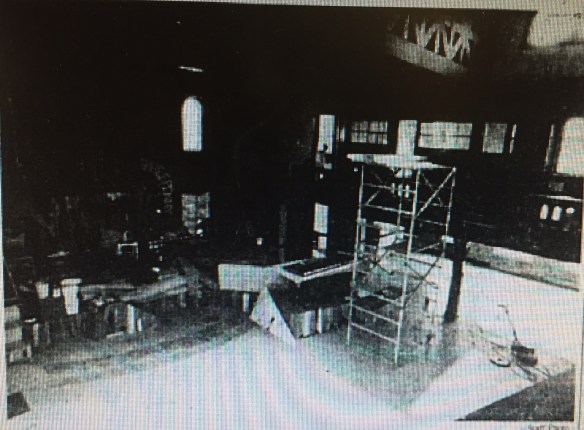
The production took place in the Rep’s home which was the converted former home of Hunter United Methodist Church on the eastern edge of MacArthur Park.  (Harriell’s business Bylites is now in that location.)

Baker had previously worked at the Arkansas Arts Center theatre when it was attached to a degree granting MFA program. He had also directed shows in other parts of Arkansas.  He returned to Little Rock and founded the Arkansas Philharmonic Theatre which performed in Hillcrest.  The Arkansas Repertory Theatre was a step forward with the establishment of a professional repertory company.

The first season of the Rep would include Company, Suddenly Last Summer, Marat/Sade, and Stop the World–I Want to Get Off. Season tickets for a total of seven shows were $30.

Baker served as Artistic Director of Arkansas Rep from 1976 until 1999.  Earlier this year, he stepped in as Interim Artistic Director between the tenures of Bob Hupp and John Miller-Stephany.  He is currently preparing to direct Sister Act for the Rep in January 2017.


Little Rock Look Back: Roosevelt Thompson

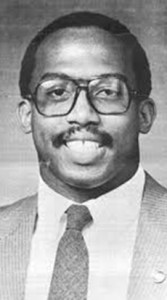
thompson-rooseveltThis evening, Calhoun College of Yale University will have a special ceremony to officially dedicate the dining hall in memory of Roosevelt Thompson.

Thompson, who had been named a Rhodes Scholar, was killed in a traffic accident in March 1984 during his senior year.  He was returning from a visit to his hometown in Little Rock.

An undergraduate prize for public service is named in his memory. Recipients of the Roosevelt L. Thompson Prize are Yale College seniors judged to be outstanding for dedication to public service–service to “the team, the college, the community” and exemplify great human warmth, commitment to fairness, compassion for all people, and the promise of moral leadership in the public sphere.

Yale has produced a video about Thompson, which can be seen here.

Thompson was an outstanding student while at Little Rock Central High School.  His funeral was held in the auditorium there, which has since been named in his memory.  Among those who attended his funeral were Governor and First Lady Clinton.  Gene Lyon wrote an obituary for him which appeared in an April 1984 issue of Newsweek.  In addition to the Central High auditorium, a west Little Rock CALS library branch is also named in his memory.

Born on January 28, 1962, to the Reverend C. R. and Dorothy L. Thompson, he was active in school plays, the school newspaper, and various academic groups, and he was named the All-Star player on the football team in his senior year, during which he also served as student-body president. He went on to become a National Merit Scholar.  The 1980 Pix yearbook is filled with images of him.

He continued to make a lasting impact at Yale.  In 2015, a movement started to rename Calhoun College in his honor. The feeling was that John C. Calhoun, as a slaveholder, was not a worthy eponym for the college.  While the university trustees opted to not rename the college, the head of the college used her prerogative to name the dining hall in his memory.  As a student of Calhoun College, Thompson spent much time in this selfsame dining hall.