
Open Studios Little Rock today (6/2) from 10am to 4pm

The City of Little Rock Arts+Culture Commission is hosting the second annual Open Studios Little Rock on Saturday, June 2, from 10 a.m. to 4 p.m.

A map of participating artists is available here: 2018 OSLR Map FINAL.

Guests can gain access to over 20 artist studios and cultural institutions that will open their doors and give you a firsthand look at their creative process. The lineup of studios visits includes artists working in the visual and performing arts, plus cultural institutions that will open their respective studios for guided tours and demonstrations.

The public can participate in FREE, self-guided tours of art-related studios, live-in/work studios and homes, galleries, schools, and other creative spaces. (Please note, some of the participating cultural institutions may have admission fees for specific exhibits.)

Referred to as a city-wide exhibition, Open Studios gives you unparalleled access to artists living and working in Little Rock. Studio visits are free and open to the public.

Artists who are unable to welcome the public into their studios will showcase their work at the Alternative Space hosted at the Bobby L. Roberts Library of Arkansas History and Art at 401 President Clinton Ave.  A welcome station will also be set up there with maps of all the participating artists and information on them.

During Open Studios, the colorful “Open Studio” signs will alert you to Open Studio spaces.

Participating Artists:

  • Co-Op Art – 7509 Cantrell Rd (back side)
  • Creative Art Studio – 7509 Cantrell Rd (back side)
  • Jennifer Cox Coleman Fine Art – 2207 Hidden Valley Dr., Suite 203
  • Amanda Heinbockel – 1701 Louisiana St, Apt 2
  • The Little Rock Violin Shop – 316 E. 11th St.
  • McCafferty Academy of Irish Dance – 6805 W 12th Street, Suite D
  • Daniella Napolitano – 916 Scott St, Apt A
  • Jenn Perren Studio – 1701 Louisiana St, Apt 4
  • Catherine Rodgers Contemporary Art – 2207 Hidden Valley Dr., Suite 202
  • Liz Smith’s Ceramics Studio – 125 Dennison St.
  • South Main Creative – 1600 Main St
  • Michael Warrick – 19 Mohawk Circ.
  • Elizabeth Weber – 11901 Hilaro Springs Rd

 Alternative Space (401 President Clinton Avenue):

  • Jericho Way Art Class
  • MNHenry Artwork
  • Paintings by Glenda McCune
  • Sheri Simon
  • Michael Ward

 Participating Cultural Institutions:

  • Arkansas Arts Center
  • Esse Purse Museum
  • Historic Arkansas Museum
  • Mosaic Templars Cultural Center
  • Old State House Museum

The Little Rock Arts+Culture Commission cultivates connections between diverse audiences and the City’s creative community. More information (including maps and artist bios) available at https://lrartsculturecommission.com/open-studios-little-rock/.

Little Rock Look Back: Cornice installed at Robinson Auditorium

On June 1, 1939, the cornice was installed on Robinson Auditorium.  This granite slab noted the name of the building as the Joseph Taylor Robinson Memorial Auditorium.  (It is interesting to note that it used the more modern “u” instead of the classical “v” which was often used in buildings during prior decades – as evidenced by the Pvlaski Covnty Covrt Hovse across the street.)

This was a milestone marking the completion of the front facade of the structure.  Much work would continue on the interior of the structure.  This step in the construction was considered major enough that the Arkansas Gazette mentioned it in a news article.

(June 1, 1939, was also the first day on the job for the auditorium’s first director – William T. Clemons.  A former Little Rock resident who came from Rochester NY.  The Auditorium Commission which hired him would not disclose the sources of his salary, but assured Mayor J. V. Satterfield the money did not come from City coffers.)

On this date in 2015 and 2016, the cornice was again surrounded by construction materials and braces. But the restoration of Robinson Center finished in November 2016. Once again, the cornice stands proudly atop the six columns with no impediments around it.

Little Rock Look Back: Brown v. Board II Decision from the US Supreme Court

On May 31, 1955, the U.S. Supreme Court issued its ruling in Brown vs. Board of Education of Topeka II.  
One year after the landmark Brown v. Board decision which declared state laws establishing separate public schools for black and white students to be unconstitutional, the Supreme Court took up the case again.  This time the focus was on the implementation of desegregation

The original Brown v. Board grew out of a class action suit filed in Topeka, Kansas, by thirteen African American parents on behalf of their children.  The District Court had ruled in favor of the Board of Education, citing Plessy v. Ferguson.  When it was appealed to the Supreme Court, Brown v. Board was combined with four other cases from other jurisdictions.

After handing down the 1954 decision, the Supreme Court planned to hear arguments during the following court session regarding the implementation.  Because the Brown v. Board case was actually a compilation of several cases from different parts of the US, the Supreme Court was faced with crafting a ruling which would apply to a variety of situations.

In the arguments before the court in April 1955, the NAACP argued for immediate desegregation while the states argued for delays.

The unanimous decision, authored by Chief Justice Earl Warren, employed the now-famous (or infamous?) phrase that the states should desegregate “with all deliberate speed.”

In making the ruling, the US Supreme Court shifted the decision-making to local school districts and lower-level federal courts. The rationale was that those entities closest to the unique situation of each locality would be best equipped to handle the distinct needs of those schools and communities.

The Supreme Court did make it clear that all school systems must immediately starting moving toward racial desegregation.   But again failed to provide any guideposts as to what that meant.

In anticipation of the Supreme Court’s Brown II ruling, earlier in May the Little Rock School Board had adopted a draft of what became known as the “Blossom Plan” (named for the superintendent, Virgil Blossom).  The thought process seems to have been that if the LRSD had a plan in place prior to a Supreme Court decision, it might buy it more time had the court ruled that things had to happen immediately.

The Blossom Plan called for phased integration to start at the senior high level.  It anticipated the new Hall High School as having an attendance zone in addition to zones for Central and Mann high schools. But the way the zones were created, the only school which would be integrated at first would be Central High.  The junior highs and elementary schools would be integrated later.

With no immediate remedy from the US Supreme Court, the NAACP – both nationally and locally – had little recourse other than expressing their unhappiness continuing to verbally protest the lack of immediate desegregation. (This is an oversimplification of the NAACP efforts, but points out that there options were very limited.)

Little Rock Look Back: May 31, 1968 – a day of transition for the Arkansas Arts Center

AAC Logo in 1963

An arts organization in financial crisis.
Programming abandoned
Summer education programming for students
Staff laid off
A challenge grant from donors
A community fundraising drive

Sound familiar?

In January 1968, the Arkansas Arts Center made the decision to cease operating a degree-granting education program effective May 31 of that year.  Sixteen faculty members lost their jobs, though a couple were retained for other positions within the organization.

After opening in May 1963 and beginning the degree-granting program in September 1964, the Arkansas Arts Center found itself operating at a deficit each year.  While Jeannette and Winthrop Rockefeller made up the deficits, it was not a sustainable model.  (Mrs. Rockefeller had been the president of the AAC board for several years after she and her husband played leadership roles in the statewide fundraising efforts to establish the AAC.)

Though the degree-granting programs were bringing national recognition to the AAC, they had essentially taken over the entire facility.  The theatre was rarely available for children’s programming or community groups. The galleries were given over largely to the displaying the works of the students and faculty.  What had been envisioned as a facility melding world-class arts with community arts, was not functioning that way.

As such, the statewide membership program was suffering. Without the creation of programming in Little Rock, it was difficult to take any substantial arts offerings out to the membership clusters throughout the state. This resulted in the decline of memberships being purchased.

Following the announcement of the cessation of the degree-granting program, the AAC Board sought ways to more fully engage the public.  Part of this was due to the fact that the Arts Center had a deficit of $295,216 (the equivalent of $2.15 million today).  The only profitable part of the AAC operation was the gift shop.  With that level of deficit, the permanent closure of the AAC was certainly a possibility on people’s minds.

A committee studying the future of the AAC decided to focus on five (5) areas.  (And of course, AAC founding mother Jeane Hamilton was part of this effort.)  The areas were Education (community classes for children and adults), Exhibits (a return to a mix of permanent and traveling exhibitions), Theatre (partnerships with Community Theatre of Little Rock and the creation of children and teen theatre productions), State Services (refocusing the Artmobile to include educational instruction), and Membership. This would result in a net budget of $260,000.

In April 1968, a fund drive was announced led by former Little Rock Mayor Byron Morse.  The goal was $130,000, to be matched dollar-for-dollar by the Rockefellers.  As of May of that year, it had raised $108,731.

There are many parallels between the AAC in 1968 and the Arkansas Repertory Theatre’s current predicament. While the causes of the financial woes may be different, the cures are very much the same.

Then, as now, the citizens of Little Rock and Arkansas had to step up and financially support an arts organization in financial crisis.  Whereas the Rockefellers were matching gifts in 1968, the Windgate Foundation is matching gifts now.  Just as the Arts Center renewed its focus on the community and redefined the way it did business, the Rep is now facing these same processes and predicaments.

What the future Rep will look like in terms of numbers and types of productions remains to be seen.  But the core leadership team is touting a mantra of Professional, Affordable, and Sustainable.  All of these are laudable. All are attainable. But all will require continued community commitment year in and year out.

An interesting side note: a key Arts Center Board member in 1968 was William Rector, the father of longtime Rep Board member Bill Rector who is currently part of the interim leadership team at the Rep.  Let’s hope Bill has the same success in his endeavor as his father did.

Viva Center Artium
Repertorium Praeter Theatrum

New play LITTLE ROCK, inspired by 1957 events, with roots at Arkansas Rep begins performances tonight in NYC

Tonight in New York City, a new play starts previews.  It is entitled Little Rock and is written and directed by Rajendra Ramoon Maharaj.

Eleven years ago, Maharaj was in a residency at the Arkansas Repertory Theatre creating It Happened in Little Rock, which was performed at the Rep in September 2007.  It was their contribution the community events commemorating the fiftieth anniversary of the integration of Little Rock Central High.

Though Maharaj’s current production is different from the 2007 Rep production, it was inspired by his time in Little Rock and the connections he made during his residency.

Here is the official description of Little Rock:

LITTLE ROCK tells the riveting true story of the Little Rock Nine, the first black students to attend their city’s formerly segregated central high school. What began as their quest for a better education soon became a national crisis, igniting the passions of a divided country and sparking a historic fight for justice in the Jim Crow South.

On the cusp of the Civil Rights Movement, a changing world watched as these nine children from Arkansas battled for their rights with only a book and pencil.

The cast includes Rebekah Brockman, Justin Cunningham, Charlie Hudson III, Ashley Robinson, Stephanie Umoh (who starred in the Arkansas Rep production of Pal Joey), Shanice Williams, Peter O’Connor, Damian Jermaine Thompson (who starred in the Arkansas Rep productions of The Whipping Man and the Scottish Play), Kea Trevett and Anita Welch.

The production officially opens on June 6 and is scheduled for a limited run through September 8.

This production illustrates why theatre is important and Arkansas Repertory Theatre specifically is important.  One, theatre is a chance to explore and explain moments from our past and present.  The Rep saw a role it could play in telling a variety of stories and perspectives while molding a narrative about events in 1957 and progress that had been made (or not) since then.

Additionally, it is important that the Arkansas Repertory Theatre provided an artistic home for a playwright and director to learn.  In addition to working on It Happened in Little Rock, over the years Maharaj directed A Raisin in the Sun, Dreamgirls, and Intimate Apparel for Arkansas Rep.  It was through his experiences in Little Rock in 2004 and 2006, that he was inspired to collaborate with Bob Hupp, Leslie Golden and the Rep staff on It Happened in Little Rock.  Developing a play is not easy, cheap, or quick.  It is vital to the future of theatre to have artistic homes which can support these initiatives.

As the Arkansas Rep is preparing for its “Next Act” it is important to remember the impact it has had artistically and as an agent for community conversation on not only Little Rock but the state of Arkansas.  Sometimes theatre sparks ideas that no other art-form can, or no amount of reading or listening to speeches can.

Repertorium Praeter Theatrum

UPDATE – on the afternoon of May 30, the producer announced that due to some technical difficulties, the production was being delayed a few days.

JFK at 101

101 years ago today, John Fitzgerald Kennedy was born to Joe and Rose Kennedy, the second of nine children. Groomed for leadership by his parents, he was thrust even more into the path of political greatness following the World War II death of his elder brother Joe Jr.  A war hero himself, following his leadership after the attack of PT-109, he was first elected to Congress from Massachusetts in 1946. He would be re-elected in 1948 and 1950.  In 1952, he challenged incumbent Senator Henry Cabot Lodge and beat him.  He was re-elected to the Senate in 1958.

Kennedy had been seen as a strong potential Vice Presidential candidate for the Democrats in 1956. But his father discouraged this fearing that a loss to Eisenhower/Nixon would set him back in the future.  In 1960, the young, dashing Senator from the Bay State sought the Democratic nomination.  After a contentious primary season where he often ran against senate colleagues, Kennedy headed into the Democratic convention with the most delegates.  He added his chief rival, Texas Senator Lyndon Baines Johnson as his running mate.

After a close election, the Kennedy-Johnson ticket bested Vice President Richard Nixon and his running mate Henry Cabot Lodge (the selfsame former Senator who had been defeated by Kennedy 8 years earlier).

Following the oldest President (at the time), the young Kennedy administration seemed to captivate the country.  During his 1,000 days in office, Kennedy faced many challenges both foreign (Bay of Pigs, Cuba missile crisis, start of Vietnam) and domestic (civil rights, organized crime). His ambitious “New Frontier” focused on education, additional services to rural areas and medical care for the elderly.  He also focused on getting the US to the moon.

Together with Franklin Roosevelt and Ronald Reagan, JFK embodied not only his generation but the mood of the country.  And his quotes resonate today including:

My fellow Americans, ask not what your country can do for you, ask what you can do for your country.

Let every nation know, whether it wishes us well or ill, that we shall pay any price, bear any burden, meet any hardship, support any friend, oppose any foe to assure the survival and the success of liberty.

Ich bin ein Berliner

On October 3, 1963, President Kennedy delivered remarks at the Arkansas State Fairgrounds.  Only a few weeks later, he would be felled by an assassins bullet in Texas.  In the speech, the President praised Arkansas’ congressional delegation including Senators John McClellan and J. William Fulbright and Congressmen Took Gathings, Bill Trimble, Wilbur Mills and Oren Harris.  Each of these men held senior leadership positions in key committees.  The main focus of the speech was to discuss President Kennedy’s vision for a new economy in the South.

The President was actually in the state to speak at the dedication of the Greers Ferry Dam. He agreed to make that appearance as a part of a negotiation with Congressman Mills as they were deadlocked over changes to the tax code.  He had previously visited Little Rock in 1957 when he came to the state to address the Arkansas Bar Association meeting in Hot Springs.

Little Rock Look Back: First Hall High Graduation in 1958

Another historic high school graduation took place on May 28, 1958.  It was the first graduation ceremony for Little Rock Hall High School.
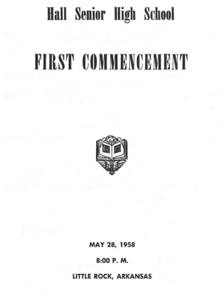
The school opened in September 1957 as Little Rock’s newest high school, located in “west” Little Rock.  (It is sometimes listed as the second Little Rock high school, ignoring the fact that Horace Mann high school existed.)

The first graduating class was smaller than future classes would be.  Because they had attended Central High School for their sophomore and junior years, many seniors who were zoned for Hall High chose to attend Central for their senior year.

Instead of processing in to Elgar’s “Pomp and Circumstance,” the Hall High seniors entered to Rimsky-Korsakov’s “Procession of the Nobles.”  The music for ceremony also included “The Star Spangled Banner,” Scarmolin’s “My Creed” and Handel’s “Sarabande and Bouree.”

Principal Terrell E. Powell (who would be tapped as superintendent of the district in a few months) presided over the ceremonies.  Superintendent Virgil Blossom (whose daughter had graduated from Central High the day before) spoke briefly to introduce the School Board members.  One of them, R. A. Lile, presented the students with their diplomas.

There were 109 seniors listed in the graduation program, seven were honor graduates.  The senior class officers were: Redding Stevenson, president; Amanda Jeanne “Toppy” Cameron, vice president; and Karl E. Stahlkopf, secretary. Porter Briggs was the first student body president. Linda Overstreet was student body vice president and Linda Neathery was 12th grade representative on the student council.

The Senior speakers were:  Anita Kluglose (“Toward a Pathless Wood”), Karl Stahlkopf (“Toward the Mysterious Stars”), Linda Neathery (“Toward Majestic Mountains”) and Thomas York (“Toward Unlimited Horizons”).  Other students participating were Redding Stevenson presenting the senior gift, Mary Ellen Lenggenhager giving the invocation, and Michael Ebert giving the benediction.