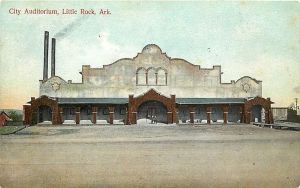
Little Rock and World War I – City Auditorium goes to war

From 1906 until 1920, a temporary structure stood next to City Hall.  It was Little Rock’s first city auditorium.

It was a flexible use structure consisting of a large room with a stage on one end. It had a variety of uses including a roller skating rink.  In the lead up to US involvement in the Great War, the Arkansas National Guard obtained permission to use it as a rifle range when it was not being used for other purposes.

Once the US entered the Great War, the facility was also used as a place for recreation for officers stationed at Camp Pike.  It was the site of dances as well as basketball games and other sporting competitions.

In addition, various organizations used the facility for patriotic rallies and music concerts.

(Note, after 1912, the front of the facade which appears in the photo was removed.  The new Central Fire Station was constructed between the auditorium and Markham Street. A new entrance to the auditorium was built off of Arch Street.)

May is Heritage Month in Arkansas.  The 2017 theme is World War I.  On Thursdays in May, the blog will look at various ways Little Rock took part in the Great War.

Arkansas Heritage Month – LR Mayor Pat L. Robinson and a municipal auditorium

PLR AuditIn April 1929, at the age of 29, Pat L. Robinson (no relation to Senator Joe T. Robinson) was inaugurated as Little Rock’s mayor.  Shortly after he took office, a variety of City Council committees and city interest groups started making proposals for projects to be funded by City bonds.  The decision was made to put a municipal bond issue before voters in August 1929.

The Young Business Men’s Association proposed a municipal auditorium be included.  In his 1929 inaugural address, Mayor Robinson had commented that an auditorium would be a worthwhile project for the city, should funding be available.  Another proposal, which seemed to have mayoral support, was the Civic Center plan (including land for an auditorium) which J. N. Heiskell had started shopping in the waning days of the Moyer administration.

The City Council approved the calling of the election and the submission of eleven different items.  Mayor Robinson then invoked the ire of the aldermen by noting he would only support four of the eleven proposals. Over the ensuing weeks, he and the aldermen traded charges and parliamentary ploys.  In July, the Council voted to cancel the election, which the mayor vetoed.  Though the Council had the votes to override the veto (and therefore not have the election), they let the veto stand.  The election proceeded as planned in August.

Hobbled by a lack of a cohesive campaign to begin with which was exacerbated by the City Hall infighting, it was probably no surprise that the few of the election proposals were approved by voters.  The marvel is probably that any were actually approved.  This appears to have been the first municipal bond election put forth after the 1926 approval of the new amendment to the Arkansas constitution.

Neither the Auditorium nor the Civic Center proposals were approved.  Throughout his term, the Hotel Marion continued to be the main site in Little Rock for conventions, while Little Rock High School’s auditorium was the showcase for performances.

No further proposals for an auditorium were put forth during the remainder of the Pat L. Robinson administration.  After continuing to alienate the Democratic power structure, he was challenged in the November 1930 primary, and failed to receive the nomination to be the Democratic nominee for mayor in 1931.

Arkansas Heritage Month – LR Mayor Moyer and a Municipal Auditorium

Moyer AuditIn anticipation of the November 2016 reopening of Robinson Center Music Hall, this week’s Arkansas Heritage Month entries look at seven Little Rock Mayors who worked on proposals for a municipal auditorium between 1904 and 1940.

After having served as Pulaski County Judge, Charles Moyer was elected Little Rock Mayor in April 1925.  He concluded his inaugural address later that month with a request that all Little Rock voters should support the auditorium district proposal in the May 1925 special election.  Voters approved the auditorium, but the concept of an auditorium district was thrown out by the Arkansas Supreme Court after a legal challenge.

Mayor Moyer then led a statewide effort to get a Constitutional amendment approved to allow for public bonds to be used on auditoriums and a host of other structures, as long as voters approved the issuance of bonds.  This was approved by voters in October 1926.  Though Mayor Moyer publicly advocated for an auditorium after that election, he did not lead a subsequent effort to create one.  During his tenure, conventions were largely centered around the Hotel Marion.  A new Little Rock High School was built (now Little Rock Central High) with that auditorium supplanting its predecessor as the location of choice for large-scale performances.

He left office in April 1929.  In the final weeks of Mayor Moyer’s second term, Planning Commission Chair J. N. Heiskell (editor of the Arkansas Gazette) started discussing the need for a civic center for Little Rock which would include space for a municipal auditorium.

Charles Moyer returned to the office of mayor for an additional two terms in the 1940s. By that time Robinson Auditorium had been opened.

Arkansas Heritage Month – LR Mayor Brickhouse and a Municipal Auditorium

Brickhouse AuditIn anticipation of the November 2016 reopening of Robinson Center Music Hall, this week’s Arkansas Heritage Month entries look at seven Little Rock Mayors who worked on proposals for a municipal auditorium between 1904 and 1940.

Former Alderman Ben D. Brickhouse took office as mayor in April 1919.  As an alderman, he had been party to the discussions and hand-wringing over the existing “temporary” auditorium, which was twelve years old at the time.  In June 1920, he and the City Council authorized City Engineer James Rice to have the building demolished.  (Rice’s grandson Jim Rice is an integral member of the team overseeing the restoration of Robinson Center Music Hall.)

On what seemed to be an annual basis, Brickhouse entertained options for a new municipal auditorium.  Sometimes it would be private groups, on at least one occasion, Mayor Brickhouse himself led the effort.  Funding and location always seemed to be stumbling blocks.  Arkansas law forbade the use of public dollars on an auditorium, so the money would have to be raised privately. Few private entities had the money for this type of project.  Another temporary auditorium had been proposed for City Park (now MacArthur Park), but aldermen balked at the expense for a temporary building.

During the Brickhouse administration, the Hotel Marion was the main site for conventions. The auditorium at the Little Rock High School (later East Side Junior High) was used frequently for performances.

Mayor Brickhouse worked behind the scenes to have the Arkansas General Assembly pass legislation to allow for the creation of an auditorium taxing district, much like a street improvement district. In May 1925 Little Rock voters would be given the chance to approve this.  But Brickhouse would not be mayor by the time that election came around.  He was defeated in his bid for a fourth term and left office in April 1925.

Ben D. Brickhouse did return to public service in 1938, when he was elected to the Arkansas General Assembly.  He was reelected in 1940 and died in June 1941.

Arkansas Heritage Month – LR Mayor Taylor and a Municipal Auditorium

Taylor AuditIn anticipation of the November 2016 reopening of Robinson Center Music Hall, this week’s Arkansas Heritage Month entries look at seven Little Rock Mayors who worked on proposals for a municipal auditorium between 1904 and 1940.

Charles Taylor became Little Rock’s mayor in April 1911.  He inherited the temporary auditorium that was already showing signs of wear and tear after four years.  Throughout the eight years he was in office, he and the City Council wrestled with the question of what to do about the auditorium.

Time and time again, there would be calls to tear the building down. Its proximity to the 1913 fire station was causing the insurance rates on that building to be increased. It was viewed as structurally unsound and had outlived its useful life.  However, without that building, there would be no public space for conventions and community meetings.  While the Hotel Marion offered convention facilities in its ballroom, it did not necessarily lend itself to trade shows. In addition, as a private entity, it was able to set its own rules without necessary regard to the general public.

A 1913 proposal by planner John Nolen had called for an auditorium to be built on a new plaza area near City Hall.  Due to funding issues, that plan never gained traction, despite repeated attempts by its backers to push for it.

At the time he left office in April 1919, Mayor Taylor had still not been able to solve the problem of a municipal auditorium.

Arkansas Heritage Month – On Armed Forces Day visit the City of Little Rock’s MacArthur Museum of Arkansas Military History

MacPark ArsenalToday is Armed Forces Day.  It is a good day to visit Little Rock’s museum devoted to Arkansas’ military heritage.  Located in the historic Arsenal Tower in MacArthur Park, the MacArthur Museum of Arkansas Military History honors the Arkansans who have served in the armed forces.  Exhibits feature artifacts, photographs, weapons, documents, uniforms and other military items that vividly portray Arkansas’s military history at home and abroad.

The exhibits include:

  • From Turbulence to Tranquility: The Little Rock Arsenal
  • Capital In Crisis and Celebration: Little Rock and the Civil War
  • Alger Cadet Gun
  • Camden Expedition
  • David Owen Dodd
  • Through the Camera’s Eye: The Allison Collection of World War II Photographs
  • By the President in the Name of Congress: Arkansas’ Medal of Honor Recipients
  • Conflict and Crisis: The MacArthur- Truman Controversy
  • Duty, Honor and Country: General Douglas MacArthur
  • The Sun Never Sets on the Mighty Jeep: The Jeep During World War II
  • War and Remembrance: The 1911 United Confederate Veterans Reunion
  • First Call – American Posters of World War I
  • Undaunted Courage, Proven Loyalty: Japanese American Soldiers in World War II
  • Vietnam, America’s Conflict

The MacArthur Museum of Arkansas Military History is a museum of the City of Little Rock.  It is led by executive director Stephan McAteer who works with the MacArthur Military History Museum Commission.  The museum is open Tuesday through Friday from 9am to 4pm, Saturday from 10am to 4pm and Sunday from 1pm to 4pm.

Under the Lights raises the barre for Ballet Arkansas

UndertheLights_ProgramCover_27july2015a-183x300Ballet Arkansas’ 2015-16 season concludes with the concert Under the Lights, currently on stage at the Arkansas Repertory Theatre through Sunday, May 22. In what has become a hallmark of Artistic Director Michael Bearden’s leadership, it offers an eclectic mix of styles of dance and music which not only highlight the strengths of the dancers, but also allow the dancers to push themselves in new directions.

The concert takes its name from Chris Stuart’s Under the Lights, which is set to the music of Johnny Cash. Created for Nashville Ballet, this piece receives its Arkansas premiere just one hour north of Cash’s birthplace in Kingsland. Being the scion of a longtime Cleveland County family, I grew up listening to Cash’s music. I approached this piece with a great deal of excitement, but also wondering exactly how ballet would meld with Cash. The answer is, they fuse very well.

Ballet is, at its heart, about expression. So are Cash’s songs. At Ballet Arkansas’ performances, the songs are performed live by Sugar + the Hi-Lows, which played them in the premiere. The central dancer, in black of course, is Toby Lewellen. He does not try to mimic Cash in any way, but instead combines lyricism and athleticism as he leads the company in “Walk the Line.” He and Amanda Sewell partner nicely on the piece’s penultimate song, “I’ve Got You Covered.

Deanna Karlheim and Paul Tillman perform a pas de deux to “Ring of Fire” which captures the raw longing of that song. Megan Hustel leads the company in a poignant “Hurt.”

After all the emotions of the piece, it ends in the joyous “Jackson” which allows each of the dancers a moment to showcase their talents. This is no balletic hoedown with forced folksiness; it is a true “let down your hair” moment of release for the dancers at the end of the piece and of the concert.

The concert starts with George Balanchine’s Glinka Pas de Trois which featured Justin Rustle, Megan Hustel and Lauren Bodenheimer at Friday evening’s performance. This 1955 piece requires the dancers to show not only classical ballet training, but also speed and subtle movements which are more inspired by modern dance. The three dancers perform alone and in various combinations. Intricate and challenging, the three dancers were up to the task.

Harrison McEldowney’s Group Therapy was an audience favorite. The four couples portrayed different sets of phobias, neuroses, or other problems. Set to pop standards of the 1930s and 1940s, each couple got a chance to display not only dancing prowess, but also a flair for comedy. In “Treat Me Rough” thankfully Toby Lewellen and Lynsie Ogden were not called upon to actually abuse each other that in this enlightened day would not be funny. But they aptly captured the on-again, off-again status of some couples with a comic edge. Justin Rustle’s uptight “Mr. Clean” was paired with Meredith Loy in a pas de deux set to Gershwin’s “Embraceable You” which was both witty but also filled with longing as Loy tried to break through Rustle’s veneer. His expert lift work was on display throughout the piece.

Megan Hustel dances not only with Tony Sewer but also with a peripatetic cigarette.   She constantly hides it from Sewer in a movement that never stops throughout the number. Sewer gets his chance to shine in a response to her, which is infused with equal parts jazz and ballet. Narcolepsy has never been so funny as when danced by Paul Tillman and Amanda Sewell in “Narcoleptic.”   Sewell goes limp in a variety of poses while Tillman tries to keep her up. This creates opportunities to show the gracefulness and strength of both dancers as Sewell sweeps and Tillman juggles her throughout the number.

The evening also contained two world premieres. The first, (e)motions by Ilya Kozadayev, was the winner of the 2015 Visions choreography contest. Featuring three couples, it was abstract and athletic. Yet each couple created a connection as they partnered. Deanna Karlheim and Paul Tillman, Meredith Loy and Toby Lewellen, and Lynsie Ogden and Tony Sewer, were definitely put through the paces on this piece.

Kiyon Gaines’ Memoryhaus was at its best when it created stark pictures whether it was Amanda Sewell alone in a spotlight, Paul Tillman approaching Deanna Karlheim, or the entire company dancing in unison. Its style is a blend of classical and modern, which is matched by the music of Max Richter.

Ballet Arkansas continues to be a company on the move. Less than a decade ago, the company was on life support existing to produce The Nutcracker in December. Now it is firmly establishing itself as an innovative member of Arkansas’ arts scene with a resident company which tours throughout the state. Not content to be a mediocre provincial dance troupe, Artistic Director Michael Bearden has programmed work that explores the depth and breadth of the ballet world and brings it to Arkansas.

The fact that the company has been granted permission to perform Balanchine selections two years in a row is no accident. It is a testament to the vision and hard work of Bearden and the dancers. Ballet Mistress Laura Hood Babcock and Production & Company Manager Erin Anson-Ellis aid Bearden in this effort. It is exciting to have seen dancers return over several seasons and have the opportunity to dance a variety of styles. Under the Lights is the culmination of a great deal of hard work, not only for the rehearsal process this season, but also for the company over several years.