
Architects of Little Rock the focus of June’s Legacies & Lunch

Architects of LR bookCharles Witsell and Gordon Wittenberg, retired principals of Little Rock architecture firms and co-authors of the newly released Architects of Little Rock: 1833-1950, will discuss Little Rock’s architectural history at Legacies & Lunch on Wednesday, June 4, noon-1 p.m. in the CALS Main Library’s Darragh Center, 100 Rock Street.

Witsell and Wittenberg are retired principals of WER Architects/Planners (Witsell, Evans and Rasco) and WD&D (Wittenberg, Delony and Davidson). Architects of Little Rock: 1833-1950 profiles thirty-five architects, including George R. Mann, Thomas Harding, Charles L. Thompson, and more. Famous buildings such as the Arkansas State Capitol, St. Andrews Cathedral, the Pulaski County Court House, Central High School, and Robinson Auditorium are showcased as well. Copies of the book will be available for purchase; Wittenberg and Witsell will sign copies after their talk.

Legacies & Lunch, the Butler Center’s monthly lecture series, is free, open to the public, and supported in part by the Arkansas Humanities Council. Programs are held from noon-1 p.m. on the first Wednesday of each month. Attendees are invited to bring a sack lunch; drinks and dessert are provided. For more information, contact 918-3033.
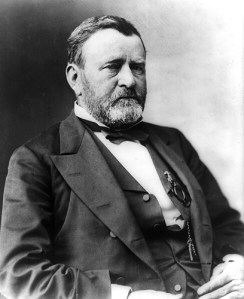
Little Rock Look Back: U S Grant speaks in Little Rock

US_Grant_fOn April 15, 1880, former president Ulysses S. Grant spoke in Little Rock as part of his world tour. While here he made a couple of appearances and participated in a parade. It was Grant’s first visit to Arkansas either as a soldier or a politician.

At his outdoor speech, his remarks followed brief comments by Governor William R. Miller and Mayor John Gould Fletcher (erroneously referred to as John C. Fletcher in the Memphis Appeal story the next day). Grant’s comments were brief and flowery. He thanked Arkansans for a warm welcome, praised the future prospects of Arkansas and discussed the demise of what he termed “sectionalism” which was undoubtedly a reference to the division between the Union and and former Confederate states.

Also that day, Grant addressed a banquet in Concordia Hall (now part of the Arkansas Studies Institute complex on the Central Arkansas Library downtown campus). His was one of fifteen toasts that evening. It was simply “The United States of America, forever United.” He expounded briefly on the theme of unity of citizens from all states. He also discussed immigration noting, “All foreigners find a welcome here. We make them American citizens. After we receive them, it is but one generation until they are Americans.” He noted that he could speak much more on the topic, but that since he was but one of fifteen toasts and that there was to be music after each toast, “It will be to-morrow (sic) orning when we get through if we all take as much time as the subjects admit of.”

Marker at the Capital Hotel noting Grant's visit. Note that it refers to him as General instead of President.  At the time, only sitting Presidents were referred to as President.

Marker at the Capital Hotel noting Grant’s visit. Notice that it refers to him as General instead of President. At the time, only sitting Presidents were referred to as President.

Grant arrived in Little Rock on the night of April 14 and lodged at the Capital Hotel. He undoubtedly enjoyed some whiskey and cigars while at the Capital. Grant had originally planned on departing in the afternoon of April 15, but Little Rock leaders pled with him to stay so that he could be honored at the banquet. He assented.

Not everyone was thrilled to have the former commander of the Union Army in Little Rock. The story goes that when he was parading down the street, some Little Rock women (in a display of Souther un-hospitality) sat in chairs with their backs to the parade route. But all in all, it appears to have been a successful visit for the man who was the only Republican in the 19th Century to win Arkansas’ Electoral votes.

Charlotte Schexnayder Brings Salt to Legacies & Lunch

legaciesschexnayderCharlotte Tillar Schexnayder has been called a “salty old editor,” and she is indeed worth her salt. She will be interviewed about her life and work in the Arkansas Delta by David Stricklin, manager of the Butler Center for Arkansas Studies, at Legacies & Lunch on Wednesday, April 2, at noon in the Main Library’s Darragh Center, 100 Rock Street.

Schexnayder has been an influential voice in the life and politics of the Delta, a member of the Arkansas House of Representatives, and a pioneer among women in the professions of politics and journalism. She and her husband, Melvin, owned the Dumas Clarion newspaper for many years. Schexnayder has served as president of every professional journalism organization she has joined, including the National Federation of Press Women and the National Newspaper Association, and she was the first female president of the Dumas Chamber of Commerce.

Copies of her memoir, Salty Old Editor, published by Butler Center Books in 2012, will be available for sale at the program or may be purchased from River Market Books & Gifts, 120 River Market Avenue, or online at http://www.uapress.com. Schexnayder will sign books after her program.

Legacies & Lunch is free, open to the public, and supported in part by the Arkansas Humanities Council. Programs are held from noon-1 p.m. on the first Wednesday of each month. Attendees are invited to bring a sack lunch; drinks and dessert are provided. For more information, contact 918-3033.

Legacies & Lunch today – “Big News from Old Stuff” with State Archeologist

legacies The University of Arkansas Museum Collections may contain prehistoric collections, but they are far from ancient history. Dr. Ann Early, State Archeologist, will give a talk at the Butler Center’s Legacies & Lunch program on Wednesday, March 5, at noon in the CALS Ron Robinson Theater.

Dr. Early will discuss a sample of recent and ongoing research projects that use old collections, some nearly a century old, kept safe here in Arkansas. The results include major advances in Arkansas studies and contributions to studies of human history on a national and international scale. Archeological collections may not always be on constant view, but they are living laboratories that are continually used by researchers, educators, descendant peoples, and citizens interested in history. People come back to these collections with new research questions and new methods of analysis. Like libraries and archives, museum collections will continue to offer new discoveries and new insights into Arkansas history far into the future.

The Arkansas State Archeologist is Dr. Ann M. Early, whose office is located in Fayetteville at the Arkansas Archeological Survey. The duties of the State Archeologist involve all aspects of public archeology from site reporting, to liaison with public agencies, to public education.

The State Archeologist works closely with the Arkansas Archeological Society on such projects as the annual Society Dig and Training Program and Arkansas Archeology Month. She oversees the Survey’s Education Program, which produces a variety of educational materials, such as books, exhibits, and informational flyers for teachers, students, and the general public.

The State Archeologist nominates Arkansas sites to the National Register of Historic Places and can provide information on reporting sites in Arkansas. Information on state laws pertaining to archaeological sites in Arkansas can also be obtained from her office.

Legacies & Lunch is free, open to the public, and supported in part by the Arkansas Humanities Council. Programs are held from noon-1 p.m. on the first Wednesday of each month. Attendees are invited to bring a sack lunch; drinks and dessert are provided. For more information, contact 918-3033.

Legacies & Lunch: Lessons from an Old School

legaciesThis month, the Butler Center’s Legacies & Lunch series not only looks at a chapter in Arkansas history, but it explores the challenges of researching and writing history.
Grace Blagdon and David Ware will discuss the Brinkley Academy, a major part of African American educational history in Arkansas. Blagdon, whose father was the school’s principal, will share what she has learned from surviving students. Ware, historian of the Arkansas State Capitol, will touch on the challenges he and Blagdon faced in creating an exhibit, Old School: Remembering the Brinkley Academy, from the school’s few remaining historical materials.
Legacies & Lunch is free, open to the public, and supported in part by the Arkansas Humanities Council.
This month, Legacies & Lunch moves to a new location.  With the opening of the new CALS Ron Robinson Theater in the Arcade Building, the program will take place there.  It is easily accessible from the Main Library’s parking lot. Attendees are invited to bring a sack lunch; drinks and dessert will be provided.

The program is held from noon-1 p.m. on the first Wednesday of each month.

The Butler Center for Arkansas Studies is a department of the Central Arkansas Library System (CALS). It was founded in 1997 to promote the study and appreciation of Arkansas history and culture.

First 2nd Friday Art Night of 2014

2nd Friday Art NightThe first 2nd Friday Art Night of 2014 takes place tonight.  Among the participating locations are Historic Arkansas Museum, the Central Arkansas Library System and Old State House Museum.

Historic Arkansas Museum will feature live music by Phil G. and Lori Marie from 5pm to 8pm.  It will also host the opening reception for Chasing the Light: Photography by Brian Chilson, in the Second Floor Gallery through March 10.  Arkansas Times photographer Brian Chilson has had a front row seat to some of the most exciting, entertaining, eventful and sometimes poignant events in Arkansas, as well as those smaller moments of everyday life. This collection of photographs taken over the past decade, from 2003 to 2013, serves as a sort of retrospective of life in Arkansas in the arenas of fashion, sports, politics and human interest.

At the Central Arkansas Library’s Butler Center a new exhibit will open.  Unusual Portraits: New Works by Michael Warrick and David O’Brien features explorations in portraiture by two accomplished Little Rock artists. Featured musician for the evening is Das Loop, a Little Rock duo that creates instrumental compositions using live loops and “layers of poly-rhythmic bliss.” The featured artist is Jacquelyn Kaucher, a painter who works with watercolor and acrylics, and she is a long-time teacher of watercolor and experimental watercolor painting in Little Rock.

The Old State House will host Second Friday Cinema: “Broncho Billy Anderson: Arkansas’s First Movie Star” at 6:00 pm. Born Max Aronson in Little Rock, Ark., Gilbert M. Anderson was a motion picture pioneer, who appeared in the groundbreaking film The Great Train Robbery in 1903. Anderson partnered with George Spoor to form the Essanay (S and A) Studios, where he wrote, directed, and starred in hundreds of one-reel westerns and comedies, the most popular featuring a character Anderson created for himself, Broncho Billy. “Broncho Billy” Anderson became Hollywood’s first western star, and Essanay one of the most successful studios of the early motion picture era.

The screening will include three short movies featuring Gilbert M. “Broncho Billy” Anderson:   The Great Train Robbery (1903) Broncho Billy’s Fatal Joke (1914) The Son-of-a-Gun (1919).  Ben Fry, General Manager of KLRE/KUAR and coordinator of the film minor at UALR, will introduce the films and lead a discussion.

Legacies & Lunch Looks at Slavery in Arkansas

legaciesSlave resistance in Arkansas is the topic of Legacies & Lunch in January. Kelly Houston Jones, a Ph.D. candidate at the University of Arkansas, will present “A Rough, Saucy Set of Hands to Manage,” a discussion of her research on slavery in Arkansas.

This work was the lead essay in the Spring 2012 issue of Arkansas Historical Quarterly. Making extensive use of legal documents and carefully reading oral histories, Jones sought “to recover the slave point of view in examining explicit resistance.” She concludes that “slaves’ resistance in Arkansas seems to have had more to do with making their lives a little easier than with a continuing, self conscious effort to undermine the slave regime.”

Legacies & Lunch is free, open to the public, and supported in part by the Arkansas Humanities Council. The program is held from noon-1 p.m. on the first Wednesday of each month in the Main Library’s Darragh Center. Attendees are invited to bring a sack lunch; drinks and dessert will be provided.

The Butler Center for Arkansas Studies is a department of the Central Arkansas Library System (CALS). It was founded in 1997 to promote the study and appreciation of Arkansas history and culture. The Butler Center’s research collections, art galleries, and offices are located in the Arkansas Studies Institute building at 401 President Clinton Ave. on the campus of the CALS Main Library.

For more information, call 918-3086.