Little Rock Women’s History Month – Lucy D. Dixon

Lucy DixonKnown professionally as Mrs. Edgar F. Dixon (in an era when married women were listed publicly by their husband’s names), Lucy D. Dixon was elected to the Little Rock City Board of Directors in November 1957.  Though not noted at the time, her election was historic.  She was the first woman elected to a municipal office in Little Rock who had not first succeeded her husband.  Prior to her service on the City Board, Mrs. Dixon had served on the Little Rock School Board.  She was secretary of that body during the 1957 desegregation crisis.

Lucy Ann Dulin was born in Hensley in 1904.  She moved to Little Rock and graduated from Little Rock High School (then located on Scott Street) and attended the University of Arkansas.  From 1927 until 1935, she worked for her family’s business – Dulin Bauxite Company.  She returned to the company in 1941 and worked there until 1950.  She later served on the company’s board of directors.

Beginning in 1935, she became involved with the PTA and rose to the position of National Secretary in 1949, serving for three years in that position. As a PTA officer, she visited thirty-six of the then forty-eight states.

Among her other leadership positions were executive vice chair of the Governor’s Advisory Committee on Education, trustee of Little Rock Junior College (now UALR), delegate to the White House Conference on Children and Youth, delegate to White House Conference on Education, Pulaski County Welfare Board, and Little Rock Planning Commission.  She was also active in many Methodist organizations.  In 1953, she was the Arkansas Democrat Woman of the Year.

Married to Edgar F. Dixon, she had three children: Philip Edgar, Barbara and Mimi.  She died in January 1996 at age of 91.

Little Rock Look Back: Leap Day City Council meetings

CLR Leap Day 1932February 29 may come around only once every four years, but it is even rarer for the City of Little Rock to have City Council or City Board meetings on that date.

The most recent official meeting on a Leap Day was on February 29, 1932.  Mayor Horace A. Knowlton presided with all sixteen Aldermen present.  Among the items discussed were regulating of junk dealers, taxes on slot machines, a building condemnation, and setting a license fee for bowling alleys.

There were several issues related to cemeteries discussed throughout the evening.  One forbade any new burials in a section of Oakland Cemetery while another sought to prohibit the creation of any new cemeteries within the City limits.  The Council also passed a motion instructing the Mayor to notify the State Board of Health that the City was “seriously objecting and would strenuously oppose the establishment of a [new] Cemetery within the present boundaries of the City of Little Rock.”  The final cemetery issue was the acceptance of the annual report of the Mount Holly Cemetery Association.

That night the Council also passed a resolution to name the city government hospital as “Little Rock City Hospital.” The purpose of the name was to “clearly designate said hospital to the citizens of Little Rock as the hospital owned and operated by the City of Little Rock.”

The issue which seems to have taken up most of the time was overriding a Mayoral veto of a resolution opposing the firing of a firefighter.  The motion to sustain the veto ended in a tie. After the Mayor promised to rehire the firefighter as soon as a vacancy occurred, on alderman changed his vote and the veto was sustained.

The only other City Council meeting on a February 29 was in 1892.  Mayor H. L. Fletcher presided over the meeting.  The main focuses of that meeting were to discuss boundaries of various sewer districts, pay the monthly bills, approve the relocation of a house from 9th Street to the corner of 12th Street and Commerce Street and to bring certain City criminal penalties in line with a new state law.

Little Rock Look Back: Mayor Byron Morse

IMG_5431On February 23, 1917, future Little Rock Mayor Byron R. Morse was born.

A founder of the real estate firm of Rector-Phillips- Morse, he was long active in civic affairs of Little Rock.

Mayor Morse was first elected to the City Board of Directors in November 1960. In 1963, he was chosen as Little Rock Mayor. After serving two years as Mayor, he chose to not seek re-election to the City Board.

In 1980, he was appointed to the City Board to fill out an unexpired term. He was later asked to fill another unexpired term but declined.

In 1983, he was elected national president of the Society of Industrial and Office Realtors. Mayor Morse also served as president of the Little Rock Chamber of Commerce, the Little Rock United Way, the Little Rock Red Cross, and was a member of the Board of Directors of the Little Rock Boy’s Club. He was a member of the Fifty for the Future.

On July 25, 2001, Mayor Morse died.


Little Rock Look Back: Acting Mayor John Herndon Hollis

John Herndon HollisOn February 5, 1870, future Little Rock alderman and acting mayor John Herndon Hollis was born shortly before his family moved to what is now Cleveland County. His parents were originally from Georgia and came from prosperous and longtime families there.

The Hollis family came to Arkansas after the Civil War and settled in Union County. A portion of that county was carved off and became Dorsey County (named after a Republican US Senator from Arkansas) but was renamed Cleveland County after Grover Cleveland was elected President. Cleveland was the first Democrat to be elected President in over 20 years. This name change also reflected the political shift in Arkansas from the Reconstruction-led Republican politics to the Democratic Party politics which would dominate for the next century.

John Herndon Hollis was one of six children, and the only one with a middle name. Herndon had been his mother’s maiden name. As one of his brothers described their childhood in Cleveland County, “they all went to country schools in their home neighborhood, worked hard on the farm in the summertime, and were inside their little Methodist Church every time the doors were open.”

Around 1900, Hollis and his new wife Malinda M. “Linda” Taliaferro Hollis (formerly of Rison) moved to Little Rock.  Together the couple had six children. In Little Rock, Hollis worked in the banking industry. For years he worked for People’s Building and Loan Association.

Hollis was first elected to the Little Rock City Council in April 1904. He would serve as one of the Aldermen from the city’s Fourth Ward until April 1918.  This was on the western border of Little Rock at the time. The family lived at 1510 S. Schiller, which is one block east of Central High, though at the time neither the school nor its predecessor (West End Park) existed.  From 1907 until 1913 he also served on the Little Rock School Board.

In April 1908, at the first City Council meeting in the new City Hall, Mayor W. E. Lenon announced his resignation. Because the resignation was effective immediately, there was a vacancy in the office of mayor.  Hollis was selected by his colleagues to serve as acting mayor until a successor could be elected. So from April 1908 through June 1908, Hollis was the City’s chief political and executive leader.

Though he was never formally mayor (and did not resign his position as alderman), since 1908, Hollis’ name has appeared on the list of mayors of Little Rock. The reason seems to be as a sign of respect since there was a vacancy.

There previously had been acting mayors when the mayor would be absent on business or due to illness. But in those instances, the mayor had not resigned. This is the only instance in Little Rock history when a mayor resigned immediately with no successor in place. So John Herndon Hollis holds a unique role in Little Rock history.

Hollis’ wife died in 1920.  He later married Ann Jewell of Little Rock (who was a distant cousin of his first wife). They were married until his death on October 23, 1941.  Ann Hollis lived in Little Rock until her death in 1980.  The Hollis family is entombed in the mausoleum at Mount Holly Cemetery.

Both of John Herndon Hollis’ wives are distant cousins of the Culture Vulture, so he is particularly fond of John Herndon Hollis.

Art+History Throwback Thursday: City Park in 1907

On February 9, Little Rock voters will have the chance to say Yes to improving the MacArthur Museum of Arkansas Military History, Arkansas Arts Center, and MacArthur Park.

Leading up to that election is a good time to look back at the development of MacArthur Park.

The land now known as MacArthur Park had originally served as a horse racetrack in the early days of Little Rock.  By 1836, the federal government purchased the land for construction of a military arsenal.  The flagship building, the Arsenal Tower building, is the only remaining structure from that time period.  

The land served as a military outpost until 1892.  On April 23, 1892, a land swap took place where in the City of Little Rock was given the property with the stipulation that it would be “forever exclusively devoted to the uses and purposes of a public park.” (Never mind that the federal government took part of the land back for the construction of the Wilbur Mills Freeway.)  

In return for giving the City this land, the federal government took possession of land on the north side of the Arkansas River (then part of Little Rock) – that 1,000 acres became Fort Logan H. Roots. The park opened on July 4, 1893, with the name Arsenal Park. Since it was the City’s first and only park at the time, residents started referring to it as City Park. In time, the designation Arsenal Park fell from use.  In fact, it is referred to as City Park exclusively and officially in City documents throughout the first 42 years of the 20th Century. 

On March 9, 1942, Little Rock’s first public park was renamed by the Little Rock City Council.  By a vote of fourteen ayes, zero nays and four absent, the alderman approved Ordinance 6,388 which renamed the park in honor of General Douglas MacArthur. 

The text of the ordinance says that “it is fitting and proper that the bravery and glorious deeds of General Douglas MacArthur, a native son of Little Rock, should be commemorated.”  This was passed a few months after the United States’ entry into World War II.   Though he was already a well-established military figure, most of the MacArthur legend during the war would take place after this naming. 

In 1952, General MacArthur (contemplating a run for the GOP nomination for President) visited Little Rock in March.  Later that year, the eventual GOP nominee (and 34th US President) General Dwight Eisenhower visited the park.  The 1952 Democratic nominee Adlai Stevenson also visited MacArthur Park in 1952.

Today, MacArthur Park is the anchor of the burgeoning MacPark district as well as the MacArthur Park Historic Distric.


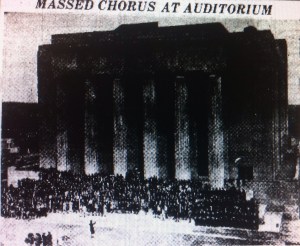
Little Rock Look Back: School Children Sing Christmas Carols at Robinson Auditorium

Christmas Carols

Photo from Arkansas Gazette

Right now, music is silenced at Robinson Center.  During the renovation, violins and tubas have been replaced by saws and heavy equipment.

Similarly, 76 years ago, the halls of that building were alive with only the sounds of construction.  But out front, on December 18, 1939, the sounds of Christmas carols filled the air.

That afternoon, 500 school children from elementary schools were joined by the A Capella Choir of Little Rock High School as they sang Christmas carols on the front steps of the auditorium on a weekday afternoon.  The singers were accompanied by the Little Rock High School Brass Sextet.  The invocation for the event, which was sponsored by the Little Rock Council of Parents and Teachers, was delivered by the Right Reverend Richard Bland Mitchell, the Episcopal Bishop of Arkansas.

A Christmas tree in front of City Hall was lit up as part of the ceremony as well.  Media coverage noted that the audience witnessing the program stood on the front steps of the Pulaski County Courthouse, the side lawn of City Hall and in front of the steps of Robinson Auditorium.  It was also noted that most windows in the nearby government buildings were filled with people watching the ceremony.

130 years of Cromwell Firm focus of Old State House Museum Brown Bag lecture today

OSH Brown BagJoin the Old State House Museum at noon on Thursday, December 3, for a Brown Bag Lunch Lecture led by Dan Fowler, Chief Operating Officer at Cromwell Architects Engineers, as he speaks about the influence and history of 130 years of Cromwell.
The talk is in support of the current temporary exhibit at the Old State House Museum, “Lost + Found.”
“Lost + Found” highlights eight different projects completed or renovated by Cromwell during its 130 year history. These include projects in Little Rock (Little Rock City Hall, the Federal Reserve Bank Building and 615 Main Street), North Little Rock (St Joseph’s Home for Children), Pine Bluff (the Temple Building and the Pines Hotel) and Hot Springs (the de Soto and Majestic Hotels). Many of these structures were designed by Charles L. Thompson, one of the founders of Cromwell and one of the most-known and prolific architects in Arkansas in the 20th century. “Lost + Found” ends December 11.
The talk is free and participants are encouraged to bring a lunch. Soft drinks and water are provided.