Little Rock Look Back: Jesse Belvin in concert at Robinson Auditorium

Ark Gazette 60.02.05 (Fri)The name Jesse Belvin is largely forgotten. As a songwriter in the 1950’s he wrote “Earth Angel.” He also had an R&B hit with “Goodnight My Love.”  If he is recalled for anything today, it is tragically for being part of the mythical “27” club of musicians who died at the age 27.

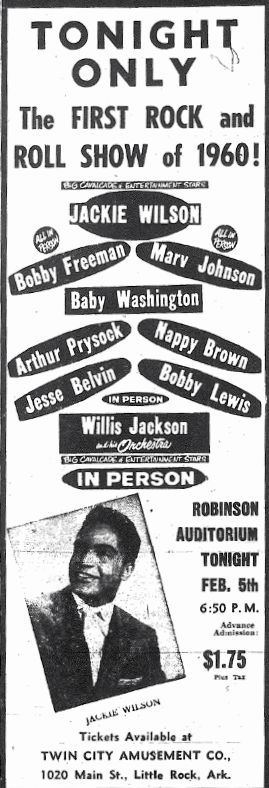
On February 5, 1960, he appeared in a concert at Robinson Auditorium for what was billed as the “First Rock & Roll Concert of 1960.”  The headliner for the concert was Jackie Wilson.  The next morning, Belvin died at age 27 in a car accident outside of Hope on his way to his next concert in Texas.  Also killed in the wreck were Belvin’s wife, the man driving the car, and a couple in another car which Belvin’s car struck.

Many urban legends have sprung up about the concert at Robinson. Some, no doubt, fueled by Little Rock’s racially divided then-recent past in September 1957.  Most of these purport that the concert in which he appeared was the first integrated concert in Little Rock. Most rumors also state that Belvin had received threats leading up to the concert, that a riot took place at the concert or at least was stopped several times by disruptions caused by white agitators, that Belvin and others were run out of town, and that the accident was caused by damage inflicted to his tires before leaving Little Rock.  There are several variations of these purported facts.

While it is true Belvin performed at Robinson Auditorium the night before he died, it was not before a racially mixed audience.  It was not until August 1961 that the first concert took place in Robinson that did not have segregated seating, and that was a one-time only event.  It would not be standard practice at Robinson Auditorium until the 1965 passage of the Civil Rights Act.

Rebecca Miller, in her blog https://jackiewilsonlover.wordpress.com/, goes into great detail debunking many of the supposed “facts” about the February 5, 1960, concert at Robinson.  While the Arkansas Gazette and Arkansas Democrat at the time did not shy away from covering racial issues (each with their own slant), neither paper mentions anything about the discord at the concert.  They do discuss Belvin’s subsequent accident near Hope.  It was apparently caused when the driver of the car containing Belvin and his wife fell asleep at the wheel.

In this day of the internet where it is easy for myths to fester into fact, it is hard to dispel rumors.  What is true is that a life was tragically cut short, and that Jesse Belvin’s last concert was on the stage of Robinson Auditorium.

Black History Month Spotlight – E. Lynn Harris

bhm lynnE. Lynn Harris was born in Flint, Michigan and raised, along with three sisters, in Little Rock. A graduate of Hall High School, he attended the University of Arkansas at Fayetteville where he was the school’s first black yearbook editor, the first black male Razorbacks cheerleader, and the president of his fraternity. He graduated with honors with a degree in journalism.

Harris sold computers for IBM, Hewlett-Packard, and AT&T for 13 years while living in Dallas, Washington, D.C. and Atlanta. He finally quit his sales job to write his first novel, Invisible Life, and, failing to find a publisher, he published it himself in 1991 and sold it mostly at black-owned bookstores, beauty salons, and book clubs before he was “discovered” by Anchor Books. Anchor published Invisible Life as a trade paperback in 1994, and thus his career as an author was “officially” launched.

Invisible Life was followed by Just As I Am (1994), And This Too Shall Pass (1996), If This World Were Mine (1997), and Abide With Me (1999), all published by Doubleday. All of Harris’s books were bestsellers. Harris’s sixth novel, Not A Day Goes By (July 2000) debuted at #2 on the New York Times bestseller list and was a #1 Publishers Weekly bestseller for two consecutive weeks. His seventh novel, Any Way the Wind Blows (July 2001), also debuted at #2 on the New York Times bestseller list. His other books included What Becomes Of The Brokenhearted – A Memoir (2003); I Say a Little Prayer (2006); Just Too Good To Be True (2008); Basketball Jones (2009); Mama Dearest (2009) (posthumously released) and In My Father’s House (2010) (posthumously released).

In 1999, the University of Arkansas honored Harris with a Citation of Distinguished Alumni for outstanding professional achievement, and in October 2000, he was inducted into the Arkansas Black Hall of Fame.  He died in July 2009 while in California for meetings. An autopsy determined it was due to heart disease.

For more on E. Lynn Harris and other inductees into the Arkansas Black Hall of Fame, visit the permanent exhibit at the Mosaic Templars Cultural Center. That museum is an agency of the Department of Arkansas Heritage.


Little Rock Look Back: John Herndon Hollis – Acting Mayor of Little Rock in 1908

John Herndon HollisOn February 5, 1870, future Little Rock alderman and acting mayor John Herndon Hollis was born shortly before his family moved to what is now Cleveland County. His parents were originally from Georgia and came from prosperous and longtime families there.

The Hollis family came to Arkansas after the Civil War and settled in Union County. A portion of that county was carved off and became Dorsey County (named after a Republican US Senator from Arkansas) but was renamed Cleveland County after Grover Cleveland was elected President. Cleveland was the first Democrat to be elected President in over 20 years. This name change also reflected the political shift in Arkansas from the Reconstruction-led Republican politics to the Democratic Party politics which would dominate for the next century.

John Herndon Hollis was one of six children, and the only one with a middle name. Herndon had been his mother’s maiden name. As one of his brothers described their childhood in Cleveland County, “they all went to country schools in their home neighborhood, worked hard on the farm in the summertime, and were inside their little Methodist Church every time the doors were open.”

Around 1900, Hollis and his new wife Malinda M. “Linda” Taliaferro Hollis (formerly of Rison) moved to Little Rock.  Together the couple had six children. In Little Rock, Hollis worked in the banking industry. For years he worked for People’s Building and Loan Association.

Hollis was first elected to the Little Rock City Council in April 1904. He would serve as one of the Aldermen from the city’s Fourth Ward until April 1918.  This was on the western border of Little Rock at the time. The family lived at 1510 S. Schiller, which is one block east of Central High, though at the time neither the school nor its predecessor (West End Park) existed.  From 1907 until 1913 he also served on the Little Rock School Board.

In April 1908, at the first City Council meeting in the new City Hall, Mayor W. E. Lenon announced his resignation. Because the resignation was effective immediately, there was a vacancy in the office of mayor.  Hollis was selected by his colleagues to serve as acting mayor until a successor could be elected. So from April 1908 through June 1908, Hollis was the City’s chief political and executive leader.

Though he was never formally mayor (and did not resign his position as alderman), since 1908, Hollis’ name has appeared on the list of mayors of Little Rock. The reason seems to be as a sign of respect since there was a vacancy.

There previously had been acting mayors when the mayor would be absent on business or due to illness. But in those instances, the mayor had not resigned. This is the only instance in Little Rock history when a mayor resigned immediately with no successor in place. So John Herndon Hollis holds a unique role in Little Rock history.

Hollis’ wife died in 1920.  He later married Ann Jewell of Little Rock (who was a distant cousin of his first wife). They were married until his death on October 23, 1941.  Ann Hollis lived in Little Rock until her death in 1980.  The Hollis family is entombed in the mausoleum at Mount Holly Cemetery.

Black History Month Spotlight – Dr. Erma Glasco Davis

Photo by Staton Breidenthal for the Arkansas Democrat-Gazette

Photo by Staton Breidenthal for the Arkansas Democrat-Gazette

Erma Lee Glasco Davis was born in Keo, Arkansas and was reared in south central Little Rock, also known as the South End.  She is a product of the Little Rock Public School System, graduating from Dunbar High School in May, 1945.  She received her Bachelor of Science degree from AM&N College (now the University of Arkansas at Pine Bluff).  A year or so after the Central High desegregation crisis of 1957, she and her husband moved to Detroit, Michigan and the Doctor of Philosophy degree from the University of Michigan at Ann Arbor.

Most of Dr. Davis’ professional career was spent in Detroit, Michigan  as a teacher, counselor and administrator.  She retired from an administrative position in the Detroit Public Schools’ Management Academy.  She also taught as an adjunct professor at Marygrove  College in Detroit.  While in Detroit, Dr. Davis has had a wealth of community involvement, serving in leadership positions on boards and committees and in organizations ranging from the NAACP to Alpha Kappa Alpha sorority.  In 1979, she co-chaired the Mayor’s Education Task Force for Detroit’s International Year of the Child event.  In 1987, she won the Spirit of Detroit Award, the city’s highest community-service award.

Dr. Davis is a past national president of the National Dunbar Alumni Association, and is co-author of a book about the school, Paul Laurence Dunbar High School of Little Rock.  She has been instrumental in marrying the goals of the association with those of the Mosaic Templars Cultural Center, the state-funded museum which showcases the history and achievements of black Arkansans.  A fruit of that marriage is the museum’s Dunbar exhibits on the museum’s first floor.  She is passionate about educating people on Dunbar’s role in the state’s history.

In 1990, Dr. Davis moved back to Arkansas form Michigan.  After her return, she quickly busied herself with community work, sitting on the boards of the Central High Museum and the Arkansas Humanities Council; taking two turns as chairman of the board of the Historic Arkansas Museum Foundation; she also chaired the gala for the opening of the Mosaic Templars Cultural Center.  In addition, Dr. Davis worked nearly four years as a founding volunteer for the Clinton Presidential Central.  In 2005, she was appointed by then-Governor Mike Huckabee to the State Review Committee for Historic Preservation, and reappointed by Governor Mike Beebe in 2007.  In 2009, she was inducted into the Arkansas Black Hall of Fame.

For more on Dr. Davis and other inductees into the Arkansas Black Hall of Fame, visit the permanent exhibit at the Mosaic Templars Cultural Center. That museum is an agency of the Department of Arkansas Heritage.


Meshugga Klezmer Band at South on Main Local Live Tonight

meshugga11-14.jpeg.190x140_q60_cropTonight’s installment of Local Live features the fabulous Meshugga Klezmer Band! Presented by the Oxford American magazine, Local Live showcases the best of local and regional music talent and is always free and open to the public. Call ahead to South on Main to make your reservations and ensure a table: (501) 244-9660.  The music starts at 7:30 p.m.

The Meshugga Klezmer Band was formed in Little Rock in 1999. They are still to this day Arkansas’ only klezmer band. Klezmer music has eastern European Jewish folk roots and is characterized by the cantorial, vocal, and emotional style reminiscent of Jewish prayer. Like the cantor, the lead musicians sob, laugh, growl, and slide from note to note. Meshugga Klezmer Band has performed with the Arkansas Symphony Orchestra, for Bar/Bat Mitzvahs and weddings, and at local festivals, lounges, and private parties.

Band members include Jim Harper (clarinet), Stephanie Smittle (vocals), Izzy Getzov (violin), Casey Huie (trombone), Peter Miller (guitar), Roland Gladden (bass), and Rand Retzloff (drums).

Black History Month is focus of discussion sponsored by Butler Center and Clinton School

legaciesIn honor of Black History Month, the Butler Center for Arkansas Studies’ monthly Legacies & Lunch will feature a discussion on the benefits and potential detriments to setting aside a month to focus on the history of African Americans.

Panelists will be Henderson State University history professor John Graves, Arkansas State University history professor Cherisse Jones-Branch, community leader Freeman McKindra, and Butler Center staff member Rhonda Stewart.  Among the topics they will discuss include: Does the promotion of Black History Month lead to decreased attention to this topic in other months, or does setting aside an entire month build commitment to the history of African Americans?

This program is co-hosted by the Clinton School of Public Service.

It will take place from noon to 1pm at the Ron Robinson Theatre in the Arcade Building.

Black History Month Spotlight – Jocko Carter

BHM JCThere is always a pioneer needed to conquer the landscape of new territories. Leo Louis Carter, or “Jocko” as he was known to his friends and listeners, was that pioneer in the field of urban radio. One of the first radio announcers for KOKY 1440 AM, the first station in Arkansas designed for the culture of the urban community, Carter made an undeniable footprint into the forays of modern African American radio programming.

The Little Rock native assisted in the establishment of the station’s “True Heritage Today,” which was designed to provide entertainment, public service announcements and advertising to the urban community.

While at KOKY, he served in many capacities, including Radio Announcer, Music Director, and later Program Director. With six years of experience in radio, and twelve years of experience in the entertainment field, Carter became one of the most versatile and successful personalities in radio.

After years of success in the Little Rock area markets, Carter became sought after in the music industry’s national arena. He went on to accept a position at FAME Records in Muscle Shoals, Alabama as a National Promotional Director. After working with several labels, including Mercury and Malaco & Stax, Carter was hired by the world’s leading recording company: Warner Brothers Record. He joined their team as the Southeast Regional Promotions Manager for Black Music.

His presence at Warner Brothers served to increase the sale of Black records. In this position, Carter was directly responsible for obtaining airplay for Black artists. With the professional backing of Carter, artists were able to commemorate sales in excess of 500,000 copies. Some of these artists and their titles include Ashford & Simpson’s Send It, George Benson’s Breezin’, and Parliament Funkadelic’s One Nation Under a Groove.

In addition to his contribution to the careers of Black artists and Arkansas urban radio, Carter will always be remembered for his favorite audience petition: “Don’t meet me there; beat me there!”

In 2011, he was posthumously inducted into the Arkansas Black Hall of Fame.  For more on Leo Louis “Jocko” Carter and other inductees into the Arkansas Black Hall of Fame, visit the permanent exhibit at the Mosaic Templars Cultural Center. That museum is an agency of the Department of Arkansas Heritage.