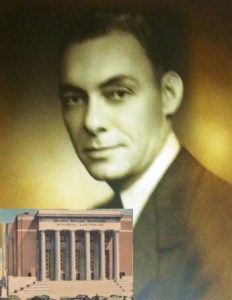
RobinsoNovember: Mayor R. E. Overman

Overman AuditR. E. Overman assumed the office of Little Rock mayor in April 1935. Around that time, a new wave of New Deal programs were filtering down from Washington DC to cities.  It can be said of Mayor Overman that he did not meet a New Deal program he did not like.  From rebuilding the sewer system, to creating a public water utility, to constructing of structures for the Museum of Fine Arts, Little Rock Zoo, and Boyle Park, Mayor Overman signed the City up for program after program.

While the programs were all worthwhile, and in some cases absolute necessities, Mayor Overman did not seem to consider how these massive projects running concurrently would impact the City finances.  In November 1935, he submitted a proposal to the Public Works Administration for the construction of a new municipal auditorium to be located at the northeast corner of the intersection of Scott Street and Capitol Avenue. It would have taken up three/quarters of that block and wrapped around the Women’s City Club building (now the Junior League of Little Rock headquarters).  Because of other projects in the works, he did not pursue any further action on the auditorium project at the time.

In November 1936, Mayor Overman asked the City Council to place three bond issues on a special election ballot for January 1937, one of which was a municipal auditorium. Though a location had previously been identified in 1935, at this point in time supporters made a concerted effort to disclose that no location had been selected.  After the election was called, there was a concerted effort by supporters of the three separate bond issues to collaborate.  Voters overwhelmingly approved all three issues, and Little Rock’s journey to a municipal auditorium at last was underway. Perhaps.

Over the summer, architects and lawyers were selected. In the autumn, a consultant was hired to help with the selection for the site.  The month of October was consumed with City Council battles over the auditorium site.  Mayor Overman favored a location at Markham and Spring Streets (now site of the Cromwell Building and the Bankruptcy Courthouse). Because the Federal Government owned half the site and did not want to sell it, that location was deemed not feasible – though that did not stop Mayor Overman and others from repeatedly citing it as their first choice.  The only person who favored the location at Markham and Broadway did not have a vote: Planning Commission Chair J. N. Heiskell. Though he had no vote, he had the twin bully pulpits of Planning Commission and the Arkansas Gazette. As other sites fell by the wayside, he kept advocating for it.  Finally, the City Council approved of Heiskell’s choice, and the auditorium had a site.

The groundbreaking had to take place by January 1, 1938, or the money would be rescinded. After finalizing a location, planning could get underway.  With a week to spare, the ground was broken on December 24, 1937.  Mrs. Joseph T. Robinson, widow of the recently deceased US Senator from Arkansas, joined Mayor Overman in the groundbreaking. This ceremony was the first mention of the building being named in memory of the fallen senator, who had died in the summer of 1937.

Construction progressed throughout 1938 and into 1939.  Because of the precarious state of the City’s finances, Mayor Overman lost the support of the business community.  In November 1938, he lost his bid for the Democratic nomination for Mayor and was denied a third two-year term.  He left office in April 1939.

RobinsoNovember: Mayor W. E. Lenon

Mayor Lenon with the plans for the original City Hall/Auditorium and the temporary auditorium.

In 1904, Little Rock Mayor W. E. Lenon first proposed that Little Rock construct at municipal auditorium.  After considering some options, he decided it would be easiest to build it in conjunction with a new City Hall and Jail.  In 1906 plans proceeded in that direction until a lawsuit by J.N. Heiskell to stop it.

Following a judge’s ruling that a municipal auditorium was not deemed a proper use for public monies, the City changed course and constructed only a City Hall and Jail (sans auditorium) at the corner of Markham and Broadway. This building opened in 1908.

In 1906, the City gave permission to a private developer to build a temporary auditorium (which also served as a roller skating rink when the chairs were removed) adjacent to the City Hall site.  This opened in 1907.

Mayor Lenon left office in 1908.  He would later chair a committee involved in an auditorium proposal in 1925, but that one would come to naught, as well.  However, he planted the seed and started the public discourse which lasted for 36 years.  His daughter, Vivion, would be married to Joseph Brewer a nephew and aide of Joseph T. Robinson, after whom the eventual auditorium would be named.

Creative Class 2016: Gretchen Hall

cc16-hallA hardhat and reflective vest have been part of Gretchen Hall‘s work wardrobe almost every day for the past 30 months.  As the President and CEO of the Little Rock Convention and Visitor’s Bureau, she has been actively overseeing the deconstruction and reconstruction of Robinson Center Music Hall. Taking a New Deal era assembly hall and making it into a state-of-the-art performance facility is not an easy task. Gretchen and her team have worked with the architects, engineers, designers and consultants to make it happen.

Gretchen joined LRCVB in 2001 and has worked her way up through the organization.  In May 2011, she was named to her current position.  Since that time, the LRCVB has undertaken numerous efforts to enhance Little Rock’s cultural life including a new amphitheatre in Riverfront Park, enhanced programming at the River Market, and increased financial support of cultural organizations.  In addition, she helped lead the effort to see the additional penny of the hotel tax be dedicated to support the Arkansas Arts Center and MacArthur Museum of Arkansas Military History. That tax was approved by voters earlier in 2016.

The new Robinson Center will feature seats that are closer to the stage and acoustics that can be adjusted to maximize the different needs of a symphony performance and a Broadway musical.  The changes in the facility have already attracted bookings by the national tours of The Phantom of the Opera (in 2017) and The Lion King (in 2018).  In addition, there will be new special event space including a ballroom and meeting rooms.  The historic lobby at the top of the iconic front steps is being restored to its original appearance — much of which was stripped away or covered up in the early 1970s.

After the November 10 ribbon cutting, Robinson Center will be re-opened.  As Hall points out, almost all residents of Central Arkansas have a connection to Robinson Center. She notes in her family alone, her mother played basketball there, her own high school graduation was there, and her niece has appeared in Ballet Arkansas’ The Nutcracker there.

Brown Bag lecture at Old State House today focuses on Robinson Center construction

robinson-auditorium-by-scott-carterToday (Thursday, October 6) at noon at the Old State House, the Brown Bag lecture focuses on the construction of the Joseph Taylor Robinson Memorial Auditorium.

After three decades of failed attempts to build a municipal auditorium in Little Rock, the New Deal finally offered the opportunity to build a structure for performances and conventions. But there were still many roadblocks on the way to the opening of the Joseph Taylor Robinson Memorial Auditorium.

For this Brown Bag Lunch Lecture, Scott Whiteley Carter will examine the changes and chances from October 1935 to April 1940 leading up to the opening of Robinson Auditorium. The period featured a reluctant but triumphant mayor, a crusading newspaper editor, political intrigue, financial chaos, and a plethora of frustration — all ultimately leading to a monument to civic pride.

A native of Little Rock, Carter is Special Projects Administrator at the City of Little Rock. Among his duties in this capacity are research and functioning as the city’s historian.

Arkansas Heritage Month – LR Mayor Satterfield oversees opening of Robinson Auditorium

Satterfield AuditUpon taking office as mayor in April 1939, J. V. Satterfield felt he was getting a handle on Little Rock’s precarious financial situation. He would soon discover that it was more unstable than he had imagined.  Included in this was Robinson Auditorium, currently under construction across the street from his office in City Hall.  Mayor Satterfield disclosed that he had voted against the auditorium in 1937 because he felt the finances were not sufficient. But as the mayor, he promised to open the building.

By the summer of 1939, it was becoming apparent that there would not sufficient money to finish the construction.  Even with the issuance of the final round of approved bonds (which had been held back as a reserve), there would not be enough money.  The Mayor and Harvey Couch made plans to go to Washington DC to try to get more money from the federal government.  Mr. Couch was a personal friend of President Roosevelt as well as head of Arkansas Power & Light.  The pair made the trip but returned with no additional money.

At the same time, the Auditorium Commission, which had been appointed by Mayor Overman to oversee the governance of the building, resigned as a group. They said they had been appointed to administer a building, not a construction site. Since it was uncertain as to when the building would open, they stepped down.

Mayor Satterfield was able to negotiate a series of deals to get the necessary work completed for construction of the building to be completed. Part of it involved issuing another round of bonds after the building had been officially opened to finish furnishing the building as well as complete the landscaping.  In January 1940, with a new opening date becoming a stronger possibility, the mayor appointed a new Auditorium Commission.

At the same time, regular events started to take place in the lower level exhibition hall.  There had been a few in November and December, but with a lack of utilities and ongoing construction upstairs in the music hall, those were curtailed.

On February 16, 1940, Joseph Taylor Robinson Memorial Auditorium officially opened. Mayor Satterfield was joined onstage for the ribbon cutting with Senator Robinson’s widow and her sister-in-law, who was a member of the Auditorium Commission.

In April 1940, Little Rock voters approved the final round of bonds which allowed for the building to be finished.

After only two years in office, Mayor Satterfield chose not to seek another term. He left City Hall in April 1941 with finances in order and a new municipal auditorium across the street.

Arkansas Heritage Month – LR Mayor Overman and a municipal auditorium

Overman AuditR. E. Overman assumed the office of Little Rock mayor in April 1935. Around that time, a new wave of New Deal programs were filtering down from Washington DC to cities.  It can be said of Mayor Overman that he did not meet a New Deal program he did not like.  From rebuilding the sewer system, to creating a public water utility, to constructing of structures for the Museum of Fine Arts, Little Rock Zoo, and Boyle Park, Mayor Overman signed the City up for program after program.

While the programs were all worthwhile, and in some cases absolute necessities, Mayor Overman did not seem to consider how these massive projects running concurrently would impact the City finances.  In November 1935, he submitted a proposal to the Public Works Administration for the construction of a new municipal auditorium to be located at the northeast corner of the intersection of Scott Street and Capitol Avenue. It would have taken up three/quarters of that block and wrapped around the Women’s City Club building (now the Junior League of Little Rock headquarters).  Because of other projects in the works, he did not pursue any further action on the auditorium project at the time.

In November 1936, Mayor Overman asked the City Council to place three bond issues on a special election ballot for January 1937, one of which was a municipal auditorium. Though a location had previously been identified in 1935, at this point in time supporters made a concerted effort to disclose that no location had been selected.  After the election was called, there was a concerted effort by supporters of the three separate bond issues to collaborate.  Voters overwhelmingly approved all three issues, and Little Rock’s journey to a municipal auditorium at last was underway. Perhaps.

Over the summer, architects and lawyers were selected. In the autumn, a consultant was hired to help with the selection for the site.  The month of October was consumed with City Council battles over the auditorium site.  Mayor Overman favored a location at Markham and Spring Streets (now site of the Cromwell Building and the Bankruptcy Courthouse). Because the Federal Government owned half the site and did not want to sell it, that location was deemed not feasible – though that did not stop Mayor Overman and others from repeatedly citing it as their first choice.  The only person who favored the location at Markham and Broadway did not have a vote: Planning Commission Chair J. N. Heiskell. Though he had no vote, he had the twin bully pulpits of Planning Commission and the Arkansas Gazette. As other sites fell by the wayside, he kept advocating for it.  Finally, the City Council approved of Heiskell’s choice, and the auditorium had a site.

The groundbreaking had to take place by January 1, 1938, or the money would be rescinded. After finalizing a location, planning could get underway.  With a week to spare, the ground was broken on December 24, 1937.  Mrs. Joseph T. Robinson, widow of the recently deceased US Senator from Arkansas, joined Mayor Overman in the groundbreaking. This ceremony was the first mention of the building being named in memory of the fallen senator, who had died in the summer of 1937.

Construction progressed throughout 1938 and into 1939.  Because of the precarious state of the City’s finances, Mayor Overman lost the support of the business community.  In November 1938, he lost his bid for the Democratic nomination for Mayor and was denied a third two-year term.  He left office in April 1939.

Arkansas Heritage Month – LR Mayor Pat L. Robinson and a municipal auditorium

PLR AuditIn April 1929, at the age of 29, Pat L. Robinson (no relation to Senator Joe T. Robinson) was inaugurated as Little Rock’s mayor.  Shortly after he took office, a variety of City Council committees and city interest groups started making proposals for projects to be funded by City bonds.  The decision was made to put a municipal bond issue before voters in August 1929.

The Young Business Men’s Association proposed a municipal auditorium be included.  In his 1929 inaugural address, Mayor Robinson had commented that an auditorium would be a worthwhile project for the city, should funding be available.  Another proposal, which seemed to have mayoral support, was the Civic Center plan (including land for an auditorium) which J. N. Heiskell had started shopping in the waning days of the Moyer administration.

The City Council approved the calling of the election and the submission of eleven different items.  Mayor Robinson then invoked the ire of the aldermen by noting he would only support four of the eleven proposals. Over the ensuing weeks, he and the aldermen traded charges and parliamentary ploys.  In July, the Council voted to cancel the election, which the mayor vetoed.  Though the Council had the votes to override the veto (and therefore not have the election), they let the veto stand.  The election proceeded as planned in August.

Hobbled by a lack of a cohesive campaign to begin with which was exacerbated by the City Hall infighting, it was probably no surprise that the few of the election proposals were approved by voters.  The marvel is probably that any were actually approved.  This appears to have been the first municipal bond election put forth after the 1926 approval of the new amendment to the Arkansas constitution.

Neither the Auditorium nor the Civic Center proposals were approved.  Throughout his term, the Hotel Marion continued to be the main site in Little Rock for conventions, while Little Rock High School’s auditorium was the showcase for performances.

No further proposals for an auditorium were put forth during the remainder of the Pat L. Robinson administration.  After continuing to alienate the Democratic power structure, he was challenged in the November 1930 primary, and failed to receive the nomination to be the Democratic nominee for mayor in 1931.