Arkansas Heritage Month – Kaki Hockersmith

KakiIn 2015, Kaki Hockersmith was honored at the Governor’s Arts Awards.  She creates art as a designer. In addition, she promotes arts and heritage through her tireless efforts on behalf of numerous cultural institutions.

In 2010, she was appointed to the President’s Advisory Committee on the Arts for The Kennedy Center.  In that capacity, she serves as a national ambassador for The Kennedy Center. She has also brought programs from The Kennedy Center to Arkansas to help established and emerging arts organizations. She also serves as a commissioner on the cultural committee of UNESCO – the United Nations Educational, Scientific and Cultural Organization.

In 1993, she redesigned the interior of The White House during the Clinton Administration. She was also appointed a member of the Committee for the Preservation of The White House.  Her work on this American landmark was featured in Hillary Clinton’s book An Invitation to the White House: In Celebration of American Culture.

Locally, she serves on the Board of Trustees for the Arkansas Arts Center and the Arkansas Governor’s Mansion Association. She is an active supporter of many cultural organizations in Little Rock.  She and her husband Max Mehlburger open their home to host receptions and fundraisers for numerous cultural institutions and organizations.  In 2014, she was recognized for this support at Ballet Arkansas’ Turning Pointe gala.

Professionally, she has been honored by the national ASID organization as well as the Washington D.C. chapter. Her projects have won 16 regional ASID awards, including seven gold awards.

Little Rock City Hall – 108 years at Markham and Broadway

108 years ago today, Little Rock City Hall officially opened at the corner of Markham and Broadway.

On April 15, 1908, the Italian Renaissance Revival style building, which had been designed by local architect Charles Thompson, played host to an open house. Staff had started moving into the building in March of that year.   This was, as often is the case, behind schedule.  The date in the cornice toward the top of the building is 1907, but the building was not completed until 1908.

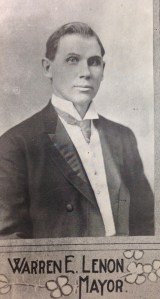
An open house took place on April 15, 1908, presided over by Acting Mayor John Herndon Hollis and his wife as well as former Mayor W. E. Lenon and his wife.

In 1903, W. E. Lenon became Mayor of Little Rock. Back then, the terms were two-year terms.  Before the start of his second term in 1905, he realized that the City was outgrowing City Hall, which was, at the time, on the northeast corner of Markham and Louisiana – where part of the Statehouse Convention Center sits today.

In February 1906, Mayor Lenon appointed a committee of five aldermen to over see the planning for the building of a new City Hall. In July 1906, the City Council approved plans, which called for a City Hall with an municipal auditorium wing. There was some hue and cry about the cost spending and a resulting lawsuit, so, in September 1906, those plans were scrapped and a simpler City Hall was approved for the cost of $175,000.

The last resolution in the old City Hall called for the banning of smoking in the new Council Chambers – while the Council was in session. This may well have been the first smoking ban in a public government building in the history of Arkansas.

When the building opened, the third floor was not finished out. The space was not needed. When the Museum of Natural History and Antiquities (now the Museum of Discovery) moved into City Hall in 1929, they had to finish out their space.

In 1913, the new Central Fire Station, designed in the Beaux Arts style, was constructed adjacent to City Hall. During the 1930s, as the City grew, more space was needed. A garage, designed in the “austere, utilitarian” style was built in 1936 and a City Jail Annex, built by the WPA in the modified Art Deco style was built in 1938.
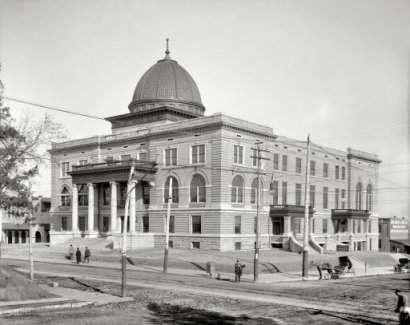
City Hall prior to 1912

By 1955, the copper-clad dome which sat on top of City Hall needed severe repairs. The wooden supports and the copper cladding were both in dire shape. Mayor Pratt Remmel set aside money for the dome to be repaired. After defeating Remmel in his bid for a third term, Mayor Woodrow Mann scrapped plans for the repair and, indeed, scrapped the dome.

Following the lead of County Judge Arch Campbell who had removed the tower at the County Courthouse, Mann proposed removal of the dome. He had an informal survey which had three options: repair the dome, replace the dome with an aluminum one, or remove it. This was open to anyone to respond – voting eligibility or Little Rock residency did not matter. By a slim margin, remove the dome won – so the dome was removed.

In 1960, as air conditioning was installed, windows were bricked in to promote energy efficiency. At the time, the feeling was that a new City Hall would be constructed in the 1970s somewhere more central to the growing city. Relocation talk persisted throughout the 1970s and early 1980s. By that time, City Hall had been modified a great deal – with no thought about historic preservation. When the Police and Fire Department had moved out into their new facilities, their old spaces had become storage.

By 1984, the decision was made to stay at Markham and Broadway. An extensive renovation and restoration effort was undertaken. In 1988, the building reopened, and the interior had been restored to its 1908 appearance.

Little Rock Look Back: First plans for a Municipal Auditorium

Mayor LenonOn April 12, 1904, Mayor W. E. Lenon made what was the first official proposal for a municipal auditorium in Little Rock.  Little did he know at the time that it would take from April 1904 until February 1940 to make this dream a reality.

Elected as a progressive, Lenon was focused on not just providing city services, but also had an interest in initiatives which would move the city forward.  With that background it is not surprising that Mayor Lenon would be a champion for the construction of both a new city hall as well as a municipal auditorium building.  During his first annual address to the City Council in April 1904 he noted:

Recently a number of our citizens have taken an active interest in building an auditorium in our city.  This being a project of such worthy consideration should not go unnoticed by us.  Apparently this is one of the greatest needs.  Our business, social, commercial and financial interests, in fact, our entire city, would be benefitted by the building of same.  It has therefore occurred to me that an auditorium might be built in conjunction with a new city hall.

The mayor further discussed that these new structures could either be built on the site of the current City Hall or at a new location.  He also touched on possible financing options including the collection of a one percent assessment.

The mayor would bring this up again in his 1905 annual address.  It would not be until December 1905 that the City Council would officially take any action on the plan.

Today is #ArkansasGives Day

Arkansas GivesIf you are like me, you’ve been receiving notifications about Arkansas Gives Day for months.  Well, today is the day!  From 8am until 8pm, you can help grow the love for Arkansas’s nonprofit organizations by making a donation to the charity of your choice.  The event is sponsored by the Arkansas Community Foundation.

As a special incentive to give, each gift made through ArkansasGives on April 7, 2016 will be matched with additional bonus dollars; the more you give, the more bonus dollars your favorite charity will receive.

Nonprofit organizations and other tax-exempt charitable organizations may participate if they:

  • Are headquartered in Arkansas or have a base of operations in Arkansas.
  • Are a member of the Arkansas Nonprofit Alliance.
  • Have 501c3 tax exempt status under IRS code AND are qualified as a 509(a)(1), (a)(2) or (a)(3) organization or as a private operating foundation.

The minimum amount is $25; there is no maximum amount you may give. You may designate up to 10 charities per transaction.

Accepted Forms of Payment: Visa, MasterCard, Discover and American Express credit cards online.
You will receive an email receipt of your gift; please retain it for tax purposes. Unless you choose to remain anonymous, your donor information will be sent to the nonprofits to which you give.

Here is a list of cultural organizations which offer services within the boundaries of the City of Little Rock.

There are MANY MANY MANY other worthy nonprofits which are participating. But since this is a culture blog, only the cultural institutions are listed.  But please consider visiting the website and perusing the entire list.

On Tartan Day, celebrating all things Scottish, visit the Brownlee House at HAM

Photo by Larry Pennington

Photo by Larry Pennington

Today is Tartan Day, designated to celebrate the contributions of Scots everywhere.

One of Little Rock’s oldest structures, the Brownlee House was built by a Scotsman.  The Brownlee House is one of the restored structures at Historic Arkansas Museum.

Robert Brownlee built this Federal style brick house in the late 1840s for his brother and sister-in-law. A Scottish stonemason, Brownlee came to Little Rock in 1837 to help build the State House (now the Old State House Museum). He pursued a number of careers before leaving for California in the 1849 Gold Rush. From the late 1840s through 1852, the home’s residents were James and Isabelle Brownlee and Tabby, a woman enslaved by James Brownlee.

Brownlee had the wooden mantels in the parlor and bedroom marbleized, a popular decorative art of the time. The home’s furnishings reflect the mid-19th century.

This house is a project of The National Society of the Colonial Dames of America in the State of Arkansas.

Historic Arkansas Museum is open seven days a week.  The galleries are free, but the tours of the historic structures have a nominal fee.  It is an agency of the Department of Arkansas Heritage and is celebrating its 75th anniversary this year.

Little Rock Look Back: Werner Knoop

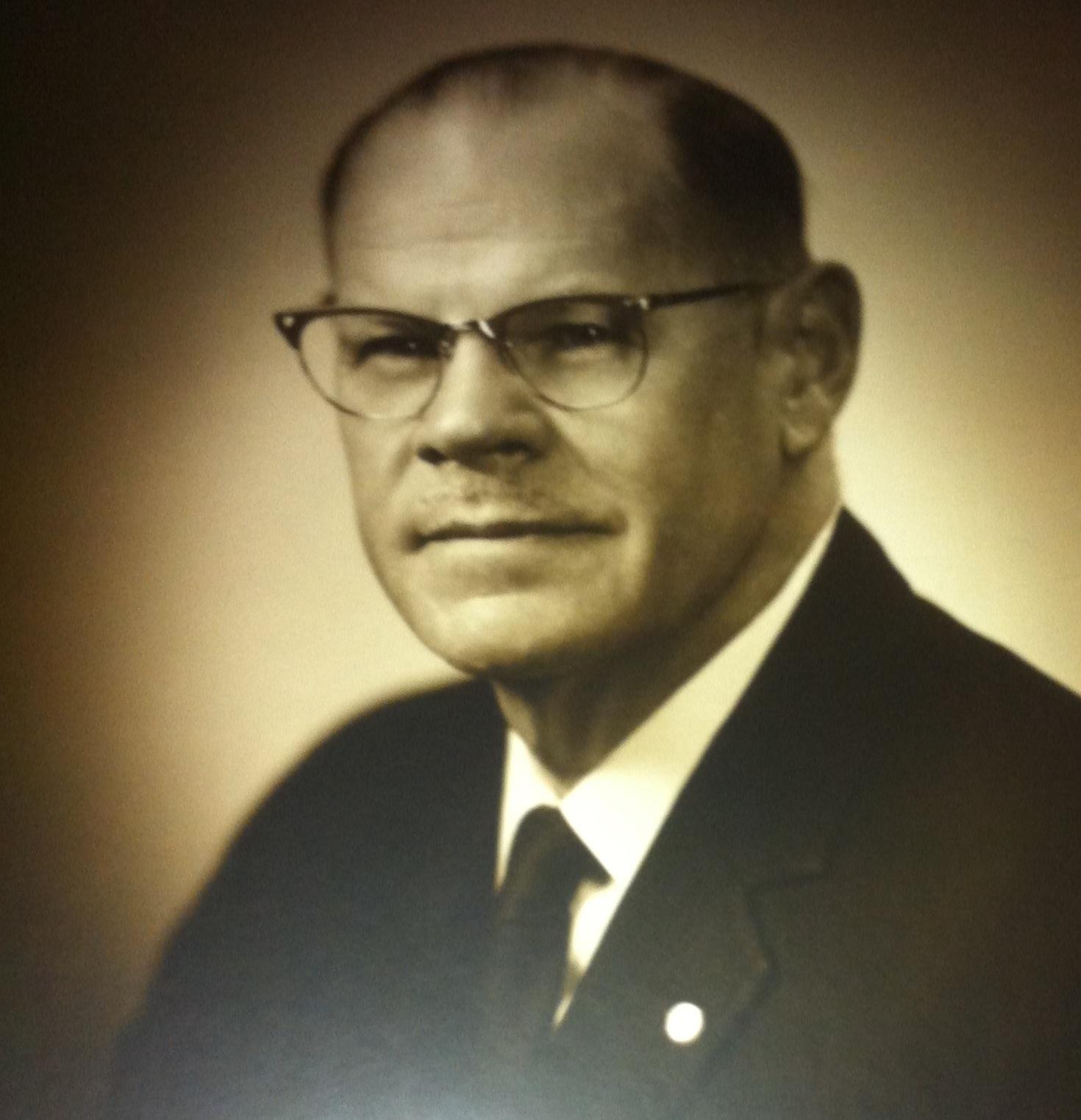
Mayor KnoopTo Little Rock citizens under a certain age, the name Knoop means Knoop Park — a picturesque park tucked away in a pocket of Hillcrest.  There are, however, still many who remember Werner C. Knoop as a business and political leader who helped shape Little Rock as a modern city.

Knoop was born on March 30, 1902.

In 1946, Knoop joined with Olen A. Cates and P. W. Baldwin to form Baldwin Construction Company in Little Rock.  Knoop had previously founded Capital Steel Company and established his business reputation there.  From 1945 through 1951, he served on the Little Rock School Board.

Following a series of political scandals, efforts were undertaken for Little Rock to shift from Mayor-Council to City Manager form of government.  Even before the desegregation of Little Rock Central put the city in the eyes of the world, an election for new leaders had been set for November 1957.  Knoop was on a “Good Government” slate and was one of the members elected.

At the first meeting of the new City Board, Werner C. Knoop was chosen by his fellow directors to serve as Little Rock Mayor.  Knoop served as Mayor until December 1962.  For the first several months in office, Little Rock had no City Manager so Knoop oversaw the transition of City staff as the forms of government changed.

Though City Hall generally stayed out of school district matters, that did not mean that the public viewed the two entities separately.  In September 1959, the Baldwin Construction offices were bombed as part of a series of terrorist activities protesting the desegregated reopening of all Little Rock high schools.

Downtown LR as viewed from Knoop Park

Downtown LR as viewed from Knoop Park

After two terms on the City Board, Knoop decided against seeking a third term.  He concluded his elected public service on December 31, 1962.  Following his time on the City Board, Knoop did not retire from Civic Affairs.  In 1970, he served as Chairman of the Little Rock Chamber of Commerce.   The previous year he served as President of the Arkansas Chapter of Associated General Contractors.

Mayor Knoop died in July 1983.  He is buried at Roselawn Memorial Park next to his wife Faith Yingling Knoop, a renowned author.

In the 1930s, Knoop moved into an Art Moderne house on Ozark Point in Hillcrest.  It was adjacent to Little Rock Waterworks property which was developed around the same time.  Eventually much of the land was deeded to the City for creation of a park.  In 1989, it was named in tribute to long-time neighbor Knoop in honor of his lifetime of service to Little Rock.

New Rooftop Terrace planned for Robinson Center

RCMH EXT-01_Aerial1The Little Rock Convention & Visitors Bureau (LRCVB) is now booking events for the all-new Robinson Conference Center, set to reopen in November of this year.  Located on the north side of the building, the Grand Ballroom and adjoining meeting rooms offer magnificent views of the Arkansas River.  With seamless connectivity to the DoubleTree Hotel’s meeting space, the center offers flexibility for convention activities, meetings, and banquets.  For booking information, please call 501-255-3323.

Earlier this week, the Little Rock Advertising and Promotion Commission (LRA&P) also approved the addition of a 5,800 sq. ft. outdoor terrace.  The terrace was part of the original project plans, however, but it was removed from the plans in 2014 during contract negotiations due to budget constraints.  Now, less than eight months from completion, LRCVB and LR A&P are able to add the finished outdoor space back into the project.  The space will offer amazing views of the Arkansas River and sits on the highest level of the new conference center, and its addition will not impact the project’s completion date.

“We are so pleased with the progress of this complex project.  Our project team, including architects Polk Stanley Wilcox and Ennead, construction manager CDI/Hunt joint venture, owner’s representatives Mike Steelman of SCM architects, and a host of sub-contractors, have continued to provide meticulous attention to detail and countless effort to this project.  The all-new Robinson Center is going to be a show-piece for Little Rock and all of Central Arkansas,” said Gretchen Hall, President & CEO of LRCVB.

For more information on the Robinson Center Second Act renovation and expansion project, visit www.RobinsonCenterSecondAct.com and follow us on https://www.facebook.com/pages/Robinson-Center/276515585880 and https://twitter.com/RobinsonCenter.

Robinson Construction Facts to Date:

  • Over 10,878 tons of material have been recycled, representing 90% of the waste material diverted
  • 1,800 tons of steel has been erected
  • 3,000 cubic yards of concrete has been placed
  • 1,104 individuals have gone through CDI/Hunt Safety Orientation
  • 75% of the project subcontractors are local
  • 250,000 +/- man hours have been utilized to date

Robinson History

The historic Robinson Auditorium has long been a landmark in Central Arkansas.  Construction of the Joseph T. Robinson Memorial Auditorium began in 1937 and officially opened in February 1940.  The structure was a WPA (Works Progress Administration) project, and is an excellent example of the Art Deco style architecture of the time.  The building was added to the National Register of Historic Places in 2007.  The facility is owned by the City of Little Rock and managed by the Little Rock Convention & Visitors Bureau.