Creative Corridor Celebrated This Afternoon

A grand opening to highlight the new features and completed sections of the Creative Corridor’s Low Impact Development (LID) streetscape will be held 3 p.m. Monday, Sept. 14, as the revitalization of Little Rock’s Main Street continues to take shape, block by block.

Little Rock Mayor Mark Stodola will join Ron Curry, Region 6 administrator for the U.S. Environmental Protection Agency, and Randy Young, executive director of the Arkansas Natural Resources Commission, for the kickoff event, which will begin with a project update at the Arkansas Repertory Theatre (601 Main Street). Professor Stephen Luoni of the University of Arkansas School of Architecture and director of the UA Community Design Center will give an informative presentation on the theories of Low Impact Development and creative place-making that underpin the project.

The most recently completed improvements in the 500 block of Main Street will be open to the public for strolling along the tree-lined boardwalk on the west side.  All of the pedestrian and environmentally friendly streetscapes in the 100, 200, 300 and 500 blocks of Main Street contain LID features such as bioswales, porous pavers, rain gardens, and other biodiverse vegetation.

The grand opening will also celebrate the elements of creative place-making that have occurred. Recent public art installations and the clustering of artistic and creative organizations on Main Street are transforming the Creative Corridor into a downtown hub that supports a great level of pedestrian activity, sociability, recreation and aesthetics.

An arts open house and reception will follow the tour, with the Arkansas Repertory Theatre, Arkansas Symphony Orchestra, Ballet Arkansas, Matt McLeod Fine Art, and Cranford Co. opening the doors to their new, connected spaces.

“The progress on Main Street is a harbinger of the exciting development yet to come for this area,” says Stodola. “The Creative Corridor, once just a vision, has become a vibrant reality that has earned national accolades, brought together many of our City’s cultural institutions, and created these beautiful spaces that will continue to grow.”

The Creative Corridor is a mixed-use development project aimed at restoring the vitality of Main Street by creating an arts district and retrofitting a four-block segment of the street between President Clinton Avenue and 7th streets. The City of Little Rock estimates that more than $100 million in private and public investment has occurred to date to help make this vision a reality.
 

Little Rock Look Back: Alderman Angelo Marre

angelomarre

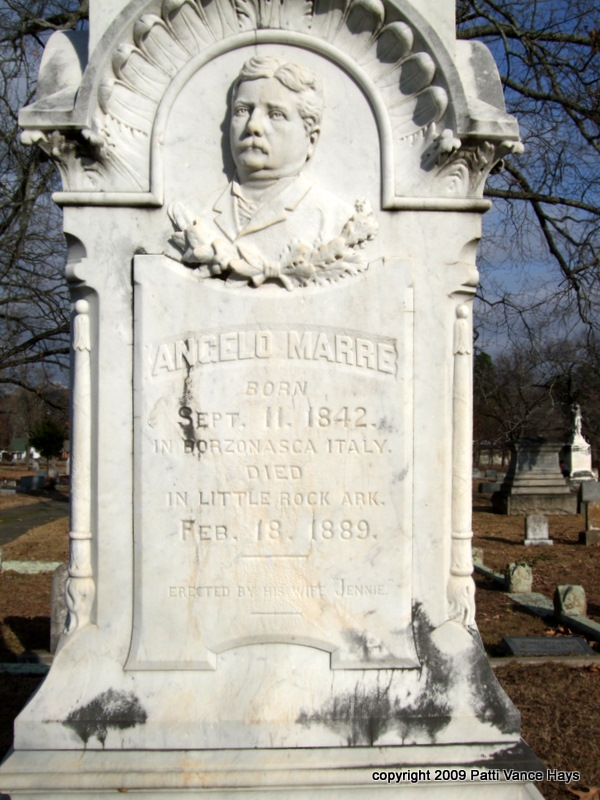
On September 11, 1842, future Little Rock Alderman Angelo Marre was born in Borzonaca, Italy.  He immigrated to Tennessee with his parents in 1854.

During the Civil War, he served in the Confederate Army. From 1865 to 1868, Angelo Marre worked for the Memphis Police Department but was forced to resign after he was accused of killing a man during an argument.  After his acquittal, he returned to the saloon business.  In 1872 Marre was convicted of stealing money and sentenced to three years in prison.

Tennessee Governor John Brown granted Marre a full pardon two years into his sentence, and he regained his citizenship in 1879.

After getting out of prison, he claimed an inheritance and joined his brothers in Little Rock.  He worked as a bartender at the Metropolitan Hotel.  He later opened a saloon and billiard parlor.

By the mid-1880s, Marre owned two saloons, a liquor import business, an office building in downtown LR, 3,000 sharesof stock in mining companies operating in Garland and Montgomery counties, and he was the first president of Edison Electric Company of LR.

In 1883, he was elected as an alderman on the Little Rock City Council.  He lost is bid for reelection in 1885. In 1888, he was an unsuccessful candidate for Pulaski County Sheriff.

villamarreAngelo Marre died February 18, 1889, as a result of his infection.  He is buried at Calvary Cemetery in LR. His custom designed, marble monument was ordered from Florence, Italy, and cost $5,000.

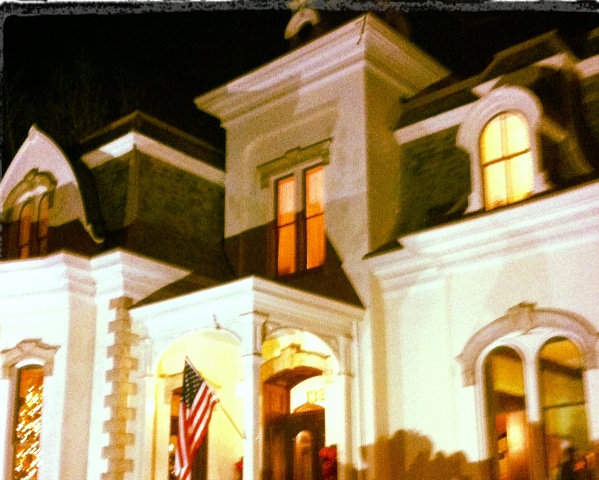
Marre is probably best known today as the builder of the structure now known as the Villa Marre.  Built in 1881, it is designed in the Italianate and Second Empire styles.  It was built in 1881 and 1882 on Block 21, Lots 5 & 6 of the Original City of Little Rock.  The cost was $5,000.

It was originally a red brick structure and has been modified and expanded several times as well as painted white.  It did not bear the name Villa Marre until the 1960s when historic preservation advocate Jimmy Strawn gave it that name.

After serving as the headquarters for the Quapaw Quarter Association for several years, it was returned to a private residence.  It is now available for special events and rentals.

The Villa Marre is probably best known locally and nationally for serving as the facade for the Sugarbaker design firm on the CBS sitcom “Designing Women.”  Though the interior of the house does not match the interior on TV, the building was featured in the opening credits as well as in exterior shots each week.

Little Rock Look Back: Plans for a new City Hall finally move forward

City Hall circa 1908

City Hall circa 1908

After a judge ruled in August 1906 that the City of Little Rock could not build a new City Hall and Auditorium complex, it looked like Little Rock would be stuck with its existing inadequate building.

However on September 10 it became obvious that much work had been taking place behind the scenes after that ruling.  On that day, the Board of Public Affairs (a City body charged with overseeing municipal government construction projects and comprised of the mayor and two citizens approved by the City Council) voted to ask the aldermen to cancel plans and rescind legislation for the city hall, jail and auditorium complex.  The Board of Public Affairs then offered up a new plan for a city hall and jail building.  Because no auditorium was involved, these plans would not be in violation of the Chancery Court.

That same evening the City Council followed suit and revoked the plans for the original project.  The aldermen then voted to proceed with building a new city hall and jail without the auditorium.  There was only one dissenting vote; Alderman Jonathan Tuohey voted no.  He explained his negative vote was not a lack of support for the project, but he was not comfortable with the way it was rushed through.

Mayor Warren E. Lenon told the Gazette, “The Chancery Court has enjoined us from erecting an auditorium and the Board of Public Affairs has consequently rescinded all resolutions and orders pertaining to that structure.” He noted that there would “be no appeal from the injunction granted by Chancellor Hart, because there is nothing to appeal.”

The coverage of the actions of the City Council that night was in keeping with the manner in which the two daily newspapers had covered the lawsuit and the trial.  The Gazette headline cried “City Hall Ordinance Railroaded Through” while the staid Democrat merely stated “New $175,000 City Hall Provided by City Council.”  The tone of theGazette’s article matched the headline while the Democrat’s story was more straightforward.

Architect Charles Thompson adjusted his plan for the new City Hall by removing the auditorium wing.  With the revised Th0mpson plan and the approval of the City Council, Little Rock was at last on its way to a new City Hall.  This was over two years after Mayor Lenon had first broached the subject.

Originally slated to open in 1907, the building officially opened in April 1908.

Labor Day Sculpture Vulture: John Deering’s RICK REDDEN

ReddenLabor Day celebrates a time to take a break from work and relax.  Today’s Sculpture Vulture showcases John Deering’s sculpture of Rick Redden which depicts the visionary architect doing just that.

As an architect, Rick Redden designed many downtown buildings including several in the River Market District.  He was involved in new projects like the 300 Third Building and River Market Tower, as well as rehab projects such as the Ottenheimer Market Hall and the Museum Center.  One of his last projects was the Arcade Building.

This sculpture, by John Deering, was commissioned by Jimmy Moses, Rett Tucker and the Central Arkansas Library System Endowment to honor Redden’s memory.  It shows him playing his banjo, with architectural drawings rolled up behind him. The piece looks like he had just taken a break from work to relax a little by playing music.

It is appropriate that the sculpture is located in front of the Arcade Building. Not only was the project one of his designs, but the building also contains space for work and for entertainment.  The placement is also a continuation of the commitment of both Moses Tucker Real Estate and the Central Arkansas Library System to include sculpture in their projects.

Sandwich in History at Shiloh Baptist Church today at noon

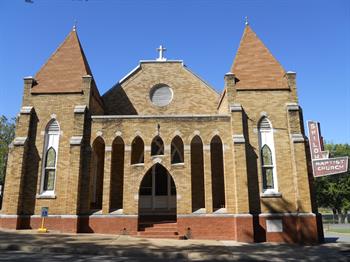
ahpp Shiloh Baptist ChurchThe monthly architectural history program “Sandwiching in History” visits Shiloh Baptist Church, located at 1200 Hanger Street. The program begins at noon today.  A historian with the Arkansas Historic Preservation Program delivers a brief lecture about the church before leading guests on a tour.

The historically black congregation of Shiloh Baptist Church was organized in 1886 by Rev. O. H. Redicks and occupied an earlier building at the southwest corner of Hanger and E. Twelfth streets in Little Rock’s Hanger Hill neighborhood. The current buff brick church features elements of the Gothic Revival style.

Sandwiching in History is a program of the Arkansas Historic Preservation Program, an agency of the Department of Arkansas Heritage.  The AHPP is responsible for identifying, evaluating, registering and preserving the state’s cultural resources. Other DAH agencies are the Arkansas Arts Council, the Delta Cultural Center in Helena, the Old State House Museum, the Mosaic Templars Cultural Center, the Arkansas Natural Heritage Commission and the Historic Arkansas Museum.

New Deputy Director for Arkansas Heritage announced

DAH Dep DirStacy Hurst, director of the Department of Arkansas Heritage (DAH), announced today that she has named Rebecca Burkes as the new deputy director for DAH. Burkes holds an M.S. in operations management from the University of Arkansas, Fayetteville, and a Juris Doctorate from the Baylor University School of Law.

“I am very happy to bring Rebecca on board to help lead and manage DAH,” said Hurst. “Her skills in managing organizations and people will be a tremendous asset to us. Our seven separate agencies, operating under the larger umbrella of Heritage, will benefit greatly from her skills.”

Burkes most recently was an assistant professor at the University of Wisconsin Law School, Madison. Previous to that, she lived in Northwest Arkansas, where she practiced law in Fayetteville (1993-95), was corporate counsel at Wal-Mart Stores, Inc., in Bentonville (1995-98) and was vice president and chief counsel for the Burkes Company, a diversified real estate development, construction and brokerage company (1998-2011).

The Department of Arkansas Heritage, through its seven agencies, seeks to recognize the state’s heritage and to enhance Arkansas’s quality of life through the discovery, preservation and presentation of the state’s cultural, natural and historic resources. The agencies are Arkansas Arts Council, Arkansas Historic Preservation Program, Arkansas Natural Heritage Commission, Delta Cultural Center, Historic Arkansas Museum, Mosaic Templars Cultural Center and Old State House Museum.

Little Rock Look Back: City Council approves 1935 auditorium plan

An August 25, 1935, rendering in the ARKANSAS GAZETTE of the proposed Little Rock auditorium at Capitol and Scott Streets.

An August 25, 1935, rendering in the ARKANSAS GAZETTE of the proposed Little Rock auditorium at Capitol and Scott Streets.

On August 26, 1935, the City of Little Rock took its first significant step in a decade for the creation of a City auditorium..  Under the leadership of Mayor R. E. Overman, the City Council approved authorization for the City to apply for $1,000,000 from the Federal Emergency Administration of Public Works (PWA) for the construction of an auditorium.  The PWA had issued a September 16, 1935, deadline for applications to be received as it sought to spend $4.8 billion in construction projects.

The auditorium plan was announced on Saturday, August 24, 1935.  Much preparation had already been undertaken before the project was publicly unveiled.  Private presentations hhad taken place, a team of architects had been chosen (Eugene Stern and the firm of Wittenberg & Delony), and a location had been selected.

The auditorium complex was slated for a block bounded by Capitol, Scott, Fourth and Cumberland Streets.  The Women’s City Club building on that block would remain with the new structure being built to wrap around two sides of the existing structure. The site was chosen because it was one block east of the Main Street business corridor and near existing meeting locations such as the Boys Club, Albert Pike Hotel, Albert Pike Masonic Lodge and several churches.

As planned by the architects, this structure’s front façade would have run the length of the Capitol Avenue side of the block.  The building was proposed to be constructed of concrete, stone and steel.  It would have a large hall with a proscenium stage and seating capacity of 4,000 with overflow of an additional 500.  The adjoining exhibition hall could seat 3,500 people.  The plan called for 150 cars to be parked in the building, and an additional 100 cars to be parked on a surface lot on the site.

Following an August 26 closed door meeting to discuss the project from which members of the public and press were excluded, in open session the City Council voted to pursue the funding for the million dollar auditorium.  If approved by the PWA, the funds would be provided in grants and loans, to be paid by over a 35 year period.

The auditorium proposal was filed with the PWA in Washington in September 1935.  Throughout the next several months, Mayor Overman and the city were engaged in a series of conversations and negotiations with the PWA for the expansion of both the water system and the sewer system. This diverted attention from pursuing the auditorium immediately.  This specific auditorium project stalled.  But because the plan had been filed by the September 16 deadline, it allowed the City to make use of PWA funds a few years later which would lead to the construction of Robinson Auditorium.