Arkansas Heritage Month – LR Mayor Taylor and a Municipal Auditorium

Taylor AuditIn anticipation of the November 2016 reopening of Robinson Center Music Hall, this week’s Arkansas Heritage Month entries look at seven Little Rock Mayors who worked on proposals for a municipal auditorium between 1904 and 1940.

Charles Taylor became Little Rock’s mayor in April 1911.  He inherited the temporary auditorium that was already showing signs of wear and tear after four years.  Throughout the eight years he was in office, he and the City Council wrestled with the question of what to do about the auditorium.

Time and time again, there would be calls to tear the building down. Its proximity to the 1913 fire station was causing the insurance rates on that building to be increased. It was viewed as structurally unsound and had outlived its useful life.  However, without that building, there would be no public space for conventions and community meetings.  While the Hotel Marion offered convention facilities in its ballroom, it did not necessarily lend itself to trade shows. In addition, as a private entity, it was able to set its own rules without necessary regard to the general public.

A 1913 proposal by planner John Nolen had called for an auditorium to be built on a new plaza area near City Hall.  Due to funding issues, that plan never gained traction, despite repeated attempts by its backers to push for it.

At the time he left office in April 1919, Mayor Taylor had still not been able to solve the problem of a municipal auditorium.

Arkansas Heritage Month – LR Mayor Lenon and a Municipal Auditorium

Mayor Lenon with the plans for the original City Hall/Auditorium and the temporary auditorium.

Mayor Lenon with the plans for the original City Hall/Auditorium and the temporary auditorium.

In anticipation of the November 2016 reopening of Robinson Center Music Hall, this week’s Arkansas Heritage Month entries look at seven Little Rock Mayors who worked on proposals for a municipal auditorium between 1904 and 1940.

In 1904, Little Rock Mayor W. E. Lenon first proposed that Little Rock construct at municipal auditorium.  After considering some options, he decided it would be easiest to build it in conjunction with a new City Hall and Jail.  In 1906 plans proceeded in that direction until a lawsuit by J.N. Heiskell to stop it. Following a judge’s ruling that a municipal auditorium was not deemed a proper use for public monies, the City changed course and constructed only a City Hall and Jail (sans auditorium) at the corner of Markham and Broadway. This building opened in 1908.

In 1906, the City gave permission to a private developer to build a temporary auditorium (which also served as a roller skating rink when the chairs were removed) adjacent to the City Hall site.  This opened in 1907.

Mayor Lenon left office in 1908.  He would later chair a committee involved in an auditorium proposal in 1925, but that one would come to naught, as well.  However, he planted the seed and started the public discourse which lasted for 36 years.

Arkansas Heritage Month – On Armed Forces Day visit the City of Little Rock’s MacArthur Museum of Arkansas Military History

MacPark ArsenalToday is Armed Forces Day.  It is a good day to visit Little Rock’s museum devoted to Arkansas’ military heritage.  Located in the historic Arsenal Tower in MacArthur Park, the MacArthur Museum of Arkansas Military History honors the Arkansans who have served in the armed forces.  Exhibits feature artifacts, photographs, weapons, documents, uniforms and other military items that vividly portray Arkansas’s military history at home and abroad.

The exhibits include:

  • From Turbulence to Tranquility: The Little Rock Arsenal
  • Capital In Crisis and Celebration: Little Rock and the Civil War
  • Alger Cadet Gun
  • Camden Expedition
  • David Owen Dodd
  • Through the Camera’s Eye: The Allison Collection of World War II Photographs
  • By the President in the Name of Congress: Arkansas’ Medal of Honor Recipients
  • Conflict and Crisis: The MacArthur- Truman Controversy
  • Duty, Honor and Country: General Douglas MacArthur
  • The Sun Never Sets on the Mighty Jeep: The Jeep During World War II
  • War and Remembrance: The 1911 United Confederate Veterans Reunion
  • First Call – American Posters of World War I
  • Undaunted Courage, Proven Loyalty: Japanese American Soldiers in World War II
  • Vietnam, America’s Conflict

The MacArthur Museum of Arkansas Military History is a museum of the City of Little Rock.  It is led by executive director Stephan McAteer who works with the MacArthur Military History Museum Commission.  The museum is open Tuesday through Friday from 9am to 4pm, Saturday from 10am to 4pm and Sunday from 1pm to 4pm.

Arkansas Heritage Month – American Institute of Steel Construction honors Polk Stanley Wilcox and CALS

AIA ALA PSW HRCCLCThe American Institute of Steel Construction (AISC) in Chicago has announced that Polk Stanley Wilcox Architect’s design of the Hillary Rodham Clinton Library and Learning Center in Little Rock, Arkansas has been honored in its prestigious annual awards.

In all, just ten building projects from around the country earned awards in the 2016 Innovative Design in Engineering and Architecture with Structural Steel awards program (IDEAS2), recently announced during AISC’s 2016 Conference in Orlando, Florida. An award presentation will be scheduled for this summer at the library in Little Rock. A panel of design and construction professionals identified National and Merit Awards in three categories, based on constructed value. Other winners included the National 9/11 Memorial Museum Pavilion in New York by Snohetta, Rutgers University School of Business by TEN Arquitectos, and Emmerson College in Los Angeles by Morphosis.

East Harding Construction of Little Rock was the General Contractor, while Engineering Consultants Inc. of Little Rock served as structural engineer for the innovative project.

Jury Comments:

“With a community driven mission, the library showcases steel in its purest form and use in a whimsical, but purposeful manner.” – Wanda Lau, Senior Editor ARCHITECT Magazine

“Playful and inspiring inside and out, this project succeeds in its goal of capturing the child’s imagination.” – Jason Stone, Senior Associate Leslie E. Robertson Associates

“The playfulness of the steel structure exterior, combined with the opportunity to utilize the structure as a teaching tool to inspire children to pursue math and science, makes this a natural choice for AISC and the IDEAS2 Awards” – Paula Pritchard, Plant Construction Co., L.P.

According to design architect Reese Rowland FAIA, “This library’s meaning can be seen in the faces of the children – their excitement and wonder, and hopeful smiles that say their future can be limitless with the right opportunities. Some of those opportunities involve teaching simple life skills that build confidence, while others focus on technology not available in the home.

The key to the library’s success comes from a vision set forth by CALS to not only build a functional public library and education facility, but also a symbol that represents hope. Being listed alongside these other nationally recognized projects is a strong indication that this vision was successfully achieved, helping create a new sense of pride for the children of Little Rock. We are grateful to the Central Arkansas Library System, as well as the people of Little Rock that funded this incredible project for our children.”

The Hillary Rodham Clinton Library and Learning Center was also honored in 2015 with Library Architecture’s highest honor, a National AIA/ALA Library Honor Award, one of just six given recognizing the best examples of new libraries from around the world. Learn more about this award at:

http://www.aia.org/practicing/awards/2015/library-awards/

This is the fourth AISC National Award for Polk Stanley Wilcox Architects, with the others being the CALS Arkansas Studies Institute in Little Rock, The El Dorado Conference Center, and Heifer International’s World Headquarters in Little Rock, which also won architecture’s highest honor: the American Institute of Architect’s National Institute Honor Award.

Arkansas Heritage Month – The architecture of AIA/ALA award winning CALS libraries by Polk Stanley Wilcox

To encourage excellence in the architectural design and planning of libraries, the AIA and the American Library Association/Library Administration and Management Association created this award to distinguish accomplishments in library architecture.  In 2011 and again in 2015, Polk Stanley Wilcox won the award for projects designed for the Central Arkansas Library System.

AIA ALA PSW ASIThe 2011 award went to for work on the Arkansas Studies Institute.  This actually combines three buildings of three different centuries and construction types into one architectural timeline, evoking imagery of pages of an opening book.

The Arkansas Studies Institute is a repository for 10 million historic documents and the papers of seven Arkansas Governors, including President Bill Clinton. Located in a thriving entertainment district comprised of rejuvenated warehouses near the Arkansas River, the design combines significant, but neglected buildings from the 1880’s and 1910’s with a new technologically expressive archive addition. This creates a pedestrian focused, iconic gateway to the public library campus – and the public face of Arkansas history.

The design philosophy is based literally on the book – a physical container of information, with pages flowing into a site-sensitive narrative of the building’s function. Taking cues from the medium for which the Institute was created, the entrance acts as an abstract book cover, pulled away from the building as a double wall, defusing western sunlight and heat in the atrium beyond.

Public Spaces – galleries, a café, museum, and meeting rooms – enliven streetscape storefronts, while the great library research hall encompasses the entire second floor of the 1914 warehouse building. A thin atrium pulls the new structure away to protect the old, stretching the building’s length and flooding all levels with light – a key sustainable strategy. 100 historic images in glass handrails signify that architecture can and should actively engage in storytelling. Suspended bridges span the gap between new and old, open and secure, today and yesterday.

The Arkansas Studies Institute weaves history, research, pedestrians, and a restored streetscape together, healing a gaping wound in the urban fabric, while expanding environmental stewardship into the public realm and serving as a beacon of knowledge.

AIA ALA PSW HRCCLCIn 2015, the award went to PSW for their work on the Hillary Rodham Clinton Children’s Library and Learning Center.

Based on experiential learning where hands-on education teaches life skills needed to become responsible adults, a new Children’s Library and Learning Center boosts hopes for a neglected neighborhood, serves as an exemplary tale of urban renewal, and acts as a beacon of hope for an entire city.

This “community embedded, supportive learning center” offers not only books, but also a performance space, teaching kitchen, greenhouse, vegetable garden, and an arboretum. It is the state’s first library holistically imagined as a children’s education destination. The Library Director’s challenge was to create a “playground without equipment” where nature and imagination create grand adventures on an abandoned six acre site in the heart of the capital city. A charrette with youth uncovered a surprising and heartbreaking result: their top desire wasn’t for the latest video game technologies… it was food security. They wanted to learn how to feed themselves. Children also desired a place that was uplifting, inspirational and full of natural light, while in contrast feeling safe, secure, and sheltered. They wanted a place that “lifted expectations”.

An interstate highway—the railroad tracks of our generation—split Little Rock 40 years ago and destroyed a unified city grid, contributing to racial and socioeconomic divisions that separated citizens physically and emotionally. The site’s border condition became a national symbol for gang violence when featured in a 1990’s HBO documentary. Its opposite side, however, continued to be the city’s version of New York City’s Central Park—the place to live, work, and play. The design team’s overarching idea was centered on three moves: bridge the gap by stretching the park across the highway, create a library that is “the place to be” for all children, and develop civic pride in an underserved neighborhood, helping to mend partitions that have plagued the city for so long.

Landscape ecology and urban connectivity themes provide experiential education. Children see natural vegetation representing the state’s varied ecological regions from the Ozark Highlands to the Mississippi Delta. Two bus lines within a quarter mile assure access from distances, while the hundreds of children living within a half mile can walk or bike. An instructional greenhouse, gardens, and teaching kitchen allow children to cultivate, harvest, prepare meals, and sell produce in a planned farmer’s market. A full time ‘Environmental Educator’ oversees programs, teaching proper use of water, energy, and resources, and how we keep healthy through decisions made within the built environment. The lobby’s smart monitors can display real time water and energy consumption. Mechanical and structural systems are purposefully exposed so operations and construction methods can be discussed.

While this Library exceeded expectations by achieving LEED Gold, the true measure of success beyond points is the neighborhood’s feel, which shifted from dangerous to full of life and pride. The library is a safe zone and home to a sustainable-minded community.

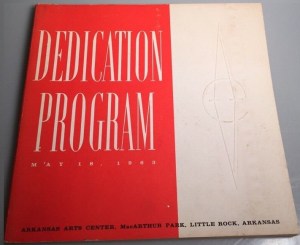
Arkansas Heritage Month – Celebrities and Celebrations open Arkansas Arts Center on May 18, 1963

AAC opening programOn Saturday, May 18, 1963, amidst fanfare and fans of the arts, the Arkansas Arts Center officially opened its doors.  (This was thirty-five years and three days after the Fine Arts Club had opened the first permanent art gallery in Arkansas in the Pulaski County Courthouse).

The dedication ceremonies on May 18 featured U.S. Senator J. William Fulbright (who was in the midst of championing what would soon be known as the John F. Kennedy Center for the Performing Arts), Congressman Wilbur Mills, Governor Orval Faubus, Little Rock Mayor Byron Morse, Winthrop Rockefeller and Jeanette Rockefeller.

On Friday, May 17, 1963, film star Gordon MacRae performed two separate concerts in the theatre space.  There were other assorted small events and tours on May 16 and 17.

The culmination of the weekend was the Beaux Arts Bal.  This black tie event, featured Oscar winner Joan Fontaine, cartoonist Charles Addams (creator of The Addams Family), James Rorimer of the Metropolitan Museum, and Dave Brubeck.  Chaired by Jeane Hamilton, the event set a new standard for events in Little Rock.

Among the exhibits at the Arkansas Arts Center for the grand opening was a special exhibit from the Metropolitan Museum of Art in New York entitled Five Centuries of European Painting.  In Little Rock for six months, this exhibit featured works by El Greco, Titian, Claude Monet, Odilon Redon, Pierre Renoir, Paul Signac, Edgar Degas, and Paul Gauguin among many others and spanned from the fifteenth century Early Renaissance era to the nineteenth century.

Prior to the opening, a profile on the Arts Center in The Christian Science Monitor touted the building as one of the first regional arts centers in the country to be completed. Benefiting from national ties of the Rockefeller family, the events in May 1963, set a high standard for the institution, and for other regional art museums.

Little Rock Look Back: Elvis in his final Robinson Auditorium Show

Photo by Wayne Cranford

Photo by Wayne Cranford


After two visits in 1955 where he was down on the bill, Elvis Presley made his third and final appearance at Robinson Auditorium on May 16, 1956.  This time he was the star and Robinson was packed. The tickets were $1.50 in advance at Walgreens and $2.00 at the box office.

The ads featured 8 great acts in “his” variety show which consisted of the Jordonaires; Rick and Emil Flaim and their orchestra; vocalists Frankie Conners and Jackie Little and comedian-magician Phil Maraquin. A second show was added at 9:30 p.m. to accommodate the ticket demand.

About 30 minutes late, due to a missed flight, Elvis appeared on stage in a purple blazer and started singing “Heartbreak Hotel.”  The crowd rushed the stage. Little Rock police officers were able to control them eventually and get the teenagers back to their seats.  While the crowd was impressed, the police officers were less so.  One of the patrolmen told the Arkansas Gazette reporter: “I wouldn’t know him if I saw him. And I wouldn’t be here unless I was being paid.”

Disc jockey Ray Green recorded the concert that night.  Copies of the concert on CD (which also includes an interview with Presley) are prized possessions of Presley collectors.

The Arkansas Democrat-Gazette has a special section on its website containing quotes from some of the concert attendees.